Aroclor 1260 (CED0000010)

Record Information
Version1.0
Creation Date2009-03-06 18:57:55 UTC
Update Date2026-08-18 21:11:56 UTC
Accession NumberCHEM000012
Identification
Common NameAroclor 1260
ClassSmall Molecule
Description
Aroclor 1260 is an exogenous organic compound with the formula C12H4Cl6 and an average molecular weight of 360.88 g/mol. It exists as a solid at room temperature. Aroclor 1260 belongs to the biphenyls and derivatives, a subclass of benzene and substituted derivatives within the organic compounds. This compound is recorded as being released from or found in electrical and electronic equipment, specifically electric switches. Aroclor 1260 interacts with several protein targets to produce various biological effects. It binds to the aryl hydrocarbon receptor (AHR), which disrupts cell function by altering gene transcription and inducing the expression of hepatic Phase I and Phase II enzymes, particularly those in the cytochrome P450 family. It causes endocrine disruption in humans by binding to and inhibiting the estrogen receptor (ESR1) and estrogen receptor beta (ESR2). Additionally, binding to estrogen sulfotransferase (SULT1E1) can produce estrogenic effects, such as reproductive dysfunction, and stimulate the growth of certain cancer cells. The compound bioaccumulates by binding to receptor proteins such as uteroglobin (SCGB1A1). Finally, the inhibition of tyrosine 3-monooxygenase (TH) and aromatic-L-amino-acid decarboxylase (DDC) by this compound is believed to cause decreased dopamine synthesis.
Contaminant Type
  • Aromatic Hydrocarbon
  • Coolant
  • Industrial/Workplace Toxin
  • Organic Compound
  • Organochloride
  • Plasticizer
  • Pollutant
  • Polychlorinated Biphenyl
  • Synthetic Compound
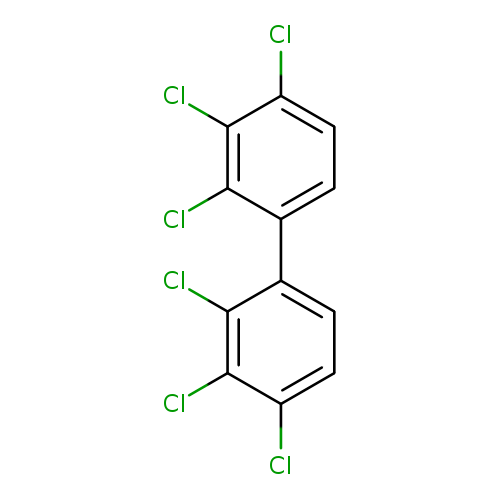
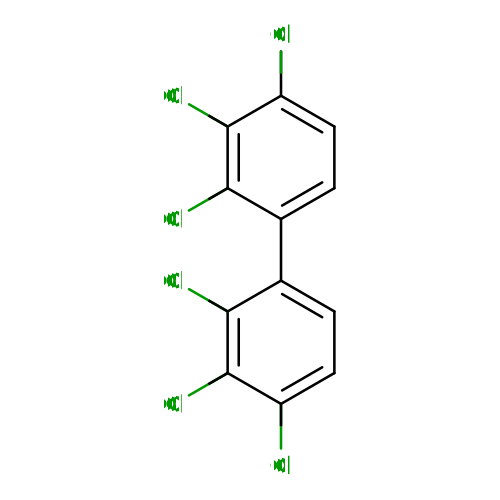
Chemical Structure
Synonyms
ValueSource
2,3,4,2',3',4'-HexachlorobiphenylMeSH
PCB 128MeSH
2,2',3,3',4,4'-HexachlorobiphenylMeSH
Chemical FormulaC12H4Cl6
Average Molecular Mass360.878 g/mol
Monoisotopic Mass357.844 g/mol
CAS Registry Number11096-82-5
IUPAC Name1,2,3-trichloro-4-(2,3,4-trichlorophenyl)benzene
Traditional Name1,2,3-trichloro-4-(2,3,4-trichlorophenyl)benzene
SMILESClC1=CC=C(C(Cl)=C1Cl)C1=CC=C(Cl)C(Cl)=C1Cl
InChI IdentifierInChI=1S/C12H4Cl6/c13-7-3-1-5(9(15)11(7)17)6-2-4-8(14)12(18)10(6)16/h1-4H
InChI KeyBTAGRXWGMYTPBY-UHFFFAOYSA-N
Chemical Taxonomy
Description Belongs to the class of organic compounds known as polychlorinated biphenyls. These are organic compounds containing at least two chlorine atoms attached to either benzene ring of the biphenyl moiety.
KingdomOrganic compounds
Super ClassBenzenoids
ClassBenzene and substituted derivatives
Sub ClassBiphenyls and derivatives
Direct ParentPolychlorinated biphenyls
Alternative Parents
Substituents
  • Polychlorinated biphenyl
  • Halobenzene
  • Chlorobenzene
  • Aryl halide
  • Aryl chloride
  • Hydrocarbon derivative
  • Organochloride
  • Organohalogen compound
  • Aromatic homomonocyclic compound
Molecular FrameworkAromatic homomonocyclic compounds
External DescriptorsNot Available
Biological Properties
StatusDetected and Not Quantified
OriginExogenous
Cellular Locations
  • Extracellular
  • Membrane
Biofluid LocationsNot Available
Tissue LocationsNot Available
ApplicationsNot Available
Biological RolesNot Available
Chemical RolesNot Available
Organoleptic EffectsNot Available
Physical Properties
StateSolid
AppearanceOily liquids or solids that are colorless to light yellow.
Experimental Properties
PropertyValue
Melting PointNot Available
Boiling Point385-420 °C
Solubility1.44e-05 mg/mL at 20 °C [YALKOWSKY,SH & DANNENFELSER,RM (1992)]; 3.5e-07 mg/mL at 25°C [YALKOWSKY,SH & DANNENFELSER,RM (1992)]
Predicted Properties
PropertyValueSource
Water Solubility1.7e-06 g/LALOGPS
logP7.27ALOGPS
logP7.24ChemAxon
logS-8.3ALOGPS
Physiological Charge0ChemAxon
Hydrogen Acceptor Count0ChemAxon
Hydrogen Donor Count0ChemAxon
Polar Surface Area0 ŲChemAxon
Rotatable Bond Count1ChemAxon
Refractivity80.02 m³·mol⁻¹ChemAxon
Polarizability30.94 ųChemAxon
Number of Rings2ChemAxon
BioavailabilityYesChemAxon
Rule of FiveNoChemAxon
Ghose FilterNoChemAxon
Veber's RuleYesChemAxon
MDDR-like RuleNoChemAxon
Spectra
Spectra
Spectrum TypeDescriptionSplash KeyDeposition DateView
Predicted GC-MSPredicted GC-MS Spectrumsplash10-0bt9-1029000000-89946dcb77e31e5c3ac8Not AvailableView Spectrum
Predicted GC-MSPredicted GC-MS SpectrumNot AvailableNot AvailableView Spectrum
Predicted LC-MS/MSPredicted LC-MS/MS Spectrumsplash10-0a4i-0009000000-3e96bb807e05d62b0364Not AvailableView Spectrum
Predicted LC-MS/MSPredicted LC-MS/MS Spectrumsplash10-0a4i-0009000000-b8a47cb8cf09dbabd74aNot AvailableView Spectrum
Predicted LC-MS/MSPredicted LC-MS/MS Spectrumsplash10-0a4i-0009000000-de7fa2cf96f860e0f902Not AvailableView Spectrum
Predicted LC-MS/MSPredicted LC-MS/MS Spectrumsplash10-0a4i-0009000000-3b587e117797ae6af1fcNot AvailableView Spectrum
Predicted LC-MS/MSPredicted LC-MS/MS Spectrumsplash10-0a4i-0009000000-df7a45438bba66dda221Not AvailableView Spectrum
Predicted LC-MS/MSPredicted LC-MS/MS Spectrumsplash10-0a4i-0009000000-78bafa0445818d9cc4baNot AvailableView Spectrum
Predicted LC-MS/MSPredicted LC-MS/MS Spectrumsplash10-0a4i-1039000000-314f3dfd02c2e21b9663Not AvailableView Spectrum
MSMS Spectrumsplash10-08fv-3945000000-c61d821385d646492d65Not AvailableView Spectrum
Toxicity Profile
Mechanism of ToxicityThe mechanism of action varies with the specific PCB. Dioxin-like PCBs bind to the aryl hydrocarbon receptor, which disrupts cell function by altering the transcription of genes, mainly be inducing the expression of hepatic Phase I and Phase II enzymes, especially of the cytochrome P450 family. Most of the toxic effects of PCBs are believed to be results of Ah receptor binding. Other PBCs are believed to interfere with calcium channels and/or change brain dopamine levels. PCBs can also cause endocrine disurption by altering the production of thyroid hormones and binding to estrogen receptors, which can stimulate the growth of certain cancer cells and produce other estrogenic effects, such as reproductive dysfunction. They will bioaccumulate by binding to receptor proteins such as uteroglobin. (1, 2, 5, 6)
Carcinogenicity (IARC Classification)1, carcinogenic to humans. (9)
Minimum Risk LevelIntermediate Oral: 0.03 ug/kg/day (8)
SymptomsChronic PCB exposure results in symptoms such as abdominal pain, nausea, vomiting, diarrhea, headache, dizziness, depression, nervousness, dermal and ocular lesions, fatigue, irregular menstrual cycles and a lowered immune response. (1)
TreatmentThere are no specific treatments for PCB poisoning, since it is not usually recognized until after substantial chronic exposure. Only preventing further exposure and treating the observed symptoms can be done. Acute inhalation can be treated by administering oxygen. (7)
Toxicity Values
Toxicity ValueUnitValue RangeOrganismDose DescriptorRoute of ExposurePredicted or ExperimentalReference
1315.0mg/kgNot AvailableRatLD50OralexperimentalT14
880.0mg/kgNot AvailableMouseLD50IntraperitonealexperimentalT14
Health Effects
Health EffectRelationshipDirectionReference
Exposure Sources
Source IDSourceSectorReference
517Electric SwitchesElectrical & Electronic EquipmentNot Available
Pathways
1 pathway
Targets
StructureProteinUniProt IDOrganismRelationshipDetails
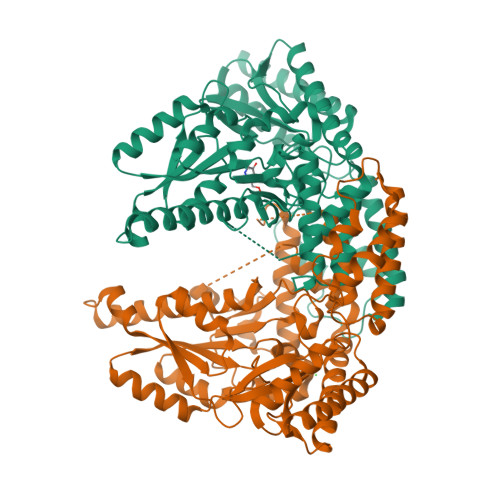
Protein phosphatase 1 regulatory subunit 15A structureClick to view 3D structureProtein phosphatase 1 regulatory subunit 15AO75807HumansPredicted (SEA)13.7015
Protein phosphatase 1 regulatory subunit 15B structureClick to view 3D structureProtein phosphatase 1 regulatory subunit 15BQ5SWA1HumansPredicted (SEA)13.7015
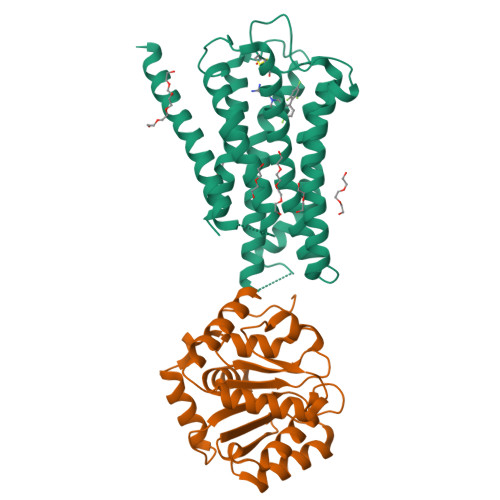
Alpha-2A adrenergic receptor structureClick to view 3D structureAlpha-2A adrenergic receptorP08913HumansPredicted (SEA)4428.61
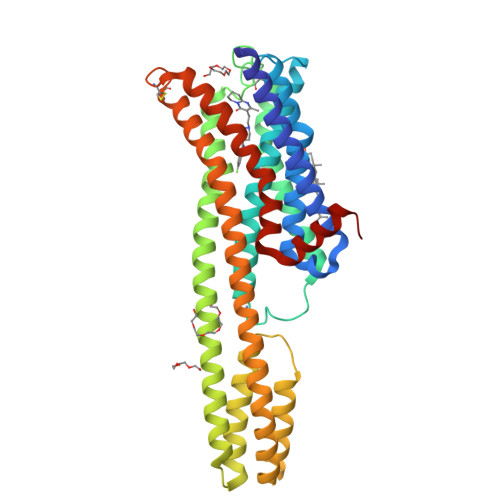
5-hydroxytryptamine receptor 2C structureClick to view 3D structure5-hydroxytryptamine receptor 2CP28335HumansPredicted (SEA)5688.29
Click to view 3D structureAlpha-2A adrenergic receptorP22909Rattus norvegicusPredicted (SEA)984.715
Cytochrome P450 2C19 structureClick to view 3D structureCytochrome P450 2C19P33261HumansPredicted (SEA)6833.84
Aryl hydrocarbon receptor structureClick to view 3D structureAryl hydrocarbon receptorP35869HumansPredicted (SEA)738.011
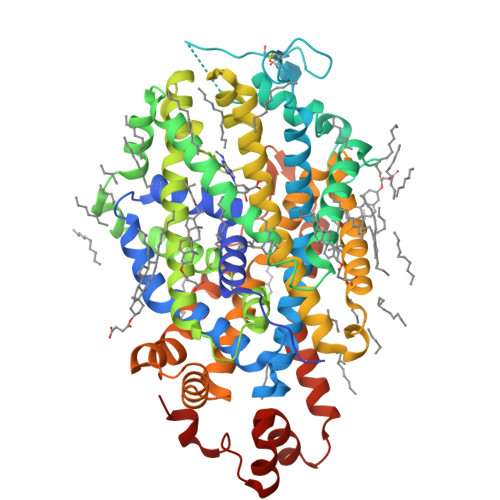
Sodium-dependent serotonin transporter structureClick to view 3D structureSodium-dependent serotonin transporterP31645HumansPredicted (SEA)5788.32
Cytochrome P450 1A2 structureClick to view 3D structureCytochrome P450 1A2P05177HumansPredicted (SEA)6960.58
5-hydroxytryptamine receptor 1A structureClick to view 3D structure5-hydroxytryptamine receptor 1AP08908HumansPredicted (SEA)6366.2
Carbonic anhydrase 9 structureClick to view 3D structureCarbonic anhydrase 9Q16790HumansPredicted (SEA)4206.19
Carbonic anhydrase 2 structureClick to view 3D structureCarbonic anhydrase 2P00918HumansPredicted (SEA)4694.0
Alkaline phosphatase, tissue-nonspecific isozyme structureClick to view 3D structureAlkaline phosphatase, tissue-nonspecific isozymeP05186HumansPredicted (SEA)917.531
Mitogen-activated protein kinase 1 structureClick to view 3D structureMitogen-activated protein kinase 1P28482HumansPredicted (SEA)6642.48
Cytochrome P450 3A4 structureClick to view 3D structureCytochrome P450 3A4P08684HumansPredicted (SEA)7446.2
Click to view 3D structureKynurenine 3-monooxygenaseP38169Saccharomyces cerevisiae (strain ATCC 204508 / S288c) (Baker's yeast)Predicted (SEA)107.977
5-hydroxytryptamine receptor 7 structureClick to view 3D structure5-hydroxytryptamine receptor 7P34969HumansPredicted (SEA)6034.25
5-hydroxytryptamine receptor 1D structureClick to view 3D structure5-hydroxytryptamine receptor 1DP28221HumansPredicted (SEA)5607.01
5-hydroxytryptamine receptor 5A structureClick to view 3D structure5-hydroxytryptamine receptor 5AP47898HumansPredicted (SEA)4487.31
Mitogen-activated protein kinase 14 structureClick to view 3D structureMitogen-activated protein kinase 14Q16539HumansPredicted (SEA)6762.06
5-hydroxytryptamine receptor 2A structureClick to view 3D structure5-hydroxytryptamine receptor 2AP28223HumansPredicted (SEA)6826.36
Click to view 3D structureSodium-dependent serotonin transporterP31652Rattus norvegicusPredicted (SEA)4438.65
5-hydroxytryptamine receptor 3A structureClick to view 3D structure5-hydroxytryptamine receptor 3AP46098HumansPredicted (SEA)4742.5
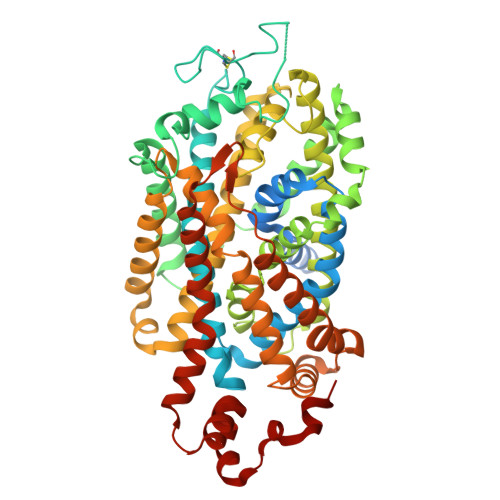
Sodium-dependent dopamine transporter structureClick to view 3D structureSodium-dependent dopamine transporterQ01959HumansPredicted (SEA)6505.39
Sodium-dependent noradrenaline transporter structureClick to view 3D structureSodium-dependent noradrenaline transporterP23975HumansPredicted (SEA)6179.75
Estrogen receptor structureClick to view 3D structureEstrogen receptorP03372HumansKnownCauses endocrine disruption in humans by binding to and inhibiting the estrogen receptor. (A590)
Estrogen receptor beta structureClick to view 3D structureEstrogen receptor betaQ92731HumansKnownCauses endocrine disruption in humans by binding to and inhibiting the estrogen receptor. (A590)
Sulfotransferase 1E1 structureClick to view 3D structureSulfotransferase 1E1P49888HumansKnownPCBs can cause endocrine disurption by binding to estrogen sulfotransferase, which can stimulate the growth of certain cancer cells and produce other estrogenic effects, such as reproductive dysfunction. (A3, A66)
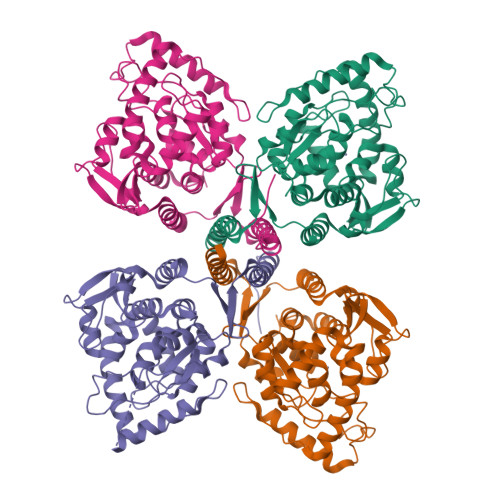
Aromatic-L-amino-acid decarboxylase structureClick to view 3D structureAromatic-L-amino-acid decarboxylaseP20711HumansKnownPCB inhibition of aromatic-L-amino-acid decarboxylase is believed to cause decreased dopamine synthesis. (L4)
Aryl hydrocarbon receptor structureClick to view 3D structureAryl hydrocarbon receptorP35869HumansKnownDioxin-like PCBs bind to the aryl hydrocarbon receptor, which disrupts cell function by altering the transcription of genes, mainly be inducing the expression of hepatic Phase I and Phase II enzymes, especially of the cytochrome P450 family. (A4)
Tyrosine 3-monooxygenase structureClick to view 3D structureTyrosine 3-monooxygenaseP07101HumansKnownPCB inhibition of tyrosine 3-monooxygenase is believed to cause decreased dopamine synthesis. (L4)
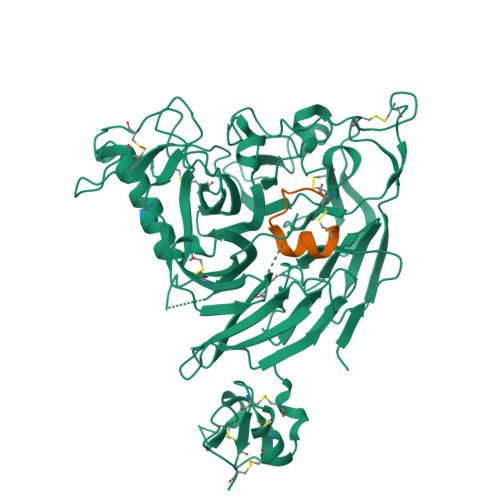
Uteroglobin structureClick to view 3D structureUteroglobinP11684HumansKnownPCBs will bioaccumulate by binding to receptor proteins such as uteroglobin. (A30)
Concentrations
Not Available
External Links
DrugBank IDNot Available
HMDB IDNot Available
FooDB IDNot Available
Phenol Explorer IDNot Available
KNApSAcK IDNot Available
BiGG IDNot Available
BioCyc IDNot Available
METLIN IDNot Available
PDB IDNot Available
Wikipedia LinkNot Available
Chemspider ID34853
ChEBI IDNot Available
PubChem Compound ID38018
Kegg Compound IDNot Available
YMDB IDNot Available
ECMDB IDNot Available
References
Synthesis ReferenceNot Available
MSDSNot Available
General References