Parathion (CED0003826)

Record Information
Version1.0
Creation Date2009-03-06 18:58:10 UTC
Update Date2026-08-18 01:04:43 UTC
SynCED IDCED0003826
Secondary Accession Numbers
  • CHEM000135
  • T3D0145
Identification
Common NameParathion
ClassSmall Molecule
Description
Parathion belongs to the thiophosphoric acid esters, a subclass of organic thiophosphoric acids and derivatives within the organic compounds. This exogenous compound has the formula C10H14NO5PS and an average molecular weight of 291.26 g/mol. At room temperature, it exists as a liquid. Parathion is an agrochemical used as a pesticide (PMC11082906 , PMC12293878 ), an avicide (PMC11082906 , PMC12293878 ), an acaricide, and an industrial biocide (PMC11082906 , PMC12293878 ). It is further classified as an organophosphate insecticide (PMC12824989 , PMC8348328 ) and an insecticide for biological and industrial use (PMC9513985 , PMC12138787 ). Biologically and chemically, it acts as an inhibitor of cholinesterase (EC 3.1.1.8) and acetylcholinesterase (EC 3.1.1.7). Its active metabolite, paraoxon, inactivates acetylcholinesterase by phosphorylating the active site of the enzyme, which inhibits activity at the motor end-plate and in the nervous system; this leads to the accumulation of the neurotransmitter acetylcholine in the neuromuscular junction or nerve synapse, resulting in overstimulation of cholinergic end organs. Other protein targets include Cytochrome P450 1A1, 1A2, 2B6, 2C9, and 11 additional proteins. Recorded exposure routes include oral intake. The compound is found in or released from 30 recorded sources, including drinking water, floors, key rings, various electrical and electronic equipment, household cleaning and consumer products, and food processing activities. Health effects associated with parathion include cancer (PMC11757986 ), miscarriage (PMC7103533 ), asthma (PMC7103533 ), inflammation (PMC5220052 ), and an increase in weight gain (PMC5325319 ). Additionally, parathion is elevated in the blood of individuals with colorectal cancer (PMC5737552 ).
Contaminant Type
  • Aromatic Hydrocarbon
  • Ester
  • Food Toxin
  • Human Neurotoxin
  • Metabolite
  • Organic Compound
  • Organophosphate
  • Pesticide
  • Pollutant
  • Synthetic Compound
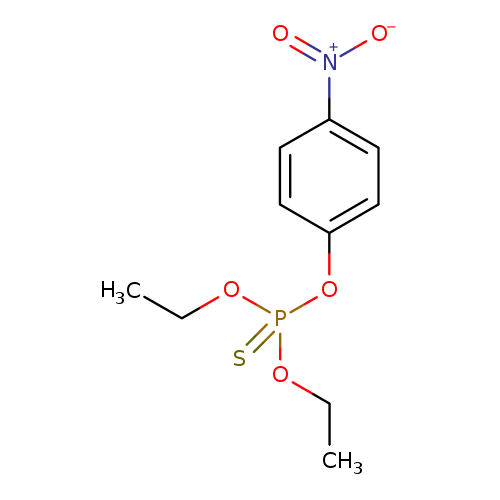
Chemical Structure
Synonyms
ValueSource
Diethyl p-nitrophenyl thiophosphateChEBI
Diethyl parathionChEBI
DNTPChEBI
Ethyl parathionChEBI
O,O-Diethyl O-(4-nitrophenyl) thiophosphateChEBI
O,O-Diethyl O-(p-nitrophenyl) thiophosphateChEBI
O,O-Diethyl O-p-nitrophenyl phosphorothioateChEBI
Phosphorothioic acid, O,O-diethyl O-(4-nitrophenyl) esterChEBI
ThiophosChEBI
Diethyl p-nitrophenyl thiophosphoric acidGenerator
O,O-Diethyl O-(4-nitrophenyl) thiophosphoric acidGenerator
O,O-Diethyl O-(p-nitrophenyl) thiophosphoric acidGenerator
O,O-Diethyl O-p-nitrophenyl phosphorothioic acidGenerator
Phosphorothioate, O,O-diethyl O-(4-nitrophenyl) esterGenerator
AlkronHMDB
AlleronHMDB
American cyanamid 3422HMDB
AphamiteHMDB
Aqua 9-parathionHMDB
AraloHMDB
BladanHMDB
BladenHMDB
CorothionHMDB
CorthioneHMDB
DanthionHMDB
Deoxynucleoside 5'-triphosphateHMDB
Diethyl 4-nitrophenyl phosphorothionateHMDB
Diethyl O-p-nitrophenyl phosphorothioateHMDB
Diethyl O-p-nitrophenyl phosphorothioic acidHMDB
Diethyl p-nitrophenyl thionophosphateHMDB
Diethyl para-nitrophenol thiophosphateHMDB
Diethyl-p-nitrophenyl monothiophosphateHMDB
DiethylparathionHMDB
Drexel parathion 8EHMDB
DurathionHMDB
EcatoxHMDB
EthlonHMDB
Ethyl parathion (O,O-diethyl-O-p-nitrophenylthiophosphate)HMDB
EtilonHMDB
FoliclalHMDB
FolidolHMDB
Folidol e e 605HMDB
Folidol e605HMDB
Folidol oilHMDB
FosfermoHMDB
FosfernoHMDB
Fosferno 50HMDB
FosfexHMDB
FosfiveHMDB
FosovaHMDB
FosternHMDB
FostoxHMDB
GearphosHMDB
GenithionHMDB
KolphosHMDB
KypthionHMDB
Lethalaire g-54HMDB
LirothionHMDB
MurfosHMDB
NiranHMDB
NitrostygmineHMDB
Niuif-100HMDB
NourithionHMDB
O,O-Diethyl-O-(p-nitrophenyl)thionophosphateHMDB
Oleofos 20HMDB
OleoparapheneHMDB
OleoparathionHMDB
OMS 19HMDB
OrthophosHMDB
p-Nitrophenol O-ester with O,O-diethylphosphorothioateHMDB
p-Nitrophenol O-ester with O,O-diethylphosphorothioic acidHMDB
PACHMDB
PacolHMDB
PanthionHMDB
ParadustHMDB
ParamarHMDB
Paramar 50HMDB
ParaphosHMDB
ParatheneHMDB
Parathion-eHMDB
ParawetHMDB
ParthionHMDB
Penncap eHMDB
Pestox plusHMDB
PethionHMDB
PhoskilHMDB
PhosphemolHMDB
PhosphenolHMDB
PhosphorothioateHMDB
Phosphorothioic acidHMDB
Phosphorothioic acid O,O-diethyl-O-(4-nitrophenyl) esterHMDB
PhosphostigmineHMDB
RhodiasolHMDB
RhodiatoxHMDB
RhodiatroxHMDB
SelephosHMDB
Sixty-three special e.cHMDB
SoprathionHMDB
Stabilized ethyl parathionHMDB
StathionHMDB
StrathionHMDB
SulfosHMDB
Super rodiatoxHMDB
T-47HMDB
ThiomexHMDB
Thionspray no.84HMDB
Thiophos 3422HMDB
TiofosHMDB
VapophosHMDB
ViranHMDB
VitrexHMDB
ThiofosHMDB
Parathion, ethylHMDB
Chemical FormulaC10H14NO5PS
Average Molecular Mass291.261 g/mol
Monoisotopic Mass291.033 g/mol
CAS Registry Number56-38-2
IUPAC NameO,O-diethyl O-4-nitrophenyl phosphorothioate
Traditional Namebladen
SMILESCCOP(=S)(OCC)OC1=CC=C(C=C1)[N+]([O-])=O
InChI IdentifierInChI=1S/C10H14NO5PS/c1-3-14-17(18,15-4-2)16-10-7-5-9(6-8-10)11(12)13/h5-8H,3-4H2,1-2H3
InChI KeyLCCNCVORNKJIRZ-UHFFFAOYSA-N
Chemical Taxonomy
Description Belongs to the class of organic compounds known as phenyl thiophosphates. These are organothiophosphorus compounds that contain a thiophosphoric acid O-esterified with a phenyl group.
KingdomOrganic compounds
Super ClassOrganic acids and derivatives
ClassOrganic thiophosphoric acids and derivatives
Sub ClassThiophosphoric acid esters
Direct ParentPhenyl thiophosphates
Alternative Parents
Substituents
  • Phenyl thiophosphate
  • Nitrobenzene
  • Phenoxy compound
  • Nitroaromatic compound
  • Thiophosphate triester
  • Monocyclic benzene moiety
  • Benzenoid
  • C-nitro compound
  • Organic nitro compound
  • Organic oxoazanium
  • Organic 1,3-dipolar compound
  • Propargyl-type 1,3-dipolar organic compound
  • Allyl-type 1,3-dipolar organic compound
  • Organic nitrogen compound
  • Hydrocarbon derivative
  • Organooxygen compound
  • Organonitrogen compound
  • Organic oxide
  • Organopnictogen compound
  • Organic oxygen compound
  • Aromatic homomonocyclic compound
Molecular FrameworkAromatic homomonocyclic compounds
External Descriptors
Biological Properties
StatusDetected and Not Quantified
OriginExogenous
Cellular Locations
  • Membrane
Biofluid LocationsNot Available
Tissue LocationsNot Available
Applications
Biological Roles
Chemical Roles
Organoleptic EffectsNot Available
Physical Properties
StateLiquid
AppearanceWhite crystals.
Experimental Properties
PropertyValue
Melting Point6.1°C
Boiling PointNot Available
Solubility0.011 mg/mL
Predicted Properties
PropertyValueSource
Water Solubility0.012 g/LALOGPS
logP3.76ALOGPS
logP3.32ChemAxon
logS-4.4ALOGPS
pKa (Strongest Basic)-9.7ChemAxon
Physiological Charge0ChemAxon
Hydrogen Acceptor Count2ChemAxon
Hydrogen Donor Count0ChemAxon
Polar Surface Area70.83 ŲChemAxon
Rotatable Bond Count7ChemAxon
Refractivity71.68 m³·mol⁻¹ChemAxon
Polarizability26.77 ųChemAxon
Number of Rings1ChemAxon
BioavailabilityYesChemAxon
Rule of FiveYesChemAxon
Ghose FilterYesChemAxon
Veber's RuleNoChemAxon
MDDR-like RuleNoChemAxon
Spectra
Spectra
Spectrum TypeDescriptionSplash KeyDeposition DateView
Predicted GC-MSPredicted GC-MS Spectrumsplash10-03fr-1390000000-256208006a2b1561db1bNot AvailableView Spectrum
Predicted GC-MSPredicted GC-MS SpectrumNot AvailableNot AvailableView Spectrum
LC-MS/MSLC-MS/MS Spectrumsplash10-01p9-0090000000-fe8742077ddcdaa84280Not AvailableView Spectrum
LC-MS/MSLC-MS/MS Spectrumsplash10-000i-0190000000-af44a385ea22b6326819Not AvailableView Spectrum
LC-MS/MSLC-MS/MS Spectrumsplash10-000l-1940000000-218556da13b43e16e2bfNot AvailableView Spectrum
LC-MS/MSLC-MS/MS Spectrumsplash10-01vo-2910000000-4a40f241595d8b5628d0Not AvailableView Spectrum
LC-MS/MSLC-MS/MS Spectrumsplash10-01vo-4900000000-c58ec980fa6b4210133cNot AvailableView Spectrum
LC-MS/MSLC-MS/MS Spectrumsplash10-01ox-6900000000-80ce5f0f59ebc4a62681Not AvailableView Spectrum
LC-MS/MSLC-MS/MS Spectrumsplash10-01ox-6900000000-0ae225ae5aa0b11161e3Not AvailableView Spectrum
LC-MS/MSLC-MS/MS Spectrumsplash10-01p9-0090000000-699baba652581ceae2beNot AvailableView Spectrum
LC-MS/MSLC-MS/MS Spectrumsplash10-000l-1940000000-15d927af1afee2c09028Not AvailableView Spectrum
LC-MS/MSLC-MS/MS Spectrumsplash10-000i-0190000000-13506519f0e449b52678Not AvailableView Spectrum
LC-MS/MSLC-MS/MS Spectrumsplash10-01vo-2910000000-e81debcb63112f1a8187Not AvailableView Spectrum
LC-MS/MSLC-MS/MS Spectrumsplash10-01vo-4900000000-697208a779d2fefe32fdNot AvailableView Spectrum
Predicted LC-MS/MSPredicted LC-MS/MS Spectrumsplash10-0006-1090000000-e7daa1435a3c8202b8dcNot AvailableView Spectrum
Predicted LC-MS/MSPredicted LC-MS/MS Spectrumsplash10-00lr-1090000000-0ee220c0c9ec67d726bbNot AvailableView Spectrum
Predicted LC-MS/MSPredicted LC-MS/MS Spectrumsplash10-004j-9720000000-be163305078ac89a7681Not AvailableView Spectrum
Predicted LC-MS/MSPredicted LC-MS/MS Spectrumsplash10-0006-0390000000-3cdf27289e65564f2028Not AvailableView Spectrum
Predicted LC-MS/MSPredicted LC-MS/MS Spectrumsplash10-0006-0490000000-9b32c86de4c27c33c405Not AvailableView Spectrum
Predicted LC-MS/MSPredicted LC-MS/MS Spectrumsplash10-000f-1940000000-6f5772e73d0e7958d6cbNot AvailableView Spectrum
Predicted LC-MS/MSPredicted LC-MS/MS Spectrumsplash10-0006-0090000000-9585d70a69dd82c677f0Not AvailableView Spectrum
Predicted LC-MS/MSPredicted LC-MS/MS Spectrumsplash10-01pc-0090000000-7f509a774ae9d3a5ac84Not AvailableView Spectrum
Predicted LC-MS/MSPredicted LC-MS/MS Spectrumsplash10-0udi-9340000000-b44b4f76ff61f463d2dbNot AvailableView Spectrum
Predicted LC-MS/MSPredicted LC-MS/MS Spectrumsplash10-0006-0090000000-f2d3ba63a2de010595cfNot AvailableView Spectrum
Predicted LC-MS/MSPredicted LC-MS/MS Spectrumsplash10-03di-0290000000-b84c6ef99ca616492499Not AvailableView Spectrum
Predicted LC-MS/MSPredicted LC-MS/MS Spectrumsplash10-006t-7910000000-fc58d956a883b5d8b5caNot AvailableView Spectrum
MSMS Spectrumsplash10-0a74-8940000000-4bf55c77de23f747eb80Not AvailableView Spectrum
Toxicity Profile
Toxicity Values
Toxicity ValueOrganismDose DescriptorRoute of ExposurePredicted or ExperimentalToxicity RatingReference
2.0 mg/kg RatLD50OralexperimentalNot Available16
6800.0 ug/kg RatLD50DermalexperimentalNot Available16
3600.0 ug/kg RatLD05IntraperitonealexperimentalNot Available16
6.0 mg/kg RatLD50IntramuscularexperimentalNot Available16
84.0 mg RatLC50InhalationexperimentalNot Available4
12.5 mg/kg-day MouseLOELinjectionexperimentalNot AvailableECOTOX - EPA ORD
0.5 mg/kg-day RatLOELoralexperimentalNot AvailableECOTOX - EPA ORD
2.1 mg/kg-day RatLOELinjectionexperimentalNot AvailableECOTOX - EPA ORD
2.0 mg/kg-day RatLOELoralexperimentalNot AvailableECOTOX - EPA ORD
40.0 mg/kg-day MouseNOELinjectionexperimentalNot AvailableECOTOX - EPA ORD
3.5 ppm RatLOELoralexperimentalNot AvailableECOTOX - EPA ORD
3.0 ppm RatNOELoralexperimentalNot AvailableECOTOX - EPA ORD
18.0 mg/kg-day RatLOELinjectionexperimentalNot AvailableECOTOX - EPA ORD
40.0 mg/kg-day MouseLOELinjectionexperimentalNot AvailableECOTOX - EPA ORD
20.0 mg/kg-day MouseNOELinjectionexperimentalNot AvailableECOTOX - EPA ORD
10.0 mg/kg-day MouseNOELinjectionexperimentalNot AvailableECOTOX - EPA ORD
1.0 mg/kg-day MouseNOELoralexperimentalNot AvailableECOTOX - EPA ORD
1.0 mg/kg-day MouseLOELoralexperimentalNot AvailableECOTOX - EPA ORD
0.4 mg/kg/org RatNOELoralexperimentalNot AvailableECOTOX - EPA ORD
4.0 ppm RatLOELoralexperimentalNot AvailableECOTOX - EPA ORD
10.0 mg/kg-day MouseLOELinjectionexperimentalNot AvailableECOTOX - EPA ORD
1.5 mg/kg-day MouseLOELoralexperimentalNot AvailableECOTOX - EPA ORD
0.15 mg/kg-day MouseNOELoralexperimentalNot AvailableECOTOX - EPA ORD
2.0 ppm RatNOELoralexperimentalNot AvailableECOTOX - EPA ORD
Toxicity / Toxin ClassNot Available
Mechanism of ToxicityParathion is a cholinesterase or acetylcholinesterase (AChE) inhibitor. A cholinesterase inhibitor (or 'anticholinesterase') suppresses the action of acetylcholinesterase. Because of its essential function, chemicals that interfere with the action of acetylcholinesterase are potent neurotoxins, causing excessive salivation and eye-watering in low doses, followed by muscle spasms and ultimately death. Nerve gases and many substances used in insecticides have been shown to act by binding a serine in the active site of acetylcholine esterase, inhibiting the enzyme completely. Acetylcholine esterase breaks down the neurotransmitter acetylcholine, which is released at nerve and muscle junctions, in order to allow the muscle or organ to relax. The result of acetylcholine esterase inhibition is that acetylcholine builds up and continues to act so that any nerve impulses are continually transmitted and muscle contractions do not stop. Among the most common acetylcholinesterase inhibitors are phosphorus-based compounds, which are designed to bind to the active site of the enzyme. The structural requirements are a phosphorus atom bearing two lipophilic groups, a leaving group (such as a halide or thiocyanate), and a terminal oxygen.
Carcinogenicity (IARC Classification)3, not classifiable as to its carcinogenicity to humans. (13)
Minimum Risk LevelNot Available
SymptomsParathion exposure can result in headaches, convulsions, poor vision, vomiting, abdominal pain, severe diarrhea, unconsciousness, tremor, dyspnea, and finally lung-edema as well as respiratory arrest. (14)
TreatmentIf the compound has been ingested, rapid gastric lavage should be performed using 5% sodium bicarbonate. For skin contact, the skin should be washed with soap and water. If the compound has entered the eyes, they should be washed with large quantities of isotonic saline or water. In serious cases, atropine and/or pralidoxime should be administered. Anti-cholinergic drugs work to counteract the effects of excess acetylcholine and reactivate AChE. Atropine can be used as an antidote in conjunction with pralidoxime or other pyridinium oximes (such as trimedoxime or obidoxime), though the use of '-oximes' has been found to be of no benefit, or possibly harmful, in at least two meta-analyses. Atropine is a muscarinic antagonist, and thus blocks the action of acetylcholine peripherally.
Health Effects
Health EffectRelationshipDirectionDescriptionReference
inflammationAssociated With?increaseNot AvailablePMC5220052
inflammationAssociated With?Not AvailableNot AvailablePMC5220052
cancerAssociated With?Not AvailableCancer is a group of diseases involving abnormal cell growth with the potential to invade or spread to other parts of the body. Possible signs and symptoms include a lump, abnormal bleeding, prolonged cough, unexplained weight loss, and a change in bowel movements. There are over 100 types of cancers affect humans. The risk of developing certain cancers can be reduced by not smoking, maintaining a healthy weight, not drinking too much alcohol, eating plenty of vegetables, fruits and whole grains, vaccination against certain infectious diseases, not eating too much processed and red meat and avoiding too much sunlight exposure. Cancer is often treated with some combination of radiation therapy, surgery, chemotherapy and targeted therapy. The majority of cancers, some 90–95% of cases, are due to genetic mutations from environmental and lifestyle factors. The remaining 5–10% are due to inherited genetics.PMC11757986
cancerAssociated With?increaseCancer is a group of diseases involving abnormal cell growth with the potential to invade or spread to other parts of the body. Possible signs and symptoms include a lump, abnormal bleeding, prolonged cough, unexplained weight loss, and a change in bowel movements. There are over 100 types of cancers affect humans. The risk of developing certain cancers can be reduced by not smoking, maintaining a healthy weight, not drinking too much alcohol, eating plenty of vegetables, fruits and whole grains, vaccination against certain infectious diseases, not eating too much processed and red meat and avoiding too much sunlight exposure. Cancer is often treated with some combination of radiation therapy, surgery, chemotherapy and targeted therapy. The majority of cancers, some 90–95% of cases, are due to genetic mutations from environmental and lifestyle factors. The remaining 5–10% are due to inherited genetics.PMC5132635
dizzinessAssociated With?Not AvailableA sensation of lightheadedness, unsteadiness, turning, spinning or rocking.PMC8307517
type 2 diabetes mellitusAssociated With?increaseNot AvailablePMC5325319
colorectal cancerElevated in Blood InNot AvailableA large intestine cancer that is located in the colon and/or located in the rectum. (DO)PMC5737552
asthmaAssociated With?Not AvailableA bronchial disease that is characterized by chronic inflammation and narrowing of the airways, which is caused by a combination of environmental and genetic factors. The disease has symptom recurring periods of wheezing (a whistling sound while breathing), has symptom chest tightness, has symptom shortness of breath, has symptom mucus production and has symptom coughing. The symptoms appear due to a variety of triggers such as allergens, irritants, respiratory infections, weather changes, exercise, stress, reflux disease, medications, foods and emotional anxiety. (DO)PMC7103533
diabetes mellitusAssociated With?increaseA glucose metabolism disease characterized by chronic hyperglycaemia with disturbances of carbohydrate, fat and protein metabolism resulting from defects in insulin secretion, insulin action, or both. (DO)PMC13119611 , PMC4127367
diabetes mellitusAssociated With?positiveA glucose metabolism disease characterized by chronic hyperglycaemia with disturbances of carbohydrate, fat and protein metabolism resulting from defects in insulin secretion, insulin action, or both. (DO)PMC4127367
diabetes mellitusAssociated With?Not AvailableA glucose metabolism disease characterized by chronic hyperglycaemia with disturbances of carbohydrate, fat and protein metabolism resulting from defects in insulin secretion, insulin action, or both. (DO)PMC4127367
headacheAssociated With?Not AvailableA disorder characterized by a sensation of marked discomfort in various parts of the head, not confined to the area of distribution of any nerve. (NCI CTCAE)PMC5725685
weight gainAssociated With?increaseA finding characterized by an increase in overall body weight; for pediatrics, greater than the baseline growth curve. (NCI CTCAE)PMC5325319
obesityAssociated With?increaseA disorder characterized by having a high amount of body fat. (NCI CTCAE)PMC6249079
nauseaAssociated With?Not AvailableA disorder characterized by a queasy sensation and/or the urge to vomit. (NCI CTCAE)PMC5725685
seizureAssociated With?Not AvailableNot AvailablePMC5725685
miscarriageAssociated With?Not AvailableA natural death of an embryo or fetus before it is able to survive independently.PMC7103533 , PMC7103533
Toxic encephalopathyAssociated With?Not AvailableNot AvailablePMC12428754 , PMC10177384
Toxic encephalopathyAssociated With?decreaseNot AvailablePMC13343263
Abnormality of mitochondrial metabolismAssociated With?decreaseNot AvailablePMC9180067
convulsionAssociated With?Not AvailableNot AvailablePMC8307517
DNA DamageAssociated With?increaseNot AvailablePMC12449350
prediabetes syndromeAssociated With?increaseNot AvailablePMC6249079
Abnormal sperm head morphologyAssociated With?increaseNot AvailablePMC11664077
Exposure Sources
Source IDSourceSectorReference
CEDs000010Insecticides?Insecticides are synthetic chemicals designed to control or eliminate insect pests that threaten crops and other agricultural products.Agriculture & land managementPubChem
CEDs000050Groundwater?Groundwater serves as a vital resource for drinking water and agricultural irrigation but is increasingly susceptible to contamination from synthetic chemicals.Aquatic systems & sedimentsPMC8309806
CEDs000070Stormwater runoff?Stormwater runoff refers to the flow of rainwater or melted snow that does not soak into the ground and instead collects pollutants as it travels over impervious surfaces such as roads and parking lots.Automotive & urban infrastructurePubChem
CEDs000115Drinking water?Drinking water can be a medium for synthetic chemical contamination, often originating from various industrial processes and agricultural practices.Drinking water & water supplyNot Available
CEDs000181Ballast water?Ballast water, taken on by ships to maintain stability and balance, often contains a diverse array of microorganisms, including bacteria, viruses, and plankton.Marine, shipping & aquaculturePubChem
CEDs000182Bilge water?Bilge water is a byproduct generated from the accumulation of water in the lowest part of a ship's hull, which may include a mixture of seawater, oil, fuel residues, and various contaminants.Marine, shipping & aquaculturePubChem
CEDs000497Floors?Floors in built environments can be a significant source of synthetic chemical contamination due to the materials and finishes used in their construction.Building & ConstructionPubChem
CEDs000505Amplifiers?Amplifiers, commonly used in various electronic devices to enhance signal strength, can be a source of synthetic chemical contamination due to the materials and processes involved in their production and disposal.Electrical & Electronic EquipmentPubChem
CEDs000506Antennas?Antennas, commonly used in communication technologies, can be a source of synthetic chemical contamination through the materials and coatings used in their construction.Electrical & Electronic EquipmentPubChem
CEDs000511Conductors Or Conductive Bodies Characterised By The Conductive Materials?Conductors, or conductive bodies, are materials that allow the flow of electrical current, typically made from metals such as copper, aluminum, or silver.Electrical & Electronic EquipmentPubChem
CEDs000514Discharge Lamps?Discharge lamps, including fluorescent and high-intensity discharge (HID) lamps, are commonly used for lighting applications due to their energy efficiency and brightness.Electrical & Electronic EquipmentPubChem
CEDs000516Electric Hearing Aids?Electric hearing aids are small electronic devices designed to amplify sound for individuals with hearing loss.Electrical & Electronic EquipmentPubChem
CEDs000517Electric Switches?Electric switches, integral components in numerous devices, can be a source of synthetic chemical contamination due to the materials and manufacturing processes involved in their production.Electrical & Electronic EquipmentPubChem
CEDs000518Electrically Stimulated Smoking Devices?Electrically stimulated smoking devices, commonly known as e-cigarettes or vape pens, utilize electrical components to heat a liquid solution, often containing nicotine, flavorings, and other additives, to produce an aerosol for inhalation.Electrical & Electronic EquipmentPubChem
CEDs000519Electrodes?Electrodes, used in various electrical and electronic applications, can be a source of synthetic chemical contamination due to the materials from which they are constructed and the processes involved in their manufacturing.Electrical & Electronic EquipmentPubChem
CEDs000521Fixed Capacitors And Their Manufacture?Fixed capacitors are passive electronic components used to store and release electrical energy, playing a critical role in various circuits.Electrical & Electronic EquipmentPubChem
CEDs000524Hybrid Capacitors?Hybrid capacitors are energy storage devices that combine the properties of electrolytic and supercapacitors, utilizing a combination of electrochemical principles to achieve higher energy density and power density.Electrical & Electronic EquipmentPubChem
CEDs000527Magnets?Magnets, commonly used in various electrical and electronic applications, can be a source of synthetic chemical contamination due to the materials used in their production.Electrical & Electronic EquipmentPubChem
CEDs000534Still Video Cameras?Still video cameras, which capture images in digital format, can be a source of synthetic chemical contamination due to the materials and components used in their production and operation.Electrical & Electronic EquipmentPubChem
CEDs000537Television Systems?Television systems can be a source of synthetic chemical contamination due to the various materials and components used in their manufacture and operation.Electrical & Electronic EquipmentPubChem
CEDs000538Thin Magnetic Films?Thin magnetic films are layers of magnetic material ranging from a few nanometers to several micrometers in thickness, commonly used in applications such as magnetic sensors, data storage devices, and electronic components.Electrical & Electronic EquipmentPubChem
CEDs000545Food Preservation?Food preservation often involves the use of synthetic chemicals, such as preservatives, flavor enhancers, and color additives, to extend shelf life and enhance the sensory qualities of food products.Food, food processing & cookwarePubChem
CEDs000546Molasses And Treatment Of Molasses?Molasses is a thick, viscous byproduct of sugar production, derived from the extraction of sugar cane or sugar beet juice.Food, food processing & cookwarePubChem
CEDs000548Preparation Of Vinegar?Vinegar is produced through the fermentation of ethanol by acetic acid bacteria, resulting in a solution that typically contains 4-8% acetic acid.Food, food processing & cookwarePubChem
CEDs000549Preparation Of Wine Or Sparkling Wine?The preparation of wine or sparkling wine involves various stages, including fermentation, aging, and bottling, which can introduce potential sources of synthetic chemical contamination.Food, food processing & cookwarePubChem
CEDs000550Preparation Of Wort?The preparation of wort involves the extraction of sugars from malted grains, a crucial step in the brewing process.Food, food processing & cookwarePubChem
CEDs000551Processing Fish?Processing fish can lead to synthetic chemical contamination through various stages of production and preservation.Food, food processing & cookwarePubChem
CEDs000552Processing Meats?Processing meats can lead to synthetic chemical contamination primarily through the use of additives and preservatives.Food, food processing & cookwarePubChem
CEDs000555Bleaching Agents?Bleaching agents are chemical substances used to whiten or lighten materials, often employed in various cleaning products for their stain removal and disinfecting properties.Household cleaning & consumer productsPubChem
CEDs000556Cigar Cigarettes?Cigar cigarettes are a source of synthetic chemical contamination due to the combustion of various tobacco blends and additives.Household cleaning & consumer productsPubChem
CEDs000561Perfumes Within Detergents And Soaps?Perfumes within detergents and soaps are synthetic fragrance compounds added to enhance the sensory experience of cleaning products.Household cleaning & consumer productsPubChem
CEDs000563Soap Detergents?Soap detergents are synthetic surfactants designed to enhance the cleaning efficacy of water by reducing surface tension, allowing for better interaction with dirt and grease.Household cleaning & consumer productsPubChem
CEDs000567Tobacco Product Cases?Tobacco product cases can serve as a source of synthetic chemical contamination due to the presence of various additives and chemicals used in tobacco processing and product manufacturing.Household cleaning & consumer productsPubChem
CEDs000569Tobacco Smoke Filters?Tobacco smoke filters are designed to reduce the inhalation of harmful substances in cigarette smoke, including tar and other particulate matter.Household cleaning & consumer productsPubChem
CEDs000573Key Rings?Key rings are commonly made from various synthetic materials, including plastics and metals, which can be sources of chemical contamination.Household itemsPubChem
CEDs000578Making Cigars?The process of making cigars involves several steps, including the cultivation of tobacco, fermentation, and the application of various additives to enhance flavor and preservation.Industrial manufacturing & chemical processingPubChem
CEDs000579Manufacture Of Iron Or Steel?The manufacture of iron or steel involves various processes, including smelting, refining, and alloying, which can result in the release of synthetic chemicals and contaminants.Industrial manufacturing & chemical processingPubChem
CEDs000580Manufacture Preparation Of Tobacco Products?The manufacture and preparation of tobacco products involve various processes that can result in the introduction of synthetic chemicals into the environment.Industrial manufacturing & chemical processingPubChem
CEDs000581Paper Making Machines?Paper making machines utilize various synthetic chemicals throughout the production process, including additives, coatings, and bleaching agents.Industrial manufacturing & chemical processingPubChem
CEDs000583Anchoring Equipment?Anchoring equipment, commonly used in marine applications, can be a source of synthetic chemical contamination due to the materials and coatings utilized in their manufacturing.Marine, shipping & aquaculturePubChem
CEDs000592Marine Propulsion Or Steering?Marine propulsion and steering systems often rely on various synthetic chemicals, including lubricants, fuels, and hydraulic fluids.Marine, shipping & aquaculturePubChem
CEDs000596Acaricides?Acaricides are synthetic chemicals specifically designed to target and control mite populations that can damage crops and plants.Agriculture & land managementPubChem
CEDs000597Chemosterilants?Chemosterilants are synthetic chemicals designed to induce sterility in target pest populations, thereby controlling their reproduction and mitigating damage to crops.Agriculture & land managementPubChem
CEDs000598Fertiliser Distributors?Fertiliser distributors play a critical role in the supply of synthetic fertilizers, which are widely used to enhance soil fertility and crop yield.Agriculture & land managementPubChem
CEDs000600Herbicides And Algicides?Herbicides and algicides are synthetic chemicals primarily used to control unwanted plants and algae in various environments.Agriculture & land managementPubChem
CEDs000601Lawn Mowers?Lawn mowers, particularly those powered by gasoline, can be a source of synthetic chemical contamination due to the combustion of fossil fuels and the use of engine oils.Agriculture & land managementPubChem
CEDs000602Molluscicides?Molluscicides are synthetic chemicals specifically designed to control and eliminate mollusks, such as snails and slugs, which can be detrimental to crops and agricultural productivity.Agriculture & land managementPubChem
CEDs000603Nematocides?Nematocides are synthetic chemicals specifically designed to control nematodes, which are microscopic roundworms that can cause significant damage to crops and plants.Agriculture & land managementPubChem
CEDs000604Pest Attractants?Pest attractants are synthetic chemicals designed to lure specific pests for monitoring or control purposes.Agriculture & land managementPubChem
CEDs000605Pest Repellants?Pest repellents, often formulated from synthetic chemicals, are widely used to protect crops from insect infestations and other pests.Agriculture & land managementPubChem
CEDs000606Plant Growth Regulators?Plant Growth Regulators (PGRs) are synthetic chemicals designed to influence the growth and development of plants.Agriculture & land managementPubChem
CEDs000607Rodenticides(1)?Rodenticides are synthetic chemicals specifically formulated to control rodent populations, serving as a crucial tool in managing pests that can damage crops and spread diseases.Agriculture & land managementPubChem
CEDs000608Rodenticides?Rodenticides are chemical substances specifically designed to control rodent populations by causing death through various mechanisms, including anticoagulation or neurotoxicity.Agriculture & land managementPubChem
CEDs000609Aftershave?Aftershave is a grooming product typically used to soothe and protect the skin following shaving.Personal care & cosmeticsPubChem
CEDs000610Aftersun Products?Aftersun products are designed to soothe and hydrate the skin after sun exposure, often containing various synthetic chemicals such as emollients, preservatives, and fragrances.Personal care & cosmeticsPubChem
CEDs000611Anti Perspirants Or Body Deoderants?Antiperspirants and body deodorants commonly contain synthetic chemicals such as aluminum compounds, parabens, and synthetic fragrances.Personal care & cosmeticsPubChem
CEDs000613Depilatories?Depilatories are products designed to remove unwanted hair through the application of synthetic chemicals that break down the protein structure of hair, facilitating its removal.Personal care & cosmeticsPubChem
CEDs000614Essential Oils Or Perfumes?Essential oils and perfumes are complex mixtures of volatile compounds derived from natural or synthetic sources, commonly used for their aromatic properties.Personal care & cosmeticsPubChem
CEDs000615Eye Makeup Products?Eye makeup products, including mascaras, eyeliners, and eyeshadows, often contain a variety of synthetic chemicals such as pigments, preservatives, and film-forming agents.Personal care & cosmeticsPubChem
CEDs000617Lip Care Products?Lip care products, including lipsticks, balms, and glosses, often contain a variety of synthetic chemicals such as parabens, phthalates, and synthetic fragrances.Personal care & cosmeticsPubChem
CEDs000618Lip Makeup Products?Lip makeup products, such as lipsticks, lip glosses, and lip liners, often contain a variety of synthetic chemicals, including pigments, preservatives, and emollients.Personal care & cosmeticsPubChem
CEDs000632Apparel?Apparel production often involves the use of various synthetic chemicals, including dyes, finishing agents, and preservatives.Textiles, leather & furnishingsPubChem
CEDs000634Buckles?Buckles, commonly used as fasteners in clothing, accessories, and furniture, can be a source of synthetic chemical contamination due to the materials and coatings employed in their production.Textiles, leather & furnishingsPubChem
CEDs000638Decorating Textiles?Decorating textiles often involves the use of synthetic chemicals such as dyes, finishes, and coatings.Textiles, leather & furnishingsPubChem
CEDs000640Embroidering And Tufting?Embroidering and tufting processes often involve the use of synthetic chemicals such as dyes, adhesives, and finishing agents.Textiles, leather & furnishingsPubChem
CEDs000642Footwear?Footwear production often involves the use of various synthetic chemicals, such as adhesives, dyes, and treatments, which can contribute to environmental contamination.Textiles, leather & furnishingsPubChem
CEDs000647Multicolour Dyeing?Multicolour dyeing involves the application of multiple synthetic dyes to textiles and other materials to achieve vibrant, diverse color patterns.Textiles, leather & furnishingsPubChem
CEDs000652Ropes?Ropes manufactured from synthetic fibers, such as polypropylene, nylon, and polyester, are widely used in various applications, including marine, construction, and outdoor activities.Textiles, leather & furnishingsPubChem
CEDs000653Sewing?Sewing processes often involve the use of various synthetic chemicals, which can become sources of contamination in the environment.Textiles, leather & furnishingsPubChem
CEDs000657Surface Finishing Of Leather?Surface finishing of leather often involves the use of various synthetic chemicals, including dyes, resins, and finishing agents.Textiles, leather & furnishingsPubChem
CEDs000662Yarns Or Threads?Yarns or threads used in textiles can be a source of synthetic chemical contamination due to the production processes and treatments they undergo.Textiles, leather & furnishingsPubChem
CEDs000671Airplanes And Helicopters?Airplanes and helicopters are significant sources of synthetic chemical contamination primarily through the use of aviation fuels, lubricants, and de-icing agents.Aviation & AerospacePubChem
CEDs000673Unmanned Aerial Vehicles?Unmanned Aerial Vehicles (UAVs), commonly known as drones, utilize various synthetic chemicals in their manufacturing, operation, and maintenance processes.Aviation & AerospacePubChem
CEDs000678Nitrogenous Fertilisers?Nitrogenous fertilizers are synthetic chemical compounds primarily used to enhance plant growth by supplying essential nitrogen, a crucial nutrient for photosynthesis and protein synthesis.Agriculture & land managementPubChem
CEDs000679Phosphatic Fertilisers?Phosphatic fertilizers are synthetic chemical products primarily composed of phosphorus, which is essential for plant growth.Agriculture & land managementPubChem
CEDs000684Cements?Cements are a composite material primarily used as a binding agent in construction applications, formed by the calcination of limestone and clay minerals at high temperatures.Building & ConstructionPubChem
CEDs000685Ceramics?Ceramics can be a source of synthetic chemical contamination through various additives and processing agents used in their production.Building & ConstructionPubChem
CEDs000686Clay Wares?Clay wares are ceramic products made from natural clay, often utilized in various construction applications such as tiles, bricks, and sanitary ware.Building & ConstructionPubChem
CEDs000688Glass Coatings?Glass coatings are synthetic chemical formulations applied to glass surfaces to enhance properties such as durability, UV resistance, and aesthetic appeal.Building & ConstructionPubChem
CEDs000690Lime?Lime, primarily comprised of calcium oxide (CaO) or calcium hydroxide (Ca(OH)₂), is widely used in various applications, including as a key ingredient in mortars, plasters, and cement.Building & ConstructionPubChem
CEDs000692Silica Free Oxide Glass?Silica Free Oxide Glass is a type of glass that is produced using alternative materials to traditional silica-based formulations.Building & ConstructionPubChem
CEDs000693Silica Glass?Silica glass, primarily composed of silicon dioxide (SiO2), is widely used in various applications, including windows, glass facades, and insulation materials.Building & ConstructionPubChem
CEDs000696Nanotechnology?Nanotechnology involves the manipulation of materials at the molecular or atomic level, typically within the range of 1 to 100 nanometers.Industrial manufacturing & chemical processingPubChem
CEDs000698Jewellery?Jewellery production often involves the use of various synthetic chemicals during the extraction and processing of metals.Mining & metal processingPubChem
CEDs000726Pens?Pens, commonly utilized for writing and marking, can be a source of synthetic chemical contamination primarily due to the materials used in their manufacturing.Paper, pulp & fiber productsPubChem
CEDs000735Explosives?Explosives are chemical compounds or mixtures designed to undergo rapid decomposition, releasing energy in the form of gas and heat.Defense & military infrastructurePubChem
CEDs000738Cooling Circuit Water?Cooling circuit water is utilized in various industrial processes to absorb and dissipate heat generated during operations.Industrial manufacturing & chemical processingPubChem
CEDs000739Inks?Inks are complex mixtures composed of pigments or dyes, solvents, resins, and additives used primarily for printing and writing applications.Paper, pulp & fiber productsPubChem
CEDs000740Paper?Paper production involves the processing of wood fibers and the use of various chemicals, which can lead to synthetic chemical contamination.Paper, pulp & fiber productsPubChem
CEDs000741Pigment Pastes?Pigment pastes are concentrated dispersions of pigments used to impart color and properties to materials.Paper, pulp & fiber productsPubChem
CEDs000742Leather Tanning?Leather tanning is a process that transforms raw animal hides into durable leather through the application of various chemicals, including chromium salts, aldehydes, and vegetable tannins.Textiles, leather & furnishingsPubChem
CEDs000743Sludge Treatment?Sludge treatment involves the processing of waste materials generated from wastewater treatment plants, which often contain a variety of organic and inorganic substances.Wastewater, sanitation & biosolidsPubChem
CEDs000744Water, Wastewater, & Sewage Treatment?Water, wastewater, and sewage treatment processes are critical for managing and mitigating pollutants in water systems.Wastewater, sanitation & biosolidsPubChem
CEDs00765Agricultural ProductsAgriculture & land managementPMC7764623
CEDs00872Field SoilAgriculture & land managementPMC12824989
CEDs01151FruitsFood, food processing & cookwarePMC8199770 , PMC10379487
CEDs01168Food ProductsFood, food processing & cookwarePMC9273335
CEDs01185Apple JuiceFood, food processing & cookwarePMC12452724
CEDs01187RiceFood, food processing & cookwarePMC12452724 , PMC8303358
CEDs01198HoneyFood, food processing & cookwarePMC9968705
CEDs01200VegetablesFood, food processing & cookwarePMC8199770 , PMC10379487
CEDs01248Wheat FlourFood, food processing & cookwarePMC10770572 , PMC11664077
CEDs01355Orange JuiceFood, food processing & cookwarePMC12452724
CEDs01425Food CommoditiesFood, food processing & cookwarePMC8303358
CEDs02255WaterAquatic systems & sedimentsPMC11769951 , PMC3565792
CEDs02260Aquatic SystemsAquatic systems & sedimentsPMC8348328
CEDs02265River WaterAquatic systems & sedimentsPMC12824989
CEDs02268Water SamplesAquatic systems & sedimentsPMC9681499
CEDs02270RiverAquatic systems & sedimentsPMC8587002
CEDs02276Aquatic EnvironmentAquatic systems & sedimentsPMC8348328
CEDs02319Lake WaterAquatic systems & sedimentsPMC8587002
Pathways
0 pathwaysPathway Source: PathBank

No pathways found

No metabolic pathways have been associated with this synthetic chemical

Targets
StructureProteinUniProt IDOrganismRelationshipDetails
Cytochrome P450 2B6 structureClick to view 3D structureCytochrome P450 2B6P20813HumansKnownNot Available
Acetylcholinesterase structureClick to view 3D structureAcetylcholinesteraseP22303HumansKnownNot Available
Aromatase structureClick to view 3D structureAromataseP11511HumansKnownNot Available
Cholinesterase structureClick to view 3D structureCholinesteraseP06276HumansKnownNot Available
Carbonic anhydrase 2 structureClick to view 3D structureCarbonic anhydrase 2P00918HumansPredicted (SEA)
Prediction Confidence Score
0.4
Applicability Domain
0.694
Statistical Significance
0.0075
Supporting Reference Compounds
472
E-value
58.3091
Click to view 3D structureFatty-acid amide hydrolase 1O08914Mus musculusPredicted (SEA)
Prediction Confidence Score
0.391
Applicability Domain
0.694
Statistical Significance
0.0014
Supporting Reference Compounds
46
E-value
10.6653
Click to view 3D structureMonoglyceride lipaseO35678Mus musculusPredicted (SEA)
Prediction Confidence Score
0.389
Applicability Domain
0.694
Statistical Significance
8.40e-04
Supporting Reference Compounds
34
E-value
6.53933
Carbonic anhydrase 1 structureClick to view 3D structureCarbonic anhydrase 1P00915HumansPredicted (SEA)
Prediction Confidence Score
0.374
Applicability Domain
0.694
Statistical Significance
0.0099
Supporting Reference Compounds
407
E-value
77.3043
Click to view 3D structureCarbonic anhydrase 13Q9D6N1Mus musculusPredicted (SEA)
Prediction Confidence Score
0.364
Applicability Domain
0.694
Statistical Significance
0.0018
Supporting Reference Compounds
70
E-value
13.935
Endolysin structureClick to view 3D structureEndolysinP00720Enterobacteria phage T4Predicted (SEA)
Prediction Confidence Score
0.361
Applicability Domain
0.361
Statistical Significance
1.80e-04
Supporting Reference Compounds
1
E-value
1.40129
Acetylcholinesterase structureClick to view 3D structureAcetylcholinesteraseP22303HumansPredicted (SEA)
Prediction Confidence Score
0.356
Applicability Domain
0.694
Statistical Significance
0.0143
Supporting Reference Compounds
406
E-value
111.636
Acetylcholinesterase structureClick to view 3D structureAcetylcholinesteraseP21836Mus musculusPredicted (SEA)
Prediction Confidence Score
0.341
Applicability Domain
0.694
Statistical Significance
0.0047
Supporting Reference Compounds
58
E-value
36.667
Click to view 3D structurePatatin-like phospholipase domain-containing protein 6Q3TRM4Mus musculusPredicted (SEA)
Prediction Confidence Score
0.333
Applicability Domain
0.333
Statistical Significance
0.0013
Supporting Reference Compounds
1
E-value
10.1204
Cholinesterase structureClick to view 3D structureCholinesteraseP06276HumansPredicted (SEA)
Prediction Confidence Score
0.312
Applicability Domain
0.694
Statistical Significance
0.018
Supporting Reference Compounds
234
E-value
140.44
Click to view 3D structureCannabinoid receptor 1P47746Mus musculusPredicted (SEA)
Prediction Confidence Score
0.31
Applicability Domain
0.694
Statistical Significance
0.0024
Supporting Reference Compounds
42
E-value
19.0731
Click to view 3D structureCarboxylesteraseB3TNN2Loxostege sticticalisPredicted (SEA)
Prediction Confidence Score
0.306
Applicability Domain
0.306
Statistical Significance
5.00e-05
Supporting Reference Compounds
1
E-value
0.389246
Click to view 3D structureMonoacylglycerol lipase ABHD6Q8R2Y0Mus musculusPredicted (SEA)
Prediction Confidence Score
0.296
Applicability Domain
0.333
Statistical Significance
0.0012
Supporting Reference Compounds
16
E-value
9.26406
Arylsulfatase structureClick to view 3D structureArylsulfataseP51691Pseudomonas aeruginosa (strain ATCC 15692 / PAO1 / 1C / PRS 101 / LMG 12228)Predicted (SEA)
Prediction Confidence Score
0.277
Applicability Domain
0.277 Low confidence
Statistical Significance
0.0017
Supporting Reference Compounds
1
E-value
13.0008
Click to view 3D structureCarbonic anhydrase 5A, mitochondrialP35218HumansPredicted (SEA)
Prediction Confidence Score
0.27
Applicability Domain
0.404
Statistical Significance
0.0346
Supporting Reference Compounds
165
E-value
269.592
Prostaglandin G/H synthase 2 structureClick to view 3D structureProstaglandin G/H synthase 2P35354HumansPredicted (SEA)
Prediction Confidence Score
0.27
Applicability Domain
0.319
Statistical Significance
0.0419
Supporting Reference Compounds
201
E-value
326.422
Monoglyceride lipase structureClick to view 3D structureMonoglyceride lipaseQ99685HumansPredicted (SEA)
Prediction Confidence Score
0.269
Applicability Domain
0.311
Statistical Significance
0.0129
Supporting Reference Compounds
76
E-value
100.737
Carbonic anhydrase 12 structureClick to view 3D structureCarbonic anhydrase 12O43570HumansPredicted (SEA)
Prediction Confidence Score
0.264
Applicability Domain
0.404
Statistical Significance
0.0773
Supporting Reference Compounds
332
E-value
602.164
Click to view 3D structureATP-dependent molecular chaperone HSP82C4YTQ8Candida albicans (strain WO-1) (Yeast)Predicted (SEA)
Prediction Confidence Score
0.261
Applicability Domain
0.322
Statistical Significance
0.0408
Supporting Reference Compounds
205
E-value
317.703
Click to view 3D structureLong-chain fatty acid transport protein 4Q6P1M0HumansPredicted (SEA)
Prediction Confidence Score
0.26
Applicability Domain
0.274 Low confidence
Statistical Significance
9.60e-04
Supporting Reference Compounds
2
E-value
7.47353
Carbonic anhydrase 9 structureClick to view 3D structureCarbonic anhydrase 9Q16790HumansPredicted (SEA)
Prediction Confidence Score
0.258
Applicability Domain
0.404
Statistical Significance
0.1069
Supporting Reference Compounds
372
E-value
832.442
Click to view 3D structureStreptokinase AP10520Streptococcus pyogenes serotype M1Predicted (SEA)
Prediction Confidence Score
0.255
Applicability Domain
0.297 Low confidence
Statistical Significance
0.1108
Supporting Reference Compounds
425
E-value
862.647
Carbonic anhydrase 14 structureClick to view 3D structureCarbonic anhydrase 14Q9ULX7HumansPredicted (SEA)
Prediction Confidence Score
0.252
Applicability Domain
0.404
Statistical Significance
0.0588
Supporting Reference Compounds
172
E-value
457.442
Carbonic anhydrase 7 structureClick to view 3D structureCarbonic anhydrase 7P43166HumansPredicted (SEA)
Prediction Confidence Score
0.251
Applicability Domain
0.404
Statistical Significance
0.0826
Supporting Reference Compounds
242
E-value
643.035
Sodium-dependent serotonin transporter structureClick to view 3D structureSodium-dependent serotonin transporterP31645HumansPredicted (SEA)
Prediction Confidence Score
0.25
Applicability Domain
0.333
Statistical Significance
0.1932
Supporting Reference Compounds
593
E-value
1504.05
Acetylcholinesterase structureClick to view 3D structureAcetylcholinesteraseP22303HumansKnownThe active metabolite of parathion, paraoxon, inactivates acetylcholinesterase by phosphorylating the active site of the enzyme, thus inhibiting its activity in the nervous system and at the motor end-plate. As a result, the neurotransmitter acetylcholine accumulates in the nerve synapse or neuromuscular junction, producing overstimulation of cholinergic end organs. (L634)
ATP-dependent translocase ABCB1 structureClick to view 3D structureATP-dependent translocase ABCB1P08183HumansKnownNot Available
Nuclear receptor subfamily 1 group I member 2 structureClick to view 3D structureNuclear receptor subfamily 1 group I member 2O75469HumansKnownNot Available
Cytochrome P450 2C19 structureClick to view 3D structureCytochrome P450 2C19P33261HumansKnownNot Available
Click to view 3D structureCytochrome P450 2J2P51589HumansKnownNot Available
Cytochrome P450 2B6 structureClick to view 3D structureCytochrome P450 2B6P20813HumansKnownNot Available
Cytochrome P450 3A5 structureClick to view 3D structureCytochrome P450 3A5P20815HumansKnownNot Available
Cytochrome P450 2C18 structureClick to view 3D structureCytochrome P450 2C18P33260HumansKnownNot Available
Cytochrome P450 1A2 structureClick to view 3D structureCytochrome P450 1A2P05177HumansKnownNot Available
Androgen receptor structureClick to view 3D structureAndrogen receptorP10275HumansKnownNot Available
Cytochrome P450 2C9 structureClick to view 3D structureCytochrome P450 2C9P11712HumansKnownNot Available
Cytochrome P450 1A1 structureClick to view 3D structureCytochrome P450 1A1P04798HumansKnownNot Available
Aryl hydrocarbon receptor structureClick to view 3D structureAryl hydrocarbon receptorP35869HumansKnownNot Available
Click to view 3D structureUDP-glucuronosyltransferase 1A1P22309HumansKnownNot Available
Cytochrome P450 3A4 structureClick to view 3D structureCytochrome P450 3A4P08684HumansKnownNot Available
Sulfotransferase 2A1 structureClick to view 3D structureSulfotransferase 2A1Q06520HumansKnownNot Available
Concentrations
Not Available
External Links
DrugBank IDNot Available
HMDB IDHMDB0001355
FooDB IDFDB022574
Phenol Explorer IDNot Available
KNApSAcK IDNot Available
BiGG IDNot Available
BioCyc IDNot Available
METLIN IDNot Available
PDB IDNot Available
Wikipedia LinkParathion
Chemspider ID13844817
ChEBI ID27928
PubChem Compound ID991
Kegg Compound IDC06604
YMDB IDNot Available
ECMDB IDM2MDB005305
References
Synthesis ReferenceNot Available
MSDSLink
General References
  1. Mutch E, Daly AK, Leathart JB, Blain PG, Williams FM: Do multiple cytochrome P450 isoforms contribute to parathion metabolism in man? Arch Toxicol. 2003 Jun;77(6):313-20. Epub 2003 Mar 21. [PubMed: 12669189]
  2. Costa LG, Richter RJ, Li WF, Cole T, Guizzetti M, Furlong CE: Paraoxonase (PON 1) as a biomarker of susceptibility for organophosphate toxicity. Biomarkers. 2003 Jan-Feb;8(1):1-12. [PubMed: 12519632]
  3. Abel EL, Bammler TK, Eaton DL: Biotransformation of methyl parathion by glutathione S-transferases. Toxicol Sci. 2004 Jun;79(2):224-32. Epub 2004 Apr 21. [PubMed: 15103050]
  4. Wolf G: Serum retinol-binding protein: a link between obesity, insulin resistance, and type 2 diabetes. Nutr Rev. 2007 May;65(5):251-6. [PubMed: 17566551]
  5. Bohn G, Rucker G, Luckas KH: [Mass spectrometric and gaschromatographic detection of parathione in autopsy material after murder by poisoning]. Z Rechtsmed. 1971;68(1):45-52. [PubMed: 5547745]
  6. SALAMA S, EL-SHIHY A, IBRAHIM HH, KODSY A: THE ACTION OF PARATHIONE ON THE C.N.S. J Egypt Med Assoc. 1963;46:500-8. [PubMed: 14066548]
  7. Youssef SH, el-Sayed MG, Atef M: Influence of gentamicin and rifamycin on toxicity and biotransformation of methyl parathione in rats. Dtsch Tierarztl Wochenschr. 1987 Apr 8;94(4):203-5. [PubMed: 3297603]
  8. Innocenti A, Supuran CT: Paraoxon, 4-nitrophenyl phosphate and acetate are substrates of alpha- but not of beta-, gamma- and zeta-carbonic anhydrases. Bioorg Med Chem Lett. 2010 Nov 1;20(21):6208-12. doi: 10.1016/j.bmcl.2010.08.110. Epub 2010 Aug 26. [PubMed: 20833546]
  9. Kawahara K, Tanaka A, Yoon J, Yokota A: Reclassification of a parathione-degrading Flavobacterium sp. ATCC 27551 as Sphingobium fuliginis. J Gen Appl Microbiol. 2010 Jun;56(3):249-55. [PubMed: 20647682]
  10. Lotz W, Fasske E: [Pneumonitis with fatal pulmonary fibrosis (Hamman-Rich syndrome) due to parathion-(E-605-) poisoning]. Rofo. 1986 May;144(5):536-41. [PubMed: 3012677]
  11. SALAMA S, EL-SHISHY A, IBRAHIM HH: THE ACTION OF PARATHIONE ON THE CIRCULATORY & RESPIRATORY SYSTEMS. J Egypt Med Assoc. 1963;46:240-62. [PubMed: 14065272]
  12. Mueller RF, Hornung S, Furlong CE, Anderson J, Giblett ER, Motulsky AG: Plasma paraoxonase polymorphism: a new enzyme assay, population, family, biochemical, and linkage studies. Am J Hum Genet. 1983 May;35(3):393-408. [PubMed: 6305189]
  13. International Agency for Research on Cancer (2014). IARC Monographs on the Evaluation of Carcinogenic Risks to Humans. - http://monographs.iarc.fr/index.php
  14. Wikipedia. Parathion. Last Updated 9 June 2009. - http://en.wikipedia.org/wiki/Parathion

  15. ATSDR - Agency for Toxic Substances and Disease Registry (2001). Toxicological profile for methyl parathion U.S. Public Health Service in collaboration with U.S. Environmental Protection Agency (EPA). - http://www.atsdr.cdc.gov/toxprofiles/tp48.html
  16. Lewis RJ (1996). Sax's Dangerous Properties of Industrial Materials. 9th ed. Volumes 1-3. New York, NY: Van Nostrand Reinhold.
  17. National Institute for Occupational Safety and Health (2002). RTECS: Registry of Toxic Effects of Chemical Substances.
  18. NIOSH: The National Institute for Occupational Safety and Health (1976). Criteria Document: Parathion.