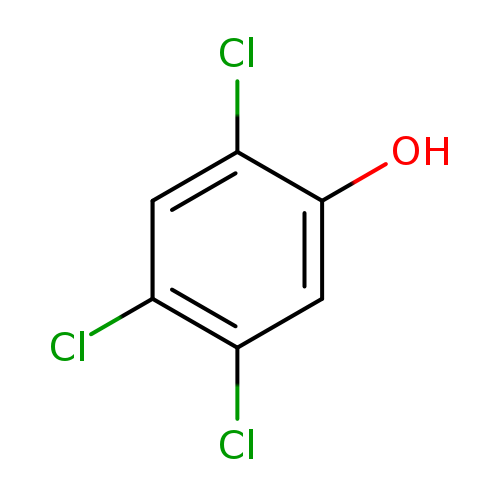
2,4,5-Trichlorophenol (CED0010847)

Record Information
Version1.0
Creation Date2009-03-06 18:58:19 UTC
Update Date2026-08-23 09:05:05 UTC
SynCED IDCED0010847
Secondary Accession Numbers
  • CHEM000194
  • T3D0222
Identification
Common Name2,4,5-Trichlorophenol
ClassSmall Molecule
Description
2,4,5-Trichlorophenol (C6H3Cl3O) is an exogenous organic compound with an average molecular weight of 197.45 g/mol. It exists as a solid at room temperature. 2,4,5-Trichlorophenol belongs to the halophenols, a subclass of phenols within the organic compounds. This benzenoid has been utilized as a fungicide, herbicide, insecticide, antiseptic, defoliant, and glue preservative, and it serves as a raw material for the production of the herbicides 2,4,5-T (2,4,5-trichlorophenoxyacetic acid) and Silvex. Biologically, the compound acts as a xenobiotic (PMC3694158 ). It is associated with six recorded protein targets, including the estrogen receptor beta (ESR2), the estrogen receptor (ESR1), cytochrome P450 4F12 (CYP4F12), nuclear receptor subfamily 1 group I member 2 (NR1I2), and hepatocyte nuclear factor 4-alpha (HNF4A). By binding to and inhibiting the estrogen receptor, the compound causes endocrine disruption in humans. Exposure to 2,4,5-trichlorophenol occurs via the oral route. It has been released from nine recorded sources, including drinking water and water supply (drinking water); food, food processing and cookware (food preservation, processing meats); household cleaning and consumer products (soap detergents, bleaching agents, perfumes within detergents and soaps); and electrical and electronic equipment (hybrid capacitors, emergency protective devices, conductors or conductive bodies characterised by the conductive materials).
Contaminant Type
  • Aromatic Hydrocarbon
  • Organic Compound
  • Organochloride
  • Pesticide
  • Pollutant
  • Synthetic Compound
Chemical Structure
Synonyms
ValueSource
2,4,5-TCPChEBI
2,4,5-Trichlorophenol, copper saltMeSH
2,4,5-Trichlorophenol, potassium saltMeSH
2,4,5-TrichlorophenolateMeSH
2,4,5-Trichlorophenol, sodium saltMeSH
Chemical FormulaC6H3Cl3O
Average Molecular Mass197.446 g/mol
Monoisotopic Mass195.925 g/mol
CAS Registry Number95-95-4
IUPAC Name2,4,5-trichlorophenol
Traditional Name2,4,5-trichlorophenol
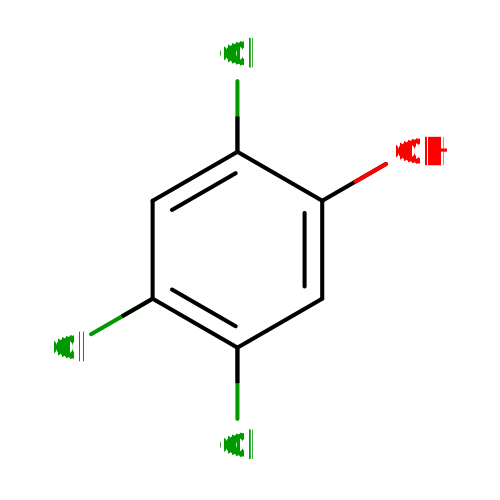
SMILESOC1=CC(Cl)=C(Cl)C=C1Cl
InChI IdentifierInChI=1S/C6H3Cl3O/c7-3-1-5(9)6(10)2-4(3)8/h1-2,10H
InChI KeyLHJGJYXLEPZJPM-UHFFFAOYSA-N
Chemical Taxonomy
Description Belongs to the class of organic compounds known as p-chlorophenols. These are chlorophenols carrying a iodine at the C4 position of the benzene ring.
KingdomOrganic compounds
Super ClassBenzenoids
ClassPhenols
Sub ClassHalophenols
Direct ParentP-chlorophenols
Alternative Parents
Substituents
  • 4-chlorophenol
  • 2-chlorophenol
  • 3-chlorophenol
  • 1-hydroxy-2-unsubstituted benzenoid
  • Halobenzene
  • Chlorobenzene
  • Monocyclic benzene moiety
  • Aryl halide
  • Aryl chloride
  • Organic oxygen compound
  • Hydrocarbon derivative
  • Organooxygen compound
  • Organochloride
  • Organohalogen compound
  • Aromatic homomonocyclic compound
Molecular FrameworkAromatic homomonocyclic compounds
External Descriptors
Biological Properties
StatusDetected and Not Quantified
OriginExogenous
Cellular Locations
  • Membrane
Biofluid LocationsNot Available
Tissue LocationsNot Available
ApplicationsNot Available
Biological Roles
Chemical RolesNot Available
Organoleptic EffectsNot Available
Physical Properties
StateSolid
AppearanceWhite powder.
Experimental Properties
PropertyValue
Melting Point69°C
Boiling PointNot Available
Solubility1.2 mg/mL at 25 °C [LEUENBERGER,C et al. (1985A)]
Predicted Properties
PropertyValueSource
Water Solubility0.48 g/LALOGPS
logP3.79ALOGPS
logP3.48ChemAxon
logS-2.6ALOGPS
pKa (Strongest Acidic)6.83ChemAxon
pKa (Strongest Basic)-7.4ChemAxon
Physiological Charge-1ChemAxon
Hydrogen Acceptor Count1ChemAxon
Hydrogen Donor Count1ChemAxon
Polar Surface Area20.23 ŲChemAxon
Rotatable Bond Count0ChemAxon
Refractivity42.45 m³·mol⁻¹ChemAxon
Polarizability16.35 ųChemAxon
Number of Rings1ChemAxon
BioavailabilityYesChemAxon
Rule of FiveYesChemAxon
Ghose FilterNoChemAxon
Veber's RuleYesChemAxon
MDDR-like RuleNoChemAxon
Spectra
Spectra
Spectrum TypeDescriptionSplash KeyDeposition DateView
GC-MSGC-MS Spectrumsplash10-0002-7900000000-1ad962df00ced72b9a73Not AvailableView Spectrum
Predicted GC-MSPredicted GC-MS Spectrumsplash10-0002-0900000000-cc8322e7ceec03d71239Not AvailableView Spectrum
LC-MS/MSLC-MS/MS Spectrumsplash10-0006-0900000000-17866a9095a4c68b6221Not AvailableView Spectrum
Predicted LC-MS/MSPredicted LC-MS/MS Spectrumsplash10-0002-0900000000-2d745e697dd9c1195f70Not AvailableView Spectrum
Predicted LC-MS/MSPredicted LC-MS/MS Spectrumsplash10-0002-0900000000-7b0e92ef3db54655fdd7Not AvailableView Spectrum
Predicted LC-MS/MSPredicted LC-MS/MS Spectrumsplash10-0002-0900000000-8df6991815fdfda9c82cNot AvailableView Spectrum
Predicted LC-MS/MSPredicted LC-MS/MS Spectrumsplash10-0006-0900000000-7d20943e8109cbd9b2c7Not AvailableView Spectrum
Predicted LC-MS/MSPredicted LC-MS/MS Spectrumsplash10-0006-0900000000-61a3b9d68e72f45b8d35Not AvailableView Spectrum
MSMS Spectrumsplash10-0002-5900000000-956600ea67d104e5c8f6Not AvailableView Spectrum
Toxicity Profile
Toxicity Values
Toxicity ValueOrganismDose DescriptorRoute of ExposurePredicted or ExperimentalToxicity RatingReference
820.0 mg/kg RatLD50OralexperimentalNot Available4
800.0 mg/kg-day MouseNOELoralexperimentalNot AvailableECOTOX - EPA ORD
800.0 mg/kg-day MouseLOELoralexperimentalNot AvailableECOTOX - EPA ORD
650.0 mg/kg-day RatNOELoralexperimentalNot AvailableECOTOX - EPA ORD
800.0 mg/kg-day MouseNOELoralexperimentalNot AvailableECOTOX - EPA ORD
800.0 mg/kg-day MouseLOELoralexperimentalNot AvailableECOTOX - EPA ORD
Toxicity / Toxin ClassNot Available
Mechanism of Toxicity2,4,5-Trichlorophenol is a cholinesterase or acetylcholinesterase (AChE) inhibitor. A cholinesterase inhibitor (or 'anticholinesterase') suppresses the action of acetylcholinesterase. Because of its essential function, chemicals that interfere with the action of acetylcholinesterase are potent neurotoxins, causing excessive salivation and eye-watering in low doses, followed by muscle spasms and ultimately death. Nerve gases and many substances used in insecticides have been shown to act by binding a serine in the active site of acetylcholine esterase, inhibiting the enzyme completely. Acetylcholine esterase breaks down the neurotransmitter acetylcholine, which is released at nerve and muscle junctions, in order to allow the muscle or organ to relax. The result of acetylcholine esterase inhibition is that acetylcholine builds up and continues to act so that any nerve impulses are continually transmitted and muscle contractions do not stop. Among the most common acetylcholinesterase inhibitors are phosphorus-based compounds, which are designed to bind to the active site of the enzyme. The structural requirements are a phosphorus atom bearing two lipophilic groups, a leaving group (such as a halide or thiocyanate), and a terminal oxygen.
Carcinogenicity (IARC Classification)2B, possibly carcinogenic to humans. (2)
Minimum Risk LevelIntermediate Oral: 0.003 mg/kg/day (1)
SymptomsInhalation of 2,4,5-trichlorophenol may cause coughing and sore throat. Eye or skin contact causes redness and pain at the site of contact. Convulsions, diarrhoea, dizziness, headache, shortness of breath, vomiting, weakness, and ataxia may occur after ingestion (3).
TreatmentIf the compound has been ingested, rapid gastric lavage should be performed using 5% sodium bicarbonate. For skin contact, the skin should be washed with soap and water. If the compound has entered the eyes, they should be washed with large quantities of isotonic saline or water. In serious cases, atropine and/or pralidoxime should be administered. Anti-cholinergic drugs work to counteract the effects of excess acetylcholine and reactivate AChE. Atropine can be used as an antidote in conjunction with pralidoxime or other pyridinium oximes (such as trimedoxime or obidoxime), though the use of '-oximes' has been found to be of no benefit, or possibly harmful, in at least two meta-analyses. Atropine is a muscarinic antagonist, and thus blocks the action of acetylcholine peripherally.
Health Effects
Health EffectRelationshipDirectionDescriptionReference
hemolysisAssociated With?Not AvailableNot AvailablePMC3649668
Exposure Sources
Source IDSourceSectorReference
CEDs000010Insecticides?Insecticides are synthetic chemicals designed to control or eliminate insect pests that threaten crops and other agricultural products.Agriculture & land managementPubChem
CEDs000115Drinking water?Drinking water can be a medium for synthetic chemical contamination, often originating from various industrial processes and agricultural practices.Drinking water & water supplyPMC3649668
CEDs000233Brushes?Brushes used in personal care and cosmetics can be a source of synthetic chemical contamination due to the materials and coatings used in their manufacturing.Personal care & cosmeticsPubChem
CEDs000511Conductors Or Conductive Bodies Characterised By The Conductive Materials?Conductors, or conductive bodies, are materials that allow the flow of electrical current, typically made from metals such as copper, aluminum, or silver.Electrical & Electronic EquipmentPubChem
CEDs000520Emergency Protective Devices?Emergency protective devices, such as circuit breakers and surge protectors, are essential components in electrical systems designed to prevent damage from overcurrent and surges.Electrical & Electronic EquipmentPubChem
CEDs000524Hybrid Capacitors?Hybrid capacitors are energy storage devices that combine the properties of electrolytic and supercapacitors, utilizing a combination of electrochemical principles to achieve higher energy density and power density.Electrical & Electronic EquipmentPubChem
CEDs000545Food Preservation?Food preservation often involves the use of synthetic chemicals, such as preservatives, flavor enhancers, and color additives, to extend shelf life and enhance the sensory qualities of food products.Food, food processing & cookwarePubChem
CEDs000552Processing Meats?Processing meats can lead to synthetic chemical contamination primarily through the use of additives and preservatives.Food, food processing & cookwarePubChem
CEDs000555Bleaching Agents?Bleaching agents are chemical substances used to whiten or lighten materials, often employed in various cleaning products for their stain removal and disinfecting properties.Household cleaning & consumer productsPubChem
CEDs000561Perfumes Within Detergents And Soaps?Perfumes within detergents and soaps are synthetic fragrance compounds added to enhance the sensory experience of cleaning products.Household cleaning & consumer productsPubChem
CEDs000563Soap Detergents?Soap detergents are synthetic surfactants designed to enhance the cleaning efficacy of water by reducing surface tension, allowing for better interaction with dirt and grease.Household cleaning & consumer productsPubChem
CEDs000579Manufacture Of Iron Or Steel?The manufacture of iron or steel involves various processes, including smelting, refining, and alloying, which can result in the release of synthetic chemicals and contaminants.Industrial manufacturing & chemical processingPubChem
CEDs000596Acaricides?Acaricides are synthetic chemicals specifically designed to target and control mite populations that can damage crops and plants.Agriculture & land managementPubChem
CEDs000597Chemosterilants?Chemosterilants are synthetic chemicals designed to induce sterility in target pest populations, thereby controlling their reproduction and mitigating damage to crops.Agriculture & land managementPubChem
CEDs000600Herbicides And Algicides?Herbicides and algicides are synthetic chemicals primarily used to control unwanted plants and algae in various environments.Agriculture & land managementPubChem
CEDs000602Molluscicides?Molluscicides are synthetic chemicals specifically designed to control and eliminate mollusks, such as snails and slugs, which can be detrimental to crops and agricultural productivity.Agriculture & land managementPubChem
CEDs000603Nematocides?Nematocides are synthetic chemicals specifically designed to control nematodes, which are microscopic roundworms that can cause significant damage to crops and plants.Agriculture & land managementPubChem
CEDs000604Pest Attractants?Pest attractants are synthetic chemicals designed to lure specific pests for monitoring or control purposes.Agriculture & land managementPubChem
CEDs000605Pest Repellants?Pest repellents, often formulated from synthetic chemicals, are widely used to protect crops from insect infestations and other pests.Agriculture & land managementPubChem
CEDs000606Plant Growth Regulators?Plant Growth Regulators (PGRs) are synthetic chemicals designed to influence the growth and development of plants.Agriculture & land managementPubChem
CEDs000607Rodenticides(1)?Rodenticides are synthetic chemicals specifically formulated to control rodent populations, serving as a crucial tool in managing pests that can damage crops and spread diseases.Agriculture & land managementPubChem
CEDs000608Rodenticides?Rodenticides are chemical substances specifically designed to control rodent populations by causing death through various mechanisms, including anticoagulation or neurotoxicity.Agriculture & land managementPubChem
CEDs000609Aftershave?Aftershave is a grooming product typically used to soothe and protect the skin following shaving.Personal care & cosmeticsPubChem
CEDs000610Aftersun Products?Aftersun products are designed to soothe and hydrate the skin after sun exposure, often containing various synthetic chemicals such as emollients, preservatives, and fragrances.Personal care & cosmeticsPubChem
CEDs000611Anti Perspirants Or Body Deoderants?Antiperspirants and body deodorants commonly contain synthetic chemicals such as aluminum compounds, parabens, and synthetic fragrances.Personal care & cosmeticsPubChem
CEDs000633Azo Dyes?Azo dyes are synthetic organic compounds characterized by the presence of one or more azo groups (-N=N-), which are widely used for coloring textiles, leather, and furnishings.Textiles, leather & furnishingsPubChem
CEDs000642Footwear?Footwear production often involves the use of various synthetic chemicals, such as adhesives, dyes, and treatments, which can contribute to environmental contamination.Textiles, leather & furnishingsPubChem
CEDs000648Nitro Dyes?Nitro dyes are synthetic colorants that contain nitro groups (-NO2) in their chemical structure.Textiles, leather & furnishingsPubChem
CEDs000650Purses Luggage Hand Bags?Purses, luggage, and handbags are often manufactured using synthetic materials such as polyvinyl chloride (PVC), polyurethane, and various types of nylon.Textiles, leather & furnishingsPubChem
CEDs000657Surface Finishing Of Leather?Surface finishing of leather often involves the use of various synthetic chemicals, including dyes, resins, and finishing agents.Textiles, leather & furnishingsPubChem
CEDs000662Yarns Or Threads?Yarns or threads used in textiles can be a source of synthetic chemical contamination due to the production processes and treatments they undergo.Textiles, leather & furnishingsPubChem
CEDs000668Non-PFAS Fire Fighting Foam?Non-PFAS fire fighting foam refers to fire suppression agents that do not contain per- and polyfluoroalkyl substances (PFAS), which are synthetic chemicals known for their water- and grease-resistant properties.Fire suppression systems & agentsPubChem
CEDs000669PFAS Fire Fighting Foam?PFAS fire fighting foam refers to a class of synthetic foams containing per- and polyfluoroalkyl substances (PFAS), which are designed to suppress flammable liquid fires.Fire suppression systems & agentsPubChem
CEDs000678Nitrogenous Fertilisers?Nitrogenous fertilizers are synthetic chemical compounds primarily used to enhance plant growth by supplying essential nitrogen, a crucial nutrient for photosynthesis and protein synthesis.Agriculture & land managementPubChem
CEDs000679Phosphatic Fertilisers?Phosphatic fertilizers are synthetic chemical products primarily composed of phosphorus, which is essential for plant growth.Agriculture & land managementPubChem
CEDs000684Cements?Cements are a composite material primarily used as a binding agent in construction applications, formed by the calcination of limestone and clay minerals at high temperatures.Building & ConstructionPubChem
CEDs000685Ceramics?Ceramics can be a source of synthetic chemical contamination through various additives and processing agents used in their production.Building & ConstructionPubChem
CEDs000686Clay Wares?Clay wares are ceramic products made from natural clay, often utilized in various construction applications such as tiles, bricks, and sanitary ware.Building & ConstructionPubChem
CEDs000696Nanotechnology?Nanotechnology involves the manipulation of materials at the molecular or atomic level, typically within the range of 1 to 100 nanometers.Industrial manufacturing & chemical processingPubChem
CEDs000730Contact Lens Cases?Contact lens cases are small containers designed to store contact lenses in a sterile environment, typically made from various synthetic materials including plastics such as polypropylene or polycarbonate.Healthcare, pharmaceuticals & veterinary productsPubChem
CEDs000738Cooling Circuit Water?Cooling circuit water is utilized in various industrial processes to absorb and dissipate heat generated during operations.Industrial manufacturing & chemical processingPubChem
CEDs000739Inks?Inks are complex mixtures composed of pigments or dyes, solvents, resins, and additives used primarily for printing and writing applications.Paper, pulp & fiber productsPubChem
CEDs000740Paper?Paper production involves the processing of wood fibers and the use of various chemicals, which can lead to synthetic chemical contamination.Paper, pulp & fiber productsPubChem
CEDs000741Pigment Pastes?Pigment pastes are concentrated dispersions of pigments used to impart color and properties to materials.Paper, pulp & fiber productsPubChem
CEDs000742Leather Tanning?Leather tanning is a process that transforms raw animal hides into durable leather through the application of various chemicals, including chromium salts, aldehydes, and vegetable tannins.Textiles, leather & furnishingsPubChem
CEDs000743Sludge Treatment?Sludge treatment involves the processing of waste materials generated from wastewater treatment plants, which often contain a variety of organic and inorganic substances.Wastewater, sanitation & biosolidsPubChem
CEDs000744Water, Wastewater, & Sewage Treatment?Water, wastewater, and sewage treatment processes are critical for managing and mitigating pollutants in water systems.Wastewater, sanitation & biosolidsPubChem
CEDs02255WaterAquatic systems & sedimentsPMC3308200
CEDs02591AtmosphereAir, dust & atmospheric transportPMC3808465
Pathways
0 pathwaysPathway Source: PathBank

No pathways found

No metabolic pathways have been associated with this synthetic chemical

Targets
StructureProteinUniProt IDOrganismRelationshipDetails
Mitogen-activated protein kinase 1 structureClick to view 3D structureMitogen-activated protein kinase 1P28482HumansPredicted (SEA)
Prediction Confidence Score
0.284
Applicability Domain
0.36
Statistical Significance
0.1322
Supporting Reference Compounds
763
E-value
1029.56
Carbonic anhydrase 2 structureClick to view 3D structureCarbonic anhydrase 2P00918HumansPredicted (SEA)
Prediction Confidence Score
0.281
Applicability Domain
0.345
Statistical Significance
0.0728
Supporting Reference Compounds
472
E-value
566.664
Vacuolar aminopeptidase 1 structureClick to view 3D structureVacuolar aminopeptidase 1P14904Saccharomyces cerevisiae S288cPredicted (SEA)
Prediction Confidence Score
0.281
Applicability Domain
0.281 Low confidence
Statistical Significance
1.70e-04
Supporting Reference Compounds
1
E-value
1.32344
Carbonic anhydrase 2 structureClick to view 3D structureCarbonic anhydrase 2Q3I4V7Cryptococcus neoformansPredicted (SEA)
Prediction Confidence Score
0.277
Applicability Domain
0.345
Statistical Significance
0.0098
Supporting Reference Compounds
60
E-value
76.5258
Carbonic anhydrase structureClick to view 3D structureCarbonic anhydraseQ5AJ71Candida albicans (strain SC5314 / ATCC MYA-2876) (Yeast)Predicted (SEA)
Prediction Confidence Score
0.277
Applicability Domain
0.345
Statistical Significance
0.012
Supporting Reference Compounds
68
E-value
93.6526
Epidermal growth factor receptor structureClick to view 3D structureEpidermal growth factor receptorP00533HumansPredicted (SEA)
Prediction Confidence Score
0.275
Applicability Domain
0.36
Statistical Significance
0.234
Supporting Reference Compounds
1301
E-value
1821.75
Alpha-2A adrenergic receptor structureClick to view 3D structureAlpha-2A adrenergic receptorP08913HumansPredicted (SEA)
Prediction Confidence Score
0.274
Applicability Domain
0.36
Statistical Significance
0.0811
Supporting Reference Compounds
487
E-value
631.046
Alpha-2C adrenergic receptor structureClick to view 3D structureAlpha-2C adrenergic receptorP18825HumansPredicted (SEA)
Prediction Confidence Score
0.274
Applicability Domain
0.36
Statistical Significance
0.0598
Supporting Reference Compounds
386
E-value
465.227
Tyrosine-protein kinase Lck structureClick to view 3D structureTyrosine-protein kinase LckP06239HumansPredicted (SEA)
Prediction Confidence Score
0.271
Applicability Domain
0.36
Statistical Significance
0.2474
Supporting Reference Compounds
1130
E-value
1925.76
Click to view 3D structureEnoyl-acyl-carrier protein reductaseQ965D5Plasmodium falciparumPredicted (SEA)
Prediction Confidence Score
0.271
Applicability Domain
0.357
Statistical Significance
0.0017
Supporting Reference Compounds
18
E-value
13.3901
5-hydroxytryptamine receptor 2B structureClick to view 3D structure5-hydroxytryptamine receptor 2BP41595HumansPredicted (SEA)
Prediction Confidence Score
0.264
Applicability Domain
0.36
Statistical Significance
0.1471
Supporting Reference Compounds
686
E-value
1145.24
Click to view 3D structureD(2) dopamine receptorP61169RatPredicted (SEA)
Prediction Confidence Score
0.262
Applicability Domain
0.275 Low confidence
Statistical Significance
0.1245
Supporting Reference Compounds
528
E-value
969.301
Click to view 3D structureD(1A) dopamine receptorP18901Rattus norvegicusPredicted (SEA)
Prediction Confidence Score
0.262
Applicability Domain
0.275 Low confidence
Statistical Significance
0.0537
Supporting Reference Compounds
206
E-value
418.206
Click to view 3D structureStreptokinase AP10520Streptococcus pyogenes serotype M1Predicted (SEA)
Prediction Confidence Score
0.262
Applicability Domain
0.36
Statistical Significance
0.0851
Supporting Reference Compounds
425
E-value
662.341
D(1A) dopamine receptor structureClick to view 3D structureD(1A) dopamine receptorP21728HumansPredicted (SEA)
Prediction Confidence Score
0.259
Applicability Domain
0.275 Low confidence
Statistical Significance
0.1087
Supporting Reference Compounds
425
E-value
846.532
Receptor tyrosine-protein kinase erbB-2 structureClick to view 3D structureReceptor tyrosine-protein kinase erbB-2P04626HumansPredicted (SEA)
Prediction Confidence Score
0.258
Applicability Domain
0.36
Statistical Significance
0.2376
Supporting Reference Compounds
674
E-value
1849.54
Estrogen receptor structureClick to view 3D structureEstrogen receptorP03372HumansPredicted (SEA)
Prediction Confidence Score
0.257
Applicability Domain
0.36
Statistical Significance
0.036
Supporting Reference Compounds
201
E-value
280.179
Carbonic anhydrase 12 structureClick to view 3D structureCarbonic anhydrase 12O43570HumansPredicted (SEA)
Prediction Confidence Score
0.255
Applicability Domain
0.29 Low confidence
Statistical Significance
0.1008
Supporting Reference Compounds
332
E-value
785.032
5-hydroxytryptamine receptor 2C structureClick to view 3D structure5-hydroxytryptamine receptor 2CP28335HumansPredicted (SEA)
Prediction Confidence Score
0.255
Applicability Domain
0.36
Statistical Significance
0.2332
Supporting Reference Compounds
823
E-value
1815.44
Click to view 3D structureCarbonic anhydrase 5B, mitochondrialQ9Y2D0HumansPredicted (SEA)
Prediction Confidence Score
0.255
Applicability Domain
0.29 Low confidence
Statistical Significance
0.0393
Supporting Reference Compounds
157
E-value
306.025
Enoyl-acyl carrier reductase structureClick to view 3D structureEnoyl-acyl carrier reductaseQ6UCJ9Toxoplasma gondiiPredicted (SEA)
Prediction Confidence Score
0.255
Applicability Domain
0.357
Statistical Significance
4.50e-04
Supporting Reference Compounds
7
E-value
3.50322
Carbonic anhydrase 9 structureClick to view 3D structureCarbonic anhydrase 9Q16790HumansPredicted (SEA)
Prediction Confidence Score
0.254
Applicability Domain
0.29 Low confidence
Statistical Significance
0.1172
Supporting Reference Compounds
372
E-value
912.471
Click to view 3D structureCarbonic anhydrase 5A, mitochondrialP35218HumansPredicted (SEA)
Prediction Confidence Score
0.254
Applicability Domain
0.29 Low confidence
Statistical Significance
0.0557
Supporting Reference Compounds
165
E-value
434.009
Carbonic anhydrase 1 structureClick to view 3D structureCarbonic anhydrase 1P00915HumansPredicted (SEA)
Prediction Confidence Score
0.253
Applicability Domain
0.29 Low confidence
Statistical Significance
0.1278
Supporting Reference Compounds
407
E-value
994.602
Carbonic anhydrase 4 structureClick to view 3D structureCarbonic anhydrase 4P22748HumansPredicted (SEA)
Prediction Confidence Score
0.253
Applicability Domain
0.29 Low confidence
Statistical Significance
0.05
Supporting Reference Compounds
193
E-value
389.635
Cytochrome P450 3A4 structureClick to view 3D structureCytochrome P450 3A4P08684HumansKnownNot Available
Estrogen receptor structureClick to view 3D structureEstrogen receptorP03372HumansKnownCauses endocrine disruption in humans by binding to and inhibiting the estrogen receptor. (A590)
Estrogen receptor beta structureClick to view 3D structureEstrogen receptor betaQ92731HumansKnownCauses endocrine disruption in humans by binding to and inhibiting the estrogen receptor. (A590)
Acetylcholinesterase structureClick to view 3D structureAcetylcholinesteraseP22303HumansKnown2,4,6-trichlorophenol (2,4,6-TCP) has been identified to hemolyze washed human erythrocytes and inhibit acetylcholinesterase (AchE) activities in the erythrocyte membrane (A116).
Click to view 3D structureCytochrome P450 4F12Q9HCS2HumansKnownNot Available
Hepatocyte nuclear factor 4-alpha structureClick to view 3D structureHepatocyte nuclear factor 4-alphaP41235HumansKnownNot Available
Nuclear receptor subfamily 1 group I member 2 structureClick to view 3D structureNuclear receptor subfamily 1 group I member 2O75469HumansKnownNot Available
Concentrations
Not Available
External Links
DrugBank IDNot Available
HMDB IDHMDB0061729
FooDB IDNot Available
Phenol Explorer IDNot Available
KNApSAcK IDNot Available
BiGG IDNot Available
BioCyc IDNot Available
METLIN IDNot Available
PDB IDNot Available
Wikipedia LinkNot Available
Chemspider IDNot Available
ChEBI ID28520
PubChem Compound ID7271
Kegg Compound IDC07101
YMDB IDNot Available
ECMDB IDNot Available
References
Synthesis ReferenceNot Available
MSDSNot Available
General References
  1. Nichkova M, Galve R, Marco MP: Biological monitoring of 2,4,5-trichlorophenol (I): preparation of antibodies and development of an immunoassay using theoretical models. Chem Res Toxicol. 2002 Nov;15(11):1360-70. [PubMed: 12437326]
  2. International Agency for Research on Cancer (2014). IARC Monographs on the Evaluation of Carcinogenic Risks to Humans. - http://monographs.iarc.fr/index.php
  3. ATSDR - Agency for Toxic Substances and Disease Registry (1999). Toxicological profile for chlorophenols. U.S. Public Health Service in collaboration with U.S. Environmental Protection Agency (EPA). - http://www.atsdr.cdc.gov/toxprofiles/tp107.html
  4. The Physical and Theoretical Chemistry Laboratory of Oxford University (2005). Material Safety Data Sheet (MSDS) for 2,4,5-trichlorophenol. - http://msds.chem.ox.ac.uk/TR/2,4,5-trichlorophenol.html
  5. Rumack BH (2009). POISINDEX(R) Information System. Englewood, CO: Micromedex, Inc. CCIS Volume 141, edition expires Aug, 2009.