Arsenic trioxide (CED0002425)

Record Information
Version1.0
Creation Date2009-03-06 18:58:19 UTC
Update Date2026-05-14 16:58:24 UTC
SynCED IDCED0002425
Secondary Accession Numbers
  • CHEM000196
  • T3D0224
Identification
Common NameArsenic trioxide
ClassSmall Molecule
Description
Arsenic trioxide is an exogenous solid with the formula As2O3 and an average molecular weight of 197.84 g/mol. Arsenic trioxide belongs to the miscellaneous metallic oxoanionic compounds, a subclass of miscellaneous mixed metal/non-metals within the inorganic compounds. It is utilized as an insecticide and an antineoplastic agent. Recorded sources of the compound include electrical and electronic equipment such as antennas, amplifiers, auxiliary devices, electric hearing aids, and gas filled discharge tubes with solid cathode; food, food processing and cookware including the preparation of vinegar and malt; household items such as key rings; household cleaning and consumer products including non electric simulated smoking devices; and healthcare, pharmaceuticals and veterinary products. The recorded route of exposure is intravenous. The compound interacts with 40 recorded protein targets. It binds to hemoglobin subunit alpha (HBA1), hemoglobin subunit beta (HBB), haptoglobin, the estrogen receptor (ESR1), the glucocorticoid receptor (NR3C1), and kelch-like ECH-associated protein 1 (KEAP1). Binding of PARP-1 is believed to induce carcinogenesis by affecting DNA repair. Arsenic trioxide binds glutathione reductase, mitochondrial (GSR), resulting in the inhibition of essential biochemical reactions, alteration of cellular redox status, and eventual cytotoxicity. Additionally, it targets pyruvate dehydrogenase E1 component subunit alpha somatic form (PDHA1), subunit beta (PDHB), and testis-specific form (PDHA2), as well as the dihydrolipoyllysine-residue acetyltransferase component of pyruvate dehydrogenase complex (DLAT). Through these targets, arsenic disrupts ATP production by inhibiting pyruvate dehydrogenase and competing with phosphate to uncouple oxidative phosphorylation, which inhibits mitochondrial respiration, ATP synthesis, and energy-linked reduction of NAD+. This process may increase hydrogen peroxide production, potentially forming oxidative stress and reactive oxygen species.
Contaminant Type
  • Antineoplastic Agent
  • Arsenic Compound
  • Drug
  • Homeopathic Agent
  • Human Neurotoxin
  • Inorganic Compound
  • Metabolite
  • Metalloid
  • Pesticide
  • Pollutant
  • Synthetic Compound
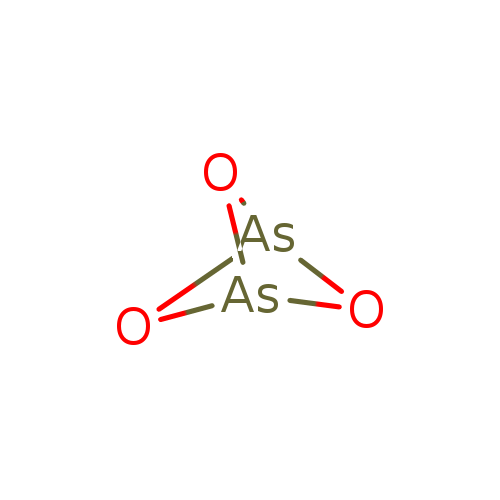
Chemical Structure
Synonyms
ValueSource
Arseni trioxydumHMDB
Arsenic oxidearsenous trioxideHMDB
Arsenious acidHMDB
Arsenious trioxideHMDB
ArsentrioxideHMDB
TrixenoxHMDB
Arsenic(III) oxideHMDB
Arsenous anhydrideHMDB
Diarsenic trioxideHMDB
NaonobinHMDB
Chemical FormulaAs2O3
Average Molecular Mass197.841 g/mol
Monoisotopic Mass197.828 g/mol
CAS Registry Number1327-53-3
IUPAC Namebicyclo[1.1.1]diarsoxane
Traditional Namearsenic trioxide
SMILESO1[As]2O[As]1O2
InChI IdentifierInChI=1S/As2O3/c3-1-4-2(3)5-1
InChI KeyGOLCXWYRSKYTSP-UHFFFAOYSA-N
Chemical Taxonomy
Description Belongs to the class of inorganic compounds known as miscellaneous arsenites. These are inorganic compounds in which the largest metallic oxoanion is arsenite, to which either no atom or a non metal atom is bonded.
KingdomInorganic compounds
Super ClassMixed metal/non-metal compounds
ClassMiscellaneous mixed metal/non-metals
Sub ClassMiscellaneous metallic oxoanionic compounds
Direct ParentMiscellaneous arsenites
Alternative Parents
Substituents
  • Arsenite
  • Trivalent inorganic arsenic compound
  • Inorganic salt
  • Inorganic metalloid salt
  • Inorganic arsenic compound
Molecular FrameworkNot Available
External DescriptorsNot Available
Biological Properties
StatusDetected and Not Quantified
OriginExogenous
Cellular Locations
  • Cytoplasm
  • Membrane
Biofluid LocationsNot Available
Tissue LocationsNot Available
Applications
Biological RolesNot Available
Chemical RolesNot Available
Organoleptic EffectsNot Available
Physical Properties
StateSolid
AppearanceWhite powder.
Experimental Properties
PropertyValue
Melting Point465°C
Boiling PointNot Available
Solubility1.7E+004 mg/L (at 16°C)
Predicted Properties
PropertyValueSource
logP2.31ChemAxon
pKa (Strongest Basic)-5.2ChemAxon
Physiological Charge0ChemAxon
Hydrogen Acceptor Count3ChemAxon
Hydrogen Donor Count0ChemAxon
Polar Surface Area27.69 ŲChemAxon
Rotatable Bond Count0ChemAxon
Refractivity4.05 m³·mol⁻¹ChemAxon
Polarizability7.14 ųChemAxon
Number of Rings2ChemAxon
BioavailabilityYesChemAxon
Rule of FiveYesChemAxon
Ghose FilterNoChemAxon
Veber's RuleYesChemAxon
MDDR-like RuleNoChemAxon
Spectra
Spectra
Spectrum TypeDescriptionSplash KeyDeposition DateView
Predicted GC-MSPredicted GC-MS Spectrumsplash10-0002-0900000000-14fe3cc303b049cb7cedNot AvailableView Spectrum
Predicted GC-MSPredicted GC-MS SpectrumNot AvailableNot AvailableView Spectrum
Predicted LC-MS/MSPredicted LC-MS/MS Spectrumsplash10-0002-0900000000-6c867befd4a45c267fb2Not AvailableView Spectrum
Predicted LC-MS/MSPredicted LC-MS/MS Spectrumsplash10-0002-0900000000-1b8349532ab21b78bc14Not AvailableView Spectrum
Predicted LC-MS/MSPredicted LC-MS/MS Spectrumsplash10-0002-0900000000-0aa3a83a61e7aa4078bcNot AvailableView Spectrum
Toxicity Profile
Toxicity Values
Toxicity ValueOrganismDose DescriptorRoute of ExposurePredicted or ExperimentalToxicity RatingReference
871.0 mg/kg RatLD50IntraperitonealexperimentalNot Available12
31500.0 ug/kg MouseLD50OralexperimentalNot Available12
9800.0 ug/kg MouseLD50SubcutaneousexperimentalNot Available12
10700.0 ug/kg MouseLD50IntravenousexperimentalNot Available12
17.75 mg/L RatLOELoralexperimentalNot AvailableECOTOX - EPA ORD
17.75 mg/L RatNOELoralexperimentalNot AvailableECOTOX - EPA ORD
Toxicity / Toxin ClassNot Available
Mechanism of ToxicityThe mechanism of action of Arsenic Trioxide is not completely understood. Arsenic trioxide causes morphological changes and DNA fragmentation characteristic of apoptosis in NB4 human promyelocytic leukemia cells in vitro. Arsenic trioxide also causes damage or degradation of the fusion protein PML/RAR-alpha. It is suspected that arsenic trioxide induces cancer cells to undergo apoptosis. Arsenic and its metabolites disrupt ATP production through several mechanisms. At the level of the citric acid cycle, arsenic inhibits pyruvate dehydrogenase and by competing with phosphate it uncouples oxidative phosphorylation, thus inhibiting energy-linked reduction of NAD+, mitochondrial respiration, and ATP synthesis. Hydrogen peroxide production is also increased, which might form reactive oxygen species and oxidative stress. Arsenic's carginogenicity is influenced by the arsenical binding of tubulin, which results in aneuploidy, polyploidy and mitotic arrests. The binding of other arsenic protein targets may also cause altered DNA repair enzyme activity, altered DNA methylation patterns and cell proliferation. (11, 3)
Carcinogenicity (IARC Classification)1, carcinogenic to humans. (9)
Minimum Risk LevelAcute Oral: 0.005 mg/kg/day (8) Chronic Oral: 0.0003 mg/kg/day (8) Chronic Inhalation: 0.01 mg/m3 (8)
SymptomsSymptoms of overdose include convulsions, muscle weakness and confusion. Exposure to lower levels of arsenic can cause nausea and vomiting, decreased production of red and white blood cells, abnormal heart rhythm, and damage to blood vessels.
TreatmentArsenic poisoning can be treated by chelation therapy, using chelating agents such as dimercaprol, EDTA or DMSA. Charcoal tablets may also be used for less severe cases. In addition, maintaining a diet high in sulfur helps eliminate arsenic from the body. (6)
Health Effects
Health EffectRelationshipDirectionDescriptionReference
Exposure Sources
Source IDSourceSectorReference
CEDs000010Insecticides?Insecticides are synthetic chemicals designed to control or eliminate insect pests that threaten crops and other agricultural products.Agriculture & land managementPubChem
CEDs000233Brushes?Brushes used in personal care and cosmetics can be a source of synthetic chemical contamination due to the materials and coatings used in their manufacturing.Personal care & cosmeticsPubChem
CEDs000358Antineoplastic agents?Antineoplastic agents are a class of synthetic chemicals used primarily in the treatment of cancer.Healthcare, pharmaceuticals & veterinary productsNot Available
CEDs000505Amplifiers?Amplifiers, commonly used in various electronic devices to enhance signal strength, can be a source of synthetic chemical contamination due to the materials and processes involved in their production and disposal.Electrical & Electronic EquipmentPubChem
CEDs000506Antennas?Antennas, commonly used in communication technologies, can be a source of synthetic chemical contamination through the materials and coatings used in their construction.Electrical & Electronic EquipmentPubChem
CEDs000507Auxiliary Devices?Auxiliary devices, such as capacitors, transformers, and circuit breakers, are integral components in various electronic systems.Electrical & Electronic EquipmentPubChem
CEDs000511Conductors Or Conductive Bodies Characterised By The Conductive Materials?Conductors, or conductive bodies, are materials that allow the flow of electrical current, typically made from metals such as copper, aluminum, or silver.Electrical & Electronic EquipmentPubChem
CEDs000514Discharge Lamps?Discharge lamps, including fluorescent and high-intensity discharge (HID) lamps, are commonly used for lighting applications due to their energy efficiency and brightness.Electrical & Electronic EquipmentPubChem
CEDs000516Electric Hearing Aids?Electric hearing aids are small electronic devices designed to amplify sound for individuals with hearing loss.Electrical & Electronic EquipmentPubChem
CEDs000517Electric Switches?Electric switches, integral components in numerous devices, can be a source of synthetic chemical contamination due to the materials and manufacturing processes involved in their production.Electrical & Electronic EquipmentPubChem
CEDs000518Electrically Stimulated Smoking Devices?Electrically stimulated smoking devices, commonly known as e-cigarettes or vape pens, utilize electrical components to heat a liquid solution, often containing nicotine, flavorings, and other additives, to produce an aerosol for inhalation.Electrical & Electronic EquipmentPubChem
CEDs000519Electrodes?Electrodes, used in various electrical and electronic applications, can be a source of synthetic chemical contamination due to the materials from which they are constructed and the processes involved in their manufacturing.Electrical & Electronic EquipmentPubChem
CEDs000521Fixed Capacitors And Their Manufacture?Fixed capacitors are passive electronic components used to store and release electrical energy, playing a critical role in various circuits.Electrical & Electronic EquipmentPubChem
CEDs000523Gas Filled Discharge Tubes With Solid Cathode?Gas Filled Discharge Tubes with Solid Cathodes are electrical components that facilitate the flow of current by ionizing gas within a sealed tube.Electrical & Electronic EquipmentPubChem
CEDs000525Line Transmission Systems?Line Transmission Systems, commonly used for the distribution of electrical energy, can be a source of synthetic chemical contamination through the insulation materials and coatings utilized in their construction.Electrical & Electronic EquipmentPubChem
CEDs000527Magnets?Magnets, commonly used in various electrical and electronic applications, can be a source of synthetic chemical contamination due to the materials used in their production.Electrical & Electronic EquipmentPubChem
CEDs000531Relays?Relays are electromechanical switches used to control circuits and manage electrical loads.Electrical & Electronic EquipmentPubChem
CEDs000537Television Systems?Television systems can be a source of synthetic chemical contamination due to the various materials and components used in their manufacture and operation.Electrical & Electronic EquipmentPubChem
CEDs000538Thin Magnetic Films?Thin magnetic films are layers of magnetic material ranging from a few nanometers to several micrometers in thickness, commonly used in applications such as magnetic sensors, data storage devices, and electronic components.Electrical & Electronic EquipmentPubChem
CEDs000545Food Preservation?Food preservation often involves the use of synthetic chemicals, such as preservatives, flavor enhancers, and color additives, to extend shelf life and enhance the sensory qualities of food products.Food, food processing & cookwarePubChem
CEDs000547Preparation Of Malt?Malt preparation involves the germination and drying of cereal grains, primarily barley, to produce malt for brewing and food products.Food, food processing & cookwarePubChem
CEDs000548Preparation Of Vinegar?Vinegar is produced through the fermentation of ethanol by acetic acid bacteria, resulting in a solution that typically contains 4-8% acetic acid.Food, food processing & cookwarePubChem
CEDs000559Non Electric Simulated Smoking Devices?Non-electric simulated smoking devices, often designed to mimic the experience of smoking without combustion, can be sources of synthetic chemical contamination due to the materials and chemicals used in their construction and operation.Household cleaning & consumer productsPubChem
CEDs000563Soap Detergents?Soap detergents are synthetic surfactants designed to enhance the cleaning efficacy of water by reducing surface tension, allowing for better interaction with dirt and grease.Household cleaning & consumer productsPubChem
CEDs000569Tobacco Smoke Filters?Tobacco smoke filters are designed to reduce the inhalation of harmful substances in cigarette smoke, including tar and other particulate matter.Household cleaning & consumer productsPubChem
CEDs000573Key Rings?Key rings are commonly made from various synthetic materials, including plastics and metals, which can be sources of chemical contamination.Household itemsPubChem
CEDs000579Manufacture Of Iron Or Steel?The manufacture of iron or steel involves various processes, including smelting, refining, and alloying, which can result in the release of synthetic chemicals and contaminants.Industrial manufacturing & chemical processingPubChem
CEDs000580Manufacture Preparation Of Tobacco Products?The manufacture and preparation of tobacco products involve various processes that can result in the introduction of synthetic chemicals into the environment.Industrial manufacturing & chemical processingPubChem
CEDs000595Ships?Ships, as vehicles for international trade and transportation, can be significant sources of synthetic chemical contamination in marine environments.Marine, shipping & aquaculturePubChem
CEDs000596Acaricides?Acaricides are synthetic chemicals specifically designed to target and control mite populations that can damage crops and plants.Agriculture & land managementPubChem
CEDs000597Chemosterilants?Chemosterilants are synthetic chemicals designed to induce sterility in target pest populations, thereby controlling their reproduction and mitigating damage to crops.Agriculture & land managementPubChem
CEDs000598Fertiliser Distributors?Fertiliser distributors play a critical role in the supply of synthetic fertilizers, which are widely used to enhance soil fertility and crop yield.Agriculture & land managementPubChem
CEDs000600Herbicides And Algicides?Herbicides and algicides are synthetic chemicals primarily used to control unwanted plants and algae in various environments.Agriculture & land managementPubChem
CEDs000602Molluscicides?Molluscicides are synthetic chemicals specifically designed to control and eliminate mollusks, such as snails and slugs, which can be detrimental to crops and agricultural productivity.Agriculture & land managementPubChem
CEDs000603Nematocides?Nematocides are synthetic chemicals specifically designed to control nematodes, which are microscopic roundworms that can cause significant damage to crops and plants.Agriculture & land managementPubChem
CEDs000604Pest Attractants?Pest attractants are synthetic chemicals designed to lure specific pests for monitoring or control purposes.Agriculture & land managementPubChem
CEDs000605Pest Repellants?Pest repellents, often formulated from synthetic chemicals, are widely used to protect crops from insect infestations and other pests.Agriculture & land managementPubChem
CEDs000606Plant Growth Regulators?Plant Growth Regulators (PGRs) are synthetic chemicals designed to influence the growth and development of plants.Agriculture & land managementPubChem
CEDs000607Rodenticides(1)?Rodenticides are synthetic chemicals specifically formulated to control rodent populations, serving as a crucial tool in managing pests that can damage crops and spread diseases.Agriculture & land managementPubChem
CEDs000608Rodenticides?Rodenticides are chemical substances specifically designed to control rodent populations by causing death through various mechanisms, including anticoagulation or neurotoxicity.Agriculture & land managementPubChem
CEDs000611Anti Perspirants Or Body Deoderants?Antiperspirants and body deodorants commonly contain synthetic chemicals such as aluminum compounds, parabens, and synthetic fragrances.Personal care & cosmeticsPubChem
CEDs000614Essential Oils Or Perfumes?Essential oils and perfumes are complex mixtures of volatile compounds derived from natural or synthetic sources, commonly used for their aromatic properties.Personal care & cosmeticsPubChem
CEDs000615Eye Makeup Products?Eye makeup products, including mascaras, eyeliners, and eyeshadows, often contain a variety of synthetic chemicals such as pigments, preservatives, and film-forming agents.Personal care & cosmeticsPubChem
CEDs000617Lip Care Products?Lip care products, including lipsticks, balms, and glosses, often contain a variety of synthetic chemicals such as parabens, phthalates, and synthetic fragrances.Personal care & cosmeticsPubChem
CEDs000618Lip Makeup Products?Lip makeup products, such as lipsticks, lip glosses, and lip liners, often contain a variety of synthetic chemicals, including pigments, preservatives, and emollients.Personal care & cosmeticsPubChem
CEDs000632Apparel?Apparel production often involves the use of various synthetic chemicals, including dyes, finishing agents, and preservatives.Textiles, leather & furnishingsPubChem
CEDs000642Footwear?Footwear production often involves the use of various synthetic chemicals, such as adhesives, dyes, and treatments, which can contribute to environmental contamination.Textiles, leather & furnishingsPubChem
CEDs000650Purses Luggage Hand Bags?Purses, luggage, and handbags are often manufactured using synthetic materials such as polyvinyl chloride (PVC), polyurethane, and various types of nylon.Textiles, leather & furnishingsPubChem
CEDs000652Ropes?Ropes manufactured from synthetic fibers, such as polypropylene, nylon, and polyester, are widely used in various applications, including marine, construction, and outdoor activities.Textiles, leather & furnishingsPubChem
CEDs000653Sewing?Sewing processes often involve the use of various synthetic chemicals, which can become sources of contamination in the environment.Textiles, leather & furnishingsPubChem
CEDs000659Transfer Printing?Transfer printing is a process used to apply designs and patterns onto various substrates, commonly utilizing synthetic dyes and inks that can contain hazardous chemicals.Textiles, leather & furnishingsPubChem
CEDs000662Yarns Or Threads?Yarns or threads used in textiles can be a source of synthetic chemical contamination due to the production processes and treatments they undergo.Textiles, leather & furnishingsPubChem
CEDs000667Gaseous Fire Fighting?Gaseous fire fighting systems utilize synthetic chemicals, such as halocarbons and inert gases, to suppress fires through chemical and physical processes.Fire suppression systems & agentsPubChem
CEDs000671Airplanes And Helicopters?Airplanes and helicopters are significant sources of synthetic chemical contamination primarily through the use of aviation fuels, lubricants, and de-icing agents.Aviation & AerospacePubChem
CEDs000673Unmanned Aerial Vehicles?Unmanned Aerial Vehicles (UAVs), commonly known as drones, utilize various synthetic chemicals in their manufacturing, operation, and maintenance processes.Aviation & AerospacePubChem
CEDs000678Nitrogenous Fertilisers?Nitrogenous fertilizers are synthetic chemical compounds primarily used to enhance plant growth by supplying essential nitrogen, a crucial nutrient for photosynthesis and protein synthesis.Agriculture & land managementPubChem
CEDs000679Phosphatic Fertilisers?Phosphatic fertilizers are synthetic chemical products primarily composed of phosphorus, which is essential for plant growth.Agriculture & land managementPubChem
CEDs000684Cements?Cements are a composite material primarily used as a binding agent in construction applications, formed by the calcination of limestone and clay minerals at high temperatures.Building & ConstructionPubChem
CEDs000685Ceramics?Ceramics can be a source of synthetic chemical contamination through various additives and processing agents used in their production.Building & ConstructionPubChem
CEDs000686Clay Wares?Clay wares are ceramic products made from natural clay, often utilized in various construction applications such as tiles, bricks, and sanitary ware.Building & ConstructionPubChem
CEDs000687Crystal Glass?Crystal glass, known for its clarity and brilliance, is often produced using lead oxide, which enhances its refractive quality.Building & ConstructionPubChem
CEDs000688Glass Coatings?Glass coatings are synthetic chemical formulations applied to glass surfaces to enhance properties such as durability, UV resistance, and aesthetic appeal.Building & ConstructionPubChem
CEDs000689Glass Fibres?Glass fibres are composed of fine strands of glass, commonly utilized for their tensile strength and lightweight properties.Building & ConstructionPubChem
CEDs000690Lime?Lime, primarily comprised of calcium oxide (CaO) or calcium hydroxide (Ca(OH)₂), is widely used in various applications, including as a key ingredient in mortars, plasters, and cement.Building & ConstructionPubChem
CEDs000691Non Oxide Glass?Non-oxide glass refers to a category of glasses primarily composed of materials other than silicon dioxide, such as boron oxide or phosphorous oxide.Building & ConstructionPubChem
CEDs000692Silica Free Oxide Glass?Silica Free Oxide Glass is a type of glass that is produced using alternative materials to traditional silica-based formulations.Building & ConstructionPubChem
CEDs000693Silica Glass?Silica glass, primarily composed of silicon dioxide (SiO2), is widely used in various applications, including windows, glass facades, and insulation materials.Building & ConstructionPubChem
CEDs000696Nanotechnology?Nanotechnology involves the manipulation of materials at the molecular or atomic level, typically within the range of 1 to 100 nanometers.Industrial manufacturing & chemical processingPubChem
CEDs000698Jewellery?Jewellery production often involves the use of various synthetic chemicals during the extraction and processing of metals.Mining & metal processingPubChem
CEDs000699Mining Or Quarrying?Mining and quarrying operations can lead to synthetic chemical contamination through the release of various pollutants associated with the extraction and processing of minerals.Mining & metal processingPubChem
CEDs000732Spectacle Cases?Spectacle cases can serve as a source of synthetic chemical contamination due to the materials used in their production, such as polycarbonate, PVC, and various plastics, which may leach harmful substances over time.Healthcare, pharmaceuticals & veterinary productsPubChem
CEDs000734Coating Compositions?Coating compositions, which include paints, sealants, and varnishes, are formulated with a variety of synthetic chemicals such as solvents, resins, pigments, and additives.Building & ConstructionPubChem
CEDs000735Explosives?Explosives are chemical compounds or mixtures designed to undergo rapid decomposition, releasing energy in the form of gas and heat.Defense & military infrastructurePubChem
CEDs000739Inks?Inks are complex mixtures composed of pigments or dyes, solvents, resins, and additives used primarily for printing and writing applications.Paper, pulp & fiber productsPubChem
CEDs000740Paper?Paper production involves the processing of wood fibers and the use of various chemicals, which can lead to synthetic chemical contamination.Paper, pulp & fiber productsPubChem
CEDs000741Pigment Pastes?Pigment pastes are concentrated dispersions of pigments used to impart color and properties to materials.Paper, pulp & fiber productsPubChem
CEDs000742Leather Tanning?Leather tanning is a process that transforms raw animal hides into durable leather through the application of various chemicals, including chromium salts, aldehydes, and vegetable tannins.Textiles, leather & furnishingsPubChem
CEDs000743Sludge Treatment?Sludge treatment involves the processing of waste materials generated from wastewater treatment plants, which often contain a variety of organic and inorganic substances.Wastewater, sanitation & biosolidsPubChem
CEDs000744Water, Wastewater, & Sewage Treatment?Water, wastewater, and sewage treatment processes are critical for managing and mitigating pollutants in water systems.Wastewater, sanitation & biosolidsPubChem
Pathways
1 pathwayPathway Source: PathBank
Targets
StructureProteinUniProt IDOrganismRelationshipDetails
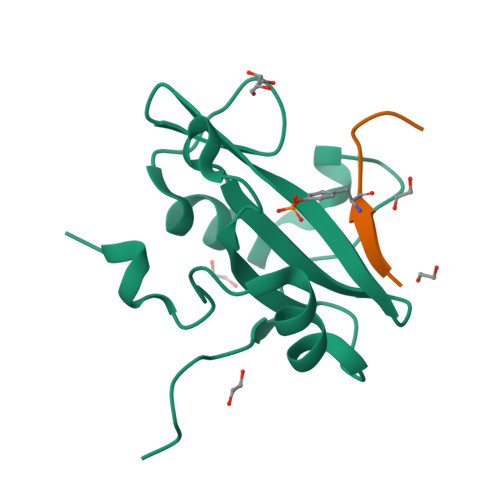
PA-I galactophilic lectin structureClick to view 3D structurePA-I galactophilic lectinQ05097Pseudomonas aeruginosa (strain ATCC 15692 / PAO1 / 1C / PRS 101 / LMG12228)Predicted (SEA)
Prediction Confidence Score
0.058
Applicability Domain
0.087 Low confidence
Statistical Significance
0.7224
Supporting Reference Compounds
4
E-value
5623.75
Click to view 3D structureSodium-dependent dopamine transporterP23977Rattus norvegicusPredicted (SEA)
Prediction Confidence Score
0.057
Applicability Domain
0.061 Low confidence
Statistical Significance
1.0
Supporting Reference Compounds
203
E-value
7784.61
Lectin structureClick to view 3D structureLectinB4EH87Burkholderia cenocepacia (strain ATCC BAA-245 / DSM 16553 / LMG 16656/ NCTC 13227 / J2315 / CF5610) (Burkholderia cepacia (strain J2315))Predicted (SEA)
Prediction Confidence Score
0.055
Applicability Domain
0.077 Low confidence
Statistical Significance
0.6683
Supporting Reference Compounds
3
E-value
5202.51
Type 1 fimbrin D-mannose specific adhesin structureClick to view 3D structureType 1 fimbrin D-mannose specific adhesinP08191Escherichia coli K-12Predicted (SEA)
Prediction Confidence Score
0.055
Applicability Domain
0.077 Low confidence
Statistical Significance
0.8284
Supporting Reference Compounds
4
E-value
6448.72
Click to view 3D structureSodium-dependent serotonin transporterP31652Rattus norvegicusPredicted (SEA)
Prediction Confidence Score
0.054
Applicability Domain
0.061 Low confidence
Statistical Significance
1.0
Supporting Reference Compounds
297
E-value
7784.61
Amine oxidase [flavin-containing] A structureClick to view 3D structureAmine oxidase [flavin-containing] AP21396Rattus norvegicusPredicted (SEA)
Prediction Confidence Score
0.052
Applicability Domain
0.069 Low confidence
Statistical Significance
1.0
Supporting Reference Compounds
66
E-value
7784.61
Click to view 3D structureAmine oxidase [flavin-containing] BP19643Rattus norvegicusPredicted (SEA)
Prediction Confidence Score
0.052
Applicability Domain
0.069 Low confidence
Statistical Significance
1.0
Supporting Reference Compounds
77
E-value
7784.61
Tyrosine-protein phosphatase non-receptor type 7 structureClick to view 3D structureTyrosine-protein phosphatase non-receptor type 7P35236HumansPredicted (SEA)
Prediction Confidence Score
0.049
Applicability Domain
0.054 Low confidence
Statistical Significance
0.9999
Supporting Reference Compounds
130
E-value
7784.53
Heat shock 70 kDa protein 1A structureClick to view 3D structureHeat shock 70 kDa protein 1AP0DMV8HumansPredicted (SEA)
Prediction Confidence Score
0.049
Applicability Domain
0.054 Low confidence
Statistical Significance
0.9997
Supporting Reference Compounds
19
E-value
7782.98
Anthrax toxin receptor 2 structureClick to view 3D structureAnthrax toxin receptor 2P58335HumansPredicted (SEA)
Prediction Confidence Score
0.048
Applicability Domain
0.049 Low confidence
Statistical Significance
0.9727
Supporting Reference Compounds
3
E-value
7572.32
Amine oxidase [flavin-containing] A structureClick to view 3D structureAmine oxidase [flavin-containing] AP21397HumansPredicted (SEA)
Prediction Confidence Score
0.048
Applicability Domain
0.063 Low confidence
Statistical Significance
1.0
Supporting Reference Compounds
241
E-value
7784.61
Click to view 3D structureSphingosine-1-phosphate transporter SPNS2Q91VM4Mus musculusPredicted (SEA)
Prediction Confidence Score
0.048
Applicability Domain
0.048 Low confidence
Statistical Significance
0.9756
Supporting Reference Compounds
1
E-value
7595.36
Acetylcholinesterase structureClick to view 3D structureAcetylcholinesteraseP22303HumansPredicted (SEA)
Prediction Confidence Score
0.046
Applicability Domain
0.051 Low confidence
Statistical Significance
1.0
Supporting Reference Compounds
406
E-value
7784.69
Protein Tat structureClick to view 3D structureProtein TatP04608Human immunodeficiency virus type 1 group M subtype B (isolate HXB2)(HIV-1)Predicted (SEA)
Prediction Confidence Score
0.046
Applicability Domain
0.049 Low confidence
Statistical Significance
1.0
Supporting Reference Compounds
108
E-value
7784.69
Endopolygalactyuronase structureClick to view 3D structureEndopolygalactyuronaseP79074Chondrostereum purpureumPredicted (SEA)
Prediction Confidence Score
0.045
Applicability Domain
0.045 Low confidence
Statistical Significance
0.7113
Supporting Reference Compounds
1
E-value
5537.65
Sodium-dependent serotonin transporter structureClick to view 3D structureSodium-dependent serotonin transporterP31645HumansPredicted (SEA)
Prediction Confidence Score
0.045
Applicability Domain
0.061 Low confidence
Statistical Significance
1.0
Supporting Reference Compounds
593
E-value
7784.69
Amine oxidase [flavin-containing] B structureClick to view 3D structureAmine oxidase [flavin-containing] BP27338HumansPredicted (SEA)
Prediction Confidence Score
0.045
Applicability Domain
0.051 Low confidence
Statistical Significance
1.0
Supporting Reference Compounds
315
E-value
7784.69
5-hydroxytryptamine receptor 2A structureClick to view 3D structure5-hydroxytryptamine receptor 2AP14842Rattus norvegicusPredicted (SEA)
Prediction Confidence Score
0.045
Applicability Domain
0.061 Low confidence
Statistical Significance
1.0
Supporting Reference Compounds
380
E-value
7784.61
Sodium-dependent dopamine transporter structureClick to view 3D structureSodium-dependent dopamine transporterQ01959HumansPredicted (SEA)
Prediction Confidence Score
0.045
Applicability Domain
0.061 Low confidence
Statistical Significance
1.0
Supporting Reference Compounds
506
E-value
7784.61
Click to view 3D structureNS3A3EZJ3Hepatitis C virusPredicted (SEA)
Prediction Confidence Score
0.045
Applicability Domain
0.049 Low confidence
Statistical Significance
0.9999
Supporting Reference Compounds
70
E-value
7784.53
Aldehyde dehydrogenase, mitochondrial structureClick to view 3D structureAldehyde dehydrogenase, mitochondrialP05091HumansPredicted (SEA)
Prediction Confidence Score
0.044
Applicability Domain
0.074 Low confidence
Statistical Significance
0.9999
Supporting Reference Compounds
24
E-value
7784.38
Sodium-dependent noradrenaline transporter structureClick to view 3D structureSodium-dependent noradrenaline transporterP23975HumansPredicted (SEA)
Prediction Confidence Score
0.044
Applicability Domain
0.061 Low confidence
Statistical Significance
1.0
Supporting Reference Compounds
451
E-value
7784.69
Carbonic anhydrase 12 structureClick to view 3D structureCarbonic anhydrase 12O43570HumansPredicted (SEA)
Prediction Confidence Score
0.044
Applicability Domain
0.05 Low confidence
Statistical Significance
1.0
Supporting Reference Compounds
332
E-value
7784.69
Dipeptidyl peptidase 1 structureClick to view 3D structureDipeptidyl peptidase 1P53634HumansPredicted (SEA)
Prediction Confidence Score
0.044
Applicability Domain
0.049 Low confidence
Statistical Significance
1.0
Supporting Reference Compounds
44
E-value
7784.61
Phosphatidylinositol 4,5-bisphosphate 3-kinase catalytic subunit alpha isoform structureClick to view 3D structurePhosphatidylinositol 4,5-bisphosphate 3-kinase catalytic subunit alpha isoformP42336HumansPredicted (SEA)
Prediction Confidence Score
0.044
Applicability Domain
0.048 Low confidence
Statistical Significance
1.0
Supporting Reference Compounds
536
E-value
7784.69
G1/S-specific cyclin-D1 structureClick to view 3D structureG1/S-specific cyclin-D1P24385HumansKnownNot Available
Mitogen-activated protein kinase 3 structureClick to view 3D structureMitogen-activated protein kinase 3P27361HumansKnownNot Available
RAC-alpha serine/threonine-protein kinase structureClick to view 3D structureRAC-alpha serine/threonine-protein kinaseP31749HumansKnownNot Available
Transcription factor Jun structureClick to view 3D structureTranscription factor JunP05412HumansKnownNot Available
Inhibitor of nuclear factor kappa-B kinase subunit beta structureClick to view 3D structureInhibitor of nuclear factor kappa-B kinase subunit betaO14920HumansKnownNot Available
Mitogen-activated protein kinase 1 structureClick to view 3D structureMitogen-activated protein kinase 1P28482HumansKnownNot Available
Actin, alpha skeletal muscle structureClick to view 3D structureActin, alpha skeletal muscleP68133HumansKnownArsenic binds to actin. (A16)
Click to view 3D structureActin, aortic smooth muscleP62736HumansKnownArsenic binds to actin. (A16)
Actin, cytoplasmic 1 structureClick to view 3D structureActin, cytoplasmic 1P60709HumansKnownArsenic binds to actin. (A16)
Actin, cytoplasmic 2 structureClick to view 3D structureActin, cytoplasmic 2P63261HumansKnownArsenic binds to actin. (A16)
Dihydrolipoyllysine-residue acetyltransferase component of pyruvate dehydrogenase complex, mitochondrial structureClick to view 3D structureDihydrolipoyllysine-residue acetyltransferase component of pyruvate dehydrogenase complex, mitochondrialP10515HumansKnownArsenic disrupts ATP production through several mechanisms. At the level of the citric acid cycle, arsenic inhibits pyruvate dehydrogenase and by competing with phosphate it uncouples oxidative phosphorylation, thus inhibiting energy-linked reduction of NAD+, mitochondrial respiration, and ATP synthesis. Hydrogen peroxide production is also increased, which might form reactive oxygen species and oxidative stress. (T1)
Estrogen receptor structureClick to view 3D structureEstrogen receptorP03372HumansKnownArsenic binds to the estrogen receptor. (A17)
Glucocorticoid receptor structureClick to view 3D structureGlucocorticoid receptorP04150HumansKnownArsenic binds to the glucocorticoid receptor. (A17)
Glutathione reductase, mitochondrial structureClick to view 3D structureGlutathione reductase, mitochondrialP00390HumansKnownArsenic binds glutathione reductase, which results in the inhibition of essential biochemical reactions, alteration of cellular redox status, and eventual cytotoxicity. (L2)
Hemoglobin subunit alpha structureClick to view 3D structureHemoglobin subunit alphaP69905HumansKnownArsenic binds to hemoglobin. (A15)
Hemoglobin subunit beta structureClick to view 3D structureHemoglobin subunit betaP68871HumansKnownArsenic binds to hemoglobin. (A15)
Kelch-like ECH-associated protein 1 structureClick to view 3D structureKelch-like ECH-associated protein 1Q14145HumansKnownArsenic binds to kelch-like ECH-associated protein 1. (A17)
Poly [ADP-ribose] polymerase 1 structureClick to view 3D structurePoly [ADP-ribose] polymerase 1P09874HumansKnownArsenic binding of PARP-1 is believed to induce carcinogenesis by affecting DNA repair. (A17)
Protein PML structureClick to view 3D structureProtein PMLP29590HumansKnownNot Available
Click to view 3D structureTubulin-like protein alpha-4BQ9H853HumansKnownArsenic's carginogenicity is believed to be caused by the arsenical binding of tubulin, which results in aneuploidy, polyploidy and mitotic arrests. (A17)
Pyruvate dehydrogenase E1 component subunit alpha, somatic form, mitochondrial structureClick to view 3D structurePyruvate dehydrogenase E1 component subunit alpha, somatic form, mitochondrialP08559HumansKnownArsenic disrupts ATP production through several mechanisms. At the level of the citric acid cycle, arsenic inhibits pyruvate dehydrogenase and by competing with phosphate it uncouples oxidative phosphorylation, thus inhibiting energy-linked reduction of NAD+, mitochondrial respiration, and ATP synthesis. Hydrogen peroxide production is also increased, which might form reactive oxygen species and oxidative stress. (T1)
Click to view 3D structurePyruvate dehydrogenase E1 component subunit alpha, testis-specific form, mitochondrialP29803HumansKnownArsenic disrupts ATP production through several mechanisms. At the level of the citric acid cycle, arsenic inhibits pyruvate dehydrogenase and by competing with phosphate it uncouples oxidative phosphorylation, thus inhibiting energy-linked reduction of NAD+, mitochondrial respiration, and ATP synthesis. Hydrogen peroxide production is also increased, which might form reactive oxygen species and oxidative stress. (T1)
Pyruvate dehydrogenase E1 component subunit beta, mitochondrial structureClick to view 3D structurePyruvate dehydrogenase E1 component subunit beta, mitochondrialP11177HumansKnownArsenic disrupts ATP production through several mechanisms. At the level of the citric acid cycle, arsenic inhibits pyruvate dehydrogenase and by competing with phosphate it uncouples oxidative phosphorylation, thus inhibiting energy-linked reduction of NAD+, mitochondrial respiration, and ATP synthesis. Hydrogen peroxide production is also increased, which might form reactive oxygen species and oxidative stress. (T1)
Thioredoxin reductase 1, cytoplasmic structureClick to view 3D structureThioredoxin reductase 1, cytoplasmicQ16881HumansKnownArsenic binds thioredoxin reductase, which results in the inhibition of essential biochemical reactions, alteration of cellular redox status, and eventual cytotoxicity. (L2)
Click to view 3D structureThioredoxin reductase 2, mitochondrialQ9NNW7HumansKnownArsenic binds thioredoxin reductase, which results in the inhibition of essential biochemical reactions, alteration of cellular redox status, and eventual cytotoxicity. (L2)
Tubulin alpha-1A chain structureClick to view 3D structureTubulin alpha-1A chainQ71U36HumansKnownArsenic's carginogenicity is believed to be caused by the arsenical binding of tubulin, which results in aneuploidy, polyploidy and mitotic arrests. (A17)
Tubulin alpha-1B chain structureClick to view 3D structureTubulin alpha-1B chainP68363HumansKnownArsenic's carginogenicity is believed to be caused by the arsenical binding of tubulin, which results in aneuploidy, polyploidy and mitotic arrests. (A17)
Click to view 3D structureTubulin alpha-1C chainQ9BQE3HumansKnownArsenic's carginogenicity is believed to be caused by the arsenical binding of tubulin, which results in aneuploidy, polyploidy and mitotic arrests. (A17)
Click to view 3D structureTubulin alpha-3E chainQ6PEY2HumansKnownArsenic's carginogenicity is believed to be caused by the arsenical binding of tubulin, which results in aneuploidy, polyploidy and mitotic arrests. (A17)
Click to view 3D structureTubulin alpha-4A chainP68366HumansKnownArsenic's carginogenicity is believed to be caused by the arsenical binding of tubulin, which results in aneuploidy, polyploidy and mitotic arrests. (A17)
Click to view 3D structureTubulin alpha-8 chainQ9NY65HumansKnownArsenic's carginogenicity is believed to be caused by the arsenical binding of tubulin, which results in aneuploidy, polyploidy and mitotic arrests. (A17)
Tubulin beta chain structureClick to view 3D structureTubulin beta chainP07437HumansKnownArsenic's carginogenicity is believed to be caused by the arsenical binding of tubulin, which results in aneuploidy, polyploidy and mitotic arrests. (A17)
Click to view 3D structureTubulin beta-1 chainQ9H4B7HumansKnownArsenic's carginogenicity is believed to be caused by the arsenical binding of tubulin, which results in aneuploidy, polyploidy and mitotic arrests. (A17)
Tubulin beta-2A chain structureClick to view 3D structureTubulin beta-2A chainQ13885HumansKnownArsenic's carginogenicity is believed to be caused by the arsenical binding of tubulin, which results in aneuploidy, polyploidy and mitotic arrests. (A17)
Tubulin beta-2B chain structureClick to view 3D structureTubulin beta-2B chainQ9BVA1HumansKnownArsenic's carginogenicity is believed to be caused by the arsenical binding of tubulin, which results in aneuploidy, polyploidy and mitotic arrests. (A17)
Tubulin beta-3 chain structureClick to view 3D structureTubulin beta-3 chainQ13509HumansKnownArsenic's carginogenicity is believed to be caused by the arsenical binding of tubulin, which results in aneuploidy, polyploidy and mitotic arrests. (A17)
Click to view 3D structureTubulin beta-4A chainP04350HumansKnownArsenic's carginogenicity is believed to be caused by the arsenical binding of tubulin, which results in aneuploidy, polyploidy and mitotic arrests. (A17)
Tubulin beta-4B chain structureClick to view 3D structureTubulin beta-4B chainP68371HumansKnownArsenic's carginogenicity is believed to be caused by the arsenical binding of tubulin, which results in aneuploidy, polyploidy and mitotic arrests. (A17)
Click to view 3D structureTubulin beta-6 chainQ9BUF5HumansKnownArsenic's carginogenicity is believed to be caused by the arsenical binding of tubulin, which results in aneuploidy, polyploidy and mitotic arrests. (A17)
Concentrations
Not Available
External Links
DrugBank IDNot Available
HMDB IDHMDB0015300
FooDB IDNot Available
Phenol Explorer IDNot Available
KNApSAcK IDNot Available
BiGG IDNot Available
BioCyc IDNot Available
METLIN IDNot Available
PDB IDNot Available
Wikipedia LinkArsenic trioxide
Chemspider ID452539
ChEBI IDNot Available
PubChem Compound ID518740
Kegg Compound IDNot Available
YMDB IDNot Available
ECMDB IDNot Available
References
Synthesis ReferenceNot Available
MSDSLink
General References
  1. Naranmandura H, Suzuki KT: Identification of the major arsenic-binding protein in rat plasma as the ternary dimethylarsinous-hemoglobin-haptoglobin complex. Chem Res Toxicol. 2008 Mar;21(3):678-85. doi: 10.1021/tx700383g. Epub 2008 Feb 2. [PubMed: 18247522]
  2. Menzel DB, Hamadeh HK, Lee E, Meacher DM, Said V, Rasmussen RE, Greene H, Roth RN: Arsenic binding proteins from human lymphoblastoid cells. Toxicol Lett. 1999 Mar 29;105(2):89-101. [PubMed: 10221271]
  3. Kitchin KT, Wallace K: The role of protein binding of trivalent arsenicals in arsenic carcinogenesis and toxicity. J Inorg Biochem. 2008 Mar;102(3):532-9. doi: 10.1016/j.jinorgbio.2007.10.021. Epub 2007 Nov 22. [PubMed: 18164070]
  4. Lu J, Chew EH, Holmgren A: Targeting thioredoxin reductase is a basis for cancer therapy by arsenic trioxide. Proc Natl Acad Sci U S A. 2007 Jul 24;104(30):12288-93. Epub 2007 Jul 18. [PubMed: 17640917]
  5. ATSDR - Agency for Toxic Substances and Disease Registry (2007). Toxicological profile for arsenic. U.S. Public Health Service in collaboration with U.S. Environmental Protection Agency (EPA). - http://www.atsdr.cdc.gov/toxprofiles/tp2.html
  6. Wikipedia. Arsenic toxicity. Last Updated 22 February 2009. - http://en.wikipedia.org/wiki/Arsenic_toxicity
  7. Wikipedia. Metallothionein. Last Updated 20 December 2008. - http://en.wikipedia.org/wiki/Metallothionein
  8. ATSDR - Agency for Toxic Substances and Disease Registry (2001). Minimal Risk Levels (MRLs) for Hazardous Substances. U.S. Public Health Service in collaboration with U.S. Environmental Protection Agency (EPA). - http://www.atsdr.cdc.gov/mrls/
  9. International Agency for Research on Cancer (2014). IARC Monographs on the Evaluation of Carcinogenic Risks to Humans. - http://monographs.iarc.fr/index.php
  10. Wikipedia. Arsenic trioxide. Last Updated 21 May 2009. - http://en.wikipedia.org/wiki/Arsenic_trioxide
  11. Klaassen C and Watkins J (2003). Casarett and Doull's Essentials of Toxicology. New York, NY: McGraw-Hill.
  12. Lewis RJ (1996). Sax's Dangerous Properties of Industrial Materials. 9th ed. Volumes 1-3. New York, NY: Van Nostrand Reinhold.
  13. Baselt RC (2000). Disposition of Toxic Drugs and Chemicals in Man, 5th ed. Foster City, CA: Chemical Toxicology Institute.