Zinc molybdate (CED0003885)

Record Information
Version1.0
Creation Date2009-03-27 01:04:28 UTC
Update Date2026-04-06 07:29:44 UTC
SynCED IDCED0003885
Secondary Accession Numbers
  • CHEM000661
  • T3D0734
Identification
Common NameZinc molybdate
ClassSmall Molecule
Description
Zinc molybdate is an exogenous inorganic compound with the formula H6MoO4Zn and an average molecular weight of 231.39 g/mol. It is a solid at room temperature and is classified as a mixed metal/non-metal compound. Zinc molybdate belongs to the transition metal hydroxides, a subclass of transition metal oxoanionic compounds within the inorganic compounds. The compound is used as a corrosion inhibitor in paints and adhesives. It is also used in various plastics, including polypropylene, polyamide, polyvinyl chloride, high-density polyethylene, and low-density polyethylene. Zinc molybdate is recorded as being found in or released from fencing in building and construction, as well as electrical and electronic equipment such as cores yokes or armatures, communication cables or conductors, and antennas. Due to its insolubility in water, zinc molybdate is essentially non-toxic, offering a lower toxicity alternative to lead salts or chromates for corrosion inhibition. One common synthesis method involves mixing aqueous solutions of zinc chloride and sodium molybdate to crystallize the insoluble compound, while an alternative method involves heating a mixture of zinc oxide powder and solid molybdenum trioxide powder above 600°C. Regarding biological interactions, the compound's protein target is superoxide dismutase [Cu-Zn] (SOD1); unbalanced levels of zinc and copper binding to this enzyme have been linked to amyotrophic lateral sclerosis (ALS).
Contaminant Type
  • Industrial/Workplace Toxin
  • Inorganic Compound
  • Synthetic Compound
  • Zinc Compound
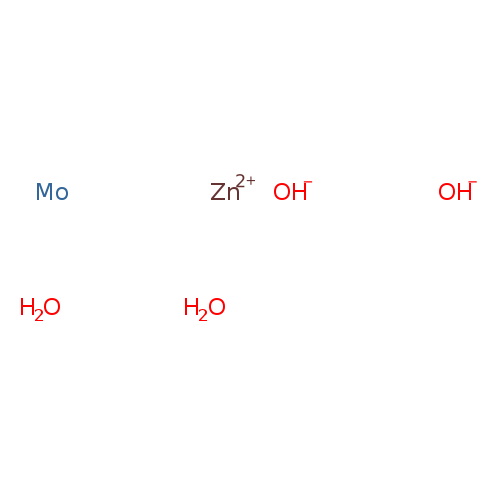
Chemical Structure
Synonyms
ValueSource
Zinc molybdic acidGenerator
Chemical FormulaH6MoO4Zn
Average Molecular Mass231.390 g/mol
Monoisotopic Mass231.861 g/mol
CAS Registry Number13767-32-3
IUPAC Namezinc(2+) ion dihydrate molybdenum dihydroxide
Traditional Namezinc(2+) ion dihydrate molybdenum dihydroxide
SMILESO.O.[OH-].[OH-].[Zn++].[Mo]
InChI IdentifierInChI=1S/Mo.4H2O.Zn/h;4*1H2;/q;;;;;+2/p-2
InChI KeyDCMCZXKWIFCESR-UHFFFAOYSA-L
Chemical Taxonomy
Description Belongs to the class of inorganic compounds known as transition metal hydroxides. These are inorganic compounds in which the largest oxoanion is hydroxide, and in which the heaviest atom not in an oxoanion is a transition metal.
KingdomInorganic compounds
Super ClassMixed metal/non-metal compounds
ClassTransition metal oxoanionic compounds
Sub ClassTransition metal hydroxides
Direct ParentTransition metal hydroxides
Alternative Parents
Substituents
  • Transition metal hydroxide
  • Inorganic hydride
  • Inorganic oxide
  • Inorganic salt
Molecular FrameworkNot Available
External DescriptorsNot Available
Biological Properties
StatusDetected and Not Quantified
OriginExogenous
Cellular Locations
  • Cell surface
  • Cytoplasm
  • Cytosol
  • Extracellular
  • Mitochondrion
  • Plasma Membrane
  • Secretory vesicle
Biofluid LocationsNot Available
Tissue LocationsNot Available
ApplicationsNot Available
Biological RolesNot Available
Chemical RolesNot Available
Organoleptic EffectsNot Available
Physical Properties
StateSolid
AppearanceWhite crystals.
Experimental Properties
PropertyValue
Melting PointNot Available
Boiling PointNot Available
SolubilityNot Available
Predicted Properties
PropertyValueSource
logP0ChemAxon
Physiological Charge0ChemAxon
Hydrogen Acceptor Count0ChemAxon
Hydrogen Donor Count0ChemAxon
Polar Surface Area0 ŲChemAxon
Rotatable Bond Count0ChemAxon
Refractivity0 m³·mol⁻¹ChemAxon
Polarizability1.78 ųChemAxon
Number of Rings0ChemAxon
BioavailabilityYesChemAxon
Rule of FiveYesChemAxon
Ghose FilterNoChemAxon
Veber's RuleYesChemAxon
MDDR-like RuleNoChemAxon
Spectra
Spectra
Spectrum TypeDescriptionSplash KeyDeposition DateView
Predicted LC-MS/MSPredicted LC-MS/MS Spectrumsplash10-001i-0090000000-a5dc86b8b29870e33f99Not AvailableView Spectrum
Predicted LC-MS/MSPredicted LC-MS/MS Spectrumsplash10-001i-0090000000-8a4440943706315c8c28Not AvailableView Spectrum
Toxicity Profile
Toxicity ValuesNot Available
Toxicity / Toxin ClassNot Available
Mechanism of ToxicityAnaemia results from the excessive absorption of zinc suppressing copper and iron absorption, most likely through competitive binding of intestinal mucosal cells. Unbalanced levels of copper and zinc binding to Cu,Zn-superoxide dismutase has been linked to amyotrophic lateral sclerosis (ALS). Stomach acid dissolves metallic zinc to give corrosive zinc chloride, which can cause damage to the stomach lining. Metal fume fever is thought to be an immune response to inhaled zinc. (2, 3, 1)
Carcinogenicity (IARC Classification)No indication of carcinogenicity to humans (not listed by IARC).
Minimum Risk LevelIntermediate Oral: 0.3 mg/kg/day (6) Chronic Oral: 0.3 mg/kg/day (6)
SymptomsIngestion of large doses of zinc causes stomach cramps, nausea, and vomiting. Acute inhalation of large amounts of zinc causes metal fume fever, which is characterized by chills, fever, headache, weakness, dryness of the nose and throat, chest pain, and coughing. Dermal contact with zinc results in skin irritation. (3)
TreatmentZinc poisoning is treated symptomatically, often by administering fluids such as water or milk, or with gastric lavage. (3)
Health Effects
Health EffectRelationshipDirectionDescriptionReference
Exposure Sources
Source IDSourceSectorReference
CEDs000070Stormwater runoff?Stormwater runoff refers to the flow of rainwater or melted snow that does not soak into the ground and instead collects pollutants as it travels over impervious surfaces such as roads and parking lots.Automotive & urban infrastructurePubChem
CEDs000496Fencing?Fencing materials, particularly those used in construction and landscaping, can be a source of synthetic chemical contamination due to the treatments and coatings applied for durability and weather resistance.Building & ConstructionPubChem
CEDs000506Antennas?Antennas, commonly used in communication technologies, can be a source of synthetic chemical contamination through the materials and coatings used in their construction.Electrical & Electronic EquipmentPubChem
CEDs000510Communication Cables Or Conductors?Communication cables or conductors are essential components in the transmission of data and signals in various applications, including telecommunications and networking.Electrical & Electronic EquipmentPubChem
CEDs000511Conductors Or Conductive Bodies Characterised By The Conductive Materials?Conductors, or conductive bodies, are materials that allow the flow of electrical current, typically made from metals such as copper, aluminum, or silver.Electrical & Electronic EquipmentPubChem
CEDs000513Cores Yokes Or Armatures?Cores, yokes, or armatures are components commonly found in electrical devices, used to facilitate the magnetic and electrical functions within motors, transformers, and generators.Electrical & Electronic EquipmentPubChem
CEDs000517Electric Switches?Electric switches, integral components in numerous devices, can be a source of synthetic chemical contamination due to the materials and manufacturing processes involved in their production.Electrical & Electronic EquipmentPubChem
CEDs000519Electrodes?Electrodes, used in various electrical and electronic applications, can be a source of synthetic chemical contamination due to the materials from which they are constructed and the processes involved in their manufacturing.Electrical & Electronic EquipmentPubChem
CEDs000524Hybrid Capacitors?Hybrid capacitors are energy storage devices that combine the properties of electrolytic and supercapacitors, utilizing a combination of electrochemical principles to achieve higher energy density and power density.Electrical & Electronic EquipmentPubChem
CEDs000527Magnets?Magnets, commonly used in various electrical and electronic applications, can be a source of synthetic chemical contamination due to the materials used in their production.Electrical & Electronic EquipmentPubChem
CEDs000529Power Cables?Power cables are used to transmit electrical energy and are typically composed of conductive materials, insulation, and protective coatings.Electrical & Electronic EquipmentPubChem
CEDs000530Radio Transmission Systems?Radio transmission systems utilize a variety of synthetic chemicals in their manufacturing and maintenance processes.Electrical & Electronic EquipmentPubChem
CEDs000545Food Preservation?Food preservation often involves the use of synthetic chemicals, such as preservatives, flavor enhancers, and color additives, to extend shelf life and enhance the sensory qualities of food products.Food, food processing & cookwarePubChem
CEDs000580Manufacture Preparation Of Tobacco Products?The manufacture and preparation of tobacco products involve various processes that can result in the introduction of synthetic chemicals into the environment.Industrial manufacturing & chemical processingPubChem
CEDs000582Aircraft Carriers?Aircraft carriers are large naval vessels that serve as floating airbases, equipped with various systems that utilize synthetic chemicals.Marine, shipping & aquaculturePubChem
CEDs000592Marine Propulsion Or Steering?Marine propulsion and steering systems often rely on various synthetic chemicals, including lubricants, fuels, and hydraulic fluids.Marine, shipping & aquaculturePubChem
CEDs000600Herbicides And Algicides?Herbicides and algicides are synthetic chemicals primarily used to control unwanted plants and algae in various environments.Agriculture & land managementPubChem
CEDs000606Plant Growth Regulators?Plant Growth Regulators (PGRs) are synthetic chemicals designed to influence the growth and development of plants.Agriculture & land managementPubChem
CEDs000611Anti Perspirants Or Body Deoderants?Antiperspirants and body deodorants commonly contain synthetic chemicals such as aluminum compounds, parabens, and synthetic fragrances.Personal care & cosmeticsPubChem
CEDs000650Purses Luggage Hand Bags?Purses, luggage, and handbags are often manufactured using synthetic materials such as polyvinyl chloride (PVC), polyurethane, and various types of nylon.Textiles, leather & furnishingsPubChem
CEDs000652Ropes?Ropes manufactured from synthetic fibers, such as polypropylene, nylon, and polyester, are widely used in various applications, including marine, construction, and outdoor activities.Textiles, leather & furnishingsPubChem
CEDs000661Umbrellas?Umbrellas are commonly manufactured using synthetic materials such as polyester, nylon, and polyvinyl chloride (PVC), which can contribute to synthetic chemical contamination.Textiles, leather & furnishingsPubChem
CEDs000662Yarns Or Threads?Yarns or threads used in textiles can be a source of synthetic chemical contamination due to the production processes and treatments they undergo.Textiles, leather & furnishingsPubChem
CEDs000664Fire Fighting Gels?Fire fighting gels are synthetic chemical formulations designed to enhance fire suppression effectiveness by creating a protective barrier against heat and flames.Fire suppression systems & agentsPubChem
CEDs000665Fire Extinguishers?Fire extinguishers contain various synthetic chemicals designed to suppress flames and prevent the spread of fire.Fire suppression systems & agentsPubChem
CEDs000670Solid Fire Fighting Substances?Solid fire fighting substances, such as certain types of dry chemical powders, are used in fire suppression applications to extinguish flames and prevent fire spread.Fire suppression systems & agentsPubChem
CEDs000678Nitrogenous Fertilisers?Nitrogenous fertilizers are synthetic chemical compounds primarily used to enhance plant growth by supplying essential nitrogen, a crucial nutrient for photosynthesis and protein synthesis.Agriculture & land managementPubChem
CEDs000679Phosphatic Fertilisers?Phosphatic fertilizers are synthetic chemical products primarily composed of phosphorus, which is essential for plant growth.Agriculture & land managementPubChem
CEDs000684Cements?Cements are a composite material primarily used as a binding agent in construction applications, formed by the calcination of limestone and clay minerals at high temperatures.Building & ConstructionPubChem
CEDs000685Ceramics?Ceramics can be a source of synthetic chemical contamination through various additives and processing agents used in their production.Building & ConstructionPubChem
CEDs000686Clay Wares?Clay wares are ceramic products made from natural clay, often utilized in various construction applications such as tiles, bricks, and sanitary ware.Building & ConstructionPubChem
CEDs000688Glass Coatings?Glass coatings are synthetic chemical formulations applied to glass surfaces to enhance properties such as durability, UV resistance, and aesthetic appeal.Building & ConstructionPubChem
CEDs000689Glass Fibres?Glass fibres are composed of fine strands of glass, commonly utilized for their tensile strength and lightweight properties.Building & ConstructionPubChem
CEDs000692Silica Free Oxide Glass?Silica Free Oxide Glass is a type of glass that is produced using alternative materials to traditional silica-based formulations.Building & ConstructionPubChem
CEDs000693Silica Glass?Silica glass, primarily composed of silicon dioxide (SiO2), is widely used in various applications, including windows, glass facades, and insulation materials.Building & ConstructionPubChem
CEDs000696Nanotechnology?Nanotechnology involves the manipulation of materials at the molecular or atomic level, typically within the range of 1 to 100 nanometers.Industrial manufacturing & chemical processingPubChem
CEDs000716Erasers?Erasers, commonly used in writing and drawing applications, are often made from synthetic rubber or thermoplastic materials, which can contain various additives such as plasticizers, fillers, and colorants.Paper, pulp & fiber productsPubChem
CEDs000734Coating Compositions?Coating compositions, which include paints, sealants, and varnishes, are formulated with a variety of synthetic chemicals such as solvents, resins, pigments, and additives.Building & ConstructionPubChem
CEDs000738Cooling Circuit Water?Cooling circuit water is utilized in various industrial processes to absorb and dissipate heat generated during operations.Industrial manufacturing & chemical processingPubChem
CEDs000739Inks?Inks are complex mixtures composed of pigments or dyes, solvents, resins, and additives used primarily for printing and writing applications.Paper, pulp & fiber productsPubChem
CEDs000740Paper?Paper production involves the processing of wood fibers and the use of various chemicals, which can lead to synthetic chemical contamination.Paper, pulp & fiber productsPubChem
CEDs000741Pigment Pastes?Pigment pastes are concentrated dispersions of pigments used to impart color and properties to materials.Paper, pulp & fiber productsPubChem
CEDs000744Water, Wastewater, & Sewage Treatment?Water, wastewater, and sewage treatment processes are critical for managing and mitigating pollutants in water systems.Wastewater, sanitation & biosolidsPubChem
Pathways
1 pathwayPathway Source: PathBank
Targets
StructureProteinUniProt IDOrganismRelationshipDetails
Sodium-dependent noradrenaline transporter structureClick to view 3D structureSodium-dependent noradrenaline transporterP23975HumansPredicted (SEA)
Prediction Confidence Score
0.073
Applicability Domain
0.2 Low confidence
Statistical Significance
0.9999
Supporting Reference Compounds
451
E-value
7784.53
Epidermal growth factor receptor structureClick to view 3D structureEpidermal growth factor receptorP00533HumansPredicted (SEA)
Prediction Confidence Score
0.069
Applicability Domain
0.2 Low confidence
Statistical Significance
1.0
Supporting Reference Compounds
1301
E-value
7784.69
Tyrosine-protein kinase Fyn structureClick to view 3D structureTyrosine-protein kinase FynP06241HumansPredicted (SEA)
Prediction Confidence Score
0.066
Applicability Domain
0.2 Low confidence
Statistical Significance
1.0
Supporting Reference Compounds
707
E-value
7784.69
Androgen receptor structureClick to view 3D structureAndrogen receptorP15207Rattus norvegicusPredicted (SEA)
Prediction Confidence Score
0.056
Applicability Domain
0.2 Low confidence
Statistical Significance
0.9999
Supporting Reference Compounds
73
E-value
7784.46
Carbonic anhydrase 1 structureClick to view 3D structureCarbonic anhydrase 1P00915HumansPredicted (SEA)
Prediction Confidence Score
0.053
Applicability Domain
0.111 Low confidence
Statistical Significance
1.0
Supporting Reference Compounds
407
E-value
7784.92
Click to view 3D structureProtein Gpr39A6QR73Rattus norvegicusPredicted (SEA)
Prediction Confidence Score
0.05
Applicability Domain
0.2 Low confidence
Statistical Significance
0.9784
Supporting Reference Compounds
4
E-value
7616.92
D(3) dopamine receptor structureClick to view 3D structureD(3) dopamine receptorP35462HumansPredicted (SEA)
Prediction Confidence Score
0.044
Applicability Domain
0.071 Low confidence
Statistical Significance
1.0
Supporting Reference Compounds
861
E-value
7784.69
Voltage-gated inwardly rectifying potassium channel KCNH2 structureClick to view 3D structureVoltage-gated inwardly rectifying potassium channel KCNH2Q12809HumansPredicted (SEA)
Prediction Confidence Score
0.043
Applicability Domain
0.053 Low confidence
Statistical Significance
1.0
Supporting Reference Compounds
1498
E-value
7784.69
Cytochrome P450 2C9 structureClick to view 3D structureCytochrome P450 2C9P11712HumansPredicted (SEA)
Prediction Confidence Score
0.043
Applicability Domain
0.056 Low confidence
Statistical Significance
1.0
Supporting Reference Compounds
1245
E-value
7784.69
Amine oxidase [flavin-containing] B structureClick to view 3D structureAmine oxidase [flavin-containing] BP27338HumansPredicted (SEA)
Prediction Confidence Score
0.043
Applicability Domain
0.067 Low confidence
Statistical Significance
1.0
Supporting Reference Compounds
315
E-value
7784.69
Click to view 3D structure5-hydroxytryptamine receptor 1AP19327Rattus norvegicusPredicted (SEA)
Prediction Confidence Score
0.043
Applicability Domain
0.051 Low confidence
Statistical Significance
1.0
Supporting Reference Compounds
541
E-value
7784.69
Mu-type opioid receptor structureClick to view 3D structureMu-type opioid receptorP35372HumansPredicted (SEA)
Prediction Confidence Score
0.043
Applicability Domain
0.069 Low confidence
Statistical Significance
1.0
Supporting Reference Compounds
527
E-value
7784.69
Carbonic anhydrase 12 structureClick to view 3D structureCarbonic anhydrase 12O43570HumansPredicted (SEA)
Prediction Confidence Score
0.043
Applicability Domain
0.053 Low confidence
Statistical Significance
1.0
Supporting Reference Compounds
332
E-value
7784.77
Click to view 3D structureCarbonic anhydrase 13Q9D6N1Mus musculusPredicted (SEA)
Prediction Confidence Score
0.042
Applicability Domain
0.111 Low confidence
Statistical Significance
1.0
Supporting Reference Compounds
70
E-value
7784.69
Cytochrome P450 3A4 structureClick to view 3D structureCytochrome P450 3A4P08684HumansPredicted (SEA)
Prediction Confidence Score
0.041
Applicability Domain
0.042 Low confidence
Statistical Significance
1.0
Supporting Reference Compounds
1538
E-value
7784.84
Prothrombin structureClick to view 3D structureProthrombinP00734HumansPredicted (SEA)
Prediction Confidence Score
0.041
Applicability Domain
0.053 Low confidence
Statistical Significance
1.0
Supporting Reference Compounds
331
E-value
7784.77
Click to view 3D structure5-hydroxytryptamine receptor 1BP28564Rattus norvegicusPredicted (SEA)
Prediction Confidence Score
0.041
Applicability Domain
0.051 Low confidence
Statistical Significance
1.0
Supporting Reference Compounds
154
E-value
7784.61
Sodium-dependent serotonin transporter structureClick to view 3D structureSodium-dependent serotonin transporterP31645HumansPredicted (SEA)
Prediction Confidence Score
0.041
Applicability Domain
0.053 Low confidence
Statistical Significance
1.0
Supporting Reference Compounds
593
E-value
7784.69
Muscarinic acetylcholine receptor M1 structureClick to view 3D structureMuscarinic acetylcholine receptor M1P11229HumansPredicted (SEA)
Prediction Confidence Score
0.04
Applicability Domain
0.043 Low confidence
Statistical Significance
1.0
Supporting Reference Compounds
385
E-value
7784.69
Cytochrome P450 1A2 structureClick to view 3D structureCytochrome P450 1A2P05177HumansPredicted (SEA)
Prediction Confidence Score
0.04
Applicability Domain
0.045 Low confidence
Statistical Significance
1.0
Supporting Reference Compounds
793
E-value
7784.69
Carbonic anhydrase 3 structureClick to view 3D structureCarbonic anhydrase 3P07451HumansPredicted (SEA)
Prediction Confidence Score
0.04
Applicability Domain
0.053 Low confidence
Statistical Significance
1.0
Supporting Reference Compounds
64
E-value
7784.61
Protein phosphatase 3 catalytic subunit alpha structureClick to view 3D structureProtein phosphatase 3 catalytic subunit alphaQ08209HumansPredicted (SEA)
Prediction Confidence Score
0.04
Applicability Domain
0.2 Low confidence
Statistical Significance
0.9982
Supporting Reference Compounds
7
E-value
7771.06
Click to view 3D structureG-protein coupled receptor 39O43194HumansPredicted (SEA)
Prediction Confidence Score
0.04
Applicability Domain
0.2 Low confidence
Statistical Significance
0.9984
Supporting Reference Compounds
6
E-value
7772.23
Sortase A structureClick to view 3D structureSortase AQ8CM62Streptococcus mutansPredicted (SEA)
Prediction Confidence Score
0.04
Applicability Domain
0.04 Low confidence
Statistical Significance
0.9712
Supporting Reference Compounds
1
E-value
7561.03
Carbonic anhydrase 2 structureClick to view 3D structureCarbonic anhydrase 2P00918HumansPredicted (SEA)
Prediction Confidence Score
0.074
Applicability Domain
0.2 Low confidence
Statistical Significance
1.0
Supporting Reference Compounds
472
E-value
7784.77
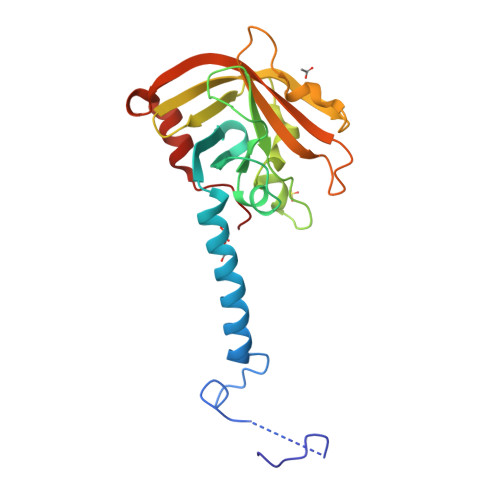
Superoxide dismutase [Cu-Zn] structureClick to view 3D structureSuperoxide dismutase [Cu-Zn]P00441HumansKnownUnbalanced levels of copper and zinc binding to Cu,Zn-superoxide dismutase has been linked to amyotrophic lateral sclerosis (ALS). (A49)
Concentrations
Not Available
External Links
DrugBank IDNot Available
HMDB IDNot Available
FooDB IDNot Available
Phenol Explorer IDNot Available
KNApSAcK IDNot Available
BiGG IDNot Available
BioCyc IDNot Available
METLIN IDNot Available
PDB IDNot Available
Wikipedia LinkZinc molybdate
Chemspider IDNot Available
ChEBI IDNot Available
PubChem Compound ID131675350
Kegg Compound IDNot Available
YMDB IDNot Available
ECMDB IDNot Available
References
Synthesis ReferenceNot Available
MSDSNot Available
General References
  1. Vonk WI, Klomp LW: Role of transition metals in the pathogenesis of amyotrophic lateral sclerosis. Biochem Soc Trans. 2008 Dec;36(Pt 6):1322-8. doi: 10.1042/BST0361322. [PubMed: 19021549]
  2. Wikipedia. Zinc. Last Updated 24 March 2009. - http://en.wikipedia.org/wiki/Zinc
  3. ATSDR - Agency for Toxic Substances and Disease Registry (2005). Toxicological profile for zinc. U.S. Public Health Service in collaboration with U.S. Environmental Protection Agency (EPA). - http://www.atsdr.cdc.gov/toxprofiles/tp60.html
  4. Wikipedia. Zinc molybdate. Last Updated 16 March 2009. - http://en.wikipedia.org/wiki/Zinc_molybdate
  5. Wikipedia. Metallothionein. Last Updated 20 December 2008. - http://en.wikipedia.org/wiki/Metallothionein
  6. ATSDR - Agency for Toxic Substances and Disease Registry (2001). Minimal Risk Levels (MRLs) for Hazardous Substances. U.S. Public Health Service in collaboration with U.S. Environmental Protection Agency (EPA). - http://www.atsdr.cdc.gov/mrls/