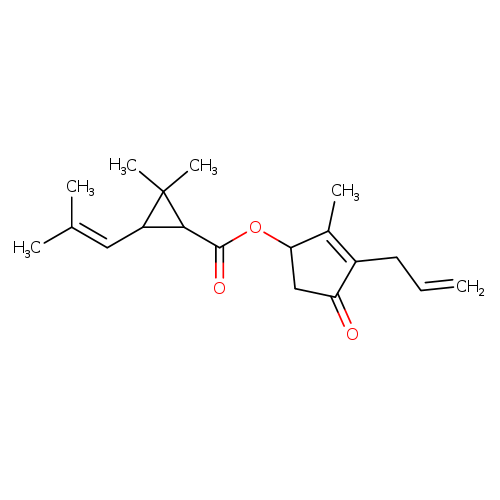
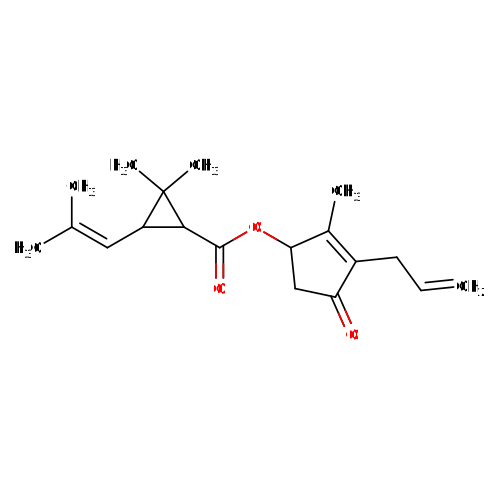
Allethrin is a pyrethroid (type I) insecticide. A pyrethroid is a synthetic chemical compound similar to the natural chemical pyrethrins produced by the flowers of pyrethrums (Chrysanthemum cinerariaefolium and C. coccineum). Pyrethroids are common in commercial products such as household insecticides and insect repellents. In the concentrations used in such products, they are generally harmless to human beings but can harm sensitive individuals. They are usually broken apart by sunlight and the atmosphere in one or two days, and do not significantly affect groundwater quality except for being toxic to fish. (7)
Belongs to the class of organic compounds known as pyrethroids. These are organic compounds similar to the pyrethrins. Some pyrethroids containing a chrysanthemic acid esterified with a cyclopentenone (pyrethrins), or with a phenoxybenzyl group.
Both type I and type II pyrethroids exert their effect by prolonging the open phase of the sodium channel gates when a nerve cell is excited. They appear to bind to the membrane lipid phase in the immediate vicinity of the sodium channel, thus modifying the channel kinetics. This blocks the closing of the sodium gates in the nerves, and thus prolongs the return of the membrane potential to its resting state. The repetitive (sensory, motor) neuronal discharge and a prolonged negative afterpotential produces effects quite similar to those produced by DDT, leading to hyperactivity of the nervous system which can result in paralysis and/or death. Other mechanisms of action of pyrethroids include antagonism of gamma-aminobutyric acid (GABA)-mediated inhibition, modulation of nicotinic cholinergic transmission, enhancement of noradrenaline release, and actions on calcium ions. They also inhibit calium channels and Ca2+, Mg2+-ATPase. (11, 12, 8)
Metabolism
Upon absorption of allethrine , biotransformation takes place through hydrolysis of the
central ester bond, oxidative attacks at several sites, and conjugation reactions to produce a complex array of primary and secondary water-soluble metabolites that undergo urinary and biliary excretion. Allethrin is oxidized not only at the chrysanthemate isobutenyl moiety to the corresponding primary alcohol but also at the allyl group to 1'-hydroxyprop-2'-enyl and 2',3'-dihydroxy-propyl derivatives, or at a methyl group on the cyclopropyl moiety to a hydroxy derivative. It is widely accepted that metabolism results in the formation of compounds that have little or no demonstrable toxicity, although the formation of reactive or toxic intermediates cannot be ruled out, and it appears that cleavage of the ester bond results in substantial detoxification. Allethrin is also converted to chrysanthemum dicarboxylic acid and allethrolone. Allethrin leaves the body quickly, mainly in the urine, but also in feces and breath. (8, 5)
As for every type I pyrethroid, allethrin effects typically include rapid onset of aggressive behavior and increased sensitivity to external stimuli, followed by fine tremor, prostration with coarse whole body tremor, elevated body temperature, coma, and death. Paresthesia can also occur after dermal exposure to allethrin. It is likely to be a human carcinogen by the oral route. (8)
Symptoms
Following dermal exposure to allethrin, feelings of numbness, itching, burning, stinging, tingling, or warmth may occur, that could last for a few hours. Dizziness, headache, nausea, muscle twitching, reduced energy, and changes in awareness can result from inhalation or ingestion of large amounts of allethrin. (8)
Treatment
Following oral exposure, the treatment is symptomatic and supportive and includes monitoring for the development of hypersensitivity reactions with respiratory distress. Provide adequate airway management when needed. Gastric decontamination is usually not required unless the pyrethrin product is combined with a hydrocarbon. Following inhalation exposure, move patient to fresh air. monitor for respiratory distress. If cough or difficulty breathing develops, evaluate for respiratory tract irritation, bronchitis, or pneumonitis. Administer oxygen and assist ventilation as required. Treat bronchospasm with inhaled beta2 agonist and oral or parenteral corticosteroids. In case of eye exposure, irrigate exposed eyes with copious amounts of room temperature water for at least 15 minutes. If irritation, pain, swelling, lacrimation, or photophobia persist, the patient should be seen in a health care facility. If the contamination occurs through dermal exposure, Remove contaminated clothing and wash exposed area thoroughly with soap and water. A physician may need to examine the area if irritation or pain persists. Vitamin E topical application is highly effective in relieving parenthesis. (6)