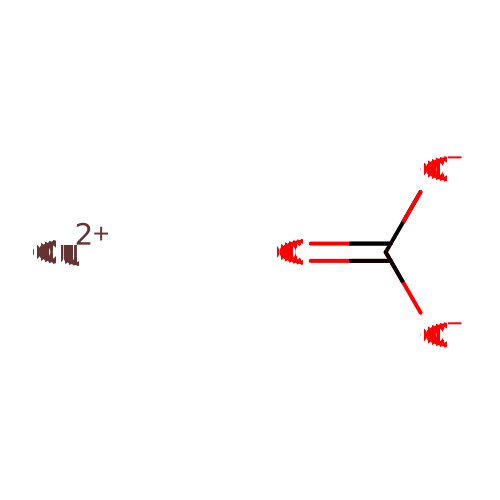
Copper(II) carbonate (CED0000794)

Record Information
Version1.0
Creation Date2009-06-19 21:58:27 UTC
Update Date2026-04-05 17:19:42 UTC
Accession NumberCHEM001035
Identification
Common NameCopper(II) carbonate
ClassSmall Molecule
Description
Copper(II) carbonate is a solid compound with the formula CCuO3 and an average molecular weight of 123.56 g/mol. Copper(II) carbonate belongs to the organic carbonic acids, a subclass of organic carbonic acids and derivatives within the organic compounds. This exogenous substance is used as a pigment, in some types of make-up, as an algaecide, and for bronze plating. It is found in or released from 24 recorded sources, including building and construction materials such as ceilings and fencing; food, food processing and cookware, specifically fermentation processes for beer; household cleaning and consumer products, including bleaching agents, soap detergents, perfumes within detergents and soaps, cigar cigarettes, and non electric simulated smoking devices; and electrical and electronic equipment, including antennas, coils, communication cables or conductors, auxiliary devices, and adjustable resistors. The compound interacts with six recorded protein targets. Copper binds to alpha-synuclein (SNCA), initiating protein aggregation and likely contributing to the development of Alzheimer's disease and Parkinson's disease. It also binds the N-terminal region of amyloid precursor protein (APP), promoting the generation of β-amyloid, which is believed to contribute to the development of Parkinson's disease and Alzheimer's disease. Additionally, copper inhibits sulfhydryl group enzymes that protect the cell from free oxygen, including glutathione reductase, mitochondrial (GSR), glucose-6-phosphate 1-dehydrogenase (G6PD), serum paraoxonase/lactonase 3 (PON3), and serum paraoxonase/arylesterase 1 (PON1). Copper hepatotoxicity is believed to occur when hepatocyte lysosomes become saturated and copper accumulates in the nucleus, causing nuclear damage possibly resulting from oxidative damage, including lipid peroxidation.
Contaminant Type
  • Copper Compound
  • Household Toxin
  • Inorganic Compound
  • Organic Compound
  • Pesticide
  • Synthetic Compound
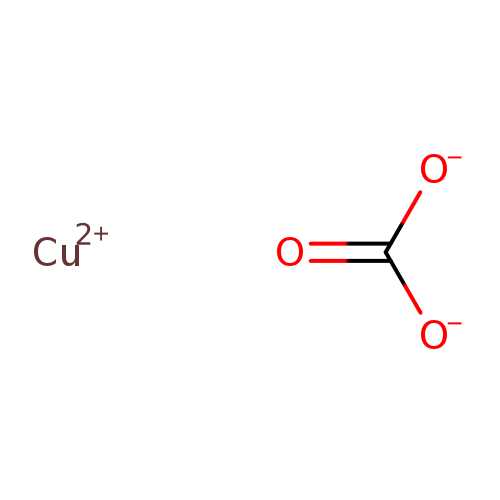
Chemical Structure
Synonyms
ValueSource
Copper(II) carbonic acidGenerator
Copper carbonate, X-cu(II) saltMeSH
Copper carbonateMeSH
Chemical FormulaCCuO3
Average Molecular Mass123.555 g/mol
Monoisotopic Mass122.914 g/mol
CAS Registry Number1184-64-1
IUPAC Namecopper(2+) ion carbonate
Traditional Namecopper(2+) ion carbonate
SMILES[Cu++].[O-]C([O-])=O
InChI IdentifierInChI=1S/CH2O3.Cu/c2-1(3)4;/h(H2,2,3,4);/q;+2/p-2
InChI KeyGEZOTWYUIKXWOA-UHFFFAOYSA-L
Chemical Taxonomy
Description Belongs to the class of organic compounds known as organic carbonic acids. Organic carbonic acids are compounds comprising the carbonic acid functional group.
KingdomOrganic compounds
Super ClassOrganic acids and derivatives
ClassOrganic carbonic acids and derivatives
Sub ClassOrganic carbonic acids
Direct ParentOrganic carbonic acids
Alternative Parents
Substituents
  • Carbonate salt
  • Carbonic acid
  • Organic transition metal salt
  • Organic oxygen compound
  • Organic oxide
  • Hydrocarbon derivative
  • Organic copper salt
  • Organic salt
  • Organooxygen compound
  • Carbonyl group
  • Aliphatic acyclic compound
Molecular FrameworkAliphatic acyclic compounds
External DescriptorsNot Available
Biological Properties
StatusDetected and Not Quantified
OriginExogenous
Cellular Locations
  • Cytoplasm
  • Extracellular
Biofluid LocationsNot Available
Tissue LocationsNot Available
ApplicationsNot Available
Biological RolesNot Available
Chemical RolesNot Available
Organoleptic EffectsNot Available
Physical Properties
StateSolid
AppearanceGreyish-black crystals.
Experimental Properties
PropertyValue
Melting PointNot Available
Boiling PointNot Available
SolubilityNot Available
Predicted Properties
PropertyValueSource
Water Solubility75.3 g/LALOGPS
logP0.41ALOGPS
logP0.25ChemAxon
logS-0.37ALOGPS
pKa (Strongest Acidic)6.05ChemAxon
Physiological Charge-1ChemAxon
Hydrogen Acceptor Count3ChemAxon
Hydrogen Donor Count0ChemAxon
Polar Surface Area63.19 ŲChemAxon
Rotatable Bond Count0ChemAxon
Refractivity31.17 m³·mol⁻¹ChemAxon
Polarizability3.52 ųChemAxon
Number of Rings0ChemAxon
BioavailabilityYesChemAxon
Rule of FiveYesChemAxon
Ghose FilterNoChemAxon
Veber's RuleNoChemAxon
MDDR-like RuleNoChemAxon
Spectra
Spectra
Spectrum TypeDescriptionSplash KeyDeposition DateView
Predicted LC-MS/MSPredicted LC-MS/MS Spectrumsplash10-00di-1900000000-fb16d2c33a51fe747559Not AvailableView Spectrum
Predicted LC-MS/MSPredicted LC-MS/MS Spectrumsplash10-00di-1900000000-96c2efda9197f72de1a3Not AvailableView Spectrum
Predicted LC-MS/MSPredicted LC-MS/MS Spectrumsplash10-00di-6900000000-9a08b5b7ddd57fe4ee20Not AvailableView Spectrum
Toxicity Profile
Mechanism of ToxicityExcess copper is sequestered within hepatocyte lysosomes, where it is complexed with metallothionein. Copper hepatotoxicity is believed to occur when the lysosomes become saturated and copper accumulates in the nucleus, causing nuclear damage. This damage is possibly a result of oxidative damage, including lipid peroxidation. Copper inhibits the sulfhydryl group enzymes such as glucose-6-phosphate 1-dehydrogenase, glutathione reductase, and paraoxonases, which protect the cell from free oxygen radicals. It also influences gene expression and is a co-factor for oxidative enzymes such as cytochrome C oxidase and lysyl oxidase. In addition, the oxidative stress induced by copper is thought to activate acid sphingomyelinase, which lead to the production of ceramide, an apoptotic signal, as well as cause hemolytic anemia. Copper-induced emesis results from stimulation of the vagus nerve. (4, 10, 1, 7)
Carcinogenicity (IARC Classification)No indication of carcinogenicity to humans (not listed by IARC).
Minimum Risk LevelAcute Oral: 0.01 mg/kg/day (3) Intermediate Oral: 0.01 mg/kg/day (3)
SymptomsBreathing high levels of copper can cause irritation of the nose and throat. Ingesting high levels of copper can cause nausea, vomiting, diarrhea, headache, dizziness, and respiratory difficulty. (5, 6)
TreatmentNot Available
Toxicity Values
Toxicity ValueUnitValue RangeOrganismDose DescriptorRoute of ExposurePredicted or ExperimentalReference
159.0mg/kgNot AvailableRatLD50OralexperimentalT56
8206.0Log mg/kg[4600:15000]RatLD50oralpredictedNot Available
Health Effects
Health EffectRelationshipDirectionReference
Exposure Sources
Source IDSourceSectorReference
10InsecticidesAgriculture & land managementNot Available
233BrushesPersonal care & cosmeticsNot Available
495CeilingsBuilding & ConstructionNot Available
496FencingBuilding & ConstructionNot Available
504Adjustable ResistorsElectrical & Electronic EquipmentNot Available
506AntennasElectrical & Electronic EquipmentNot Available
507Auxiliary DevicesElectrical & Electronic EquipmentNot Available
508CoilsElectrical & Electronic EquipmentNot Available
510Communication Cables Or ConductorsElectrical & Electronic EquipmentNot Available
514Discharge LampsElectrical & Electronic EquipmentNot Available
517Electric SwitchesElectrical & Electronic EquipmentNot Available
518Electrically Stimulated Smoking DevicesElectrical & Electronic EquipmentNot Available
521Fixed Capacitors And Their ManufactureElectrical & Electronic EquipmentNot Available
524Hybrid CapacitorsElectrical & Electronic EquipmentNot Available
529Power CablesElectrical & Electronic EquipmentNot Available
530Radio Transmission SystemsElectrical & Electronic EquipmentNot Available
533Sparking PlugsElectrical & Electronic EquipmentNot Available
536Superconductive Or Hyperconductive Conductors Cables Or Transmission LinesElectrical & Electronic EquipmentNot Available
538Thin Magnetic FilmsElectrical & Electronic EquipmentNot Available
544Fermentation Processes For BeerFood, food processing & cookwareNot Available
555Bleaching AgentsHousehold cleaning & consumer productsNot Available
556Cigar CigarettesHousehold cleaning & consumer productsNot Available
559Non Electric Simulated Smoking DevicesHousehold cleaning & consumer productsNot Available
561Perfumes Within Detergents And SoapsHousehold cleaning & consumer productsNot Available
563Soap DetergentsHousehold cleaning & consumer productsNot Available
569Tobacco Smoke FiltersHousehold cleaning & consumer productsNot Available
578Making CigarsIndustrial manufacturing & chemical processingNot Available
579Manufacture Of Iron Or SteelIndustrial manufacturing & chemical processingNot Available
580Manufacture Preparation Of Tobacco ProductsIndustrial manufacturing & chemical processingNot Available
581Paper Making MachinesIndustrial manufacturing & chemical processingNot Available
583Anchoring EquipmentMarine, shipping & aquacultureNot Available
592Marine Propulsion Or SteeringMarine, shipping & aquacultureNot Available
596AcaricidesAgriculture & land managementNot Available
597ChemosterilantsAgriculture & land managementNot Available
600Herbicides And AlgicidesAgriculture & land managementNot Available
601Lawn MowersAgriculture & land managementNot Available
602MolluscicidesAgriculture & land managementNot Available
603NematocidesAgriculture & land managementNot Available
604Pest AttractantsAgriculture & land managementNot Available
605Pest RepellantsAgriculture & land managementNot Available
606Plant Growth RegulatorsAgriculture & land managementNot Available
607Rodenticides(1)Agriculture & land managementNot Available
608RodenticidesAgriculture & land managementNot Available
614Essential Oils Or PerfumesPersonal care & cosmeticsNot Available
615Eye Makeup ProductsPersonal care & cosmeticsNot Available
617Lip Care ProductsPersonal care & cosmeticsNot Available
618Lip Makeup ProductsPersonal care & cosmeticsNot Available
630ToysRecreation & sports surfacesNot Available
638Decorating TextilesTextiles, leather & furnishingsNot Available
642FootwearTextiles, leather & furnishingsNot Available
650Purses Luggage Hand BagsTextiles, leather & furnishingsNot Available
651Purses Money Bags WalletsTextiles, leather & furnishingsNot Available
652RopesTextiles, leather & furnishingsNot Available
655Slide FastenersTextiles, leather & furnishingsNot Available
659Transfer PrintingTextiles, leather & furnishingsNot Available
662Yarns Or ThreadsTextiles, leather & furnishingsNot Available
Pathways
0 pathways

No pathways found

No metabolic pathways have been associated with this synthetic chemical

Targets
StructureProteinUniProt IDOrganismRelationshipDetails
Click to view 3D structure3-isopropylmalate dehydrogenaseQ5SIY4Thermus thermophilusPredicted (SEA)0.233548
Click to view 3D structureFree fatty acid receptor 3B2GV46Rattus norvegicusPredicted (SEA)1.08989
Carbonic anhydrase 9 structureClick to view 3D structureCarbonic anhydrase 9Q16790HumansPredicted (SEA)4846.43
Click to view 3D structureFumarate hydratase, mitochondrialP10173Sus scrofaPredicted (SEA)1.40129
Click to view 3D structureAlpha carbonic anhydraseB5SU02Stylophora pistillataPredicted (SEA)443.818
Egl nine homolog 1 structureClick to view 3D structureEgl nine homolog 1Q9GZT9HumansPredicted (SEA)3560.67
Olfactory receptor 51E2 structureClick to view 3D structureOlfactory receptor 51E2Q9H255HumansPredicted (SEA)53.2489
Click to view 3D structureBeta-lactamase VIM-1Q9XAY4Pseudomonas aeruginosaPredicted (SEA)9.809
Carbonic anhydrase 1 structureClick to view 3D structureCarbonic anhydrase 1P00915HumansPredicted (SEA)6790.71
Click to view 3D structureAsc-type amino acid transporter 1P63116RatPredicted (SEA)35.5771
Click to view 3D structureSodium- and chloride-dependent GABA transporter 2P31646Rattus norvegicusPredicted (SEA)59.399
Carbonic anhydrase 4 structureClick to view 3D structureCarbonic anhydrase 4P22748HumansPredicted (SEA)6601.3
Carbonic anhydrase 2 structureClick to view 3D structureCarbonic anhydrase 2P00918HumansPredicted (SEA)7483.49
Carbonic anhydrase 7 structureClick to view 3D structureCarbonic anhydrase 7P43166HumansPredicted (SEA)7057.34
Carbonic anhydrase 12 structureClick to view 3D structureCarbonic anhydrase 12O43570HumansPredicted (SEA)7386.1
Carbonic anhydrase 6 structureClick to view 3D structureCarbonic anhydrase 6P23280HumansPredicted (SEA)6814.61
Carbonic anhydrase 14 structureClick to view 3D structureCarbonic anhydrase 14Q9ULX7HumansPredicted (SEA)6890.28
Click to view 3D structureCarnitine O-palmitoyltransferase 2, mitochondrialP23786HumansPredicted (SEA)4633.66
Click to view 3D structureCocaine esteraseO00748HumansPredicted (SEA)5012.71
Liver carboxylesterase 1 structureClick to view 3D structureLiver carboxylesterase 1P23141HumansPredicted (SEA)4944.44
Lysine-specific demethylase 5C structureClick to view 3D structureLysine-specific demethylase 5CP41229HumansPredicted (SEA)6512.4
Click to view 3D structureCarbonic anhydrase 4Q95323Bos taurusPredicted (SEA)4837.78
Click to view 3D structureCarbonic anhydrase 5B, mitochondrialQ9Y2D0HumansPredicted (SEA)7145.86
Click to view 3D structureCarbonic anhydrase 5A, mitochondrialP35218HumansPredicted (SEA)7287.47
Click to view 3D structureCarbonic anhydrase 15Q99N23Mus musculusPredicted (SEA)6572.11
Glucose-6-phosphate 1-dehydrogenase structureClick to view 3D structureGlucose-6-phosphate 1-dehydrogenaseP11413HumansKnownExcess copper is sequestered within hepatocyte lysosomes, where it is complexed with metallothionein. Copper hepatotoxicity is believed to occur when the lysosomes become saturated and copper accumulates in the nucleus, causing nuclear damage. This damage is possibly a result of oxidative damage, including lipid peroxidation. Copper inhibits the sulfhydryl group enzymes such as glucose-6-phosphate 1-dehydrogenase, glutathione reductase, and paraoxonases, which protect the cell from free oxygen radicals. It also influences gene expression and is a co-factor for oxidative enzymes such as cytochrome C oxidase and lysyl oxidase. In addition, the oxidative stress induced by copper is thought to activate acid sphingomyelinase, which lead to the production of ceramide, an apoptotic signal, as well as cause hemolytic anemia. (L277, T49, A174, L280)
Glutathione reductase, mitochondrial structureClick to view 3D structureGlutathione reductase, mitochondrialP00390HumansKnownExcess copper is sequestered within hepatocyte lysosomes, where it is complexed with metallothionein. Copper hepatotoxicity is believed to occur when the lysosomes become saturated and copper accumulates in the nucleus, causing nuclear damage. This damage is possibly a result of oxidative damage, including lipid peroxidation. Copper inhibits the sulfhydryl group enzymes such as glucose-6-phosphate 1-dehydrogenase, glutathione reductase, and paraoxonases, which protect the cell from free oxygen radicals. It also influences gene expression and is a co-factor for oxidative enzymes such as cytochrome C oxidase and lysyl oxidase. In addition, the oxidative stress induced by copper is thought to activate acid sphingomyelinase, which lead to the production of ceramide, an apoptotic signal, as well as cause hemolytic anemia. (L277, T49, A174, L280)
Serum paraoxonase/arylesterase 1 structureClick to view 3D structureSerum paraoxonase/arylesterase 1P27169HumansKnownExcess copper is sequestered within hepatocyte lysosomes, where it is complexed with metallothionein. Copper hepatotoxicity is believed to occur when the lysosomes become saturated and copper accumulates in the nucleus, causing nuclear damage. This damage is possibly a result of oxidative damage, including lipid peroxidation. Copper inhibits the sulfhydryl group enzymes such as glucose-6-phosphate 1-dehydrogenase, glutathione reductase, and paraoxonases, which protect the cell from free oxygen radicals. It also influences gene expression and is a co-factor for oxidative enzymes such as cytochrome C oxidase and lysyl oxidase. In addition, the oxidative stress induced by copper is thought to activate acid sphingomyelinase, which lead to the production of ceramide, an apoptotic signal, as well as cause hemolytic anemia. (L277, T49, A174, L280)
Click to view 3D structureSerum paraoxonase/lactonase 3Q15166HumansKnownExcess copper is sequestered within hepatocyte lysosomes, where it is complexed with metallothionein. Copper hepatotoxicity is believed to occur when the lysosomes become saturated and copper accumulates in the nucleus, causing nuclear damage. This damage is possibly a result of oxidative damage, including lipid peroxidation. Copper inhibits the sulfhydryl group enzymes such as glucose-6-phosphate 1-dehydrogenase, glutathione reductase, and paraoxonases, which protect the cell from free oxygen radicals. It also influences gene expression and is a co-factor for oxidative enzymes such as cytochrome C oxidase and lysyl oxidase. In addition, the oxidative stress induced by copper is thought to activate acid sphingomyelinase, which lead to the production of ceramide, an apoptotic signal, as well as cause hemolytic anemia. (L277, T49, A174, L280)
Alpha-synuclein structureClick to view 3D structureAlpha-synucleinP37840HumansKnownCopper binds to alpha-synuclein, initiating protein aggregation and likely contributing to the development of the neurodegenerative disorders Parkinson's disease and Alzheimer's disease. (A173)
Amyloid-beta precursor protein structureClick to view 3D structureAmyloid-beta precursor proteinP05067HumansKnownCopper binds the N-terminal region of amyloid precursor protein, promoting the generation of _-amyloid from the protein. This is believed to contribute to the development of the neurodegenerative disorders Parkinson's disease and Alzheimer's disease. (A173)
Concentrations
Not Available
External Links
DrugBank IDNot Available
HMDB IDNot Available
FooDB IDNot Available
Phenol Explorer IDNot Available
KNApSAcK IDNot Available
BiGG IDNot Available
BioCyc IDNot Available
METLIN IDNot Available
PDB IDNot Available
Wikipedia LinkCopper(II) carbonate
Chemspider IDNot Available
ChEBI IDNot Available
PubChem Compound IDNot Available
Kegg Compound IDNot Available
YMDB IDNot Available
ECMDB IDNot Available
References
Synthesis ReferenceNot Available
MSDSNot Available
General References