Zinc dimethyldithiocarbamate (CED0009896)

Record Information
Version1.0
Creation Date2009-06-19 21:58:49 UTC
Update Date2026-04-05 15:31:29 UTC
SynCED IDCED0009896
Secondary Accession Numbers
  • CHEM001250
  • T3D1465
Identification
Common NameZinc dimethyldithiocarbamate
ClassSmall Molecule
Description
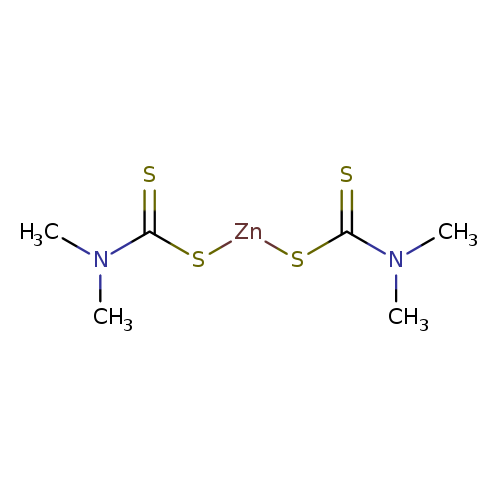
Zinc dimethyldithiocarbamate is an exogenous chemical compound with the formula C6H12N2S4Zn and an average molecular weight of 305.84 g/mol. It is a solid at room temperature. Zinc dimethyldithiocarbamate belongs to the organic transition metal salts, a subclass of organic metal salts within the organic compounds. Industrially, the compound is utilized as a catalyst, a chemical reaction regulator, and a biocide. It has been released from 18 recorded sources, including drinking water, soap detergents, and perfumes within detergents and soaps. Other sources include food processing activities such as food preservation, processing meats, and the preparation of malt. Additionally, it is found in building and construction materials like floors, fencing, and tents or canopies, as well as electrical and electronic equipment, including antennas, communication cables or conductors, electrodes, adjustable resistors, and conductive bodies characterized by the conductive materials. The recorded exposure route for this compound is oral. It interacts with seven recorded protein targets, including the insulin receptor (INSR), the glucocorticoid receptor (NR3C1), tyrosine-protein phosphatase non-receptor type 1 (PTPN1), and cellular tumor antigen p53 (TP53). One of its targets is Cu,Zn-superoxide dismutase (SOD1); unbalanced levels of copper and zinc binding to this protein has been linked to amyotrophic lateral sclerosis (ALS).
Contaminant Type
  • Amine
  • Carbamate
  • Household Toxin
  • Industrial/Workplace Toxin
  • Organic Compound
  • Organometallic
  • Pesticide
  • Synthetic Compound
  • Zinc Compound
Chemical Structure
Synonyms
ValueSource
(T-4)-Bis(dimethylcarbamodithioato-kappas,kappas')zincChEBI
Bis(dimethylcarbamodithioato-S,s')zincChEBI
Bis(dimethyldithiocarbamato)zincChEBI
Bis-dimethyldithiocarbamate de zincChEBI
Dimethyldithiocarbamate zinc saltChEBI
Zinc bis(dimethyldithiocarbamate)ChEBI
Zinc bis(dimethyldithiocarbamoyl)disulphideChEBI
Zinc bis(dimethylthiocarbamoyl)disulfideChEBI
Bis-dimethyldithiocarbamic acid de zincGenerator
Dimethyldithiocarbamic acid zinc saltGenerator
Zinc bis(dimethyldithiocarbamic acid)Generator
Zinc bis(dimethyldithiocarbamoyl)disulfideGenerator
Zinc bis(dimethylthiocarbamoyl)disulphideGenerator
Zinc dimethyldithiocarbamic acidGenerator
MilbamMeSH
FuklasinMeSH
Cuman LMeSH
Dimethyldithiocarbamate, zincMeSH
ZerlateMeSH
Chemical FormulaC6H12N2S4Zn
Average Molecular Mass305.842 g/mol
Monoisotopic Mass303.917 g/mol
CAS Registry Number137-30-4
IUPAC Namebis[(dimethylcarbamothioyl)sulfanyl]zinc
Traditional Nameziram
SMILESCN(C)C(=S)S[Zn]SC(=S)N(C)C
InChI IdentifierInChI=1S/2C3H7NS2.Zn/c2*1-4(2)3(5)6;/h2*1-2H3,(H,5,6);/q;;+2/p-2
InChI KeyDUBNHZYBDBBJHD-UHFFFAOYSA-L
Chemical Taxonomy
Description Belongs to the class of organic compounds known as organic transition metal salts. These are organic salt compounds containing a transition metal atom in its ionic form.
KingdomOrganic compounds
Super ClassOrganic salts
ClassOrganic metal salts
Sub ClassOrganic transition metal salts
Direct ParentOrganic transition metal salts
Alternative Parents
Substituents
  • Organic transition metal salt
  • Organic nitrogen compound
  • Organopnictogen compound
  • Hydrocarbon derivative
  • Organosulfur compound
  • Organonitrogen compound
  • Aliphatic acyclic compound
Molecular FrameworkNot Available
External Descriptors
Biological Properties
StatusDetected and Not Quantified
OriginExogenous
Cellular Locations
  • Cytoplasm
  • Extracellular
Biofluid LocationsNot Available
Tissue LocationsNot Available
ApplicationsNot Available
Biological Roles
Chemical RolesNot Available
Organoleptic EffectsNot Available
Physical Properties
StateSolid
AppearanceWhite crystals.
Experimental Properties
PropertyValue
Melting Point250°C
Boiling PointNot Available
Solubility0.065 mg/mL at 25°C [GUNTHER,FA et al. (1968)]
Predicted Properties
PropertyValueSource
Water Solubility0.12 g/LALOGPS
logP1.86ALOGPS
logP1.74ChemAxon
logS-3.4ALOGPS
Physiological Charge0ChemAxon
Hydrogen Acceptor Count0ChemAxon
Hydrogen Donor Count0ChemAxon
Polar Surface Area6.48 ŲChemAxon
Rotatable Bond Count4ChemAxon
Refractivity69.24 m³·mol⁻¹ChemAxon
Polarizability26.56 ųChemAxon
Number of Rings0ChemAxon
BioavailabilityYesChemAxon
Rule of FiveYesChemAxon
Ghose FilterYesChemAxon
Veber's RuleYesChemAxon
MDDR-like RuleNoChemAxon
Spectra
Spectra
Spectrum TypeDescriptionSplash KeyDeposition DateView
Predicted LC-MS/MSPredicted LC-MS/MS Spectrumsplash10-0udi-0139000000-e6dfbc43c92ba0245ebeNot AvailableView Spectrum
Predicted LC-MS/MSPredicted LC-MS/MS Spectrumsplash10-000i-9100000000-c9631804bff9f34036cbNot AvailableView Spectrum
Predicted LC-MS/MSPredicted LC-MS/MS Spectrumsplash10-014r-9750000000-18a89bf261bf4687dd26Not AvailableView Spectrum
Predicted LC-MS/MSPredicted LC-MS/MS Spectrumsplash10-0udi-3119000000-93b3e9f8d240e91db696Not AvailableView Spectrum
Predicted LC-MS/MSPredicted LC-MS/MS Spectrumsplash10-0uy0-9625000000-08c5f6307170a4d62ca7Not AvailableView Spectrum
Predicted LC-MS/MSPredicted LC-MS/MS Spectrumsplash10-014r-7971000000-d0912a64c40ba4d2c93aNot AvailableView Spectrum
MSMS Spectrumsplash10-0k9i-6539000000-4cf7031e44557fbc7ee3Not AvailableView Spectrum
Toxicity Profile
Toxicity Values
Toxicity ValueOrganismDose DescriptorRoute of ExposurePredicted or ExperimentalToxicity RatingReference
18.0 mg/kg MouseLD50IntravenousexperimentalNot Available7
23.0 mg/kg RatLD50IntraperitonealexperimentalNot Available7
320.0 mg/kg RatLD50OralexperimentalNot Available8
81.0 mg/m3 RatLC50Inhalation (4 hours)experimentalNot Available7
0.12 mmol/kg RatNOELoralexperimentalNot AvailableECOTOX - EPA ORD
2.08 mmol/kg RatLOELoralexperimentalNot AvailableECOTOX - EPA ORD
12.5 mg/kg-day RatNOELinjectionexperimentalNot AvailableECOTOX - EPA ORD
50.0 mg/kg-day RatLOELinjectionexperimentalNot AvailableECOTOX - EPA ORD
20.0 mg/kg-day MouseNOELinjectionexperimentalNot AvailableECOTOX - EPA ORD
50.0 ul/org MouseLOELdermalexperimentalNot AvailableECOTOX - EPA ORD
1.0 mmol/kg RatLOELoralexperimentalNot AvailableECOTOX - EPA ORD
4.16 mmol/kg RatLOELoralexperimentalNot AvailableECOTOX - EPA ORD
2.08 mmol/kg RatNOELoralexperimentalNot AvailableECOTOX - EPA ORD
20.0 mg/kg-day MouseNOELinjectionexperimentalNot AvailableECOTOX - EPA ORD
10.0 mg/kg-day RatLOELinjectionexperimentalNot AvailableECOTOX - EPA ORD
1.0 mmol/kg MouseLOELoralexperimentalNot AvailableECOTOX - EPA ORD
50.0 mg/kg-day MouseNOELinjectionexperimentalNot AvailableECOTOX - EPA ORD
25.0 mg/kg-day MouseLOELinjectionexperimentalNot AvailableECOTOX - EPA ORD
10.0 mg/kg-day MouseNOELinjectionexperimentalNot AvailableECOTOX - EPA ORD
5.0 mg/kg-day MouseNOELinjectionexperimentalNot AvailableECOTOX - EPA ORD
10.0 mg/kg-day MouseLOELinjectionexperimentalNot AvailableECOTOX - EPA ORD
5.0 mg/kg-day MouseNOELinjectionexperimentalNot AvailableECOTOX - EPA ORD
25.0 mg/kg-day MouseLOELinjectionexperimentalNot AvailableECOTOX - EPA ORD
1.0 mmol/kg RatLOELoralexperimentalNot AvailableECOTOX - EPA ORD
25.0 mg/kg-day MouseLOELinjectionexperimentalNot AvailableECOTOX - EPA ORD
25.0 mg/kg-day RatNOELoralexperimentalNot AvailableECOTOX - EPA ORD
350.0 mg/kg-day MouseLOELoralexperimentalNot AvailableECOTOX - EPA ORD
1.56 mg/kg-day RatLOELoralexperimentalNot AvailableECOTOX - EPA ORD
16.146 mg/kg-day RatNOELoralexperimentalNot AvailableECOTOX - EPA ORD
1.56 mg/kg-day RatLOELoralexperimentalNot AvailableECOTOX - EPA ORD
5.0 mg/kg-day RatLOELoralexperimentalNot AvailableECOTOX - EPA ORD
111.0 mg/kg-day MouseNOELoralexperimentalNot AvailableECOTOX - EPA ORD
12.5 mg/kg-day RatNOELoralexperimentalNot AvailableECOTOX - EPA ORD
9.5 mg/kg-day RatNOELoralexperimentalNot AvailableECOTOX - EPA ORD
5.0 mg/kg-day RatLOELoralexperimentalNot AvailableECOTOX - EPA ORD
46.8 mg/kg-day RatNOELoralexperimentalNot AvailableECOTOX - EPA ORD
111.0 mg/kg-day MouseNOELoralexperimentalNot AvailableECOTOX - EPA ORD
46.8 mg/kg-day RatLOELoralexperimentalNot AvailableECOTOX - EPA ORD
5.0 mg/kg-day RatLOELoralexperimentalNot AvailableECOTOX - EPA ORD
4.0 mg/kg-day RatNOELoralexperimentalNot AvailableECOTOX - EPA ORD
Toxicity / Toxin ClassNot Available
Mechanism of ToxicityAnaemia results from the excessive absorption of zinc suppressing copper and iron absorption, most likely through competitive binding of intestinal mucosal cells. Unbalanced levels of copper and zinc binding to Cu,Zn-superoxide dismutase has been linked to amyotrophic lateral sclerosis (ALS). Stomach acid dissolves metallic zinc to give corrosive zinc chloride, which can cause damage to the stomach lining. Metal fume fever is thought to be an immune response to inhaled zinc. (2, 3, 1)
Carcinogenicity (IARC Classification)3, not classifiable as to its carcinogenicity to humans. (6)
Minimum Risk LevelIntermediate Oral: 0.3 mg/kg/day (5) Chronic Oral: 0.3 mg/kg/day (5)
SymptomsIngestion of large doses of zinc causes stomach cramps, nausea, and vomiting. Acute inhalation of large amounts of zinc causes metal fume fever, which is characterized by chills, fever, headache, weakness, dryness of the nose and throat, chest pain, and coughing. Dermal contact with zinc results in skin irritation. (3)
TreatmentZinc poisoning is treated symptomatically, often by administering fluids such as water or milk, or with gastric lavage. (3)
Health Effects
Health EffectRelationshipDirectionDescriptionReference
Exposure Sources
Source IDSourceSectorReference
CEDs000010Insecticides?Insecticides are synthetic chemicals designed to control or eliminate insect pests that threaten crops and other agricultural products.Agriculture & land managementPubChem
CEDs000070Stormwater runoff?Stormwater runoff refers to the flow of rainwater or melted snow that does not soak into the ground and instead collects pollutants as it travels over impervious surfaces such as roads and parking lots.Automotive & urban infrastructurePubChem
CEDs000115Drinking water?Drinking water can be a medium for synthetic chemical contamination, often originating from various industrial processes and agricultural practices.Drinking water & water supplyNot Available
CEDs000181Ballast water?Ballast water, taken on by ships to maintain stability and balance, often contains a diverse array of microorganisms, including bacteria, viruses, and plankton.Marine, shipping & aquaculturePubChem
CEDs000182Bilge water?Bilge water is a byproduct generated from the accumulation of water in the lowest part of a ship's hull, which may include a mixture of seawater, oil, fuel residues, and various contaminants.Marine, shipping & aquaculturePubChem
CEDs000233Brushes?Brushes used in personal care and cosmetics can be a source of synthetic chemical contamination due to the materials and coatings used in their manufacturing.Personal care & cosmeticsPubChem
CEDs000496Fencing?Fencing materials, particularly those used in construction and landscaping, can be a source of synthetic chemical contamination due to the treatments and coatings applied for durability and weather resistance.Building & ConstructionPubChem
CEDs000497Floors?Floors in built environments can be a significant source of synthetic chemical contamination due to the materials and finishes used in their construction.Building & ConstructionPubChem
CEDs000503Tents Or Canopies?Tents and canopies used in various applications can be a source of synthetic chemical contamination primarily due to the materials from which they are made.Building & ConstructionPubChem
CEDs000504Adjustable Resistors?Adjustable resistors, commonly used in various electronic devices, can contribute to synthetic chemical contamination through the materials and substances used in their manufacturing and disposal.Electrical & Electronic EquipmentPubChem
CEDs000506Antennas?Antennas, commonly used in communication technologies, can be a source of synthetic chemical contamination through the materials and coatings used in their construction.Electrical & Electronic EquipmentPubChem
CEDs000510Communication Cables Or Conductors?Communication cables or conductors are essential components in the transmission of data and signals in various applications, including telecommunications and networking.Electrical & Electronic EquipmentPubChem
CEDs000511Conductors Or Conductive Bodies Characterised By The Conductive Materials?Conductors, or conductive bodies, are materials that allow the flow of electrical current, typically made from metals such as copper, aluminum, or silver.Electrical & Electronic EquipmentPubChem
CEDs000519Electrodes?Electrodes, used in various electrical and electronic applications, can be a source of synthetic chemical contamination due to the materials from which they are constructed and the processes involved in their manufacturing.Electrical & Electronic EquipmentPubChem
CEDs000524Hybrid Capacitors?Hybrid capacitors are energy storage devices that combine the properties of electrolytic and supercapacitors, utilizing a combination of electrochemical principles to achieve higher energy density and power density.Electrical & Electronic EquipmentPubChem
CEDs000529Power Cables?Power cables are used to transmit electrical energy and are typically composed of conductive materials, insulation, and protective coatings.Electrical & Electronic EquipmentPubChem
CEDs000531Relays?Relays are electromechanical switches used to control circuits and manage electrical loads.Electrical & Electronic EquipmentPubChem
CEDs000537Television Systems?Television systems can be a source of synthetic chemical contamination due to the various materials and components used in their manufacture and operation.Electrical & Electronic EquipmentPubChem
CEDs000539Video Games?Video games, through their production and disposal processes, can be a source of synthetic chemical contamination.Electrical & Electronic EquipmentPubChem
CEDs000545Food Preservation?Food preservation often involves the use of synthetic chemicals, such as preservatives, flavor enhancers, and color additives, to extend shelf life and enhance the sensory qualities of food products.Food, food processing & cookwarePubChem
CEDs000547Preparation Of Malt?Malt preparation involves the germination and drying of cereal grains, primarily barley, to produce malt for brewing and food products.Food, food processing & cookwarePubChem
CEDs000552Processing Meats?Processing meats can lead to synthetic chemical contamination primarily through the use of additives and preservatives.Food, food processing & cookwarePubChem
CEDs000561Perfumes Within Detergents And Soaps?Perfumes within detergents and soaps are synthetic fragrance compounds added to enhance the sensory experience of cleaning products.Household cleaning & consumer productsPubChem
CEDs000563Soap Detergents?Soap detergents are synthetic surfactants designed to enhance the cleaning efficacy of water by reducing surface tension, allowing for better interaction with dirt and grease.Household cleaning & consumer productsPubChem
CEDs000581Paper Making Machines?Paper making machines utilize various synthetic chemicals throughout the production process, including additives, coatings, and bleaching agents.Industrial manufacturing & chemical processingPubChem
CEDs000583Anchoring Equipment?Anchoring equipment, commonly used in marine applications, can be a source of synthetic chemical contamination due to the materials and coatings utilized in their manufacturing.Marine, shipping & aquaculturePubChem
CEDs000596Acaricides?Acaricides are synthetic chemicals specifically designed to target and control mite populations that can damage crops and plants.Agriculture & land managementPubChem
CEDs000597Chemosterilants?Chemosterilants are synthetic chemicals designed to induce sterility in target pest populations, thereby controlling their reproduction and mitigating damage to crops.Agriculture & land managementPubChem
CEDs000598Fertiliser Distributors?Fertiliser distributors play a critical role in the supply of synthetic fertilizers, which are widely used to enhance soil fertility and crop yield.Agriculture & land managementPubChem
CEDs000600Herbicides And Algicides?Herbicides and algicides are synthetic chemicals primarily used to control unwanted plants and algae in various environments.Agriculture & land managementPubChem
CEDs000602Molluscicides?Molluscicides are synthetic chemicals specifically designed to control and eliminate mollusks, such as snails and slugs, which can be detrimental to crops and agricultural productivity.Agriculture & land managementPubChem
CEDs000603Nematocides?Nematocides are synthetic chemicals specifically designed to control nematodes, which are microscopic roundworms that can cause significant damage to crops and plants.Agriculture & land managementPubChem
CEDs000604Pest Attractants?Pest attractants are synthetic chemicals designed to lure specific pests for monitoring or control purposes.Agriculture & land managementPubChem
CEDs000605Pest Repellants?Pest repellents, often formulated from synthetic chemicals, are widely used to protect crops from insect infestations and other pests.Agriculture & land managementPubChem
CEDs000606Plant Growth Regulators?Plant Growth Regulators (PGRs) are synthetic chemicals designed to influence the growth and development of plants.Agriculture & land managementPubChem
CEDs000607Rodenticides(1)?Rodenticides are synthetic chemicals specifically formulated to control rodent populations, serving as a crucial tool in managing pests that can damage crops and spread diseases.Agriculture & land managementPubChem
CEDs000608Rodenticides?Rodenticides are chemical substances specifically designed to control rodent populations by causing death through various mechanisms, including anticoagulation or neurotoxicity.Agriculture & land managementPubChem
CEDs000609Aftershave?Aftershave is a grooming product typically used to soothe and protect the skin following shaving.Personal care & cosmeticsPubChem
CEDs000611Anti Perspirants Or Body Deoderants?Antiperspirants and body deodorants commonly contain synthetic chemicals such as aluminum compounds, parabens, and synthetic fragrances.Personal care & cosmeticsPubChem
CEDs000613Depilatories?Depilatories are products designed to remove unwanted hair through the application of synthetic chemicals that break down the protein structure of hair, facilitating its removal.Personal care & cosmeticsPubChem
CEDs000614Essential Oils Or Perfumes?Essential oils and perfumes are complex mixtures of volatile compounds derived from natural or synthetic sources, commonly used for their aromatic properties.Personal care & cosmeticsPubChem
CEDs000615Eye Makeup Products?Eye makeup products, including mascaras, eyeliners, and eyeshadows, often contain a variety of synthetic chemicals such as pigments, preservatives, and film-forming agents.Personal care & cosmeticsPubChem
CEDs000617Lip Care Products?Lip care products, including lipsticks, balms, and glosses, often contain a variety of synthetic chemicals such as parabens, phthalates, and synthetic fragrances.Personal care & cosmeticsPubChem
CEDs000618Lip Makeup Products?Lip makeup products, such as lipsticks, lip glosses, and lip liners, often contain a variety of synthetic chemicals, including pigments, preservatives, and emollients.Personal care & cosmeticsPubChem
CEDs000619Manicure Pedicure?Manicure and pedicure procedures often involve the use of various synthetic chemicals, including solvents, nail polishes, and nail adhesives.Personal care & cosmeticsPubChem
CEDs000630Toys?Toys, particularly those made from synthetic materials such as plastics, can be a source of chemical contamination due to the presence of various additives and compounds used in their production.Recreation & sports surfacesPubChem
CEDs000632Apparel?Apparel production often involves the use of various synthetic chemicals, including dyes, finishing agents, and preservatives.Textiles, leather & furnishingsPubChem
CEDs000642Footwear?Footwear production often involves the use of various synthetic chemicals, such as adhesives, dyes, and treatments, which can contribute to environmental contamination.Textiles, leather & furnishingsPubChem
CEDs000643Headwear?Headwear made from synthetic materials often incorporates chemicals used in the manufacturing and finishing processes, such as dyes, flame retardants, and water repellents.Textiles, leather & furnishingsPubChem
CEDs000652Ropes?Ropes manufactured from synthetic fibers, such as polypropylene, nylon, and polyester, are widely used in various applications, including marine, construction, and outdoor activities.Textiles, leather & furnishingsPubChem
CEDs000662Yarns Or Threads?Yarns or threads used in textiles can be a source of synthetic chemical contamination due to the production processes and treatments they undergo.Textiles, leather & furnishingsPubChem
CEDs000671Airplanes And Helicopters?Airplanes and helicopters are significant sources of synthetic chemical contamination primarily through the use of aviation fuels, lubricants, and de-icing agents.Aviation & AerospacePubChem
CEDs000672Light Than Air Aircraft?Light than air aircraft, such as dirigibles and airships, utilize lifting gases like helium or hydrogen for buoyancy.Aviation & AerospacePubChem
CEDs000673Unmanned Aerial Vehicles?Unmanned Aerial Vehicles (UAVs), commonly known as drones, utilize various synthetic chemicals in their manufacturing, operation, and maintenance processes.Aviation & AerospacePubChem
CEDs000678Nitrogenous Fertilisers?Nitrogenous fertilizers are synthetic chemical compounds primarily used to enhance plant growth by supplying essential nitrogen, a crucial nutrient for photosynthesis and protein synthesis.Agriculture & land managementPubChem
CEDs000679Phosphatic Fertilisers?Phosphatic fertilizers are synthetic chemical products primarily composed of phosphorus, which is essential for plant growth.Agriculture & land managementPubChem
CEDs000684Cements?Cements are a composite material primarily used as a binding agent in construction applications, formed by the calcination of limestone and clay minerals at high temperatures.Building & ConstructionPubChem
CEDs000685Ceramics?Ceramics can be a source of synthetic chemical contamination through various additives and processing agents used in their production.Building & ConstructionPubChem
CEDs000686Clay Wares?Clay wares are ceramic products made from natural clay, often utilized in various construction applications such as tiles, bricks, and sanitary ware.Building & ConstructionPubChem
CEDs000688Glass Coatings?Glass coatings are synthetic chemical formulations applied to glass surfaces to enhance properties such as durability, UV resistance, and aesthetic appeal.Building & ConstructionPubChem
CEDs000693Silica Glass?Silica glass, primarily composed of silicon dioxide (SiO2), is widely used in various applications, including windows, glass facades, and insulation materials.Building & ConstructionPubChem
CEDs000696Nanotechnology?Nanotechnology involves the manipulation of materials at the molecular or atomic level, typically within the range of 1 to 100 nanometers.Industrial manufacturing & chemical processingPubChem
CEDs000727Printing Machines Or Presses?Printing machines or presses commonly utilize synthetic chemicals such as inks, solvents, and cleaning agents.Paper, pulp & fiber productsPubChem
CEDs000733Walking Sticks?Walking sticks, while primarily designed for mobility assistance, can be sources of synthetic chemical contamination if not properly manufactured or maintained.Healthcare, pharmaceuticals & veterinary productsPubChem
CEDs000734Coating Compositions?Coating compositions, which include paints, sealants, and varnishes, are formulated with a variety of synthetic chemicals such as solvents, resins, pigments, and additives.Building & ConstructionPubChem
CEDs000735Explosives?Explosives are chemical compounds or mixtures designed to undergo rapid decomposition, releasing energy in the form of gas and heat.Defense & military infrastructurePubChem
CEDs000738Cooling Circuit Water?Cooling circuit water is utilized in various industrial processes to absorb and dissipate heat generated during operations.Industrial manufacturing & chemical processingPubChem
CEDs000739Inks?Inks are complex mixtures composed of pigments or dyes, solvents, resins, and additives used primarily for printing and writing applications.Paper, pulp & fiber productsPubChem
CEDs000740Paper?Paper production involves the processing of wood fibers and the use of various chemicals, which can lead to synthetic chemical contamination.Paper, pulp & fiber productsPubChem
CEDs000741Pigment Pastes?Pigment pastes are concentrated dispersions of pigments used to impart color and properties to materials.Paper, pulp & fiber productsPubChem
CEDs000742Leather Tanning?Leather tanning is a process that transforms raw animal hides into durable leather through the application of various chemicals, including chromium salts, aldehydes, and vegetable tannins.Textiles, leather & furnishingsPubChem
CEDs000744Water, Wastewater, & Sewage Treatment?Water, wastewater, and sewage treatment processes are critical for managing and mitigating pollutants in water systems.Wastewater, sanitation & biosolidsPubChem
CEDs01724Wine GrapesFood, food processing & cookwarePMC7448057
Pathways
0 pathwaysPathway Source: PathBank

No pathways found

No metabolic pathways have been associated with this synthetic chemical

Targets
StructureProteinUniProt IDOrganismRelationshipDetails
Monoglyceride lipase structureClick to view 3D structureMonoglyceride lipaseQ99685HumansPredicted (SEA)
Prediction Confidence Score
0.302
Applicability Domain
0.526
Statistical Significance
0.0045
Supporting Reference Compounds
76
E-value
34.7208
Click to view 3D structureCarbamate kinaseO97438Giardia intestinalisPredicted (SEA)
Prediction Confidence Score
0.28
Applicability Domain
0.28 Low confidence
Statistical Significance
2.00e-05
Supporting Reference Compounds
1
E-value
0.155698
Fructose-1,6-bisphosphatase 1 structureClick to view 3D structureFructose-1,6-bisphosphatase 1P09467HumansPredicted (SEA)
Prediction Confidence Score
0.267
Applicability Domain
0.526
Statistical Significance
0.0084
Supporting Reference Compounds
28
E-value
65.6269
Aldehyde dehydrogenase 1A1 structureClick to view 3D structureAldehyde dehydrogenase 1A1P00352HumansPredicted (SEA)
Prediction Confidence Score
0.254
Applicability Domain
0.526
Statistical Significance
0.0043
Supporting Reference Compounds
31
E-value
33.3973
Replicase polyprotein 1ab structureClick to view 3D structureReplicase polyprotein 1abP0DTD1SARS-CoV-2Predicted (SEA)
Prediction Confidence Score
0.243
Applicability Domain
0.526
Statistical Significance
0.0771
Supporting Reference Compounds
215
E-value
600.607
Gasdermin-D structureClick to view 3D structureGasdermin-DP57764HumansPredicted (SEA)
Prediction Confidence Score
0.236
Applicability Domain
0.28 Low confidence
Statistical Significance
6.00e-05
Supporting Reference Compounds
2
E-value
0.467095
Gasdermin-D structureClick to view 3D structureGasdermin-DQ9D8T2Mus musculusPredicted (SEA)
Prediction Confidence Score
0.236
Applicability Domain
0.28 Low confidence
Statistical Significance
6.00e-05
Supporting Reference Compounds
2
E-value
0.467095
Histone-lysine N-methyltransferase EHMT2 structureClick to view 3D structureHistone-lysine N-methyltransferase EHMT2Q96KQ7HumansPredicted (SEA)
Prediction Confidence Score
0.226
Applicability Domain
0.526
Statistical Significance
0.0592
Supporting Reference Compounds
52
E-value
461.179
Aldehyde dehydrogenase, mitochondrial structureClick to view 3D structureAldehyde dehydrogenase, mitochondrialP05091HumansPredicted (SEA)
Prediction Confidence Score
0.223
Applicability Domain
0.526
Statistical Significance
0.0074
Supporting Reference Compounds
24
E-value
57.842
Lysyl oxidase homolog 2 structureClick to view 3D structureLysyl oxidase homolog 2Q9Y4K0HumansPredicted (SEA)
Prediction Confidence Score
0.199
Applicability Domain
0.526
Statistical Significance
0.0585
Supporting Reference Compounds
26
E-value
455.807
Click to view 3D structureProtein-lysine 6-oxidaseP28300HumansPredicted (SEA)
Prediction Confidence Score
0.194
Applicability Domain
0.526
Statistical Significance
0.0213
Supporting Reference Compounds
17
E-value
165.741
D-3-phosphoglycerate dehydrogenase structureClick to view 3D structureD-3-phosphoglycerate dehydrogenaseO43175HumansPredicted (SEA)
Prediction Confidence Score
0.194
Applicability Domain
0.28 Low confidence
Statistical Significance
0.0084
Supporting Reference Compounds
12
E-value
65.1598
Histone-lysine N-methyltransferase EHMT1 structureClick to view 3D structureHistone-lysine N-methyltransferase EHMT1Q9H9B1HumansPredicted (SEA)
Prediction Confidence Score
0.189
Applicability Domain
0.526
Statistical Significance
0.0949
Supporting Reference Compounds
26
E-value
739.101
Click to view 3D structureLysyl oxidase homolog 4Q96JB6HumansPredicted (SEA)
Prediction Confidence Score
0.186
Applicability Domain
0.526
Statistical Significance
1.10e-04
Supporting Reference Compounds
5
E-value
0.856341
Click to view 3D structureLysyl oxidase homolog 3P58215HumansPredicted (SEA)
Prediction Confidence Score
0.181
Applicability Domain
0.526
Statistical Significance
0.0263
Supporting Reference Compounds
12
E-value
204.821
Tyrosine-protein kinase JAK2 structureClick to view 3D structureTyrosine-protein kinase JAK2O60674HumansPredicted (SEA)
Prediction Confidence Score
0.174
Applicability Domain
0.526
Statistical Significance
0.9613
Supporting Reference Compounds
1022
E-value
7484.03
E3 ubiquitin-protein ligase Mdm2 structureClick to view 3D structureE3 ubiquitin-protein ligase Mdm2Q00987HumansPredicted (SEA)
Prediction Confidence Score
0.16
Applicability Domain
0.526
Statistical Significance
0.6497
Supporting Reference Compounds
50
E-value
5057.63
Replicase polyprotein 1ab structureClick to view 3D structureReplicase polyprotein 1abK9N7C7Middle East respiratory syndrome-related coronavirus (isolate United Kingdom/H123990006/2012)Predicted (SEA)
Prediction Confidence Score
0.153
Applicability Domain
0.526
Statistical Significance
0.5253
Supporting Reference Compounds
48
E-value
4089.34
Click to view 3D structurePhotosystem II protein D1P06402Marchantia polymorphaPredicted (SEA)
Prediction Confidence Score
0.137
Applicability Domain
0.143 Low confidence
Statistical Significance
0.2281
Supporting Reference Compounds
2
E-value
1776.05
C-X-C chemokine receptor type 2 structureClick to view 3D structureC-X-C chemokine receptor type 2P25025HumansPredicted (SEA)
Prediction Confidence Score
0.136
Applicability Domain
0.28 Low confidence
Statistical Significance
0.8785
Supporting Reference Compounds
40
E-value
6839.21
D(2) dopamine receptor structureClick to view 3D structureD(2) dopamine receptorP14416HumansPredicted (SEA)
Prediction Confidence Score
0.133
Applicability Domain
0.28 Low confidence
Statistical Significance
0.9979
Supporting Reference Compounds
1103
E-value
7768.42
Cholinesterase structureClick to view 3D structureCholinesteraseP06276HumansPredicted (SEA)
Prediction Confidence Score
0.133
Applicability Domain
0.154 Low confidence
Statistical Significance
0.9912
Supporting Reference Compounds
234
E-value
7716.26
Kappa-type opioid receptor structureClick to view 3D structureKappa-type opioid receptorP41145HumansPredicted (SEA)
Prediction Confidence Score
0.132
Applicability Domain
0.28 Low confidence
Statistical Significance
0.9982
Supporting Reference Compounds
532
E-value
7771.14
D(1A) dopamine receptor structureClick to view 3D structureD(1A) dopamine receptorP21728HumansPredicted (SEA)
Prediction Confidence Score
0.132
Applicability Domain
0.28 Low confidence
Statistical Significance
0.9955
Supporting Reference Compounds
425
E-value
7749.73
D(3) dopamine receptor structureClick to view 3D structureD(3) dopamine receptorP35462HumansPredicted (SEA)
Prediction Confidence Score
0.131
Applicability Domain
0.28 Low confidence
Statistical Significance
0.9978
Supporting Reference Compounds
861
E-value
7767.72
Superoxide dismutase [Cu-Zn] structureClick to view 3D structureSuperoxide dismutase [Cu-Zn]P00441HumansKnownUnbalanced levels of copper and zinc binding to Cu,Zn-superoxide dismutase has been linked to amyotrophic lateral sclerosis (ALS). (A49)
Aromatase structureClick to view 3D structureAromataseP11511HumansKnownNot Available
Cellular tumor antigen p53 structureClick to view 3D structureCellular tumor antigen p53P04637HumansKnownNot Available
Tyrosine-protein phosphatase non-receptor type 1 structureClick to view 3D structureTyrosine-protein phosphatase non-receptor type 1P18031HumansKnownNot Available
Glucocorticoid receptor structureClick to view 3D structureGlucocorticoid receptorP04150HumansKnownNot Available
Insulin receptor structureClick to view 3D structureInsulin receptorP06213HumansKnownNot Available
Peroxisome proliferator-activated receptor gamma structureClick to view 3D structurePeroxisome proliferator-activated receptor gammaP37231HumansKnownNot Available
Concentrations
Not Available
External Links
DrugBank IDNot Available
HMDB IDNot Available
FooDB IDNot Available
Phenol Explorer IDNot Available
KNApSAcK IDNot Available
BiGG IDNot Available
BioCyc IDNot Available
METLIN IDNot Available
PDB IDNot Available
Wikipedia LinkZiram
Chemspider IDNot Available
ChEBI ID79736
PubChem Compound ID8722
Kegg Compound IDC15229
YMDB IDNot Available
ECMDB IDNot Available
References
Synthesis ReferenceNot Available
MSDSNot Available
General References
  1. Vonk WI, Klomp LW: Role of transition metals in the pathogenesis of amyotrophic lateral sclerosis. Biochem Soc Trans. 2008 Dec;36(Pt 6):1322-8. doi: 10.1042/BST0361322. [PubMed: 19021549]
  2. Wikipedia. Zinc. Last Updated 24 March 2009. - http://en.wikipedia.org/wiki/Zinc
  3. ATSDR - Agency for Toxic Substances and Disease Registry (2005). Toxicological profile for zinc. U.S. Public Health Service in collaboration with U.S. Environmental Protection Agency (EPA). - http://www.atsdr.cdc.gov/toxprofiles/tp60.html
  4. Wikipedia. Metallothionein. Last Updated 20 December 2008. - http://en.wikipedia.org/wiki/Metallothionein
  5. ATSDR - Agency for Toxic Substances and Disease Registry (2001). Minimal Risk Levels (MRLs) for Hazardous Substances. U.S. Public Health Service in collaboration with U.S. Environmental Protection Agency (EPA). - http://www.atsdr.cdc.gov/mrls/
  6. International Agency for Research on Cancer (2014). IARC Monographs on the Evaluation of Carcinogenic Risks to Humans. - http://monographs.iarc.fr/index.php
  7. Lewis RJ (1996). Sax's Dangerous Properties of Industrial Materials. 9th ed. Volumes 1-3. New York, NY: Van Nostrand Reinhold.
  8. Tomlin CDS (ed) (1994). The Pesticide Manual - World Compendium. 10th ed. Surrey, UK: The British Crop Protection Council.