Aluminum palmitate (CED0003753)

Record Information
Version1.0
Creation Date2009-06-19 21:58:56 UTC
Update Date2026-04-05 18:19:25 UTC
SynCED IDCED0003753
Secondary Accession Numbers
  • CHEM001315
  • T3D1547
Identification
Common NameAluminum palmitate
ClassSmall Molecule
Description
Aluminum palmitate is a solid compound with the formula C48H93AlO6. Aluminum palmitate belongs to the fatty acids and conjugates, a subclass of fatty acyls within the organic compounds. With an average molecular weight of 793.23 g/mol, Aluminum palmitate is a heavy molecule. This exogenous substance is used industrially as an emulsifier, an anti-caking agent, and as processing aids not otherwise specified. It is found in household cleaning and consumer products, including soap detergents and bleaching agents, as well as perfumes within detergents and soaps. Additionally, it is recorded in food preservation and in electrical and electronic equipment, such as electrodes, relays, fixed capacitors and their manufacture, antennas, and conductors or conductive bodies characterised by the conductive materials. Regarding biological activity, aluminum palmitate has a recorded protein target in the estrogen receptor (ESR1), where aluminum can interact with the receptor to increase the expression of estrogen-related genes and contribute to the progression of breast cancer. Furthermore, certain aluminum salts activate the NALP3 inflammasome, an unnamed protein that induces the production of interleukins to trigger immune responses. Aluminum also binds with dietary phosphorus via an unnamed protein, which impairs gastrointestinal absorption of phosphorus. This decrease in phosphate body burden results in rickets and osteomalacia, which is the softening of the bones due to defective bone mineralization.
Contaminant Type
  • Aluminum Compound
  • Food Toxin
  • Household Toxin
  • Industrial/Workplace Toxin
  • Organic Compound
  • Organometallic
  • Synthetic Compound
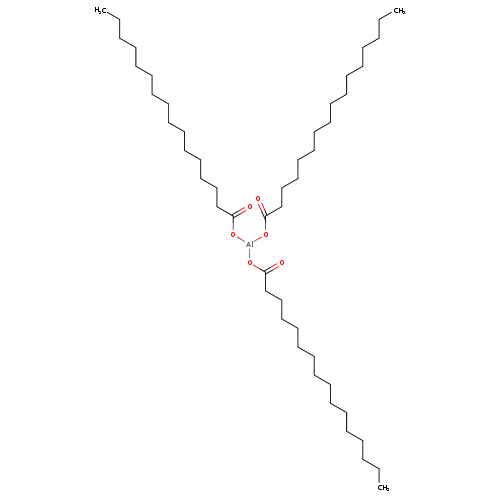
Chemical Structure
Synonyms
ValueSource
Aluminum palmitic acidGenerator
Chemical FormulaC48H93AlO6
Average Molecular Mass793.230 g/mol
Monoisotopic Mass792.679 g/mol
CAS Registry Number555-35-1
IUPAC Namebis(hexadecanoyloxy)alumanyl hexadecanoate
Traditional Namebis(hexadecanoyloxy)alumanyl hexadecanoate
SMILESCCCCCCCCCCCCCCCC(=O)O[Al](OC(=O)CCCCCCCCCCCCCCC)OC(=O)CCCCCCCCCCCCCCC
InChI IdentifierInChI=1S/3C16H32O2.Al/c3*1-2-3-4-5-6-7-8-9-10-11-12-13-14-15-16(17)18;/h3*2-15H2,1H3,(H,17,18);/q;;;+3/p-3
InChI KeyPZWDHVKNXVLHOV-UHFFFAOYSA-K
Chemical Taxonomy
Description Belongs to the class of organic compounds known as long-chain fatty acids. These are fatty acids with an aliphatic tail that contains between 13 and 21 carbon atoms.
KingdomOrganic compounds
Super ClassLipids and lipid-like molecules
ClassFatty Acyls
Sub ClassFatty acids and conjugates
Direct ParentLong-chain fatty acids
Alternative Parents
Substituents
  • Long-chain fatty acid
  • Carboxylic acid salt
  • Monocarboxylic acid or derivatives
  • Carboxylic acid
  • Carboxylic acid derivative
  • Organic oxygen compound
  • Organic oxide
  • Hydrocarbon derivative
  • Organic aluminium salt
  • Organic salt
  • Organooxygen compound
  • Carbonyl group
  • Aliphatic acyclic compound
Molecular FrameworkNot Available
External DescriptorsNot Available
Biological Properties
StatusDetected and Not Quantified
OriginExogenous
Cellular Locations
  • Membrane
Biofluid LocationsNot Available
Tissue LocationsNot Available
ApplicationsNot Available
Biological RolesNot Available
Chemical RolesNot Available
Organoleptic EffectsNot Available
Physical Properties
StateSolid
AppearanceYellow/white powder.
Experimental Properties
PropertyValue
Melting Point61.8°C
Boiling PointNot Available
SolubilityNot Available
Predicted Properties
PropertyValueSource
Water Solubility1.0e-05 g/LALOGPS
logP10.76ALOGPS
logP17.42ChemAxon
logS-7.9ALOGPS
pKa (Strongest Basic)-6.1ChemAxon
Physiological Charge0ChemAxon
Hydrogen Acceptor Count3ChemAxon
Hydrogen Donor Count0ChemAxon
Polar Surface Area78.9 ŲChemAxon
Rotatable Bond Count48ChemAxon
Refractivity228.47 m³·mol⁻¹ChemAxon
Polarizability105.55 ųChemAxon
Number of Rings0ChemAxon
BioavailabilityNoChemAxon
Rule of FiveNoChemAxon
Ghose FilterNoChemAxon
Veber's RuleNoChemAxon
MDDR-like RuleNoChemAxon
Spectra
Spectra
Spectrum TypeDescriptionSplash KeyDeposition DateView
Predicted LC-MS/MSPredicted LC-MS/MS Spectrumsplash10-0002-0000000900-4f7fffc0269f5aeaf2fdNot AvailableView Spectrum
Predicted LC-MS/MSPredicted LC-MS/MS Spectrumsplash10-0006-0000000900-47eb6823dd9a0967682bNot AvailableView Spectrum
Toxicity Profile
Toxicity Values
Toxicity ValueOrganismDose DescriptorRoute of ExposurePredicted or ExperimentalToxicity RatingReference
14112.0 Log mg/kg [7900:25000]RatLD50oralpredictedNot AvailableNot Available
Toxicity / Toxin ClassNot Available
Mechanism of ToxicityThe main target organs of aluminum are the central nervous system and bone. Aluminum binds with dietary phosphorus and impairs gastrointestinal absorption of phosphorus. The decreased phosphate body burden results in osteomalacia (softening of the bones due to defective bone mineralization) and rickets. Aluminum's neurotoxicity is believed to involve several mechanisms. Changes in cytoskeletal protein functions as a results of altered phosphorylation, proteolysis, transport, and synthesis are believed to be one cause. Aluminum may induce neurobehavioral effects by affecting permeability of the blood-brain barrier, cholinergic activity, signal transduction pathways, lipid peroxidation, and impair neuronal glutamate nitric oxide-cyclic GMP pathway, as well as interfere with metabolism of essential trace elements because of similar coordination chemistries and consequent competitive interactions. It has been suggested that aluminum's interaction with estrogen receptors increases the expression of estrogen-related genes and thereby contributes to the progression of breast cancer (1), but studies have not been able to establish a clear link between aluminum and increased risk of breast cancer (3). Certain aluminum salts induce immune responses by activating inflammasomes. (6, 1, 2)
Carcinogenicity (IARC Classification)Not listed by IARC. IARC classified aluminum production as carcinogenic to humans (Group 1), but did not implicate aluminum itself as a human carcinogen. (5) A link between use of aluminum-containing antiperspirants and increased risk of breast cancer has been proposed (1), but studies have not been able to establish a clear link (3).
Minimum Risk LevelIntermediate Oral: 1.0 mg/kg/day (4) Chronic Oral: 1.0 mg/kg/day (4)
SymptomsInhalating aluminum dust causes coughing and abnormal chest X-rays. A small percentage of people are allergic to aluminium and experience contact dermatitis, digestive disorders, vomiting or other symptoms upon contact or ingestion of products containing aluminium. (6, 7)
TreatmentNot Available
Health Effects
Health EffectRelationshipDirectionDescriptionReference
Exposure Sources
Source IDSourceSectorReference
CEDs000233Brushes?Brushes used in personal care and cosmetics can be a source of synthetic chemical contamination due to the materials and coatings used in their manufacturing.Personal care & cosmeticsPubChem
CEDs000506Antennas?Antennas, commonly used in communication technologies, can be a source of synthetic chemical contamination through the materials and coatings used in their construction.Electrical & Electronic EquipmentPubChem
CEDs000511Conductors Or Conductive Bodies Characterised By The Conductive Materials?Conductors, or conductive bodies, are materials that allow the flow of electrical current, typically made from metals such as copper, aluminum, or silver.Electrical & Electronic EquipmentPubChem
CEDs000519Electrodes?Electrodes, used in various electrical and electronic applications, can be a source of synthetic chemical contamination due to the materials from which they are constructed and the processes involved in their manufacturing.Electrical & Electronic EquipmentPubChem
CEDs000521Fixed Capacitors And Their Manufacture?Fixed capacitors are passive electronic components used to store and release electrical energy, playing a critical role in various circuits.Electrical & Electronic EquipmentPubChem
CEDs000531Relays?Relays are electromechanical switches used to control circuits and manage electrical loads.Electrical & Electronic EquipmentPubChem
CEDs000532Selectors?Selectors are components used in various electronic devices to control the flow of electrical signals.Electrical & Electronic EquipmentPubChem
CEDs000545Food Preservation?Food preservation often involves the use of synthetic chemicals, such as preservatives, flavor enhancers, and color additives, to extend shelf life and enhance the sensory qualities of food products.Food, food processing & cookwarePubChem
CEDs000555Bleaching Agents?Bleaching agents are chemical substances used to whiten or lighten materials, often employed in various cleaning products for their stain removal and disinfecting properties.Household cleaning & consumer productsPubChem
CEDs000561Perfumes Within Detergents And Soaps?Perfumes within detergents and soaps are synthetic fragrance compounds added to enhance the sensory experience of cleaning products.Household cleaning & consumer productsPubChem
CEDs000563Soap Detergents?Soap detergents are synthetic surfactants designed to enhance the cleaning efficacy of water by reducing surface tension, allowing for better interaction with dirt and grease.Household cleaning & consumer productsPubChem
CEDs000611Anti Perspirants Or Body Deoderants?Antiperspirants and body deodorants commonly contain synthetic chemicals such as aluminum compounds, parabens, and synthetic fragrances.Personal care & cosmeticsPubChem
CEDs000615Eye Makeup Products?Eye makeup products, including mascaras, eyeliners, and eyeshadows, often contain a variety of synthetic chemicals such as pigments, preservatives, and film-forming agents.Personal care & cosmeticsPubChem
CEDs000618Lip Makeup Products?Lip makeup products, such as lipsticks, lip glosses, and lip liners, often contain a variety of synthetic chemicals, including pigments, preservatives, and emollients.Personal care & cosmeticsPubChem
CEDs000642Footwear?Footwear production often involves the use of various synthetic chemicals, such as adhesives, dyes, and treatments, which can contribute to environmental contamination.Textiles, leather & furnishingsPubChem
CEDs000685Ceramics?Ceramics can be a source of synthetic chemical contamination through various additives and processing agents used in their production.Building & ConstructionPubChem
CEDs000696Nanotechnology?Nanotechnology involves the manipulation of materials at the molecular or atomic level, typically within the range of 1 to 100 nanometers.Industrial manufacturing & chemical processingPubChem
CEDs000711Coloured Pencils?Coloured pencils are commonly used tools for artistic expression and education, composed primarily of a wood casing and a core made from a mixture of pigments, binders, and waxes.Paper, pulp & fiber productsPubChem
CEDs000734Coating Compositions?Coating compositions, which include paints, sealants, and varnishes, are formulated with a variety of synthetic chemicals such as solvents, resins, pigments, and additives.Building & ConstructionPubChem
CEDs000739Inks?Inks are complex mixtures composed of pigments or dyes, solvents, resins, and additives used primarily for printing and writing applications.Paper, pulp & fiber productsPubChem
CEDs000740Paper?Paper production involves the processing of wood fibers and the use of various chemicals, which can lead to synthetic chemical contamination.Paper, pulp & fiber productsPubChem
CEDs000743Sludge Treatment?Sludge treatment involves the processing of waste materials generated from wastewater treatment plants, which often contain a variety of organic and inorganic substances.Wastewater, sanitation & biosolidsPubChem
CEDs000744Water, Wastewater, & Sewage Treatment?Water, wastewater, and sewage treatment processes are critical for managing and mitigating pollutants in water systems.Wastewater, sanitation & biosolidsPubChem
Pathways
0 pathwaysPathway Source: PathBank

No pathways found

No metabolic pathways have been associated with this synthetic chemical

Targets
StructureProteinUniProt IDOrganismRelationshipDetails
Tyrosine-protein phosphatase non-receptor type 1 structureClick to view 3D structureTyrosine-protein phosphatase non-receptor type 1P18031HumansPredicted (SEA)
Prediction Confidence Score
0.463
Applicability Domain
0.5
Statistical Significance
0.0011
Supporting Reference Compounds
197
E-value
8.25202
Peroxisome proliferator-activated receptor alpha structureClick to view 3D structurePeroxisome proliferator-activated receptor alphaQ07869HumansPredicted (SEA)
Prediction Confidence Score
0.463
Applicability Domain
0.5
Statistical Significance
0.0014
Supporting Reference Compounds
127
E-value
11.0546
Transient receptor potential cation channel subfamily V member 2 structureClick to view 3D structureTransient receptor potential cation channel subfamily V member 2Q9WUD2Rattus norvegicusPredicted (SEA)
Prediction Confidence Score
0.441
Applicability Domain
0.5
Statistical Significance
6.10e-04
Supporting Reference Compounds
21
E-value
4.7488
Peroxisome proliferator-activated receptor delta structureClick to view 3D structurePeroxisome proliferator-activated receptor deltaQ03181HumansPredicted (SEA)
Prediction Confidence Score
0.437
Applicability Domain
0.5
Statistical Significance
0.0013
Supporting Reference Compounds
89
E-value
10.0426
Click to view 3D structureCAI-1 autoinducer sensor kinase/phosphatase CqsSQ9KM66Vibrio cholerae serotype O1 (strain ATCC 39315 / El Tor Inaba N16961)Predicted (SEA)
Prediction Confidence Score
0.419
Applicability Domain
0.419
Statistical Significance
7.00e-05
Supporting Reference Compounds
1
E-value
0.544945
Peroxisome proliferator-activated receptor gamma structureClick to view 3D structurePeroxisome proliferator-activated receptor gammaP37231HumansPredicted (SEA)
Prediction Confidence Score
0.411
Applicability Domain
0.5
Statistical Significance
0.0028
Supporting Reference Compounds
192
E-value
21.5642
Click to view 3D structureMitochondrial carnitine/acylcarnitine carrier proteinO43772HumansPredicted (SEA)
Prediction Confidence Score
0.4
Applicability Domain
0.4
Statistical Significance
5.00e-05
Supporting Reference Compounds
1
E-value
0.389246
G-protein coupled receptor 84 structureClick to view 3D structureG-protein coupled receptor 84Q9NQS5HumansPredicted (SEA)
Prediction Confidence Score
0.398
Applicability Domain
0.5
Statistical Significance
3.50e-04
Supporting Reference Compounds
15
E-value
2.72472
Click to view 3D structureFatty-acid amide hydrolase 1O00519HumansPredicted (SEA)
Prediction Confidence Score
0.39
Applicability Domain
0.433
Statistical Significance
0.0027
Supporting Reference Compounds
106
E-value
20.9414
Click to view 3D structureHistone deacetylase 11Q96DB2HumansPredicted (SEA)
Prediction Confidence Score
0.382
Applicability Domain
0.5
Statistical Significance
0.0033
Supporting Reference Compounds
149
E-value
25.4567
Autotaxin structureClick to view 3D structureAutotaxinQ13822HumansPredicted (SEA)
Prediction Confidence Score
0.378
Applicability Domain
0.39
Statistical Significance
8.30e-04
Supporting Reference Compounds
40
E-value
6.46149
Click to view 3D structureLysophosphatidic acid receptor 3Q9UBY5HumansPredicted (SEA)
Prediction Confidence Score
0.378
Applicability Domain
0.39
Statistical Significance
4.10e-04
Supporting Reference Compounds
21
E-value
3.19182
Click to view 3D structureCocaine esteraseO00748HumansPredicted (SEA)
Prediction Confidence Score
0.378
Applicability Domain
0.433
Statistical Significance
2.30e-04
Supporting Reference Compounds
40
E-value
1.79053
Lysophosphatidic acid receptor 1 structureClick to view 3D structureLysophosphatidic acid receptor 1Q92633HumansPredicted (SEA)
Prediction Confidence Score
0.373
Applicability Domain
0.39
Statistical Significance
4.40e-04
Supporting Reference Compounds
31
E-value
3.42537
Lysophosphatidic acid receptor 2 structureClick to view 3D structureLysophosphatidic acid receptor 2Q9HBW0HumansPredicted (SEA)
Prediction Confidence Score
0.371
Applicability Domain
0.381
Statistical Significance
4.10e-04
Supporting Reference Compounds
30
E-value
3.19182
Juvenile hormone esterase structureClick to view 3D structureJuvenile hormone esteraseQ9GPG0Manduca sextaPredicted (SEA)
Prediction Confidence Score
0.365
Applicability Domain
0.433
Statistical Significance
8.00e-05
Supporting Reference Compounds
2
E-value
0.622794
Click to view 3D structureAcidic phospholipase A2 CM-IP00602Naja mossambicaPredicted (SEA)
Prediction Confidence Score
0.364
Applicability Domain
0.364
Statistical Significance
4.40e-04
Supporting Reference Compounds
1
E-value
3.42537
DNA-directed DNA/RNA polymerase mu structureClick to view 3D structureDNA-directed DNA/RNA polymerase muQ9NP87HumansPredicted (SEA)
Prediction Confidence Score
0.364
Applicability Domain
0.364
Statistical Significance
4.00e-05
Supporting Reference Compounds
1
E-value
0.311397
Click to view 3D structureDNA nucleotidylexotransferaseP06526Bos taurusPredicted (SEA)
Prediction Confidence Score
0.364
Applicability Domain
0.364
Statistical Significance
4.00e-05
Supporting Reference Compounds
1
E-value
0.311397
Click to view 3D structureCannabinoid receptor 1P20272Rattus norvegicusPredicted (SEA)
Prediction Confidence Score
0.362
Applicability Domain
0.406
Statistical Significance
0.0031
Supporting Reference Compounds
83
E-value
24.289
Fatty-acid amide hydrolase 1 structureClick to view 3D structureFatty-acid amide hydrolase 1P97612Rattus norvegicusPredicted (SEA)
Prediction Confidence Score
0.356
Applicability Domain
0.433
Statistical Significance
0.003
Supporting Reference Compounds
102
E-value
23.1212
Click to view 3D structureLysophosphatidic acid receptor 4Q8BLG2Mus musculusPredicted (SEA)
Prediction Confidence Score
0.356
Applicability Domain
0.356
Statistical Significance
4.00e-04
Supporting Reference Compounds
1
E-value
3.11397
Liver carboxylesterase 1 structureClick to view 3D structureLiver carboxylesterase 1P23141HumansPredicted (SEA)
Prediction Confidence Score
0.352
Applicability Domain
0.433
Statistical Significance
0.0011
Supporting Reference Compounds
55
E-value
8.95266
Click to view 3D structureCG8425-PA [Drosophila melanogaster]A1ZA98Drosophila melanogasterPredicted (SEA)
Prediction Confidence Score
0.343
Applicability Domain
0.433
Statistical Significance
9.00e-05
Supporting Reference Compounds
4
E-value
0.700643
DNA polymerase iota structureClick to view 3D structureDNA polymerase iotaQ6R3M4Mus musculusPredicted (SEA)
Prediction Confidence Score
0.342
Applicability Domain
0.364
Statistical Significance
7.00e-05
Supporting Reference Compounds
2
E-value
0.544945
Estrogen receptor structureClick to view 3D structureEstrogen receptorP03372HumansKnownAluminum can also interact with estrogen receptors, increasing the expression of estrogen-related genes and contributing to the progression of breast cancer. (A235)
Concentrations
Not Available
External Links
DrugBank IDNot Available
HMDB IDNot Available
FooDB IDNot Available
Phenol Explorer IDNot Available
KNApSAcK IDNot Available
BiGG IDNot Available
BioCyc IDNot Available
METLIN IDNot Available
PDB IDNot Available
Wikipedia LinkNot Available
Chemspider IDNot Available
ChEBI IDNot Available
PubChem Compound ID11144
Kegg Compound IDNot Available
YMDB IDNot Available
ECMDB IDNot Available
References
Synthesis ReferenceNot Available
MSDSNot Available
General References
  1. Darbre PD: Metalloestrogens: an emerging class of inorganic xenoestrogens with potential to add to the oestrogenic burden of the human breast. J Appl Toxicol. 2006 May-Jun;26(3):191-7. [PubMed: 16489580]
  2. Aimanianda V, Haensler J, Lacroix-Desmazes S, Kaveri SV, Bayry J: Novel cellular and molecular mechanisms of induction of immune responses by aluminum adjuvants. Trends Pharmacol Sci. 2009 Jun;30(6):287-95. doi: 10.1016/j.tips.2009.03.005. Epub 2009 May 11. [PubMed: 19439372]
  3. Willhite CC, Karyakina NA, Yokel RA, Yenugadhati N, Wisniewski TM, Arnold IM, Momoli F, Krewski D: Systematic review of potential health risks posed by pharmaceutical, occupational and consumer exposures to metallic and nanoscale aluminum, aluminum oxides, aluminum hydroxide and its soluble salts. Crit Rev Toxicol. 2014 Oct;44 Suppl 4:1-80. doi: 10.3109/10408444.2014.934439. [PubMed: 25233067]
  4. ATSDR - Agency for Toxic Substances and Disease Registry (2001). Minimal Risk Levels (MRLs) for Hazardous Substances. U.S. Public Health Service in collaboration with U.S. Environmental Protection Agency (EPA). - http://www.atsdr.cdc.gov/mrls/
  5. International Agency for Research on Cancer (2014). IARC Monographs on the Evaluation of Carcinogenic Risks to Humans. - http://monographs.iarc.fr/index.php
  6. ATSDR - Agency for Toxic Substances and Disease Registry (2008). Toxicological profile for aluminum. U.S. Public Health Service in collaboration with U.S. Environmental Protection Agency (EPA). - http://www.atsdr.cdc.gov/toxprofiles/tp22.html
  7. Wikipedia. Aluminium. Last Updated 16 June 2009. - http://en.wikipedia.org/wiki/Aluminum