Phenyl isocyanate (CED0008077)

Record Information
Version1.0
Creation Date2009-06-22 16:08:24 UTC
Update Date2026-08-24 03:30:01 UTC
SynCED IDCED0008077
Secondary Accession Numbers
  • CHEM001416
  • T3D1659
Identification
Common NamePhenyl isocyanate
ClassSmall Molecule
Description
Phenyl isocyanate belongs to the benzene and substituted derivatives, a class of benzenoids within the organic compounds. This exogenous liquid has the formula C7H5NO and an average molecular weight of 119.12 g/mol. It serves a biological role as a hapten. The compound is found in or released from 25 recorded sources. These include electrical and electronic equipment such as antennas, coils, contacts, auxiliary devices, and conductors or conductive bodies characterised by the conductive materials. It is also present in building and construction materials like floors, roofs, and tents or canopies. In household cleaning and consumer products, it is found in soap dispensers, soap detergents, and perfumes within detergents and soaps. Additionally, it is associated with drinking water and water supply, as well as food, food processing and cookware, specifically including food preservation, food contact materials, and processing fish. Recorded exposure routes include touch, oral, and inhalation. Phenyl isocyanate is associated with 31 recorded protein targets. It inhibits tyrosinase and glutathione reductase, mitochondrial. It also inhibits superoxide dismutase [Cu-Zn], catalase, and alkaline phosphatases, including the tissue-nonspecific isozyme (ALPL) and germ cell type (ALPG). Furthermore, it inhibits glutathione peroxidases, including glutathione peroxidase 1 (GPX1), 2 (GPX2), 3 (GPX3), and epididymal secretory glutathione peroxidase (GPX5), among four other proteins. It inhibits succinate dehydrogenases, specifically the mitochondrial subunits SDHA, SDHB, SDHC, and SDHD. Finally, it acts as an inhibitor of cytochrome c oxidase in the fourth complex of the electron transport chain, targeting proteins such as cytochrome c oxidase subunit 1 (MT-CO1), subunit 2 (MT-CO2), subunit 3 (MT-CO3), and subunit 7A1 (COX7A1), along with nine other proteins.
Contaminant Type
  • Aromatic Hydrocarbon
  • Cyanide Compound
  • Industrial/Workplace Toxin
  • Organic Compound
  • Pollutant
  • Synthetic Compound
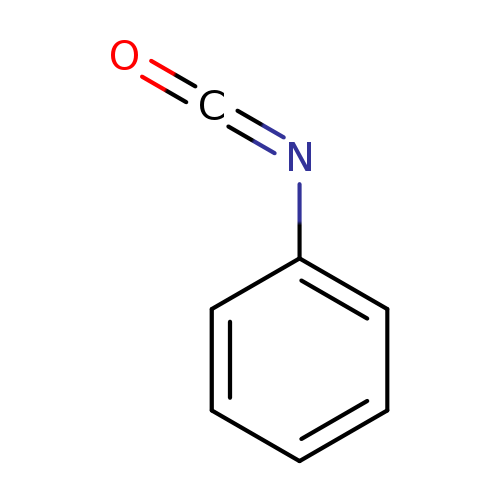
Chemical Structure
Synonyms
ValueSource
CarbanilChEBI
Isocyanic acid, phenyl esterChEBI
Phenyl carbonimideChEBI
PhenylcarbimideChEBI
PhNCOChEBI
PIChEBI
PICChEBI
Isocyanate, phenyl esterGenerator
Phenyl isocyanic acidHMDB
Phenyl isocyanate, 14C-labeled CPDHMDB
Chemical FormulaC7H5NO
Average Molecular Mass119.121 g/mol
Monoisotopic Mass119.037 g/mol
CAS Registry Number103-71-9
IUPAC Nameisocyanatobenzene
Traditional Namephenyl isocyanate
SMILESO=C=NC1=CC=CC=C1
InChI IdentifierInChI=1S/C7H5NO/c9-6-8-7-4-2-1-3-5-7/h1-5H
InChI KeyDGTNSSLYPYDJGL-UHFFFAOYSA-N
Chemical Taxonomy
Description Belongs to the class of organic compounds known as benzene and substituted derivatives. These are aromatic compounds containing one monocyclic ring system consisting of benzene.
KingdomOrganic compounds
Super ClassBenzenoids
ClassBenzene and substituted derivatives
Sub ClassNot Available
Direct ParentBenzene and substituted derivatives
Alternative Parents
Substituents
  • Monocyclic benzene moiety
  • Isocyanate
  • Organic 1,3-dipolar compound
  • Propargyl-type 1,3-dipolar organic compound
  • Organic nitrogen compound
  • Organic oxygen compound
  • Organopnictogen compound
  • Organic oxide
  • Hydrocarbon derivative
  • Organooxygen compound
  • Organonitrogen compound
  • Aromatic homomonocyclic compound
Molecular FrameworkAromatic homomonocyclic compounds
External Descriptors
Biological Properties
StatusDetected and Not Quantified
OriginExogenous
Cellular Locations
  • Cytoplasm
  • Extracellular
Biofluid LocationsNot Available
Tissue LocationsNot Available
ApplicationsNot Available
Biological Roles
Chemical RolesNot Available
Organoleptic EffectsNot Available
Physical Properties
StateLiquid
AppearanceNot Available
Experimental Properties
PropertyValue
Melting Point< 25°C
Boiling PointNot Available
SolubilityNot Available
Predicted Properties
PropertyValueSource
Water Solubility0.74 g/LALOGPS
logP1.3ALOGPS
logP1.88ChemAxon
logS-2.2ALOGPS
pKa (Strongest Basic)-1.8ChemAxon
Physiological Charge0ChemAxon
Hydrogen Acceptor Count2ChemAxon
Hydrogen Donor Count0ChemAxon
Polar Surface Area29.43 ŲChemAxon
Rotatable Bond Count1ChemAxon
Refractivity35.13 m³·mol⁻¹ChemAxon
Polarizability11.7 ųChemAxon
Number of Rings1ChemAxon
BioavailabilityYesChemAxon
Rule of FiveYesChemAxon
Ghose FilterNoChemAxon
Veber's RuleYesChemAxon
MDDR-like RuleNoChemAxon
Spectra
Spectra
Spectrum TypeDescriptionSplash KeyDeposition DateView
GC-MSGC-MS Spectrumsplash10-014i-9800000000-e9dab12b4b75a24bbf57Not AvailableView Spectrum
Predicted GC-MSPredicted GC-MS Spectrumsplash10-014i-9700000000-287f0a2529e025f628feNot AvailableView Spectrum
Predicted GC-MSPredicted GC-MS SpectrumNot AvailableNot AvailableView Spectrum
Predicted LC-MS/MSPredicted LC-MS/MS Spectrumsplash10-00di-0900000000-c6404c22cbedb4c88ed6Not AvailableView Spectrum
Predicted LC-MS/MSPredicted LC-MS/MS Spectrumsplash10-00di-0900000000-060d6e8c291f812bd15aNot AvailableView Spectrum
Predicted LC-MS/MSPredicted LC-MS/MS Spectrumsplash10-00di-6900000000-3da7c2a24c7ae532965dNot AvailableView Spectrum
Predicted LC-MS/MSPredicted LC-MS/MS Spectrumsplash10-014i-0900000000-82b9326983fdd9820a88Not AvailableView Spectrum
Predicted LC-MS/MSPredicted LC-MS/MS Spectrumsplash10-014i-3900000000-e5eb02eae55efd00ba8cNot AvailableView Spectrum
Predicted LC-MS/MSPredicted LC-MS/MS Spectrumsplash10-014i-0900000000-d0736534b1b53c3585caNot AvailableView Spectrum
Predicted LC-MS/MSPredicted LC-MS/MS Spectrumsplash10-014i-9200000000-5567121493ffaf5d16e0Not AvailableView Spectrum
Predicted LC-MS/MSPredicted LC-MS/MS Spectrumsplash10-00di-0900000000-0e7b8f26b3bbd86a97ceNot AvailableView Spectrum
Predicted LC-MS/MSPredicted LC-MS/MS Spectrumsplash10-00di-1900000000-b1eaeff85b64e1f5ad44Not AvailableView Spectrum
Predicted LC-MS/MSPredicted LC-MS/MS Spectrumsplash10-014i-9000000000-498b7964d2c0a8237a53Not AvailableView Spectrum
MSMS Spectrumsplash10-02tc-9300000000-2ad487bf457f70a7b7afNot AvailableView Spectrum
Toxicity Profile
Toxicity Values
Toxicity ValueOrganismDose DescriptorRoute of ExposurePredicted or ExperimentalToxicity RatingReference
196.0 mg/kg RatLD50OralexperimentalNot Available1
953.0 Log mg/kg [540:1700]RatLD50oralpredictedNot AvailableNot Available
Toxicity / Toxin ClassNot Available
Mechanism of ToxicityCyanide is an inhibitor of cytochrome c oxidase in the fourth complex of the electron transport chain (found in the membrane of the mitochondria of eukaryotic cells). It complexes with the ferric iron atom in this enzyme. The binding of cyanide to this cytochrome prevents transport of electrons from cytochrome c oxidase to oxygen. As a result, the electron transport chain is disrupted and the cell can no longer aerobically produce ATP for energy. Tissues that mainly depend on aerobic respiration, such as the central nervous system and the heart, are particularly affected. Cyanide is also known produce some of its toxic effects by binding to catalase, glutathione peroxidase, methemoglobin, hydroxocobalamin, phosphatase, tyrosinase, ascorbic acid oxidase, xanthine oxidase, succinic dehydrogenase, and Cu/Zn superoxide dismutase. Cyanide binds to the ferric ion of methemoglobin to form inactive cyanmethemoglobin. (3)
Carcinogenicity (IARC Classification)No indication of carcinogenicity to humans (not listed by IARC).
Minimum Risk LevelNot Available
SymptomsCyanide poisoning is identified by rapid, deep breathing and shortness of breath, general weakness, giddiness, headaches, vertigo, confusion, convulsions/seizures and eventually loss of consciousness. (2, 3)
TreatmentAntidotes to cyanide poisoning include hydroxocobalamin and sodium nitrite, which release the cyanide from the cytochrome system, and rhodanase, which is an enzyme occurring naturally in mammals that combines serum cyanide with thiosulfate, producing comparatively harmless thiocyanate. Oxygen therapy can also be administered. (3)
Health Effects
Health EffectRelationshipDirectionDescriptionReference
Exposure Sources
Source IDSourceSectorReference
CEDs000010Insecticides?Insecticides are synthetic chemicals designed to control or eliminate insect pests that threaten crops and other agricultural products.Agriculture & land managementPubChem
CEDs000115Drinking water?Drinking water can be a medium for synthetic chemical contamination, often originating from various industrial processes and agricultural practices.Drinking water & water supplyNot Available
CEDs000233Brushes?Brushes used in personal care and cosmetics can be a source of synthetic chemical contamination due to the materials and coatings used in their manufacturing.Personal care & cosmeticsPubChem
CEDs000494Food contact materials?Food contact materials refer to substances and products that are intended to come into contact with food during processing, packaging, or preparation.Food, food processing & cookwareNot Available
CEDs000497Floors?Floors in built environments can be a significant source of synthetic chemical contamination due to the materials and finishes used in their construction.Building & ConstructionPubChem
CEDs000499Roofs?Roofs can be a significant source of synthetic chemical contamination due to the materials used in their construction and maintenance.Building & ConstructionPubChem
CEDs000503Tents Or Canopies?Tents and canopies used in various applications can be a source of synthetic chemical contamination primarily due to the materials from which they are made.Building & ConstructionPubChem
CEDs000506Antennas?Antennas, commonly used in communication technologies, can be a source of synthetic chemical contamination through the materials and coatings used in their construction.Electrical & Electronic EquipmentPubChem
CEDs000507Auxiliary Devices?Auxiliary devices, such as capacitors, transformers, and circuit breakers, are integral components in various electronic systems.Electrical & Electronic EquipmentPubChem
CEDs000508Coils?Coils are components used in various electrical and electronic applications, such as transformers, inductors, and motors.Electrical & Electronic EquipmentPubChem
CEDs000511Conductors Or Conductive Bodies Characterised By The Conductive Materials?Conductors, or conductive bodies, are materials that allow the flow of electrical current, typically made from metals such as copper, aluminum, or silver.Electrical & Electronic EquipmentPubChem
CEDs000512Contacts?Contacts in electrical and electronic equipment are components that facilitate the flow of electricity between circuits.Electrical & Electronic EquipmentPubChem
CEDs000513Cores Yokes Or Armatures?Cores, yokes, or armatures are components commonly found in electrical devices, used to facilitate the magnetic and electrical functions within motors, transformers, and generators.Electrical & Electronic EquipmentPubChem
CEDs000516Electric Hearing Aids?Electric hearing aids are small electronic devices designed to amplify sound for individuals with hearing loss.Electrical & Electronic EquipmentPubChem
CEDs000517Electric Switches?Electric switches, integral components in numerous devices, can be a source of synthetic chemical contamination due to the materials and manufacturing processes involved in their production.Electrical & Electronic EquipmentPubChem
CEDs000519Electrodes?Electrodes, used in various electrical and electronic applications, can be a source of synthetic chemical contamination due to the materials from which they are constructed and the processes involved in their manufacturing.Electrical & Electronic EquipmentPubChem
CEDs000520Emergency Protective Devices?Emergency protective devices, such as circuit breakers and surge protectors, are essential components in electrical systems designed to prevent damage from overcurrent and surges.Electrical & Electronic EquipmentPubChem
CEDs000521Fixed Capacitors And Their Manufacture?Fixed capacitors are passive electronic components used to store and release electrical energy, playing a critical role in various circuits.Electrical & Electronic EquipmentPubChem
CEDs000524Hybrid Capacitors?Hybrid capacitors are energy storage devices that combine the properties of electrolytic and supercapacitors, utilizing a combination of electrochemical principles to achieve higher energy density and power density.Electrical & Electronic EquipmentPubChem
CEDs000529Power Cables?Power cables are used to transmit electrical energy and are typically composed of conductive materials, insulation, and protective coatings.Electrical & Electronic EquipmentPubChem
CEDs000532Selectors?Selectors are components used in various electronic devices to control the flow of electrical signals.Electrical & Electronic EquipmentPubChem
CEDs000535Superconducting Magnets And Superconducting Coils?Superconducting magnets and coils are utilized in various applications that require strong magnetic fields, such as magnetic resonance imaging (MRI) and particle accelerators.Electrical & Electronic EquipmentPubChem
CEDs000545Food Preservation?Food preservation often involves the use of synthetic chemicals, such as preservatives, flavor enhancers, and color additives, to extend shelf life and enhance the sensory qualities of food products.Food, food processing & cookwarePubChem
CEDs000551Processing Fish?Processing fish can lead to synthetic chemical contamination through various stages of production and preservation.Food, food processing & cookwarePubChem
CEDs000561Perfumes Within Detergents And Soaps?Perfumes within detergents and soaps are synthetic fragrance compounds added to enhance the sensory experience of cleaning products.Household cleaning & consumer productsPubChem
CEDs000563Soap Detergents?Soap detergents are synthetic surfactants designed to enhance the cleaning efficacy of water by reducing surface tension, allowing for better interaction with dirt and grease.Household cleaning & consumer productsPubChem
CEDs000564Soap Dispensers?Soap dispensers, commonly used for dispensing liquid soaps and sanitizers, can become a source of synthetic chemical contamination due to the materials used in their construction and the products they dispense.Household cleaning & consumer productsPubChem
CEDs000579Manufacture Of Iron Or Steel?The manufacture of iron or steel involves various processes, including smelting, refining, and alloying, which can result in the release of synthetic chemicals and contaminants.Industrial manufacturing & chemical processingPubChem
CEDs000581Paper Making Machines?Paper making machines utilize various synthetic chemicals throughout the production process, including additives, coatings, and bleaching agents.Industrial manufacturing & chemical processingPubChem
CEDs000596Acaricides?Acaricides are synthetic chemicals specifically designed to target and control mite populations that can damage crops and plants.Agriculture & land managementPubChem
CEDs000600Herbicides And Algicides?Herbicides and algicides are synthetic chemicals primarily used to control unwanted plants and algae in various environments.Agriculture & land managementPubChem
CEDs000602Molluscicides?Molluscicides are synthetic chemicals specifically designed to control and eliminate mollusks, such as snails and slugs, which can be detrimental to crops and agricultural productivity.Agriculture & land managementPubChem
CEDs000603Nematocides?Nematocides are synthetic chemicals specifically designed to control nematodes, which are microscopic roundworms that can cause significant damage to crops and plants.Agriculture & land managementPubChem
CEDs000604Pest Attractants?Pest attractants are synthetic chemicals designed to lure specific pests for monitoring or control purposes.Agriculture & land managementPubChem
CEDs000605Pest Repellants?Pest repellents, often formulated from synthetic chemicals, are widely used to protect crops from insect infestations and other pests.Agriculture & land managementPubChem
CEDs000606Plant Growth Regulators?Plant Growth Regulators (PGRs) are synthetic chemicals designed to influence the growth and development of plants.Agriculture & land managementPubChem
CEDs000611Anti Perspirants Or Body Deoderants?Antiperspirants and body deodorants commonly contain synthetic chemicals such as aluminum compounds, parabens, and synthetic fragrances.Personal care & cosmeticsPubChem
CEDs000614Essential Oils Or Perfumes?Essential oils and perfumes are complex mixtures of volatile compounds derived from natural or synthetic sources, commonly used for their aromatic properties.Personal care & cosmeticsPubChem
CEDs000615Eye Makeup Products?Eye makeup products, including mascaras, eyeliners, and eyeshadows, often contain a variety of synthetic chemicals such as pigments, preservatives, and film-forming agents.Personal care & cosmeticsPubChem
CEDs000617Lip Care Products?Lip care products, including lipsticks, balms, and glosses, often contain a variety of synthetic chemicals such as parabens, phthalates, and synthetic fragrances.Personal care & cosmeticsPubChem
CEDs000618Lip Makeup Products?Lip makeup products, such as lipsticks, lip glosses, and lip liners, often contain a variety of synthetic chemicals, including pigments, preservatives, and emollients.Personal care & cosmeticsPubChem
CEDs000619Manicure Pedicure?Manicure and pedicure procedures often involve the use of various synthetic chemicals, including solvents, nail polishes, and nail adhesives.Personal care & cosmeticsPubChem
CEDs000625Racing Sports?Racing sports often utilize synthetic surfaces, such as polyurethane or rubberized tracks, to enhance performance and safety.Recreation & sports surfacesPubChem
CEDs000630Toys?Toys, particularly those made from synthetic materials such as plastics, can be a source of chemical contamination due to the presence of various additives and compounds used in their production.Recreation & sports surfacesPubChem
CEDs000631Anthraquinone Dyes?Anthraquinone dyes are a class of synthetic organic compounds characterized by their vibrant colors and stability, making them widely used in various applications, particularly in coloring textiles and leather.Textiles, leather & furnishingsPubChem
CEDs000632Apparel?Apparel production often involves the use of various synthetic chemicals, including dyes, finishing agents, and preservatives.Textiles, leather & furnishingsPubChem
CEDs000633Azo Dyes?Azo dyes are synthetic organic compounds characterized by the presence of one or more azo groups (-N=N-), which are widely used for coloring textiles, leather, and furnishings.Textiles, leather & furnishingsPubChem
CEDs000634Buckles?Buckles, commonly used as fasteners in clothing, accessories, and furniture, can be a source of synthetic chemical contamination due to the materials and coatings employed in their production.Textiles, leather & furnishingsPubChem
CEDs000638Decorating Textiles?Decorating textiles often involves the use of synthetic chemicals such as dyes, finishes, and coatings.Textiles, leather & furnishingsPubChem
CEDs000642Footwear?Footwear production often involves the use of various synthetic chemicals, such as adhesives, dyes, and treatments, which can contribute to environmental contamination.Textiles, leather & furnishingsPubChem
CEDs000643Headwear?Headwear made from synthetic materials often incorporates chemicals used in the manufacturing and finishing processes, such as dyes, flame retardants, and water repellents.Textiles, leather & furnishingsPubChem
CEDs000648Nitro Dyes?Nitro dyes are synthetic colorants that contain nitro groups (-NO2) in their chemical structure.Textiles, leather & furnishingsPubChem
CEDs000650Purses Luggage Hand Bags?Purses, luggage, and handbags are often manufactured using synthetic materials such as polyvinyl chloride (PVC), polyurethane, and various types of nylon.Textiles, leather & furnishingsPubChem
CEDs000652Ropes?Ropes manufactured from synthetic fibers, such as polypropylene, nylon, and polyester, are widely used in various applications, including marine, construction, and outdoor activities.Textiles, leather & furnishingsPubChem
CEDs000657Surface Finishing Of Leather?Surface finishing of leather often involves the use of various synthetic chemicals, including dyes, resins, and finishing agents.Textiles, leather & furnishingsPubChem
CEDs000658Touch Fasteners?Touch fasteners, commonly known as hook-and-loop fasteners, are composed of synthetic materials such as nylon or polyester.Textiles, leather & furnishingsPubChem
CEDs000659Transfer Printing?Transfer printing is a process used to apply designs and patterns onto various substrates, commonly utilizing synthetic dyes and inks that can contain hazardous chemicals.Textiles, leather & furnishingsPubChem
CEDs000661Umbrellas?Umbrellas are commonly manufactured using synthetic materials such as polyester, nylon, and polyvinyl chloride (PVC), which can contribute to synthetic chemical contamination.Textiles, leather & furnishingsPubChem
CEDs000662Yarns Or Threads?Yarns or threads used in textiles can be a source of synthetic chemical contamination due to the production processes and treatments they undergo.Textiles, leather & furnishingsPubChem
CEDs000670Solid Fire Fighting Substances?Solid fire fighting substances, such as certain types of dry chemical powders, are used in fire suppression applications to extinguish flames and prevent fire spread.Fire suppression systems & agentsPubChem
CEDs000671Airplanes And Helicopters?Airplanes and helicopters are significant sources of synthetic chemical contamination primarily through the use of aviation fuels, lubricants, and de-icing agents.Aviation & AerospacePubChem
CEDs000678Nitrogenous Fertilisers?Nitrogenous fertilizers are synthetic chemical compounds primarily used to enhance plant growth by supplying essential nitrogen, a crucial nutrient for photosynthesis and protein synthesis.Agriculture & land managementPubChem
CEDs000679Phosphatic Fertilisers?Phosphatic fertilizers are synthetic chemical products primarily composed of phosphorus, which is essential for plant growth.Agriculture & land managementPubChem
CEDs000684Cements?Cements are a composite material primarily used as a binding agent in construction applications, formed by the calcination of limestone and clay minerals at high temperatures.Building & ConstructionPubChem
CEDs000685Ceramics?Ceramics can be a source of synthetic chemical contamination through various additives and processing agents used in their production.Building & ConstructionPubChem
CEDs000686Clay Wares?Clay wares are ceramic products made from natural clay, often utilized in various construction applications such as tiles, bricks, and sanitary ware.Building & ConstructionPubChem
CEDs000688Glass Coatings?Glass coatings are synthetic chemical formulations applied to glass surfaces to enhance properties such as durability, UV resistance, and aesthetic appeal.Building & ConstructionPubChem
CEDs000693Silica Glass?Silica glass, primarily composed of silicon dioxide (SiO2), is widely used in various applications, including windows, glass facades, and insulation materials.Building & ConstructionPubChem
CEDs000696Nanotechnology?Nanotechnology involves the manipulation of materials at the molecular or atomic level, typically within the range of 1 to 100 nanometers.Industrial manufacturing & chemical processingPubChem
CEDs000697Submarines?Submarines, while essential for military and research purposes, can be a source of synthetic chemical contamination due to their use of various industrial chemicals.Marine, shipping & aquaculturePubChem
CEDs000703Blackboards?Blackboards, traditionally made from slate or coated wood, can also be produced using synthetic materials that may contain various chemicals.Paper, pulp & fiber productsPubChem
CEDs000727Printing Machines Or Presses?Printing machines or presses commonly utilize synthetic chemicals such as inks, solvents, and cleaning agents.Paper, pulp & fiber productsPubChem
CEDs000734Coating Compositions?Coating compositions, which include paints, sealants, and varnishes, are formulated with a variety of synthetic chemicals such as solvents, resins, pigments, and additives.Building & ConstructionPubChem
CEDs000735Explosives?Explosives are chemical compounds or mixtures designed to undergo rapid decomposition, releasing energy in the form of gas and heat.Defense & military infrastructurePubChem
CEDs000737Chemical Igniters?Chemical igniters are substances or devices designed to initiate combustion in various applications, often found in products like lighters, candles, and certain household cleaning agents.Household itemsPubChem
CEDs000739Inks?Inks are complex mixtures composed of pigments or dyes, solvents, resins, and additives used primarily for printing and writing applications.Paper, pulp & fiber productsPubChem
CEDs000740Paper?Paper production involves the processing of wood fibers and the use of various chemicals, which can lead to synthetic chemical contamination.Paper, pulp & fiber productsPubChem
CEDs000741Pigment Pastes?Pigment pastes are concentrated dispersions of pigments used to impart color and properties to materials.Paper, pulp & fiber productsPubChem
CEDs000742Leather Tanning?Leather tanning is a process that transforms raw animal hides into durable leather through the application of various chemicals, including chromium salts, aldehydes, and vegetable tannins.Textiles, leather & furnishingsPubChem
CEDs000743Sludge Treatment?Sludge treatment involves the processing of waste materials generated from wastewater treatment plants, which often contain a variety of organic and inorganic substances.Wastewater, sanitation & biosolidsPubChem
CEDs000744Water, Wastewater, & Sewage Treatment?Water, wastewater, and sewage treatment processes are critical for managing and mitigating pollutants in water systems.Wastewater, sanitation & biosolidsPubChem
Pathways
0 pathwaysPathway Source: PathBank

No pathways found

No metabolic pathways have been associated with this synthetic chemical

Targets
StructureProteinUniProt IDOrganismRelationshipDetails
Click to view 3D structureAldehyde dehydrogenase 1A1P51647Rattus norvegicusPredicted (SEA)
Prediction Confidence Score
0.476
Applicability Domain
0.476
Statistical Significance
1.00e-05
Supporting Reference Compounds
1
E-value
0.0778492
Carbonic anhydrase 2 structureClick to view 3D structureCarbonic anhydrase 2P00918HumansPredicted (SEA)
Prediction Confidence Score
0.262
Applicability Domain
0.273 Low confidence
Statistical Significance
0.1196
Supporting Reference Compounds
472
E-value
931.155
Carbonic anhydrase 1 structureClick to view 3D structureCarbonic anhydrase 1P00915HumansPredicted (SEA)
Prediction Confidence Score
0.256
Applicability Domain
0.269 Low confidence
Statistical Significance
0.118
Supporting Reference Compounds
407
E-value
918.854
Carbonic anhydrase 12 structureClick to view 3D structureCarbonic anhydrase 12O43570HumansPredicted (SEA)
Prediction Confidence Score
0.253
Applicability Domain
0.273 Low confidence
Statistical Significance
0.1081
Supporting Reference Compounds
332
E-value
841.394
Carbonic anhydrase 4 structureClick to view 3D structureCarbonic anhydrase 4P22748HumansPredicted (SEA)
Prediction Confidence Score
0.252
Applicability Domain
0.273 Low confidence
Statistical Significance
0.0505
Supporting Reference Compounds
193
E-value
393.528
Transient receptor potential cation channel subfamily A member 1 structureClick to view 3D structureTransient receptor potential cation channel subfamily A member 1O75762HumansPredicted (SEA)
Prediction Confidence Score
0.249
Applicability Domain
0.296 Low confidence
Statistical Significance
0.0115
Supporting Reference Compounds
70
E-value
89.2152
Indoleamine 2,3-dioxygenase 1 structureClick to view 3D structureIndoleamine 2,3-dioxygenase 1P14902HumansPredicted (SEA)
Prediction Confidence Score
0.247
Applicability Domain
0.294 Low confidence
Statistical Significance
0.0243
Supporting Reference Compounds
108
E-value
189.329
Cytochrome P450 2A6 structureClick to view 3D structureCytochrome P450 2A6P11509HumansPredicted (SEA)
Prediction Confidence Score
0.247
Applicability Domain
0.348
Statistical Significance
0.0083
Supporting Reference Compounds
68
E-value
64.537
Click to view 3D structureCocaine esteraseO00748HumansPredicted (SEA)
Prediction Confidence Score
0.247
Applicability Domain
0.292 Low confidence
Statistical Significance
0.0054
Supporting Reference Compounds
40
E-value
42.35
Liver carboxylesterase 1 structureClick to view 3D structureLiver carboxylesterase 1P23141HumansPredicted (SEA)
Prediction Confidence Score
0.247
Applicability Domain
0.292 Low confidence
Statistical Significance
0.0142
Supporting Reference Compounds
55
E-value
110.546
Carbonic anhydrase 9 structureClick to view 3D structureCarbonic anhydrase 9Q16790HumansPredicted (SEA)
Prediction Confidence Score
0.244
Applicability Domain
0.273 Low confidence
Statistical Significance
0.1611
Supporting Reference Compounds
372
E-value
1253.84
Glucose-6-phosphatase catalytic subunit 1 structureClick to view 3D structureGlucose-6-phosphatase catalytic subunit 1P35575HumansPredicted (SEA)
Prediction Confidence Score
0.242
Applicability Domain
0.242 Low confidence
Statistical Significance
6.00e-04
Supporting Reference Compounds
1
E-value
4.67095
Nicotinate phosphoribosyltransferase structureClick to view 3D structureNicotinate phosphoribosyltransferaseQ6XQN6HumansPredicted (SEA)
Prediction Confidence Score
0.239
Applicability Domain
0.292 Low confidence
Statistical Significance
0.0055
Supporting Reference Compounds
12
E-value
42.7392
Carbonic anhydrase 6 structureClick to view 3D structureCarbonic anhydrase 6P23280HumansPredicted (SEA)
Prediction Confidence Score
0.236
Applicability Domain
0.269 Low confidence
Statistical Significance
0.0711
Supporting Reference Compounds
151
E-value
553.586
Mandelate racemase structureClick to view 3D structureMandelate racemaseP11444Pseudomonas putidaPredicted (SEA)
Prediction Confidence Score
0.233
Applicability Domain
0.233 Low confidence
Statistical Significance
0.0022
Supporting Reference Compounds
1
E-value
17.049
Amine oxidase [flavin-containing] B structureClick to view 3D structureAmine oxidase [flavin-containing] BP27338HumansPredicted (SEA)
Prediction Confidence Score
0.233
Applicability Domain
0.257 Low confidence
Statistical Significance
0.2238
Supporting Reference Compounds
315
E-value
1742.19
Cytochrome P450 1A2 structureClick to view 3D structureCytochrome P450 1A2P05177HumansPredicted (SEA)
Prediction Confidence Score
0.233
Applicability Domain
0.25 Low confidence
Statistical Significance
0.5556
Supporting Reference Compounds
793
E-value
4325.38
Protein deacetylase HDAC6 structureClick to view 3D structureProtein deacetylase HDAC6Q9UBN7HumansPredicted (SEA)
Prediction Confidence Score
0.23
Applicability Domain
0.25 Low confidence
Statistical Significance
0.4357
Supporting Reference Compounds
553
E-value
3391.97
Amine oxidase [flavin-containing] A structureClick to view 3D structureAmine oxidase [flavin-containing] AP21397HumansPredicted (SEA)
Prediction Confidence Score
0.229
Applicability Domain
0.25 Low confidence
Statistical Significance
0.1822
Supporting Reference Compounds
241
E-value
1418.18
Prostaglandin G/H synthase 2 structureClick to view 3D structureProstaglandin G/H synthase 2P35354HumansPredicted (SEA)
Prediction Confidence Score
0.229
Applicability Domain
0.25 Low confidence
Statistical Significance
0.1847
Supporting Reference Compounds
201
E-value
1438.26
Metabotropic glutamate receptor 5 structureClick to view 3D structureMetabotropic glutamate receptor 5P41594HumansPredicted (SEA)
Prediction Confidence Score
0.226
Applicability Domain
0.292 Low confidence
Statistical Significance
0.0795
Supporting Reference Compounds
89
E-value
618.823
Macrophage migration inhibitory factor structureClick to view 3D structureMacrophage migration inhibitory factorP14174HumansPredicted (SEA)
Prediction Confidence Score
0.226
Applicability Domain
0.276 Low confidence
Statistical Significance
0.0094
Supporting Reference Compounds
36
E-value
73.0226
Carbonic anhydrase 7 structureClick to view 3D structureCarbonic anhydrase 7P43166HumansPredicted (SEA)
Prediction Confidence Score
0.225
Applicability Domain
0.269 Low confidence
Statistical Significance
0.1956
Supporting Reference Compounds
242
E-value
1522.81
Click to view 3D structureCytochrome P450 2A5P20852Mus musculusPredicted (SEA)
Prediction Confidence Score
0.221
Applicability Domain
0.348
Statistical Significance
0.0043
Supporting Reference Compounds
11
E-value
33.3973
Click to view 3D structureStreptokinase AP10520Streptococcus pyogenes serotype M1Predicted (SEA)
Prediction Confidence Score
0.221
Applicability Domain
0.25 Low confidence
Statistical Significance
0.3653
Supporting Reference Compounds
425
E-value
2844.07
Click to view 3D structureAlkaline phosphatase, germ cell typeP10696HumansKnownCyanide inhibits alkaline phosphatases. (A73)
Alkaline phosphatase, tissue-nonspecific isozyme structureClick to view 3D structureAlkaline phosphatase, tissue-nonspecific isozymeP05186HumansKnownCyanide inhibits alkaline phosphatases. (A73)
Catalase structureClick to view 3D structureCatalaseP04040HumansKnownCyanide inhibits catalase. (A74)
Cytochrome c oxidase subunit 1 structureClick to view 3D structureCytochrome c oxidase subunit 1P00395HumansKnownCyanide is an inhibitor of cytochrome c oxidase in the fourth complex of the electron transport chain (found in the membrane of the mitochondria of eukaryotic cells). It complexes with the ferric iron atom in this enzyme. The binding of cyanide to this cytochrome prevents transport of electrons from cytochrome c oxidase to oxygen. As a result, the electron transport chain is disrupted and the cell can no longer aerobically produce ATP for energy. Tissues that mainly depend on aerobic respiration, such as the central nervous system and the heart, are particularly affected. (L97)
Cytochrome c oxidase subunit 2 structureClick to view 3D structureCytochrome c oxidase subunit 2P00403HumansKnownCyanide is an inhibitor of cytochrome c oxidase in the fourth complex of the electron transport chain (found in the membrane of the mitochondria of eukaryotic cells). It complexes with the ferric iron atom in this enzyme. The binding of cyanide to this cytochrome prevents transport of electrons from cytochrome c oxidase to oxygen. As a result, the electron transport chain is disrupted and the cell can no longer aerobically produce ATP for energy. Tissues that mainly depend on aerobic respiration, such as the central nervous system and the heart, are particularly affected. (L97)
Cytochrome c oxidase subunit 3 structureClick to view 3D structureCytochrome c oxidase subunit 3P00414HumansKnownCyanide is an inhibitor of cytochrome c oxidase in the fourth complex of the electron transport chain (found in the membrane of the mitochondria of eukaryotic cells). It complexes with the ferric iron atom in this enzyme. The binding of cyanide to this cytochrome prevents transport of electrons from cytochrome c oxidase to oxygen. As a result, the electron transport chain is disrupted and the cell can no longer aerobically produce ATP for energy. Tissues that mainly depend on aerobic respiration, such as the central nervous system and the heart, are particularly affected. (L97)
Cytochrome c oxidase subunit 4 isoform 1, mitochondrial structureClick to view 3D structureCytochrome c oxidase subunit 4 isoform 1, mitochondrialP13073HumansKnownCyanide is an inhibitor of cytochrome c oxidase in the fourth complex of the electron transport chain (found in the membrane of the mitochondria of eukaryotic cells). It complexes with the ferric iron atom in this enzyme. The binding of cyanide to this cytochrome prevents transport of electrons from cytochrome c oxidase to oxygen. As a result, the electron transport chain is disrupted and the cell can no longer aerobically produce ATP for energy. Tissues that mainly depend on aerobic respiration, such as the central nervous system and the heart, are particularly affected. (L97)
Cytochrome c oxidase subunit 5A, mitochondrial structureClick to view 3D structureCytochrome c oxidase subunit 5A, mitochondrialP20674HumansKnownCyanide is an inhibitor of cytochrome c oxidase in the fourth complex of the electron transport chain (found in the membrane of the mitochondria of eukaryotic cells). It complexes with the ferric iron atom in this enzyme. The binding of cyanide to this cytochrome prevents transport of electrons from cytochrome c oxidase to oxygen. As a result, the electron transport chain is disrupted and the cell can no longer aerobically produce ATP for energy. Tissues that mainly depend on aerobic respiration, such as the central nervous system and the heart, are particularly affected. (L97)
Cytochrome c oxidase subunit 5B, mitochondrial structureClick to view 3D structureCytochrome c oxidase subunit 5B, mitochondrialP10606HumansKnownCyanide is an inhibitor of cytochrome c oxidase in the fourth complex of the electron transport chain (found in the membrane of the mitochondria of eukaryotic cells). It complexes with the ferric iron atom in this enzyme. The binding of cyanide to this cytochrome prevents transport of electrons from cytochrome c oxidase to oxygen. As a result, the electron transport chain is disrupted and the cell can no longer aerobically produce ATP for energy. Tissues that mainly depend on aerobic respiration, such as the central nervous system and the heart, are particularly affected. (L97)
Click to view 3D structureCytochrome c oxidase subunit 6A2, mitochondrialQ02221HumansKnownCyanide is an inhibitor of cytochrome c oxidase in the fourth complex of the electron transport chain (found in the membrane of the mitochondria of eukaryotic cells). It complexes with the ferric iron atom in this enzyme. The binding of cyanide to this cytochrome prevents transport of electrons from cytochrome c oxidase to oxygen. As a result, the electron transport chain is disrupted and the cell can no longer aerobically produce ATP for energy. Tissues that mainly depend on aerobic respiration, such as the central nervous system and the heart, are particularly affected. (L97)
Cytochrome c oxidase subunit 6B1 structureClick to view 3D structureCytochrome c oxidase subunit 6B1P14854HumansKnownCyanide is an inhibitor of cytochrome c oxidase in the fourth complex of the electron transport chain (found in the membrane of the mitochondria of eukaryotic cells). It complexes with the ferric iron atom in this enzyme. The binding of cyanide to this cytochrome prevents transport of electrons from cytochrome c oxidase to oxygen. As a result, the electron transport chain is disrupted and the cell can no longer aerobically produce ATP for energy. Tissues that mainly depend on aerobic respiration, such as the central nervous system and the heart, are particularly affected. (L97)
Cytochrome c oxidase subunit 6C structureClick to view 3D structureCytochrome c oxidase subunit 6CP09669HumansKnownCyanide is an inhibitor of cytochrome c oxidase in the fourth complex of the electron transport chain (found in the membrane of the mitochondria of eukaryotic cells). It complexes with the ferric iron atom in this enzyme. The binding of cyanide to this cytochrome prevents transport of electrons from cytochrome c oxidase to oxygen. As a result, the electron transport chain is disrupted and the cell can no longer aerobically produce ATP for energy. Tissues that mainly depend on aerobic respiration, such as the central nervous system and the heart, are particularly affected. (L97)
Click to view 3D structureCytochrome c oxidase subunit 7A1, mitochondrialP24310HumansKnownCyanide is an inhibitor of cytochrome c oxidase in the fourth complex of the electron transport chain (found in the membrane of the mitochondria of eukaryotic cells). It complexes with the ferric iron atom in this enzyme. The binding of cyanide to this cytochrome prevents transport of electrons from cytochrome c oxidase to oxygen. As a result, the electron transport chain is disrupted and the cell can no longer aerobically produce ATP for energy. Tissues that mainly depend on aerobic respiration, such as the central nervous system and the heart, are particularly affected. (L97)
Cytochrome c oxidase subunit 7B, mitochondrial structureClick to view 3D structureCytochrome c oxidase subunit 7B, mitochondrialP24311HumansKnownCyanide is an inhibitor of cytochrome c oxidase in the fourth complex of the electron transport chain (found in the membrane of the mitochondria of eukaryotic cells). It complexes with the ferric iron atom in this enzyme. The binding of cyanide to this cytochrome prevents transport of electrons from cytochrome c oxidase to oxygen. As a result, the electron transport chain is disrupted and the cell can no longer aerobically produce ATP for energy. Tissues that mainly depend on aerobic respiration, such as the central nervous system and the heart, are particularly affected. (L97)
Cytochrome c oxidase subunit 7C, mitochondrial structureClick to view 3D structureCytochrome c oxidase subunit 7C, mitochondrialP15954HumansKnownCyanide is an inhibitor of cytochrome c oxidase in the fourth complex of the electron transport chain (found in the membrane of the mitochondria of eukaryotic cells). It complexes with the ferric iron atom in this enzyme. The binding of cyanide to this cytochrome prevents transport of electrons from cytochrome c oxidase to oxygen. As a result, the electron transport chain is disrupted and the cell can no longer aerobically produce ATP for energy. Tissues that mainly depend on aerobic respiration, such as the central nervous system and the heart, are particularly affected. (L97)
Cytochrome c oxidase subunit 8A, mitochondrial structureClick to view 3D structureCytochrome c oxidase subunit 8A, mitochondrialP10176HumansKnownCyanide is an inhibitor of cytochrome c oxidase in the fourth complex of the electron transport chain (found in the membrane of the mitochondria of eukaryotic cells). It complexes with the ferric iron atom in this enzyme. The binding of cyanide to this cytochrome prevents transport of electrons from cytochrome c oxidase to oxygen. As a result, the electron transport chain is disrupted and the cell can no longer aerobically produce ATP for energy. Tissues that mainly depend on aerobic respiration, such as the central nervous system and the heart, are particularly affected. (L97)
Epididymal secretory glutathione peroxidase structureClick to view 3D structureEpididymal secretory glutathione peroxidaseO75715HumansKnownCyanide inhibits glutathione peroxidases. (A75)
Glutathione peroxidase 1 structureClick to view 3D structureGlutathione peroxidase 1P07203HumansKnownCyanide inhibits glutathione peroxidases. (A75)
Glutathione peroxidase 2 structureClick to view 3D structureGlutathione peroxidase 2P18283HumansKnownCyanide inhibits glutathione peroxidases. (A75)
Glutathione peroxidase 3 structureClick to view 3D structureGlutathione peroxidase 3P22352HumansKnownCyanide inhibits glutathione peroxidases. (A75)
Click to view 3D structureGlutathione peroxidase 6P59796HumansKnownCyanide inhibits glutathione peroxidases. (A75)
Glutathione peroxidase 7 structureClick to view 3D structureGlutathione peroxidase 7Q96SL4HumansKnownCyanide inhibits glutathione peroxidases. (A75)
Glutathione reductase, mitochondrial structureClick to view 3D structureGlutathione reductase, mitochondrialP00390HumansKnownCyanide inhibits glutathione reductase. (A76)
Phospholipid hydroperoxide glutathione peroxidase GPX4 structureClick to view 3D structurePhospholipid hydroperoxide glutathione peroxidase GPX4P36969HumansKnownCyanide inhibits glutathione peroxidases. (A75)
Probable glutathione peroxidase 8 structureClick to view 3D structureProbable glutathione peroxidase 8Q8TED1HumansKnownCyanide inhibits glutathione peroxidases. (A75)
Succinate dehydrogenase [ubiquinone] cytochrome b small subunit, mitochondrial structureClick to view 3D structureSuccinate dehydrogenase [ubiquinone] cytochrome b small subunit, mitochondrialO14521HumansKnownCyanide inhibits succinate dehydrogenases. (A76)
Succinate dehydrogenase [ubiquinone] flavoprotein subunit, mitochondrial structureClick to view 3D structureSuccinate dehydrogenase [ubiquinone] flavoprotein subunit, mitochondrialP31040HumansKnownCyanide inhibits succinate dehydrogenases. (A76)
Succinate dehydrogenase [ubiquinone] iron-sulfur subunit, mitochondrial structureClick to view 3D structureSuccinate dehydrogenase [ubiquinone] iron-sulfur subunit, mitochondrialP21912HumansKnownCyanide inhibits succinate dehydrogenases. (A76)
Succinate dehydrogenase cytochrome b560 subunit, mitochondrial structureClick to view 3D structureSuccinate dehydrogenase cytochrome b560 subunit, mitochondrialQ99643HumansKnownCyanide inhibits succinate dehydrogenases. (A76)
Superoxide dismutase [Cu-Zn] structureClick to view 3D structureSuperoxide dismutase [Cu-Zn]P00441HumansKnownCyanide inhibits superoxide dismutase [Cu-Zn]. (A72)
Tyrosinase structureClick to view 3D structureTyrosinaseP14679HumansKnownCyanide inhibits tyrosinase. (A77)
Concentrations
Not Available
External Links
DrugBank IDNot Available
HMDB IDHMDB0062270
FooDB IDNot Available
Phenol Explorer IDNot Available
KNApSAcK IDNot Available
BiGG IDNot Available
BioCyc IDNot Available
METLIN IDNot Available
PDB IDNot Available
Wikipedia LinkPhenylisocyanate
Chemspider IDNot Available
ChEBI ID53806
PubChem Compound ID7672
Kegg Compound IDNot Available
YMDB IDNot Available
ECMDB IDNot Available
References
Synthesis ReferenceNot Available
MSDSNot Available
General References
  1. Nehez M, Fischer GW, Nehez I, Scheufler H, Desi I: Investigations on the acute toxic, cytogenetic, and embryotoxic activity of phenyl isocyanate and diethoxyphosphoryl isocyanate. Ecotoxicol Environ Saf. 1989 Apr;17(2):258-63. [PubMed: 2737118]
  2. ATSDR - Agency for Toxic Substances and Disease Registry (2006). Toxicological profile for cyanide. U.S. Public Health Service in collaboration with U.S. Environmental Protection Agency (EPA). - http://www.atsdr.cdc.gov/toxprofiles/tp8.html
  3. Wikipedia. Cyanide poisoning. Last Updated 30 March 2009. - http://en.wikipedia.org/wiki/Cyanide_poisoning
  4. Baselt RC and Cravey RH (1989). Disposition of Toxic Drugs and Chemicals in Man. 3rd ed. Chicago, IL.: Year Book Medical Publishers.