Ferric hexacyanoferrate (CED0008923)

Record Information
Version1.0
Creation Date2009-06-22 16:08:26 UTC
Update Date2026-05-14 18:24:28 UTC
SynCED IDCED0008923
Secondary Accession Numbers
  • CHEM001440
  • T3D1684
Identification
Common NameFerric hexacyanoferrate
ClassSmall Molecule
Description
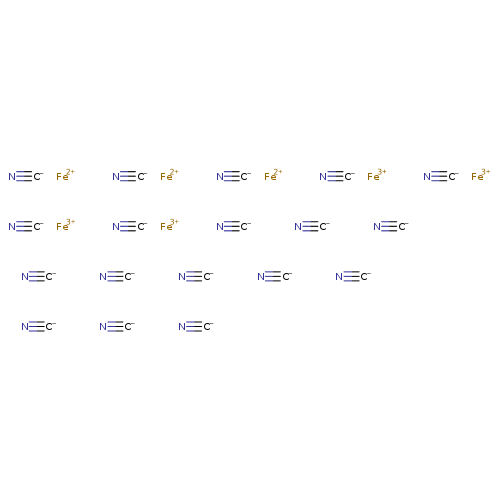
Ferric hexacyanoferrate (C18Fe7N18) is an exogenous solid at room temperature. Ferric hexacyanoferrate belongs to the transition metal nitrides, a subclass of transition metal organides within the inorganic compounds. With an average molecular weight of 859.23 g/mol, Ferric hexacyanoferrate is a heavy molecule. This compound is found in or released from seven recorded sources, including household cleaning and consumer products such as non electric simulated smoking devices, building and construction materials like stairs and ramps, healthcare, pharmaceuticals and veterinary products specifically unclassified therapeutic products, and electrical and electronic equipment including antennas, coils, video games, and adjustable resistors. The recorded route of exposure is oral. The compound interacts with 31 recorded protein targets. Cyanide inhibits tyrosinase, glutathione reductase, and superoxide dismutase [Cu-Zn]. It further inhibits glutathione peroxidases, including glutathione peroxidase 1, 2, 3, and epididymal secretory glutathione peroxidase. Additionally, cyanide inhibits alkaline phosphatases, such as the germ cell type and tissue-nonspecific isozyme, as well as catalase and succinate dehydrogenases, including the mitochondrial iron-sulfur, flavoprotein, cytochrome b small, and cytochrome b560 subunits. Cyanide also acts as an inhibitor of cytochrome c oxidase in the fourth complex of the electron transport chain, which is found in the membrane of the mitochondria of eukaryotic cells, affecting subunits 1, 2, 3, and 7A1. By complexing with the ferric iron atom in this enzyme, the binding of cyanide prevents the transport of electrons from cytochrome c oxidase to oxygen. This disrupts the electron transport chain, preventing the cell from aerobically producing ATP for energy in tissues that mainly depend on aerobic respiration.
Contaminant Type
  • Cyanide Compound
  • Household Toxin
  • Industrial/Workplace Toxin
  • Inorganic Compound
  • Synthetic Compound
Chemical Structure
Synonyms
ValueSource
RadiogardaseKegg
Ferric hexacyanoferric acidGenerator
FerrocinMeSH
FerrotsinMeSH
Ferric ferrocyanideMeSH
Prussian blueMeSH
FerrihexacyanoferrateMeSH
Berlin blueMeSH
Radiogardase-CSKEGG
Chemical FormulaC18Fe7N18
Average Molecular Mass859.228 g/mol
Monoisotopic Mass859.600 g/mol
CAS Registry Number14038-43-8
IUPAC Nametetrairon(3+) ion tris(λ²-iron(2+) ion) octadecakis(iminomethanide)
Traditional Nametetrairon(3+) ion tris(λ²-iron(2+) ion) octadecakis(cyanide)
SMILES[Fe++].[Fe++].[Fe++].[Fe+3].[Fe+3].[Fe+3].[Fe+3].[C-]#N.[C-]#N.[C-]#N.[C-]#N.[C-]#N.[C-]#N.[C-]#N.[C-]#N.[C-]#N.[C-]#N.[C-]#N.[C-]#N.[C-]#N.[C-]#N.[C-]#N.[C-]#N.[C-]#N.[C-]#N
InChI IdentifierInChI=1S/18CN.7Fe/c18*1-2;;;;;;;/q18*-1;3*+2;4*+3
InChI KeyDCYOBGZUOMKFPA-UHFFFAOYSA-N
Chemical Taxonomy
Description Belongs to the class of inorganic compounds known as transition metal nitrides. These are inorganic compounds of nitrogen where nitrogen has a formal oxidation state of -3, and the heaviest metal atom is a transition metal.
KingdomInorganic compounds
Super ClassMixed metal/non-metal compounds
ClassTransition metal organides
Sub ClassTransition metal nitrides
Direct ParentTransition metal nitrides
Alternative Parents
Substituents
  • Transition metal nitride
  • Transition metal cyanide salt
  • Inorganic nitride
  • Inorganic salt
  • Inorganic cyanide
Molecular FrameworkNot Available
External DescriptorsNot Available
Biological Properties
StatusDetected and Not Quantified
OriginExogenous
Cellular Locations
  • Cytoplasm
  • Extracellular
Biofluid LocationsNot Available
Tissue LocationsNot Available
ApplicationsNot Available
Biological Roles
Chemical RolesNot Available
Organoleptic Effects
  • blue colour ?
  • black colour ?
  • dark blue colour ?
Physical Properties
StateSolid
AppearanceDark blue powder.
Experimental Properties
PropertyValue
Melting PointNot Available
Boiling PointNot Available
SolubilityNot Available
Predicted Properties
PropertyValueSource
Water Solubility4.72 g/LALOGPS
logP-0.14ALOGPS
logP-0.35ChemAxon
logS-1.4ALOGPS
pKa (Strongest Acidic)9.5ChemAxon
Physiological Charge0ChemAxon
Hydrogen Acceptor Count1ChemAxon
Hydrogen Donor Count0ChemAxon
Polar Surface Area23.79 ŲChemAxon
Rotatable Bond Count0ChemAxon
Refractivity15.81 m³·mol⁻¹ChemAxon
Polarizability2.07 ųChemAxon
Number of Rings0ChemAxon
BioavailabilityYesChemAxon
Rule of FiveNoChemAxon
Ghose FilterNoChemAxon
Veber's RuleYesChemAxon
MDDR-like RuleNoChemAxon
Spectra
Spectra
Spectrum TypeDescriptionSplash KeyDeposition DateView
Predicted LC-MS/MSPredicted LC-MS/MS Spectrumsplash10-03di-0000000090-9f1df19dd31a1ed63590Not AvailableView Spectrum
Predicted LC-MS/MSPredicted LC-MS/MS Spectrumsplash10-0a4i-0000000090-c7ac75714f43cd408014Not AvailableView Spectrum
Toxicity Profile
Toxicity Values
Toxicity ValueOrganismDose DescriptorRoute of ExposurePredicted or ExperimentalToxicity RatingReference
1.13 mg/g RatLD50IntraperitonealexperimentalNot Available3
1.0 g/kg >1.0RatLD50OralexperimentalNot Available3
Toxicity / Toxin ClassNot Available
Mechanism of ToxicityCyanide is an inhibitor of cytochrome c oxidase in the fourth complex of the electron transport chain (found in the membrane of the mitochondria of eukaryotic cells). It complexes with the ferric iron atom in this enzyme. The binding of cyanide to this cytochrome prevents transport of electrons from cytochrome c oxidase to oxygen. As a result, the electron transport chain is disrupted and the cell can no longer aerobically produce ATP for energy. Tissues that mainly depend on aerobic respiration, such as the central nervous system and the heart, are particularly affected. Cyanide is also known produce some of its toxic effects by binding to catalase, glutathione peroxidase, methemoglobin, hydroxocobalamin, phosphatase, tyrosinase, ascorbic acid oxidase, xanthine oxidase, succinic dehydrogenase, and Cu/Zn superoxide dismutase. Cyanide binds to the ferric ion of methemoglobin to form inactive cyanmethemoglobin. (2)
Carcinogenicity (IARC Classification)No indication of carcinogenicity to humans (not listed by IARC).
Minimum Risk LevelNot Available
SymptomsCyanide poisoning is identified by rapid, deep breathing and shortness of breath, general weakness, giddiness, headaches, vertigo, confusion, convulsions/seizures and eventually loss of consciousness. (1, 2)
TreatmentAntidotes to cyanide poisoning include hydroxocobalamin and sodium nitrite, which release the cyanide from the cytochrome system, and rhodanase, which is an enzyme occurring naturally in mammals that combines serum cyanide with thiosulfate, producing comparatively harmless thiocyanate. Oxygen therapy can also be administered. (2)
Health Effects
Health EffectRelationshipDirectionDescriptionReference
hypokalemiaAssociated With?Not AvailableNot AvailablePMC6080556
Toxic encephalopathyHas Therapeutic Effect OnNot AvailableNot AvailablePMC12572074
injuryHas Therapeutic Effect OnNot AvailableNot AvailablePMC13462034
cardiovascular disorderHas Therapeutic Effect OnNot AvailableNot AvailablePMC12572074
heavy metal poisoningNot AvailableNot AvailableNot AvailablePMC9299340
thallium poisoningNot AvailableNot AvailableNot AvailablePMC5944205
radiation injuryNot AvailableNot AvailableNot AvailablePMC6434856
Exposure Sources
Source IDSourceSectorReference
CEDs000010Insecticides?Insecticides are synthetic chemicals designed to control or eliminate insect pests that threaten crops and other agricultural products.Agriculture & land managementPubChem
CEDs000013Soil?Soil serves as a critical medium for plant growth and sustains various ecological functions; however, it can become a reservoir for synthetic chemical contamination.Agriculture & land managementPMC5506515
CEDs000233Brushes?Brushes used in personal care and cosmetics can be a source of synthetic chemical contamination due to the materials and coatings used in their manufacturing.Personal care & cosmeticsPubChem
CEDs000409Unclassified therapeutic products?Unclassified therapeutic products encompass a range of substances used in medical and veterinary contexts that have not undergone formal classification processes.Healthcare, pharmaceuticals & veterinary productsNot Available
CEDs000500Stairs And Ramps?Stairs and ramps in construction are often treated with various synthetic chemicals to enhance durability, slip resistance, and weather resistance.Building & ConstructionPubChem
CEDs000504Adjustable Resistors?Adjustable resistors, commonly used in various electronic devices, can contribute to synthetic chemical contamination through the materials and substances used in their manufacturing and disposal.Electrical & Electronic EquipmentPubChem
CEDs000506Antennas?Antennas, commonly used in communication technologies, can be a source of synthetic chemical contamination through the materials and coatings used in their construction.Electrical & Electronic EquipmentPubChem
CEDs000508Coils?Coils are components used in various electrical and electronic applications, such as transformers, inductors, and motors.Electrical & Electronic EquipmentPubChem
CEDs000511Conductors Or Conductive Bodies Characterised By The Conductive Materials?Conductors, or conductive bodies, are materials that allow the flow of electrical current, typically made from metals such as copper, aluminum, or silver.Electrical & Electronic EquipmentPubChem
CEDs000518Electrically Stimulated Smoking Devices?Electrically stimulated smoking devices, commonly known as e-cigarettes or vape pens, utilize electrical components to heat a liquid solution, often containing nicotine, flavorings, and other additives, to produce an aerosol for inhalation.Electrical & Electronic EquipmentPubChem
CEDs000519Electrodes?Electrodes, used in various electrical and electronic applications, can be a source of synthetic chemical contamination due to the materials from which they are constructed and the processes involved in their manufacturing.Electrical & Electronic EquipmentPubChem
CEDs000521Fixed Capacitors And Their Manufacture?Fixed capacitors are passive electronic components used to store and release electrical energy, playing a critical role in various circuits.Electrical & Electronic EquipmentPubChem
CEDs000524Hybrid Capacitors?Hybrid capacitors are energy storage devices that combine the properties of electrolytic and supercapacitors, utilizing a combination of electrochemical principles to achieve higher energy density and power density.Electrical & Electronic EquipmentPubChem
CEDs000539Video Games?Video games, through their production and disposal processes, can be a source of synthetic chemical contamination.Electrical & Electronic EquipmentPubChem
CEDs000545Food Preservation?Food preservation often involves the use of synthetic chemicals, such as preservatives, flavor enhancers, and color additives, to extend shelf life and enhance the sensory qualities of food products.Food, food processing & cookwarePubChem
CEDs000555Bleaching Agents?Bleaching agents are chemical substances used to whiten or lighten materials, often employed in various cleaning products for their stain removal and disinfecting properties.Household cleaning & consumer productsPubChem
CEDs000559Non Electric Simulated Smoking Devices?Non-electric simulated smoking devices, often designed to mimic the experience of smoking without combustion, can be sources of synthetic chemical contamination due to the materials and chemicals used in their construction and operation.Household cleaning & consumer productsPubChem
CEDs000561Perfumes Within Detergents And Soaps?Perfumes within detergents and soaps are synthetic fragrance compounds added to enhance the sensory experience of cleaning products.Household cleaning & consumer productsPubChem
CEDs000563Soap Detergents?Soap detergents are synthetic surfactants designed to enhance the cleaning efficacy of water by reducing surface tension, allowing for better interaction with dirt and grease.Household cleaning & consumer productsPubChem
CEDs000569Tobacco Smoke Filters?Tobacco smoke filters are designed to reduce the inhalation of harmful substances in cigarette smoke, including tar and other particulate matter.Household cleaning & consumer productsPubChem
CEDs000580Manufacture Preparation Of Tobacco Products?The manufacture and preparation of tobacco products involve various processes that can result in the introduction of synthetic chemicals into the environment.Industrial manufacturing & chemical processingPubChem
CEDs000596Acaricides?Acaricides are synthetic chemicals specifically designed to target and control mite populations that can damage crops and plants.Agriculture & land managementPubChem
CEDs000600Herbicides And Algicides?Herbicides and algicides are synthetic chemicals primarily used to control unwanted plants and algae in various environments.Agriculture & land managementPubChem
CEDs000603Nematocides?Nematocides are synthetic chemicals specifically designed to control nematodes, which are microscopic roundworms that can cause significant damage to crops and plants.Agriculture & land managementPubChem
CEDs000605Pest Repellants?Pest repellents, often formulated from synthetic chemicals, are widely used to protect crops from insect infestations and other pests.Agriculture & land managementPubChem
CEDs000606Plant Growth Regulators?Plant Growth Regulators (PGRs) are synthetic chemicals designed to influence the growth and development of plants.Agriculture & land managementPubChem
CEDs000609Aftershave?Aftershave is a grooming product typically used to soothe and protect the skin following shaving.Personal care & cosmeticsPubChem
CEDs000610Aftersun Products?Aftersun products are designed to soothe and hydrate the skin after sun exposure, often containing various synthetic chemicals such as emollients, preservatives, and fragrances.Personal care & cosmeticsPubChem
CEDs000611Anti Perspirants Or Body Deoderants?Antiperspirants and body deodorants commonly contain synthetic chemicals such as aluminum compounds, parabens, and synthetic fragrances.Personal care & cosmeticsPubChem
CEDs000612Body Washing Or Cleaning Implements?Body washing or cleaning implements, such as synthetic sponges, loofahs, and washcloths, can be sources of synthetic chemical contamination due to the materials used in their production.Personal care & cosmeticsPubChem
CEDs000613Depilatories?Depilatories are products designed to remove unwanted hair through the application of synthetic chemicals that break down the protein structure of hair, facilitating its removal.Personal care & cosmeticsPubChem
CEDs000614Essential Oils Or Perfumes?Essential oils and perfumes are complex mixtures of volatile compounds derived from natural or synthetic sources, commonly used for their aromatic properties.Personal care & cosmeticsPubChem
CEDs000615Eye Makeup Products?Eye makeup products, including mascaras, eyeliners, and eyeshadows, often contain a variety of synthetic chemicals such as pigments, preservatives, and film-forming agents.Personal care & cosmeticsPubChem
CEDs000616Face Mask Cosmetics?Face mask cosmetics often contain a variety of synthetic chemicals, including preservatives, emulsifiers, and fragrances, which can contribute to chemical contamination.Personal care & cosmeticsPubChem
CEDs000617Lip Care Products?Lip care products, including lipsticks, balms, and glosses, often contain a variety of synthetic chemicals such as parabens, phthalates, and synthetic fragrances.Personal care & cosmeticsPubChem
CEDs000618Lip Makeup Products?Lip makeup products, such as lipsticks, lip glosses, and lip liners, often contain a variety of synthetic chemicals, including pigments, preservatives, and emollients.Personal care & cosmeticsPubChem
CEDs000619Manicure Pedicure?Manicure and pedicure procedures often involve the use of various synthetic chemicals, including solvents, nail polishes, and nail adhesives.Personal care & cosmeticsPubChem
CEDs000632Apparel?Apparel production often involves the use of various synthetic chemicals, including dyes, finishing agents, and preservatives.Textiles, leather & furnishingsPubChem
CEDs000642Footwear?Footwear production often involves the use of various synthetic chemicals, such as adhesives, dyes, and treatments, which can contribute to environmental contamination.Textiles, leather & furnishingsPubChem
CEDs000659Transfer Printing?Transfer printing is a process used to apply designs and patterns onto various substrates, commonly utilizing synthetic dyes and inks that can contain hazardous chemicals.Textiles, leather & furnishingsPubChem
CEDs000662Yarns Or Threads?Yarns or threads used in textiles can be a source of synthetic chemical contamination due to the production processes and treatments they undergo.Textiles, leather & furnishingsPubChem
CEDs000670Solid Fire Fighting Substances?Solid fire fighting substances, such as certain types of dry chemical powders, are used in fire suppression applications to extinguish flames and prevent fire spread.Fire suppression systems & agentsPubChem
CEDs000671Airplanes And Helicopters?Airplanes and helicopters are significant sources of synthetic chemical contamination primarily through the use of aviation fuels, lubricants, and de-icing agents.Aviation & AerospacePubChem
CEDs000672Light Than Air Aircraft?Light than air aircraft, such as dirigibles and airships, utilize lifting gases like helium or hydrogen for buoyancy.Aviation & AerospacePubChem
CEDs000678Nitrogenous Fertilisers?Nitrogenous fertilizers are synthetic chemical compounds primarily used to enhance plant growth by supplying essential nitrogen, a crucial nutrient for photosynthesis and protein synthesis.Agriculture & land managementPubChem
CEDs000679Phosphatic Fertilisers?Phosphatic fertilizers are synthetic chemical products primarily composed of phosphorus, which is essential for plant growth.Agriculture & land managementPubChem
CEDs000682Traction Harness?Traction harnesses, commonly used in agricultural practices for animals and machinery, can be a source of synthetic chemical contamination through the materials used in their production.Agriculture & land managementPubChem
CEDs000684Cements?Cements are a composite material primarily used as a binding agent in construction applications, formed by the calcination of limestone and clay minerals at high temperatures.Building & ConstructionPubChem
CEDs000685Ceramics?Ceramics can be a source of synthetic chemical contamination through various additives and processing agents used in their production.Building & ConstructionPubChem
CEDs000686Clay Wares?Clay wares are ceramic products made from natural clay, often utilized in various construction applications such as tiles, bricks, and sanitary ware.Building & ConstructionPubChem
CEDs000688Glass Coatings?Glass coatings are synthetic chemical formulations applied to glass surfaces to enhance properties such as durability, UV resistance, and aesthetic appeal.Building & ConstructionPubChem
CEDs000691Non Oxide Glass?Non-oxide glass refers to a category of glasses primarily composed of materials other than silicon dioxide, such as boron oxide or phosphorous oxide.Building & ConstructionPubChem
CEDs000692Silica Free Oxide Glass?Silica Free Oxide Glass is a type of glass that is produced using alternative materials to traditional silica-based formulations.Building & ConstructionPubChem
CEDs000693Silica Glass?Silica glass, primarily composed of silicon dioxide (SiO2), is widely used in various applications, including windows, glass facades, and insulation materials.Building & ConstructionPubChem
CEDs000696Nanotechnology?Nanotechnology involves the manipulation of materials at the molecular or atomic level, typically within the range of 1 to 100 nanometers.Industrial manufacturing & chemical processingPubChem
CEDs000698Jewellery?Jewellery production often involves the use of various synthetic chemicals during the extraction and processing of metals.Mining & metal processingPubChem
CEDs000703Blackboards?Blackboards, traditionally made from slate or coated wood, can also be produced using synthetic materials that may contain various chemicals.Paper, pulp & fiber productsPubChem
CEDs000704Blotters?Blotters are absorbent paper products commonly used in various applications, including ink absorption, oil removal, and moisture control.Paper, pulp & fiber productsPubChem
CEDs000705Bookbinding?Bookbinding involves the use of various synthetic chemicals, including adhesives, inks, and coatings, which can contribute to environmental contamination.Paper, pulp & fiber productsPubChem
CEDs000707Books?Books can be a source of synthetic chemical contamination due to the use of various chemicals in their production and preservation processes.Paper, pulp & fiber productsPubChem
CEDs000710Chalks?Chalks, primarily composed of calcium carbonate, are commonly used in various industrial applications, including as fillers and coatings in the production of paper and related products.Paper, pulp & fiber productsPubChem
CEDs000711Coloured Pencils?Coloured pencils are commonly used tools for artistic expression and education, composed primarily of a wood casing and a core made from a mixture of pigments, binders, and waxes.Paper, pulp & fiber productsPubChem
CEDs000712Combination Pens?Combination pens, which typically contain both ink and additional functionalities such as highlighters or stylus tips, may contribute to synthetic chemical contamination primarily through their ink formulations and plastic components.Paper, pulp & fiber productsPubChem
CEDs000716Erasers?Erasers, commonly used in writing and drawing applications, are often made from synthetic rubber or thermoplastic materials, which can contain various additives such as plasticizers, fillers, and colorants.Paper, pulp & fiber productsPubChem
CEDs000717Fountain Pens?Fountain pens utilize a liquid ink that often contains synthetic chemicals, including dyes, pigments, and solvents, which can contribute to environmental contamination.Paper, pulp & fiber productsPubChem
CEDs000718Ink Receptacles?Ink receptacles, commonly utilized in printing processes, can be a source of synthetic chemical contamination due to the solvents, pigments, and additives contained within the inks.Paper, pulp & fiber productsPubChem
CEDs000719Ink Reservoir Pens?Ink reservoir pens are writing instruments that contain a reservoir filled with ink, often made from synthetic dyes and solvents.Paper, pulp & fiber productsPubChem
CEDs000720Ink Reservoir Pens2?Ink reservoir pens are writing instruments that utilize a reservoir to store ink, which is often composed of synthetic dyes, solvents, and additives.Paper, pulp & fiber productsPubChem
CEDs000725Pencils?Pencils, primarily composed of graphite encased in wood or synthetic materials, can contribute to synthetic chemical contamination through their manufacturing and disposal processes.Paper, pulp & fiber productsPubChem
CEDs000726Pens?Pens, commonly utilized for writing and marking, can be a source of synthetic chemical contamination primarily due to the materials used in their manufacturing.Paper, pulp & fiber productsPubChem
CEDs000727Printing Machines Or Presses?Printing machines or presses commonly utilize synthetic chemicals such as inks, solvents, and cleaning agents.Paper, pulp & fiber productsPubChem
CEDs000729Stamps?Stamps, particularly those produced using synthetic inks and adhesives, can contribute to chemical contamination when disposed of improperly.Paper, pulp & fiber productsPubChem
CEDs000734Coating Compositions?Coating compositions, which include paints, sealants, and varnishes, are formulated with a variety of synthetic chemicals such as solvents, resins, pigments, and additives.Building & ConstructionPubChem
CEDs000735Explosives?Explosives are chemical compounds or mixtures designed to undergo rapid decomposition, releasing energy in the form of gas and heat.Defense & military infrastructurePubChem
CEDs000737Chemical Igniters?Chemical igniters are substances or devices designed to initiate combustion in various applications, often found in products like lighters, candles, and certain household cleaning agents.Household itemsPubChem
CEDs000738Cooling Circuit Water?Cooling circuit water is utilized in various industrial processes to absorb and dissipate heat generated during operations.Industrial manufacturing & chemical processingPubChem
CEDs000739Inks?Inks are complex mixtures composed of pigments or dyes, solvents, resins, and additives used primarily for printing and writing applications.Paper, pulp & fiber productsPubChem
CEDs000740Paper?Paper production involves the processing of wood fibers and the use of various chemicals, which can lead to synthetic chemical contamination.Paper, pulp & fiber productsPubChem
CEDs000741Pigment Pastes?Pigment pastes are concentrated dispersions of pigments used to impart color and properties to materials.Paper, pulp & fiber productsPubChem
CEDs000742Leather Tanning?Leather tanning is a process that transforms raw animal hides into durable leather through the application of various chemicals, including chromium salts, aldehydes, and vegetable tannins.Textiles, leather & furnishingsPubChem
CEDs000743Sludge Treatment?Sludge treatment involves the processing of waste materials generated from wastewater treatment plants, which often contain a variety of organic and inorganic substances.Wastewater, sanitation & biosolidsPubChem
CEDs000744Water, Wastewater, & Sewage Treatment?Water, wastewater, and sewage treatment processes are critical for managing and mitigating pollutants in water systems.Wastewater, sanitation & biosolidsPubChem
CEDs01144FoodFood, food processing & cookwarePMC12218971
CEDs02255WaterAquatic systems & sedimentsPMC6270328
CEDs02777Black PaintBuilding & ConstructionPMC8515334
CEDs03225Carbon ClothTextiles, leather & furnishingsPMC12031313
Pathways
2 pathwaysPathway Source: PathBank
Targets
StructureProteinUniProt IDOrganismRelationshipDetails
Amine oxidase [flavin-containing] B structureClick to view 3D structureAmine oxidase [flavin-containing] BP27338HumansPredicted (SEA)
Prediction Confidence Score
0.048
Applicability Domain
0.063 Low confidence
Statistical Significance
1.0
Supporting Reference Compounds
315
E-value
7784.69
Carbonic anhydrase 9 structureClick to view 3D structureCarbonic anhydrase 9Q16790HumansPredicted (SEA)
Prediction Confidence Score
0.046
Applicability Domain
0.111 Low confidence
Statistical Significance
1.0
Supporting Reference Compounds
372
E-value
7784.92
Click to view 3D structureCDGSH iron-sulfur domain-containing protein 1B0K020Rattus norvegicusPredicted (SEA)
Prediction Confidence Score
0.045
Applicability Domain
0.053 Low confidence
Statistical Significance
0.9995
Supporting Reference Compounds
3
E-value
7780.87
Carbonic anhydrase 1 structureClick to view 3D structureCarbonic anhydrase 1P00915HumansPredicted (SEA)
Prediction Confidence Score
0.043
Applicability Domain
0.1 Low confidence
Statistical Significance
1.0
Supporting Reference Compounds
407
E-value
7784.92
Carbonic anhydrase 2 structureClick to view 3D structureCarbonic anhydrase 2P00918HumansPredicted (SEA)
Prediction Confidence Score
0.042
Applicability Domain
0.05 Low confidence
Statistical Significance
1.0
Supporting Reference Compounds
472
E-value
7784.92
Peroxisome proliferator-activated receptor gamma structureClick to view 3D structurePeroxisome proliferator-activated receptor gammaP37231HumansPredicted (SEA)
Prediction Confidence Score
0.041
Applicability Domain
0.044 Low confidence
Statistical Significance
1.0
Supporting Reference Compounds
192
E-value
7784.69
Mitochondrial pyruvate carrier 2 structureClick to view 3D structureMitochondrial pyruvate carrier 2O95563HumansPredicted (SEA)
Prediction Confidence Score
0.04
Applicability Domain
0.04 Low confidence
Statistical Significance
0.9996
Supporting Reference Compounds
2
E-value
7781.81
Click to view 3D structurePeroxisome proliferator-activated receptor gammaP37238Mus musculusPredicted (SEA)
Prediction Confidence Score
0.039
Applicability Domain
0.044 Low confidence
Statistical Significance
0.9999
Supporting Reference Compounds
38
E-value
7784.46
CDGSH iron-sulfur domain-containing protein 1 structureClick to view 3D structureCDGSH iron-sulfur domain-containing protein 1Q9NZ45HumansPredicted (SEA)
Prediction Confidence Score
0.039
Applicability Domain
0.053 Low confidence
Statistical Significance
1.0
Supporting Reference Compounds
22
E-value
7784.61
Epidermal growth factor receptor structureClick to view 3D structureEpidermal growth factor receptorP00533HumansPredicted (SEA)
Prediction Confidence Score
0.038
Applicability Domain
0.044 Low confidence
Statistical Significance
1.0
Supporting Reference Compounds
1301
E-value
7784.69
D(2) dopamine receptor structureClick to view 3D structureD(2) dopamine receptorP14416HumansPredicted (SEA)
Prediction Confidence Score
0.036
Applicability Domain
0.041 Low confidence
Statistical Significance
1.0
Supporting Reference Compounds
1103
E-value
7784.77
D(3) dopamine receptor structureClick to view 3D structureD(3) dopamine receptorP35462HumansPredicted (SEA)
Prediction Confidence Score
0.035
Applicability Domain
0.044 Low confidence
Statistical Significance
1.0
Supporting Reference Compounds
861
E-value
7784.77
Click to view 3D structureGlucose-6-phosphate dehydrogenase-6-phosphogluconolactonaseQ9BHT9Plasmodium bergheiPredicted (SEA)
Prediction Confidence Score
0.035
Applicability Domain
0.065 Low confidence
Statistical Significance
1.0
Supporting Reference Compounds
105
E-value
7784.69
5-hydroxytryptamine receptor 7 structureClick to view 3D structure5-hydroxytryptamine receptor 7P34969HumansPredicted (SEA)
Prediction Confidence Score
0.035
Applicability Domain
0.041 Low confidence
Statistical Significance
1.0
Supporting Reference Compounds
565
E-value
7784.77
Glycogen synthase kinase-3 beta structureClick to view 3D structureGlycogen synthase kinase-3 betaP49841HumansPredicted (SEA)
Prediction Confidence Score
0.035
Applicability Domain
0.038 Low confidence
Statistical Significance
1.0
Supporting Reference Compounds
1157
E-value
7784.84
Serine/threonine-protein kinase pim-1 structureClick to view 3D structureSerine/threonine-protein kinase pim-1P11309HumansPredicted (SEA)
Prediction Confidence Score
0.034
Applicability Domain
0.038 Low confidence
Statistical Significance
1.0
Supporting Reference Compounds
967
E-value
7784.84
Tyrosine-protein phosphatase non-receptor type 1 structureClick to view 3D structureTyrosine-protein phosphatase non-receptor type 1P18031HumansPredicted (SEA)
Prediction Confidence Score
0.034
Applicability Domain
0.042 Low confidence
Statistical Significance
1.0
Supporting Reference Compounds
197
E-value
7784.69
Serine/threonine-protein kinase pim-2 structureClick to view 3D structureSerine/threonine-protein kinase pim-2Q9P1W9HumansPredicted (SEA)
Prediction Confidence Score
0.034
Applicability Domain
0.038 Low confidence
Statistical Significance
1.0
Supporting Reference Compounds
525
E-value
7784.77
Protein RecA structureClick to view 3D structureProtein RecAP9WHJ3Mycobacterium tuberculosisPredicted (SEA)
Prediction Confidence Score
0.033
Applicability Domain
0.042 Low confidence
Statistical Significance
1.0
Supporting Reference Compounds
296
E-value
7784.69
Tyrosine-protein kinase Lck structureClick to view 3D structureTyrosine-protein kinase LckP06239HumansPredicted (SEA)
Prediction Confidence Score
0.033
Applicability Domain
0.038 Low confidence
Statistical Significance
1.0
Supporting Reference Compounds
1130
E-value
7784.84
5-hydroxytryptamine receptor 2A structureClick to view 3D structure5-hydroxytryptamine receptor 2AP28223HumansPredicted (SEA)
Prediction Confidence Score
0.033
Applicability Domain
0.041 Low confidence
Statistical Significance
1.0
Supporting Reference Compounds
955
E-value
7784.84
5-hydroxytryptamine receptor 1A structureClick to view 3D structure5-hydroxytryptamine receptor 1AP08908HumansPredicted (SEA)
Prediction Confidence Score
0.032
Applicability Domain
0.041 Low confidence
Statistical Significance
1.0
Supporting Reference Compounds
953
E-value
7784.84
Mitogen-activated protein kinase 1 structureClick to view 3D structureMitogen-activated protein kinase 1P28482HumansPredicted (SEA)
Prediction Confidence Score
0.032
Applicability Domain
0.038 Low confidence
Statistical Significance
1.0
Supporting Reference Compounds
763
E-value
7784.92
Cyclin-dependent kinase 2 structureClick to view 3D structureCyclin-dependent kinase 2P24941HumansPredicted (SEA)
Prediction Confidence Score
0.032
Applicability Domain
0.038 Low confidence
Statistical Significance
1.0
Supporting Reference Compounds
1029
E-value
7784.92
Cyclin-dependent kinase 1 structureClick to view 3D structureCyclin-dependent kinase 1P06493HumansPredicted (SEA)
Prediction Confidence Score
0.032
Applicability Domain
0.038 Low confidence
Statistical Significance
1.0
Supporting Reference Compounds
715
E-value
7784.84
Click to view 3D structureAlkaline phosphatase, germ cell typeP10696HumansKnownCyanide inhibits alkaline phosphatases. (A73)
Alkaline phosphatase, tissue-nonspecific isozyme structureClick to view 3D structureAlkaline phosphatase, tissue-nonspecific isozymeP05186HumansKnownCyanide inhibits alkaline phosphatases. (A73)
Catalase structureClick to view 3D structureCatalaseP04040HumansKnownCyanide inhibits catalase. (A74)
Cytochrome c oxidase subunit 1 structureClick to view 3D structureCytochrome c oxidase subunit 1P00395HumansKnownCyanide is an inhibitor of cytochrome c oxidase in the fourth complex of the electron transport chain (found in the membrane of the mitochondria of eukaryotic cells). It complexes with the ferric iron atom in this enzyme. The binding of cyanide to this cytochrome prevents transport of electrons from cytochrome c oxidase to oxygen. As a result, the electron transport chain is disrupted and the cell can no longer aerobically produce ATP for energy. Tissues that mainly depend on aerobic respiration, such as the central nervous system and the heart, are particularly affected. (L97)
Cytochrome c oxidase subunit 2 structureClick to view 3D structureCytochrome c oxidase subunit 2P00403HumansKnownCyanide is an inhibitor of cytochrome c oxidase in the fourth complex of the electron transport chain (found in the membrane of the mitochondria of eukaryotic cells). It complexes with the ferric iron atom in this enzyme. The binding of cyanide to this cytochrome prevents transport of electrons from cytochrome c oxidase to oxygen. As a result, the electron transport chain is disrupted and the cell can no longer aerobically produce ATP for energy. Tissues that mainly depend on aerobic respiration, such as the central nervous system and the heart, are particularly affected. (L97)
Cytochrome c oxidase subunit 3 structureClick to view 3D structureCytochrome c oxidase subunit 3P00414HumansKnownCyanide is an inhibitor of cytochrome c oxidase in the fourth complex of the electron transport chain (found in the membrane of the mitochondria of eukaryotic cells). It complexes with the ferric iron atom in this enzyme. The binding of cyanide to this cytochrome prevents transport of electrons from cytochrome c oxidase to oxygen. As a result, the electron transport chain is disrupted and the cell can no longer aerobically produce ATP for energy. Tissues that mainly depend on aerobic respiration, such as the central nervous system and the heart, are particularly affected. (L97)
Cytochrome c oxidase subunit 4 isoform 1, mitochondrial structureClick to view 3D structureCytochrome c oxidase subunit 4 isoform 1, mitochondrialP13073HumansKnownCyanide is an inhibitor of cytochrome c oxidase in the fourth complex of the electron transport chain (found in the membrane of the mitochondria of eukaryotic cells). It complexes with the ferric iron atom in this enzyme. The binding of cyanide to this cytochrome prevents transport of electrons from cytochrome c oxidase to oxygen. As a result, the electron transport chain is disrupted and the cell can no longer aerobically produce ATP for energy. Tissues that mainly depend on aerobic respiration, such as the central nervous system and the heart, are particularly affected. (L97)
Cytochrome c oxidase subunit 5A, mitochondrial structureClick to view 3D structureCytochrome c oxidase subunit 5A, mitochondrialP20674HumansKnownCyanide is an inhibitor of cytochrome c oxidase in the fourth complex of the electron transport chain (found in the membrane of the mitochondria of eukaryotic cells). It complexes with the ferric iron atom in this enzyme. The binding of cyanide to this cytochrome prevents transport of electrons from cytochrome c oxidase to oxygen. As a result, the electron transport chain is disrupted and the cell can no longer aerobically produce ATP for energy. Tissues that mainly depend on aerobic respiration, such as the central nervous system and the heart, are particularly affected. (L97)
Cytochrome c oxidase subunit 5B, mitochondrial structureClick to view 3D structureCytochrome c oxidase subunit 5B, mitochondrialP10606HumansKnownCyanide is an inhibitor of cytochrome c oxidase in the fourth complex of the electron transport chain (found in the membrane of the mitochondria of eukaryotic cells). It complexes with the ferric iron atom in this enzyme. The binding of cyanide to this cytochrome prevents transport of electrons from cytochrome c oxidase to oxygen. As a result, the electron transport chain is disrupted and the cell can no longer aerobically produce ATP for energy. Tissues that mainly depend on aerobic respiration, such as the central nervous system and the heart, are particularly affected. (L97)
Click to view 3D structureCytochrome c oxidase subunit 6A2, mitochondrialQ02221HumansKnownCyanide is an inhibitor of cytochrome c oxidase in the fourth complex of the electron transport chain (found in the membrane of the mitochondria of eukaryotic cells). It complexes with the ferric iron atom in this enzyme. The binding of cyanide to this cytochrome prevents transport of electrons from cytochrome c oxidase to oxygen. As a result, the electron transport chain is disrupted and the cell can no longer aerobically produce ATP for energy. Tissues that mainly depend on aerobic respiration, such as the central nervous system and the heart, are particularly affected. (L97)
Cytochrome c oxidase subunit 6B1 structureClick to view 3D structureCytochrome c oxidase subunit 6B1P14854HumansKnownCyanide is an inhibitor of cytochrome c oxidase in the fourth complex of the electron transport chain (found in the membrane of the mitochondria of eukaryotic cells). It complexes with the ferric iron atom in this enzyme. The binding of cyanide to this cytochrome prevents transport of electrons from cytochrome c oxidase to oxygen. As a result, the electron transport chain is disrupted and the cell can no longer aerobically produce ATP for energy. Tissues that mainly depend on aerobic respiration, such as the central nervous system and the heart, are particularly affected. (L97)
Cytochrome c oxidase subunit 6C structureClick to view 3D structureCytochrome c oxidase subunit 6CP09669HumansKnownCyanide is an inhibitor of cytochrome c oxidase in the fourth complex of the electron transport chain (found in the membrane of the mitochondria of eukaryotic cells). It complexes with the ferric iron atom in this enzyme. The binding of cyanide to this cytochrome prevents transport of electrons from cytochrome c oxidase to oxygen. As a result, the electron transport chain is disrupted and the cell can no longer aerobically produce ATP for energy. Tissues that mainly depend on aerobic respiration, such as the central nervous system and the heart, are particularly affected. (L97)
Click to view 3D structureCytochrome c oxidase subunit 7A1, mitochondrialP24310HumansKnownCyanide is an inhibitor of cytochrome c oxidase in the fourth complex of the electron transport chain (found in the membrane of the mitochondria of eukaryotic cells). It complexes with the ferric iron atom in this enzyme. The binding of cyanide to this cytochrome prevents transport of electrons from cytochrome c oxidase to oxygen. As a result, the electron transport chain is disrupted and the cell can no longer aerobically produce ATP for energy. Tissues that mainly depend on aerobic respiration, such as the central nervous system and the heart, are particularly affected. (L97)
Cytochrome c oxidase subunit 7B, mitochondrial structureClick to view 3D structureCytochrome c oxidase subunit 7B, mitochondrialP24311HumansKnownCyanide is an inhibitor of cytochrome c oxidase in the fourth complex of the electron transport chain (found in the membrane of the mitochondria of eukaryotic cells). It complexes with the ferric iron atom in this enzyme. The binding of cyanide to this cytochrome prevents transport of electrons from cytochrome c oxidase to oxygen. As a result, the electron transport chain is disrupted and the cell can no longer aerobically produce ATP for energy. Tissues that mainly depend on aerobic respiration, such as the central nervous system and the heart, are particularly affected. (L97)
Cytochrome c oxidase subunit 7C, mitochondrial structureClick to view 3D structureCytochrome c oxidase subunit 7C, mitochondrialP15954HumansKnownCyanide is an inhibitor of cytochrome c oxidase in the fourth complex of the electron transport chain (found in the membrane of the mitochondria of eukaryotic cells). It complexes with the ferric iron atom in this enzyme. The binding of cyanide to this cytochrome prevents transport of electrons from cytochrome c oxidase to oxygen. As a result, the electron transport chain is disrupted and the cell can no longer aerobically produce ATP for energy. Tissues that mainly depend on aerobic respiration, such as the central nervous system and the heart, are particularly affected. (L97)
Cytochrome c oxidase subunit 8A, mitochondrial structureClick to view 3D structureCytochrome c oxidase subunit 8A, mitochondrialP10176HumansKnownCyanide is an inhibitor of cytochrome c oxidase in the fourth complex of the electron transport chain (found in the membrane of the mitochondria of eukaryotic cells). It complexes with the ferric iron atom in this enzyme. The binding of cyanide to this cytochrome prevents transport of electrons from cytochrome c oxidase to oxygen. As a result, the electron transport chain is disrupted and the cell can no longer aerobically produce ATP for energy. Tissues that mainly depend on aerobic respiration, such as the central nervous system and the heart, are particularly affected. (L97)
Epididymal secretory glutathione peroxidase structureClick to view 3D structureEpididymal secretory glutathione peroxidaseO75715HumansKnownCyanide inhibits glutathione peroxidases. (A75)
Glutathione peroxidase 1 structureClick to view 3D structureGlutathione peroxidase 1P07203HumansKnownCyanide inhibits glutathione peroxidases. (A75)
Glutathione peroxidase 2 structureClick to view 3D structureGlutathione peroxidase 2P18283HumansKnownCyanide inhibits glutathione peroxidases. (A75)
Glutathione peroxidase 3 structureClick to view 3D structureGlutathione peroxidase 3P22352HumansKnownCyanide inhibits glutathione peroxidases. (A75)
Click to view 3D structureGlutathione peroxidase 6P59796HumansKnownCyanide inhibits glutathione peroxidases. (A75)
Glutathione peroxidase 7 structureClick to view 3D structureGlutathione peroxidase 7Q96SL4HumansKnownCyanide inhibits glutathione peroxidases. (A75)
Glutathione reductase, mitochondrial structureClick to view 3D structureGlutathione reductase, mitochondrialP00390HumansKnownCyanide inhibits glutathione reductase. (A76)
Phospholipid hydroperoxide glutathione peroxidase GPX4 structureClick to view 3D structurePhospholipid hydroperoxide glutathione peroxidase GPX4P36969HumansKnownCyanide inhibits glutathione peroxidases. (A75)
Probable glutathione peroxidase 8 structureClick to view 3D structureProbable glutathione peroxidase 8Q8TED1HumansKnownCyanide inhibits glutathione peroxidases. (A75)
Succinate dehydrogenase [ubiquinone] cytochrome b small subunit, mitochondrial structureClick to view 3D structureSuccinate dehydrogenase [ubiquinone] cytochrome b small subunit, mitochondrialO14521HumansKnownCyanide inhibits succinate dehydrogenases. (A76)
Succinate dehydrogenase [ubiquinone] flavoprotein subunit, mitochondrial structureClick to view 3D structureSuccinate dehydrogenase [ubiquinone] flavoprotein subunit, mitochondrialP31040HumansKnownCyanide inhibits succinate dehydrogenases. (A76)
Succinate dehydrogenase [ubiquinone] iron-sulfur subunit, mitochondrial structureClick to view 3D structureSuccinate dehydrogenase [ubiquinone] iron-sulfur subunit, mitochondrialP21912HumansKnownCyanide inhibits succinate dehydrogenases. (A76)
Succinate dehydrogenase cytochrome b560 subunit, mitochondrial structureClick to view 3D structureSuccinate dehydrogenase cytochrome b560 subunit, mitochondrialQ99643HumansKnownCyanide inhibits succinate dehydrogenases. (A76)
Superoxide dismutase [Cu-Zn] structureClick to view 3D structureSuperoxide dismutase [Cu-Zn]P00441HumansKnownCyanide inhibits superoxide dismutase [Cu-Zn]. (A72)
Tyrosinase structureClick to view 3D structureTyrosinaseP14679HumansKnownCyanide inhibits tyrosinase. (A77)
Concentrations
Not Available
External Links
DrugBank IDNot Available
HMDB IDNot Available
FooDB IDNot Available
Phenol Explorer IDNot Available
KNApSAcK IDNot Available
BiGG IDNot Available
BioCyc IDNot Available
METLIN IDNot Available
PDB IDNot Available
Wikipedia LinkPrussian blue
Chemspider IDNot Available
ChEBI IDNot Available
PubChem Compound ID61711
Kegg Compound IDNot Available
YMDB IDNot Available
ECMDB IDNot Available
References
Synthesis ReferenceNot Available
MSDSNot Available
General References
  1. ATSDR - Agency for Toxic Substances and Disease Registry (2006). Toxicological profile for cyanide. U.S. Public Health Service in collaboration with U.S. Environmental Protection Agency (EPA). - http://www.atsdr.cdc.gov/toxprofiles/tp8.html
  2. Wikipedia. Cyanide poisoning. Last Updated 30 March 2009. - http://en.wikipedia.org/wiki/Cyanide_poisoning
  3. ORAU (2003). Radiation Emergency Assistance Center.
  4. Baselt RC and Cravey RH (1989). Disposition of Toxic Drugs and Chemicals in Man. 3rd ed. Chicago, IL.: Year Book Medical Publishers.