Fluvoxamine (CED0002849)

Record Information
Version1.0
Creation Date2009-07-21 20:26:13 UTC
Update Date2026-05-14 16:24:29 UTC
SynCED IDCED0002849
Secondary Accession Numbers
  • CHEM002137
  • T3D2705
Identification
Common NameFluvoxamine
ClassSmall Molecule
Description
Fluvoxamine is an exogenous solid with the formula C15H21F3N2O2 and an average molecular weight of 318.33 g/mol. Fluvoxamine belongs to the trifluoromethylbenzenes, a subclass of benzene and substituted derivatives within the organic compounds. It is utilized as an antidepressant, an anxiolytic drug, and a biological serotonin uptake inhibitor. Recorded exposure routes for the compound include oral administration. It has been identified in seven recorded sources, including antidepressants within healthcare, pharmaceuticals, and veterinary products; drinking water and water supply; household cleaning and consumer products such as other smoking requisites and non-electric simulated smoking devices; and electrical and electronic equipment, specifically magnets, relays, and electric hearing aids. The compound interacts with eight recorded protein targets, including the sodium-dependent serotonin transporter (SLC6A4), 5-hydroxytryptamine receptor 1A (HTR1A), 5-hydroxytryptamine receptor 2A (HTR2A), muscarinic acetylcholine receptor M1 (CHRM1), cytochrome P450 2C9 (CYP2C9), sodium-dependent noradrenaline transporter (SLC6A2), and sodium-dependent dopamine transporter (SLC6A3). The antidepressant, antiobsessive-compulsive, and antibulimic actions of fluvoxamine are presumed to be linked to its inhibition of CNS neuronal uptake of serotonin. It blocks the reuptake of serotonin at the serotonin reuptake pump of the neuronal membrane, which enhances the actions of serotonin on 5HT1A autoreceptors. Furthermore, SSRIs bind with significantly less affinity to norepinephrine, acetylcholine, and histamine receptors than tricyclic antidepressant drugs.
Contaminant Type
  • Amine
  • Anti-Anxiety Agent
  • Antidepressant
  • Antidepressant, Second-Generation
  • Antidepressive Agent, Second-Generation
  • Drug
  • Ether
  • Metabolite
  • Organic Compound
  • Organofluoride
  • Selective Serotonin Reuptake Inhibitor
  • Serotonin Uptake Inhibitor
  • Synthetic Compound
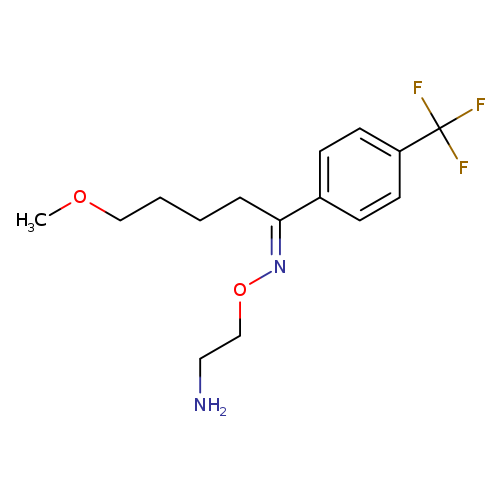
Chemical Structure
Synonyms
ValueSource
FluvoxaminaChEBI
FluvoxaminumChEBI
Aliud brand OF fluvoxamine maleateMeSH
Fluvoxamin neuraxpharmMeSH
Geminis, fluvoxaminaMeSH
Ratiopharm brand OF fluvoxamine maleateMeSH
Fluvoxamin stadaMeSH
FluvoxamineMeSH
Novopharm brand OF fluvoxamine maleateMeSH
Nu fluvoxamineMeSH
Stadapharm brand OF fluvoxamine maleateMeSH
Neuraxpharm brand OF fluvoxamine maleateMeSH
FaverinMeSH
Fluvoxamin alMeSH
Fluvoxamin ratiopharmMeSH
Fluvoxamin-neuraxpharmMeSH
Fluvoxamine, (Z)-isomerMeSH
novo-FluvoxamineMeSH
Nu pharm brand OF fluvoxamine maleateMeSH
Nu-fluvoxamineMeSH
Declimed brand OF fluvoxamine maleateMeSH
PMS FluvoxamineMeSH
FloxyfralMeSH
Fluvoxamine maleateMeSH
Pharmascience brand OF fluvoxamine maleateMeSH
DesifluMeSH
DumiroxMeSH
FluvoxaduraMeSH
Fluvoxamin betaMeSH
Fluvoxamin-ratiopharmMeSH
Geminis brand OF fluvoxamine maleateMeSH
LuvoxMeSH
Solvay brand OF fluvoxamine maleateMeSH
FevarinMeSH
Fluvoxamina geminisMeSH
Fluvoxamine maleate, (e)-isomerMeSH
Merck dura brand OF fluvoxamine maleateMeSH
Nu-pharm brand OF fluvoxamine maleateMeSH
Betapharm brand OF fluvoxamine maleateMeSH
novo FluvoxamineMeSH
PMS-FluvoxamineMeSH
ratio FluvoxamineMeSH
ratio-FluvoxamineMeSH
Chemical FormulaC15H21F3N2O2
Average Molecular Mass318.335 g/mol
Monoisotopic Mass318.156 g/mol
CAS Registry Number54739-18-3
IUPAC Name(E)-(2-aminoethoxy)({5-methoxy-1-[4-(trifluoromethyl)phenyl]pentylidene})amine
Traditional Namefluvoxamine
SMILESCOCCCC\C(=N/OCCN)C1=CC=C(C=C1)C(F)(F)F
InChI IdentifierInChI=1S/C15H21F3N2O2/c1-21-10-3-2-4-14(20-22-11-9-19)12-5-7-13(8-6-12)15(16,17)18/h5-8H,2-4,9-11,19H2,1H3/b20-14+
InChI KeyInChIKey=CJOFXWAVKWHTFT-XSFVSMFZSA-N
Chemical Taxonomy
Description Belongs to the class of organic compounds known as trifluoromethylbenzenes. These are organofluorine compounds that contain a benzene ring substituted with one or more trifluoromethyl groups.
KingdomOrganic compounds
Super ClassBenzenoids
ClassBenzene and substituted derivatives
Sub ClassTrifluoromethylbenzenes
Direct ParentTrifluoromethylbenzenes
Alternative Parents
Substituents
  • Trifluoromethylbenzene
  • Dialkyl ether
  • Ether
  • Alkyl fluoride
  • Organopnictogen compound
  • Hydrocarbon derivative
  • Primary amine
  • Organooxygen compound
  • Organonitrogen compound
  • Organofluoride
  • Organohalogen compound
  • Primary aliphatic amine
  • Organic oxygen compound
  • Organic nitrogen compound
  • Amine
  • Alkyl halide
  • Aromatic homomonocyclic compound
Molecular FrameworkAromatic homomonocyclic compounds
External Descriptors
Biological Properties
StatusDetected and Not Quantified
OriginExogenous
Cellular Locations
  • Membrane
Biofluid LocationsNot Available
Tissue LocationsNot Available
Applications
Biological Roles
Chemical RolesNot Available
Organoleptic EffectsNot Available
Physical Properties
StateSolid
AppearanceWhite powder.
Experimental Properties
PropertyValue
Melting Point120-121.5°C
Boiling PointNot Available
Solubility7.34e-03 g/L
Predicted Properties
PropertyValueSource
Water Solubility0.0073 g/LALOGPS
logP2.89ALOGPS
logP2.8ChemAxon
logS-4.6ALOGPS
pKa (Strongest Basic)9.16ChemAxon
Physiological Charge1ChemAxon
Hydrogen Acceptor Count4ChemAxon
Hydrogen Donor Count1ChemAxon
Polar Surface Area56.84 ŲChemAxon
Rotatable Bond Count10ChemAxon
Refractivity79.2 m³·mol⁻¹ChemAxon
Polarizability32.44 ųChemAxon
Number of Rings1ChemAxon
BioavailabilityYesChemAxon
Rule of FiveYesChemAxon
Ghose FilterYesChemAxon
Veber's RuleNoChemAxon
MDDR-like RuleNoChemAxon
Spectra
SpectraNot Available
Toxicity Profile
Toxicity Values
Toxicity ValueOrganismDose DescriptorRoute of ExposurePredicted or ExperimentalToxicity RatingReference
544.0 Log mg/kg [310:970]RatLD50oralpredictedNot AvailableNot Available
Toxicity / Toxin ClassNot Available
Mechanism of ToxicityThe exact mechanism of action of fluvoxamine has not been fully determined, but appears to be linked to its inhibition of CNS neuronal uptake of serotonin. Fluvoxamine blocks the reuptake of serotonin at the serotonin reuptake pump of the neuronal membrane, enhancing the actions of serotonin on 5HT1A autoreceptors. In-vitro studies suggest that fluvoxamine is more potent than clomipramine, fluoxetine, and desipramine as a serotonin-reuptake inhibitor. Studies have also demonstrated that fluvoxamine has virtually no affinity for alpha1- or alpha2-adrenergic, beta-adrenergic, muscarinic, dopamine D2, histamine H1, GABA-benzodiazepine, opiate, 5-HT1, or 5-HT2 receptors.
Carcinogenicity (IARC Classification)No indication of carcinogenicity to humans (not listed by IARC).
Minimum Risk LevelNot Available
SymptomsSide effects include anorexia, constipation, dry mouth, headache, nausea, nervousness, skin rash, sleep problems, somnolence, liver toxicity, mania, increase urination, seizures, sweating increase, tremors, or Tourette's syndrome.
TreatmentTreatment should consist of those general measures employed in the management of overdosage with any antidepressant. Ensure an adequate airway, oxygenation, and ventilation. Monitor cardiac rhythm and vital signs. General supportive and symptomatic measures are also recommended. Induction of emesis is not recommended. Gastric lavage with a large-bore orogastric tube with appropriate airway protection, if needed, may be indicated if performed soon after ingestion, or in symptomatic patients. Activated charcoal should be administered. Due to the large volume of distribution of this drug, forced diuresis, dialysis, hemoperfusion and exchange transfusion are unlikely to be of benefit. No specific antidotes for fluvoxamine are known. (4)
Health Effects
Health EffectRelationshipDirectionDescriptionReference
major depressive disorderNot AvailableNot AvailableAn endogenous depression that is characterized by an all-encompassing low mood accompanied by low self-esteem, and by loss of interest or pleasure in normally enjoyable activities. (DO)PMC7806491
renal fibrosisHas Therapeutic Effect OnNot AvailableNot AvailablePMC13237055 , PMC13237055
anxiety disorderNot AvailableNot AvailableNot AvailablePMC13237055
depressive disorderNot AvailableNot AvailableNot AvailablePMC13237055
obsessive-compulsive disorderNot AvailableNot AvailableNot AvailablePMC13237055
Exposure Sources
Source IDSourceSectorReference
CEDs000010Insecticides?Insecticides are synthetic chemicals designed to control or eliminate insect pests that threaten crops and other agricultural products.Agriculture & land managementPubChem
CEDs000115Drinking water?Drinking water can be a medium for synthetic chemical contamination, often originating from various industrial processes and agricultural practices.Drinking water & water supplyNot Available
CEDs000377Antidepressants?Antidepressants, a class of synthetic chemicals designed to alleviate symptoms of depression and anxiety, can enter the environment through various pathways, leading to contamination of water systems.Healthcare, pharmaceuticals & veterinary productsNot Available
CEDs000479Effluent?Effluent refers to liquid waste or sewage that is discharged into the environment, typically resulting from industrial processes, municipal wastewater treatment, or agricultural runoff.Wastewater, sanitation & biosolidsPMC11816319
CEDs000516Electric Hearing Aids?Electric hearing aids are small electronic devices designed to amplify sound for individuals with hearing loss.Electrical & Electronic EquipmentPubChem
CEDs000518Electrically Stimulated Smoking Devices?Electrically stimulated smoking devices, commonly known as e-cigarettes or vape pens, utilize electrical components to heat a liquid solution, often containing nicotine, flavorings, and other additives, to produce an aerosol for inhalation.Electrical & Electronic EquipmentPubChem
CEDs000519Electrodes?Electrodes, used in various electrical and electronic applications, can be a source of synthetic chemical contamination due to the materials from which they are constructed and the processes involved in their manufacturing.Electrical & Electronic EquipmentPubChem
CEDs000527Magnets?Magnets, commonly used in various electrical and electronic applications, can be a source of synthetic chemical contamination due to the materials used in their production.Electrical & Electronic EquipmentPubChem
CEDs000530Radio Transmission Systems?Radio transmission systems utilize a variety of synthetic chemicals in their manufacturing and maintenance processes.Electrical & Electronic EquipmentPubChem
CEDs000531Relays?Relays are electromechanical switches used to control circuits and manage electrical loads.Electrical & Electronic EquipmentPubChem
CEDs000545Food Preservation?Food preservation often involves the use of synthetic chemicals, such as preservatives, flavor enhancers, and color additives, to extend shelf life and enhance the sensory qualities of food products.Food, food processing & cookwarePubChem
CEDs000556Cigar Cigarettes?Cigar cigarettes are a source of synthetic chemical contamination due to the combustion of various tobacco blends and additives.Household cleaning & consumer productsPubChem
CEDs000559Non Electric Simulated Smoking Devices?Non-electric simulated smoking devices, often designed to mimic the experience of smoking without combustion, can be sources of synthetic chemical contamination due to the materials and chemicals used in their construction and operation.Household cleaning & consumer productsPubChem
CEDs000560Other Smoking Requisites?Other smoking requisites, including items such as lighters, matches, and rolling papers, can introduce synthetic chemical contamination through various components and additives.Household cleaning & consumer productsPubChem
CEDs000569Tobacco Smoke Filters?Tobacco smoke filters are designed to reduce the inhalation of harmful substances in cigarette smoke, including tar and other particulate matter.Household cleaning & consumer productsPubChem
CEDs000580Manufacture Preparation Of Tobacco Products?The manufacture and preparation of tobacco products involve various processes that can result in the introduction of synthetic chemicals into the environment.Industrial manufacturing & chemical processingPubChem
CEDs000596Acaricides?Acaricides are synthetic chemicals specifically designed to target and control mite populations that can damage crops and plants.Agriculture & land managementPubChem
CEDs000600Herbicides And Algicides?Herbicides and algicides are synthetic chemicals primarily used to control unwanted plants and algae in various environments.Agriculture & land managementPubChem
CEDs000602Molluscicides?Molluscicides are synthetic chemicals specifically designed to control and eliminate mollusks, such as snails and slugs, which can be detrimental to crops and agricultural productivity.Agriculture & land managementPubChem
CEDs000603Nematocides?Nematocides are synthetic chemicals specifically designed to control nematodes, which are microscopic roundworms that can cause significant damage to crops and plants.Agriculture & land managementPubChem
CEDs000605Pest Repellants?Pest repellents, often formulated from synthetic chemicals, are widely used to protect crops from insect infestations and other pests.Agriculture & land managementPubChem
CEDs000611Anti Perspirants Or Body Deoderants?Antiperspirants and body deodorants commonly contain synthetic chemicals such as aluminum compounds, parabens, and synthetic fragrances.Personal care & cosmeticsPubChem
CEDs000615Eye Makeup Products?Eye makeup products, including mascaras, eyeliners, and eyeshadows, often contain a variety of synthetic chemicals such as pigments, preservatives, and film-forming agents.Personal care & cosmeticsPubChem
CEDs000632Apparel?Apparel production often involves the use of various synthetic chemicals, including dyes, finishing agents, and preservatives.Textiles, leather & furnishingsPubChem
CEDs000671Airplanes And Helicopters?Airplanes and helicopters are significant sources of synthetic chemical contamination primarily through the use of aviation fuels, lubricants, and de-icing agents.Aviation & AerospacePubChem
CEDs000685Ceramics?Ceramics can be a source of synthetic chemical contamination through various additives and processing agents used in their production.Building & ConstructionPubChem
CEDs000696Nanotechnology?Nanotechnology involves the manipulation of materials at the molecular or atomic level, typically within the range of 1 to 100 nanometers.Industrial manufacturing & chemical processingPubChem
CEDs000698Jewellery?Jewellery production often involves the use of various synthetic chemicals during the extraction and processing of metals.Mining & metal processingPubChem
CEDs000735Explosives?Explosives are chemical compounds or mixtures designed to undergo rapid decomposition, releasing energy in the form of gas and heat.Defense & military infrastructurePubChem
CEDs000743Sludge Treatment?Sludge treatment involves the processing of waste materials generated from wastewater treatment plants, which often contain a variety of organic and inorganic substances.Wastewater, sanitation & biosolidsPubChem
CEDs000744Water, Wastewater, & Sewage Treatment?Water, wastewater, and sewage treatment processes are critical for managing and mitigating pollutants in water systems.Wastewater, sanitation & biosolidsPubChem
CEDs01102Pharmaceutical PreparationsHealthcare, pharmaceuticals & veterinary productsPMC7183319
CEDs02255WaterAquatic systems & sedimentsPMC5306312
CEDs02257WatersAquatic systems & sedimentsPMC10114359
CEDs02268Water SamplesAquatic systems & sedimentsPMC9403794
Pathways
2 pathwaysPathway Source: PathBank
Targets
StructureProteinUniProt IDOrganismRelationshipDetails
Voltage-gated inwardly rectifying potassium channel KCNH2 structureClick to view 3D structureVoltage-gated inwardly rectifying potassium channel KCNH2Q12809HumansPredicted (SEA)
Prediction Confidence Score
0.39
Applicability Domain
1.0
Statistical Significance
0.0341
Supporting Reference Compounds
1498
E-value
265.622
Cytochrome P450 2D6 structureClick to view 3D structureCytochrome P450 2D6P10635HumansPredicted (SEA)
Prediction Confidence Score
0.383
Applicability Domain
1.0
Statistical Significance
0.0182
Supporting Reference Compounds
1130
E-value
141.763
Sodium-dependent dopamine transporter structureClick to view 3D structureSodium-dependent dopamine transporterQ01959HumansPredicted (SEA)
Prediction Confidence Score
0.374
Applicability Domain
1.0
Statistical Significance
0.0088
Supporting Reference Compounds
506
E-value
68.1959
Sigma non-opioid intracellular receptor 1 structureClick to view 3D structureSigma non-opioid intracellular receptor 1Q99720HumansPredicted (SEA)
Prediction Confidence Score
0.368
Applicability Domain
1.0
Statistical Significance
0.0198
Supporting Reference Compounds
562
E-value
154.375
Cytochrome P450 2C9 structureClick to view 3D structureCytochrome P450 2C9P11712HumansPredicted (SEA)
Prediction Confidence Score
0.368
Applicability Domain
1.0
Statistical Significance
0.0308
Supporting Reference Compounds
1245
E-value
240.009
Sodium-dependent serotonin transporter structureClick to view 3D structureSodium-dependent serotonin transporterP31645HumansPredicted (SEA)
Prediction Confidence Score
0.365
Applicability Domain
1.0
Statistical Significance
0.0168
Supporting Reference Compounds
593
E-value
131.02
Click to view 3D structureSodium-dependent serotonin transporterP31652Rattus norvegicusPredicted (SEA)
Prediction Confidence Score
0.355
Applicability Domain
1.0
Statistical Significance
0.0117
Supporting Reference Compounds
297
E-value
91.3171
Click to view 3D structureSigma non-opioid intracellular receptor 1Q9R0C9Rattus norvegicusPredicted (SEA)
Prediction Confidence Score
0.349
Applicability Domain
1.0
Statistical Significance
0.0081
Supporting Reference Compounds
207
E-value
62.9022
Click to view 3D structureNorepinephrine transporterQ9WTR4Rattus norvegicusPredicted (SEA)
Prediction Confidence Score
0.335
Applicability Domain
1.0
Statistical Significance
0.0058
Supporting Reference Compounds
112
E-value
45.5418
Click to view 3D structureSigma intracellular receptor 2Q5U3Y7Rattus norvegicusPredicted (SEA)
Prediction Confidence Score
0.334
Applicability Domain
1.0
Statistical Significance
0.0101
Supporting Reference Compounds
110
E-value
78.5499
Click to view 3D structureVoltage-dependent L-type calcium channel subunit alpha-1CO35505Cavia porcellusPredicted (SEA)
Prediction Confidence Score
0.323
Applicability Domain
1.0
Statistical Significance
3.10e-04
Supporting Reference Compounds
25
E-value
2.41333
Envelope phospholipase OPG057 structureClick to view 3D structureEnvelope phospholipase OPG057P04021Vaccinia virus (strain Western Reserve) (VACV) (Vaccinia virus (strainWR))Predicted (SEA)
Prediction Confidence Score
0.286
Applicability Domain
0.286 Low confidence
Statistical Significance
0.002
Supporting Reference Compounds
1
E-value
15.8812
Click to view 3D structureVoltage-gated potassium channel KCNC1P25122Rattus norvegicusPredicted (SEA)
Prediction Confidence Score
0.281
Applicability Domain
0.281 Low confidence
Statistical Significance
5.00e-04
Supporting Reference Compounds
1
E-value
3.89246
Click to view 3D structureSnake venom metalloproteinase neuwiedaseQ9I9R4Bothrops pauloensisPredicted (SEA)
Prediction Confidence Score
0.27
Applicability Domain
0.27 Low confidence
Statistical Significance
0.0023
Supporting Reference Compounds
1
E-value
17.9053
Peroxisome proliferator-activated receptor gamma structureClick to view 3D structurePeroxisome proliferator-activated receptor gammaP37231HumansPredicted (SEA)
Prediction Confidence Score
0.238
Applicability Domain
0.27 Low confidence
Statistical Significance
0.1566
Supporting Reference Compounds
192
E-value
1219.43
Click to view 3D structureBeta-2 adrenergic receptorP18762Mus musculusPredicted (SEA)
Prediction Confidence Score
0.237
Applicability Domain
0.237 Low confidence
Statistical Significance
0.0055
Supporting Reference Compounds
1
E-value
42.7392
Peroxisome proliferator-activated receptor alpha structureClick to view 3D structurePeroxisome proliferator-activated receptor alphaQ07869HumansPredicted (SEA)
Prediction Confidence Score
0.233
Applicability Domain
0.27 Low confidence
Statistical Significance
0.1405
Supporting Reference Compounds
127
E-value
1093.55
Thromboxane A2 receptor structureClick to view 3D structureThromboxane A2 receptorP21731HumansPredicted (SEA)
Prediction Confidence Score
0.231
Applicability Domain
0.338
Statistical Significance
0.0858
Supporting Reference Compounds
96
E-value
667.713
5-hydroxytryptamine receptor 2A structureClick to view 3D structure5-hydroxytryptamine receptor 2AP28223HumansPredicted (SEA)
Prediction Confidence Score
0.23
Applicability Domain
0.255 Low confidence
Statistical Significance
0.4988
Supporting Reference Compounds
955
E-value
3883.35
Amine oxidase [flavin-containing] B structureClick to view 3D structureAmine oxidase [flavin-containing] BP27338HumansPredicted (SEA)
Prediction Confidence Score
0.229
Applicability Domain
0.25 Low confidence
Statistical Significance
0.2518
Supporting Reference Compounds
315
E-value
1960.4
Cytochrome P450 3A4 structureClick to view 3D structureCytochrome P450 3A4P08684HumansPredicted (SEA)
Prediction Confidence Score
0.227
Applicability Domain
0.237 Low confidence
Statistical Significance
0.8006
Supporting Reference Compounds
1538
E-value
6232.45
Cytochrome P450 1A2 structureClick to view 3D structureCytochrome P450 1A2P05177HumansPredicted (SEA)
Prediction Confidence Score
0.227
Applicability Domain
0.237 Low confidence
Statistical Significance
0.635
Supporting Reference Compounds
793
E-value
4943.74
Cytochrome P450 1A2 structureClick to view 3D structureCytochrome P450 1A2P05177HumansKnownNot Available
Peroxisome proliferator-activated receptor delta structureClick to view 3D structurePeroxisome proliferator-activated receptor deltaQ03181HumansPredicted (SEA)
Prediction Confidence Score
0.226
Applicability Domain
0.236 Low confidence
Statistical Significance
0.1258
Supporting Reference Compounds
89
E-value
979.732
5-hydroxytryptamine receptor 2C structureClick to view 3D structure5-hydroxytryptamine receptor 2CP28335HumansPredicted (SEA)
Prediction Confidence Score
0.226
Applicability Domain
0.255 Low confidence
Statistical Significance
0.5144
Supporting Reference Compounds
823
E-value
4004.33
Glucagon receptor structureClick to view 3D structureGlucagon receptorP47871HumansPredicted (SEA)
Prediction Confidence Score
0.226
Applicability Domain
0.244 Low confidence
Statistical Significance
0.0655
Supporting Reference Compounds
46
E-value
509.679
Cytochrome P450 2C19 structureClick to view 3D structureCytochrome P450 2C19P33261HumansKnownNot Available
Cytochrome P450 3A4 structureClick to view 3D structureCytochrome P450 3A4P08684HumansKnownNot Available
Sodium-dependent serotonin transporter structureClick to view 3D structureSodium-dependent serotonin transporterP31645HumansKnownThe antidepressant, antiobsessive-compulsive, and antibulimic actions of Fluvoxamine are presumed to be linked to its inhibition of CNS neuronal uptake of serotonin. Fluvoxamine blocks the reuptake of serotonin at the serotonin reuptake pump of the neuronal membrane, enhancing the actions of serotonin on 5HT1A autoreceptors. SSRIs bind with significantly less affinity to histamine, acetylcholine, and norepinephrine receptors than tricyclic antidepressant drugs.
5-hydroxytryptamine receptor 1A structureClick to view 3D structure5-hydroxytryptamine receptor 1AP08908HumansKnownThe antidepressant, antiobsessive-compulsive, and antibulimic actions of Fluvoxamine are presumed to be linked to its inhibition of CNS neuronal uptake of serotonin. Fluvoxamine blocks the reuptake of serotonin at the serotonin reuptake pump of the neuronal membrane, enhancing the actions of serotonin on 5HT1A autoreceptors. SSRIs bind with significantly less affinity to histamine, acetylcholine, and norepinephrine receptors than tricyclic antidepressant drugs.
5-hydroxytryptamine receptor 2A structureClick to view 3D structure5-hydroxytryptamine receptor 2AP28223HumansKnownThe antidepressant, antiobsessive-compulsive, and antibulimic actions of Fluvoxamine are presumed to be linked to its inhibition of CNS neuronal uptake of serotonin. Fluvoxamine blocks the reuptake of serotonin at the serotonin reuptake pump of the neuronal membrane, enhancing the actions of serotonin on 5HT1A autoreceptors. SSRIs bind with significantly less affinity to histamine, acetylcholine, and norepinephrine receptors than tricyclic antidepressant drugs.
Sodium-dependent dopamine transporter structureClick to view 3D structureSodium-dependent dopamine transporterQ01959HumansKnownNot Available
Sodium-dependent noradrenaline transporter structureClick to view 3D structureSodium-dependent noradrenaline transporterP23975HumansKnownNot Available
Cytochrome P450 2C9 structureClick to view 3D structureCytochrome P450 2C9P11712HumansKnownNot Available
Muscarinic acetylcholine receptor M1 structureClick to view 3D structureMuscarinic acetylcholine receptor M1P11229HumansKnownNot Available
Voltage-gated inwardly rectifying potassium channel KCNH2 structureClick to view 3D structureVoltage-gated inwardly rectifying potassium channel KCNH2Q12809HumansKnownNot Available
Concentrations
Not Available
External Links
DrugBank IDNot Available
HMDB IDNot Available
FooDB IDNot Available
Phenol Explorer IDNot Available
KNApSAcK IDNot Available
BiGG IDNot Available
BioCyc IDNot Available
METLIN IDNot Available
PDB IDNot Available
Wikipedia LinkFluvoxamine
Chemspider IDNot Available
ChEBI ID5138
PubChem Compound ID5324346
Kegg Compound IDC07571
YMDB IDNot Available
ECMDB IDNot Available
References
Synthesis Reference

Welle, H.B.A. and Claassen, V.; U.S. Patent 4,085,225; April 18, 1978; assigned to U.S. Phillips Corp.

MSDSLink
General References
  1. Dell'Osso B, Allen A, Hollander E: Fluvoxamine: a selective serotonin re-uptake inhibitor for the treatment of obsessive-compulsive disorder. Expert Opin Pharmacother. 2005 Dec;6(15):2727-40. [PubMed: 16316311]
  2. Irons J: Fluvoxamine in the treatment of anxiety disorders. Neuropsychiatr Dis Treat. 2005 Dec;1(4):289-99. [PubMed: 18568110]
  3. Drugs.com - http://www.drugs.com/cons/Fluvoxamine.html
  4. RxList: The Internet Drug Index (2009). - http://www.rxlist.com/