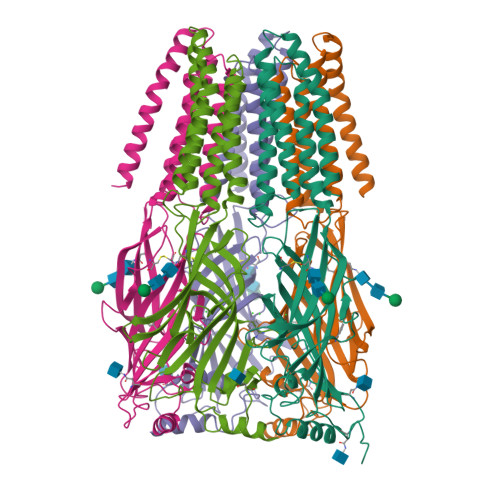
Pentobarbital (CED0000869)

Record Information
Version1.0
Creation Date2009-07-21 20:26:33 UTC
Update Date2026-05-14 16:25:20 UTC
SynCED IDCED0000869
Secondary Accession Numbers
  • CHEM002166
  • T3D2745
Identification
Common NamePentobarbital
ClassSmall Molecule
Description
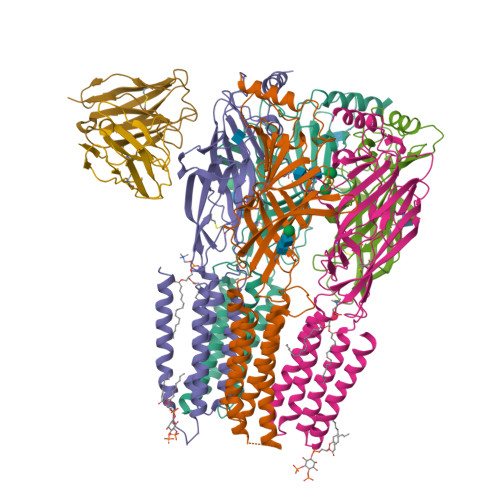
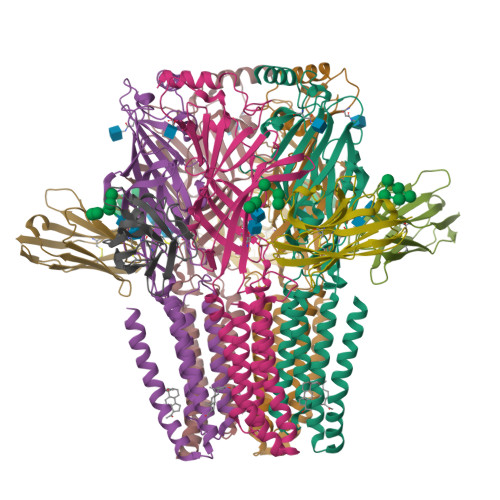
Pentobarbital belongs to the pyrimidines and pyrimidine derivatives, a subclass of diazines within the organic compounds. This exogenous organic compound has the formula C11H18N2O3 and an average molecular weight of 226.27 g/mol. At room temperature, it exists as a solid. It is utilized as a sedative and hypnotic agent, typically administered orally, though it is prescribed more frequently for sleep induction than for sedation. Its effectiveness may decrease by the second week of continued administration. The compound is associated with 14 recorded sources, including healthcare, pharmaceuticals and veterinary products (hypnotics and sedatives), drinking water and water supply, food, food processing and cookware (preparation of wort, food preservation, and fermentation processes for beer), household cleaning and consumer products (tobacco smoke filters, cigar cigarettes, non electric simulated smoking devices, and other smoking requisites), and electrical and electronic equipment (electrodes, magnets, antennas, conductors or conductive bodies characterised by the conductive materials, and electrically stimulated smoking devices). Recorded routes of exposure include oral, intravenous, intramuscular, and rectal administration. Pentobarbital interacts with 30 recorded protein targets, including Gamma-aminobutyric acid receptor subunit alpha-2 (GABRA2), alpha-3 (GABRA3), alpha-4 (GABRA4), and alpha-6 (GABRA6). It acts as an antagonist/positive allosteric modulator of these receptors. Specifically, pentobarbital binds at a distinct binding site associated with a Cl- ionopore at the GABAA receptor, increasing the duration for which the Cl- ionopore remains open. This prolongs the post-synaptic inhibitory effect of GABA in the thalamus and is associated with marked decreases in GABA-sensitive neuronal calcium conductance (gCa), resulting in the acute potentiation of inhibitory GABAergic tone.
Contaminant Type
  • Adjuvant, Anesthesia
  • Amide
  • Amine
  • Barbiturate
  • Drug
  • GABA Modulator
  • Hypnotic and Sedative
  • Metabolite
  • Organic Compound
  • Synthetic Compound
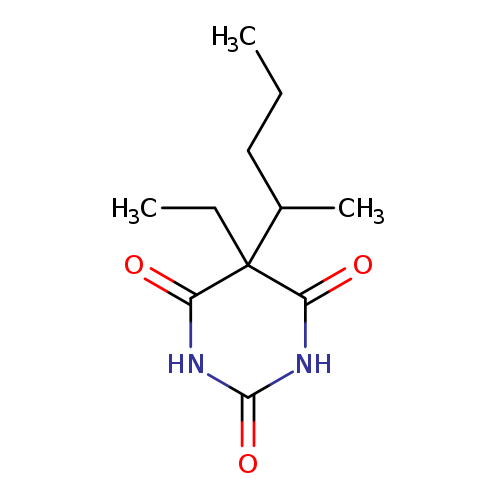
Chemical Structure
Synonyms
ValueSource
5-Ethyl-5-(1-methyl-butyl)-pyrimidine-2,4,6-trioneChEBI
5-Ethyl-5-(1-methylbutyl)-2,4,6(1H,3H,5H)-pyrimidinetrioneChEBI
5-Ethyl-5-(1-methylbutyl)barbituric acidChEBI
5-Ethyl-5-(sec-pentyl)barbituric acidChEBI
NembutalChEBI
PentobarbitoneChEBI
5-Ethyl-5-(1-methylbutyl)barbitateGenerator
5-Ethyl-5-(1-methylbutyl)barbitic acidGenerator
5-Ethyl-5-(sec-pentyl)barbitateGenerator
5-Ethyl-5-(sec-pentyl)barbitic acidGenerator
PentabarbitalHMDB
PentabarbitoneHMDB
PentobarbiturateHMDB
Pentobarbituric acidHMDB
Sodium pentobarbitalHMDB
EtaminalMeSH, HMDB
EthaminalMeSH, HMDB
Pentobarbital sodiumMeSH, HMDB
SagatalMeSH, HMDB
DiabutalMeSH, HMDB
Pentobarbital, monosodium saltMeSH, HMDB
MebubarbitalMeSH, HMDB
MebumalMeSH, HMDB
Monosodium salt pentobarbitalMeSH, HMDB
Chemical FormulaC11H18N2O3
Average Molecular Mass226.272 g/mol
Monoisotopic Mass226.132 g/mol
CAS Registry Number76-74-4
IUPAC Name5-ethyl-5-(pentan-2-yl)-1,3-diazinane-2,4,6-trione
Traditional Namepentobarbital
SMILESCCCC(C)C1(CC)C(=O)NC(=O)NC1=O
InChI IdentifierInChI=1S/C11H18N2O3/c1-4-6-7(3)11(5-2)8(14)12-10(16)13-9(11)15/h7H,4-6H2,1-3H3,(H2,12,13,14,15,16)
InChI KeyWEXRUCMBJFQVBZ-UHFFFAOYSA-N
Chemical Taxonomy
Description Belongs to the class of organic compounds known as pyrimidones. Pyrimidones are compounds that contain a pyrimidine ring, which bears a ketone. Pyrimidine is a 6-membered ring consisting of four carbon atoms and two nitrogen centers at the 1- and 3- ring positions.
KingdomOrganic compounds
Super ClassOrganoheterocyclic compounds
ClassDiazines
Sub ClassPyrimidines and pyrimidine derivatives
Direct ParentPyrimidones
Alternative Parents
Substituents
  • Pyrimidone
  • Hydropyrimidine
  • 2,5-dihydropyrimidine
  • Carbonic acid derivative
  • Propargyl-type 1,3-dipolar organic compound
  • Organic 1,3-dipolar compound
  • Azacycle
  • Organic oxide
  • Organooxygen compound
  • Organonitrogen compound
  • Organopnictogen compound
  • Organic oxygen compound
  • Carbonyl group
  • Organic nitrogen compound
  • Hydrocarbon derivative
  • Aliphatic heteromonocyclic compound
Molecular FrameworkAliphatic heteromonocyclic compounds
External Descriptors
Biological Properties
StatusDetected and Not Quantified
OriginExogenous
Cellular Locations
  • Membrane
Biofluid LocationsNot Available
Tissue LocationsNot Available
ApplicationsNot Available
Biological Roles
Chemical RolesNot Available
Organoleptic EffectsNot Available
Physical Properties
StateSolid
AppearanceWhite powder.
Experimental Properties
PropertyValue
Melting Point129.5°C
Boiling PointNot Available
Solubility679 mg/L (at 25°C)
Predicted Properties
PropertyValueSource
Water Solubility0.86 g/LALOGPS
logP2.16ALOGPS
logP1.89ChemAxon
logS-2.4ALOGPS
pKa (Strongest Acidic)8.48ChemAxon
Physiological Charge0ChemAxon
Hydrogen Acceptor Count3ChemAxon
Hydrogen Donor Count2ChemAxon
Polar Surface Area75.27 ŲChemAxon
Rotatable Bond Count4ChemAxon
Refractivity58 m³·mol⁻¹ChemAxon
Polarizability23.41 ųChemAxon
Number of Rings1ChemAxon
BioavailabilityYesChemAxon
Rule of FiveYesChemAxon
Ghose FilterYesChemAxon
Veber's RuleNoChemAxon
MDDR-like RuleNoChemAxon
Spectra
Spectra
Spectrum TypeDescriptionSplash KeyDeposition DateView
GC-MSGC-MS Spectrumsplash10-004i-0090000000-0f97406e79f836abc074Not AvailableView Spectrum
GC-MSGC-MS Spectrumsplash10-0a4l-5900000000-08245bcc95f52792c863Not AvailableView Spectrum
GC-MSGC-MS Spectrumsplash10-004i-0090000000-0f97406e79f836abc074Not AvailableView Spectrum
GC-MSGC-MS Spectrumsplash10-0a4l-5900000000-08245bcc95f52792c863Not AvailableView Spectrum
Predicted GC-MSPredicted GC-MS Spectrumsplash10-01xy-9720000000-ebfd954ba228514ca347Not AvailableView Spectrum
Predicted GC-MSPredicted GC-MS SpectrumNot AvailableNot AvailableView Spectrum
Predicted LC-MS/MSPredicted LC-MS/MS Spectrumsplash10-004i-1290000000-90bfbd79bea4fe2b007bNot AvailableView Spectrum
Predicted LC-MS/MSPredicted LC-MS/MS Spectrumsplash10-0bti-1900000000-7e31dcdb272669c13101Not AvailableView Spectrum
Predicted LC-MS/MSPredicted LC-MS/MS Spectrumsplash10-01bc-9100000000-c9fe8276b8137dc73d20Not AvailableView Spectrum
Predicted LC-MS/MSPredicted LC-MS/MS Spectrumsplash10-004i-3980000000-84ea889a0fae4bed224bNot AvailableView Spectrum
Predicted LC-MS/MSPredicted LC-MS/MS Spectrumsplash10-0006-9500000000-c226fe2dfb4ee13e4ae8Not AvailableView Spectrum
Predicted LC-MS/MSPredicted LC-MS/MS Spectrumsplash10-000x-9500000000-cd4190b9c110ee5e4428Not AvailableView Spectrum
Predicted LC-MS/MSPredicted LC-MS/MS Spectrumsplash10-0a4i-0930000000-ce337224a05a5827ddf4Not AvailableView Spectrum
Predicted LC-MS/MSPredicted LC-MS/MS Spectrumsplash10-0a4i-1910000000-61c3bd30210f2bd15034Not AvailableView Spectrum
Predicted LC-MS/MSPredicted LC-MS/MS Spectrumsplash10-0aos-6900000000-cd89b663334e7901acd1Not AvailableView Spectrum
Predicted LC-MS/MSPredicted LC-MS/MS Spectrumsplash10-004i-1390000000-b300ae41f3e7623fa882Not AvailableView Spectrum
Predicted LC-MS/MSPredicted LC-MS/MS Spectrumsplash10-0006-9000000000-b2af88d76179b3402570Not AvailableView Spectrum
Predicted LC-MS/MSPredicted LC-MS/MS Spectrumsplash10-0006-9300000000-99ecf1568fa04b732c33Not AvailableView Spectrum
MSMS Spectrumsplash10-0a4l-6900000000-a65d8c67e006ad448814Not AvailableView Spectrum
Toxicity Profile
Toxicity Values
Toxicity ValueOrganismDose DescriptorRoute of ExposurePredicted or ExperimentalToxicity RatingReference
255.0 Log mg/kg [140:450]RatLD50oralpredictedNot AvailableNot Available
40.0 mg/kg-day RatLOELinjectionexperimentalNot AvailableECOTOX - EPA ORD
Toxicity / Toxin ClassNot Available
Mechanism of ToxicityPentobarbital binds at a distinct binding site associated with a Cl- ionopore at the GABAA receptor, increasing the duration of time for which the Cl- ionopore is open. The post-synaptic inhibitory effect of GABA in the thalamus is, therefore, prolonged. All of these effects are associated with marked decreases in GABA-sensitive neuronal calcium conductance (gCa). The net result of barbiturate action is acute potentiation of inhibitory GABAergic tone. Barbiturates also act through potent (if less well characterized) and direct inhibition of excitatory AMPA-type glutamate receptors, resulting in a profound suppression of glutamatergic neurotransmission.
Carcinogenicity (IARC Classification)No indication of carcinogenicity to humans (not listed by IARC).
Minimum Risk LevelNot Available
SymptomsSymptoms of an overdose typically include sluggishness, incoordination, difficulty in thinking, slowness of speech, faulty judgment, drowsiness or coma, shallow breathing, staggering, and in severe cases coma and death.
TreatmentTreatment of overdosage is mainly supportive and consists of maintaining an adequate airway, with assisted respiration and oxygen administration as necessary, monitoring of vital signs and fluid balance, and fluid therapy and other standard treatment for shock, if needed. If renal function is normal, forced diuresis may aid in the elimination of the barbiturate. Alkalinization of the urine increases renal excretion of some barbiturates, especially phenobarbital, also aprobarbital and mephobarbital (which is metabolized to phenobarbital). Although not recommended as a routine procedure, hemodialysis may be used in severe barbiturate intoxications or if the patient is anuric or in shock. The patient should be rolled from side to side every 30 minutes and antibiotics should be given if pneumonia is suspected. Appropriate nursing care to prevent hypostatic pneumonia, decubiti, aspiration, and other complications of patients with altered states of consciousness. (3)
Health Effects
Health EffectRelationshipDirectionDescriptionReference
seizureNot AvailableNot AvailableNot AvailablePMC7322764
cardiac arrestAssociated With?Not AvailableA congestive heart failure characterized by a sudden stop in effective blood circulation due to the failure of the heart to contract effectively or at all.PMC7642011
MortalityAssociated With?Not AvailableNot AvailablePMC4358825
DeathAssociated With?Not AvailableNot AvailablePMC7642011
Exposure Sources
Source IDSourceSectorReference
CEDs000010Insecticides?Insecticides are synthetic chemicals designed to control or eliminate insect pests that threaten crops and other agricultural products.Agriculture & land managementPubChem
CEDs000115Drinking water?Drinking water can be a medium for synthetic chemical contamination, often originating from various industrial processes and agricultural practices.Drinking water & water supplyNot Available
CEDs000233Brushes?Brushes used in personal care and cosmetics can be a source of synthetic chemical contamination due to the materials and coatings used in their manufacturing.Personal care & cosmeticsPubChem
CEDs000376Hypnotics and sedatives?Hypnotics and sedatives are synthetic chemicals primarily used to induce sleep, reduce anxiety, and manage various psychiatric disorders.Healthcare, pharmaceuticals & veterinary productsNot Available
CEDs000506Antennas?Antennas, commonly used in communication technologies, can be a source of synthetic chemical contamination through the materials and coatings used in their construction.Electrical & Electronic EquipmentPubChem
CEDs000511Conductors Or Conductive Bodies Characterised By The Conductive Materials?Conductors, or conductive bodies, are materials that allow the flow of electrical current, typically made from metals such as copper, aluminum, or silver.Electrical & Electronic EquipmentPubChem
CEDs000518Electrically Stimulated Smoking Devices?Electrically stimulated smoking devices, commonly known as e-cigarettes or vape pens, utilize electrical components to heat a liquid solution, often containing nicotine, flavorings, and other additives, to produce an aerosol for inhalation.Electrical & Electronic EquipmentPubChem
CEDs000519Electrodes?Electrodes, used in various electrical and electronic applications, can be a source of synthetic chemical contamination due to the materials from which they are constructed and the processes involved in their manufacturing.Electrical & Electronic EquipmentPubChem
CEDs000527Magnets?Magnets, commonly used in various electrical and electronic applications, can be a source of synthetic chemical contamination due to the materials used in their production.Electrical & Electronic EquipmentPubChem
CEDs000544Fermentation Processes For Beer?Fermentation processes for beer involve the conversion of sugars into alcohol and carbon dioxide by yeast.Food, food processing & cookwarePubChem
CEDs000545Food Preservation?Food preservation often involves the use of synthetic chemicals, such as preservatives, flavor enhancers, and color additives, to extend shelf life and enhance the sensory qualities of food products.Food, food processing & cookwarePubChem
CEDs000550Preparation Of Wort?The preparation of wort involves the extraction of sugars from malted grains, a crucial step in the brewing process.Food, food processing & cookwarePubChem
CEDs000556Cigar Cigarettes?Cigar cigarettes are a source of synthetic chemical contamination due to the combustion of various tobacco blends and additives.Household cleaning & consumer productsPubChem
CEDs000559Non Electric Simulated Smoking Devices?Non-electric simulated smoking devices, often designed to mimic the experience of smoking without combustion, can be sources of synthetic chemical contamination due to the materials and chemicals used in their construction and operation.Household cleaning & consumer productsPubChem
CEDs000560Other Smoking Requisites?Other smoking requisites, including items such as lighters, matches, and rolling papers, can introduce synthetic chemical contamination through various components and additives.Household cleaning & consumer productsPubChem
CEDs000569Tobacco Smoke Filters?Tobacco smoke filters are designed to reduce the inhalation of harmful substances in cigarette smoke, including tar and other particulate matter.Household cleaning & consumer productsPubChem
CEDs000578Making Cigars?The process of making cigars involves several steps, including the cultivation of tobacco, fermentation, and the application of various additives to enhance flavor and preservation.Industrial manufacturing & chemical processingPubChem
CEDs000580Manufacture Preparation Of Tobacco Products?The manufacture and preparation of tobacco products involve various processes that can result in the introduction of synthetic chemicals into the environment.Industrial manufacturing & chemical processingPubChem
CEDs000596Acaricides?Acaricides are synthetic chemicals specifically designed to target and control mite populations that can damage crops and plants.Agriculture & land managementPubChem
CEDs000605Pest Repellants?Pest repellents, often formulated from synthetic chemicals, are widely used to protect crops from insect infestations and other pests.Agriculture & land managementPubChem
CEDs000606Plant Growth Regulators?Plant Growth Regulators (PGRs) are synthetic chemicals designed to influence the growth and development of plants.Agriculture & land managementPubChem
CEDs000609Aftershave?Aftershave is a grooming product typically used to soothe and protect the skin following shaving.Personal care & cosmeticsPubChem
CEDs000610Aftersun Products?Aftersun products are designed to soothe and hydrate the skin after sun exposure, often containing various synthetic chemicals such as emollients, preservatives, and fragrances.Personal care & cosmeticsPubChem
CEDs000611Anti Perspirants Or Body Deoderants?Antiperspirants and body deodorants commonly contain synthetic chemicals such as aluminum compounds, parabens, and synthetic fragrances.Personal care & cosmeticsPubChem
CEDs000613Depilatories?Depilatories are products designed to remove unwanted hair through the application of synthetic chemicals that break down the protein structure of hair, facilitating its removal.Personal care & cosmeticsPubChem
CEDs000614Essential Oils Or Perfumes?Essential oils and perfumes are complex mixtures of volatile compounds derived from natural or synthetic sources, commonly used for their aromatic properties.Personal care & cosmeticsPubChem
CEDs000615Eye Makeup Products?Eye makeup products, including mascaras, eyeliners, and eyeshadows, often contain a variety of synthetic chemicals such as pigments, preservatives, and film-forming agents.Personal care & cosmeticsPubChem
CEDs000617Lip Care Products?Lip care products, including lipsticks, balms, and glosses, often contain a variety of synthetic chemicals such as parabens, phthalates, and synthetic fragrances.Personal care & cosmeticsPubChem
CEDs000618Lip Makeup Products?Lip makeup products, such as lipsticks, lip glosses, and lip liners, often contain a variety of synthetic chemicals, including pigments, preservatives, and emollients.Personal care & cosmeticsPubChem
CEDs000630Toys?Toys, particularly those made from synthetic materials such as plastics, can be a source of chemical contamination due to the presence of various additives and compounds used in their production.Recreation & sports surfacesPubChem
CEDs000632Apparel?Apparel production often involves the use of various synthetic chemicals, including dyes, finishing agents, and preservatives.Textiles, leather & furnishingsPubChem
CEDs000642Footwear?Footwear production often involves the use of various synthetic chemicals, such as adhesives, dyes, and treatments, which can contribute to environmental contamination.Textiles, leather & furnishingsPubChem
CEDs000650Purses Luggage Hand Bags?Purses, luggage, and handbags are often manufactured using synthetic materials such as polyvinyl chloride (PVC), polyurethane, and various types of nylon.Textiles, leather & furnishingsPubChem
CEDs000651Purses Money Bags Wallets?Purses, money bags, and wallets are often manufactured using synthetic materials, including plastics, polyurethanes, and various treated fabrics.Textiles, leather & furnishingsPubChem
CEDs000653Sewing?Sewing processes often involve the use of various synthetic chemicals, which can become sources of contamination in the environment.Textiles, leather & furnishingsPubChem
CEDs000662Yarns Or Threads?Yarns or threads used in textiles can be a source of synthetic chemical contamination due to the production processes and treatments they undergo.Textiles, leather & furnishingsPubChem
CEDs000671Airplanes And Helicopters?Airplanes and helicopters are significant sources of synthetic chemical contamination primarily through the use of aviation fuels, lubricants, and de-icing agents.Aviation & AerospacePubChem
CEDs000684Cements?Cements are a composite material primarily used as a binding agent in construction applications, formed by the calcination of limestone and clay minerals at high temperatures.Building & ConstructionPubChem
CEDs000685Ceramics?Ceramics can be a source of synthetic chemical contamination through various additives and processing agents used in their production.Building & ConstructionPubChem
CEDs000686Clay Wares?Clay wares are ceramic products made from natural clay, often utilized in various construction applications such as tiles, bricks, and sanitary ware.Building & ConstructionPubChem
CEDs000688Glass Coatings?Glass coatings are synthetic chemical formulations applied to glass surfaces to enhance properties such as durability, UV resistance, and aesthetic appeal.Building & ConstructionPubChem
CEDs000689Glass Fibres?Glass fibres are composed of fine strands of glass, commonly utilized for their tensile strength and lightweight properties.Building & ConstructionPubChem
CEDs000692Silica Free Oxide Glass?Silica Free Oxide Glass is a type of glass that is produced using alternative materials to traditional silica-based formulations.Building & ConstructionPubChem
CEDs000693Silica Glass?Silica glass, primarily composed of silicon dioxide (SiO2), is widely used in various applications, including windows, glass facades, and insulation materials.Building & ConstructionPubChem
CEDs000696Nanotechnology?Nanotechnology involves the manipulation of materials at the molecular or atomic level, typically within the range of 1 to 100 nanometers.Industrial manufacturing & chemical processingPubChem
CEDs000729Stamps?Stamps, particularly those produced using synthetic inks and adhesives, can contribute to chemical contamination when disposed of improperly.Paper, pulp & fiber productsPubChem
CEDs000735Explosives?Explosives are chemical compounds or mixtures designed to undergo rapid decomposition, releasing energy in the form of gas and heat.Defense & military infrastructurePubChem
CEDs000739Inks?Inks are complex mixtures composed of pigments or dyes, solvents, resins, and additives used primarily for printing and writing applications.Paper, pulp & fiber productsPubChem
CEDs000740Paper?Paper production involves the processing of wood fibers and the use of various chemicals, which can lead to synthetic chemical contamination.Paper, pulp & fiber productsPubChem
CEDs000741Pigment Pastes?Pigment pastes are concentrated dispersions of pigments used to impart color and properties to materials.Paper, pulp & fiber productsPubChem
CEDs000742Leather Tanning?Leather tanning is a process that transforms raw animal hides into durable leather through the application of various chemicals, including chromium salts, aldehydes, and vegetable tannins.Textiles, leather & furnishingsPubChem
CEDs000744Water, Wastewater, & Sewage Treatment?Water, wastewater, and sewage treatment processes are critical for managing and mitigating pollutants in water systems.Wastewater, sanitation & biosolidsPubChem
Pathways
3 pathwaysPathway Source: PathBank
Targets
StructureProteinUniProt IDOrganismRelationshipDetails
Matrix metalloproteinase-14 structureClick to view 3D structureMatrix metalloproteinase-14P50281HumansPredicted (SEA)
Prediction Confidence Score
0.209
Applicability Domain
0.235 Low confidence
Statistical Significance
0.3429
Supporting Reference Compounds
198
E-value
2669.29
A disintegrin and metalloproteinase with thrombospondin motifs 5 structureClick to view 3D structureA disintegrin and metalloproteinase with thrombospondin motifs 5Q9UNA0HumansPredicted (SEA)
Prediction Confidence Score
0.201
Applicability Domain
0.217 Low confidence
Statistical Significance
0.2494
Supporting Reference Compounds
79
E-value
1941.64
72 kDa type IV collagenase structureClick to view 3D structure72 kDa type IV collagenaseP08253HumansPredicted (SEA)
Prediction Confidence Score
0.2
Applicability Domain
0.217 Low confidence
Statistical Significance
0.6063
Supporting Reference Compounds
400
E-value
4719.92
Collagenase 3 structureClick to view 3D structureCollagenase 3P45452HumansPredicted (SEA)
Prediction Confidence Score
0.198
Applicability Domain
0.207 Low confidence
Statistical Significance
0.5608
Supporting Reference Compounds
269
E-value
4366.17
Disintegrin and metalloproteinase domain-containing protein 17 structureClick to view 3D structureDisintegrin and metalloproteinase domain-containing protein 17P78536HumansPredicted (SEA)
Prediction Confidence Score
0.196
Applicability Domain
0.217 Low confidence
Statistical Significance
0.5094
Supporting Reference Compounds
166
E-value
3965.41
A disintegrin and metalloproteinase with thrombospondin motifs 4 structureClick to view 3D structureA disintegrin and metalloproteinase with thrombospondin motifs 4O75173HumansPredicted (SEA)
Prediction Confidence Score
0.193
Applicability Domain
0.207 Low confidence
Statistical Significance
0.3319
Supporting Reference Compounds
79
E-value
2583.82
Macrophage metalloelastase structureClick to view 3D structureMacrophage metalloelastaseP39900HumansPredicted (SEA)
Prediction Confidence Score
0.191
Applicability Domain
0.197 Low confidence
Statistical Significance
0.5029
Supporting Reference Compounds
136
E-value
3915.27
Click to view 3D structureAdenosine receptor A1P47745Cavia porcellusPredicted (SEA)
Prediction Confidence Score
0.19
Applicability Domain
0.204 Low confidence
Statistical Significance
0.0429
Supporting Reference Compounds
38
E-value
333.662
Adenosine receptor A2b structureClick to view 3D structureAdenosine receptor A2bP29275HumansPredicted (SEA)
Prediction Confidence Score
0.186
Applicability Domain
0.191 Low confidence
Statistical Significance
0.6176
Supporting Reference Compounds
187
E-value
4808.28
Click to view 3D structureAdenosine receptor A1P25099Rattus norvegicusPredicted (SEA)
Prediction Confidence Score
0.185
Applicability Domain
0.191 Low confidence
Statistical Significance
0.5225
Supporting Reference Compounds
221
E-value
4067.31
Click to view 3D structureToll-like receptor 7B3Y652Macaca fascicularisPredicted (SEA)
Prediction Confidence Score
0.182
Applicability Domain
0.182 Low confidence
Statistical Significance
0.0104
Supporting Reference Compounds
1
E-value
81.3524
Stromelysin-1 structureClick to view 3D structureStromelysin-1P08254HumansPredicted (SEA)
Prediction Confidence Score
0.18
Applicability Domain
0.194 Low confidence
Statistical Significance
0.6868
Supporting Reference Compounds
200
E-value
5346.61
Click to view 3D structureAdenosine receptor A2aP46616Cavia porcellusPredicted (SEA)
Prediction Confidence Score
0.178
Applicability Domain
0.191 Low confidence
Statistical Significance
0.0624
Supporting Reference Compounds
27
E-value
485.623
Click to view 3D structureADAM metallopeptidase with thrombospondin type 1 motif 4A0A8C0SKI4Canis lupus familiarisPredicted (SEA)
Prediction Confidence Score
0.177
Applicability Domain
0.194 Low confidence
Statistical Significance
0.0547
Supporting Reference Compounds
3
E-value
425.68
Click to view 3D structureAlkaline ceramidase 2Q5QJU3HumansPredicted (SEA)
Prediction Confidence Score
0.176
Applicability Domain
0.176 Low confidence
Statistical Significance
0.0904
Supporting Reference Compounds
1
E-value
703.991
HTH-type quorum-sensing regulator RhlR structureClick to view 3D structureHTH-type quorum-sensing regulator RhlRP54292Pseudomonas aeruginosa (strain ATCC 15692 / PAO1 / 1C / PRS 101 / LMG12228)Predicted (SEA)
Prediction Confidence Score
0.176
Applicability Domain
0.176 Low confidence
Statistical Significance
0.0155
Supporting Reference Compounds
1
E-value
120.744
Click to view 3D structureCAI-1 autoinducer sensor kinase/phosphatase CqsSQ9KM66Vibrio cholerae serotype O1 (strain ATCC 39315 / El Tor Inaba N16961)Predicted (SEA)
Prediction Confidence Score
0.175
Applicability Domain
0.175 Low confidence
Statistical Significance
0.0085
Supporting Reference Compounds
1
E-value
66.5611
G-protein coupled receptor 84 structureClick to view 3D structureG-protein coupled receptor 84Q9NQS5HumansPredicted (SEA)
Prediction Confidence Score
0.174
Applicability Domain
0.205 Low confidence
Statistical Significance
0.0662
Supporting Reference Compounds
15
E-value
515.206
Neutrophil collagenase structureClick to view 3D structureNeutrophil collagenaseP22894HumansPredicted (SEA)
Prediction Confidence Score
0.174
Applicability Domain
0.194 Low confidence
Statistical Significance
0.6826
Supporting Reference Compounds
176
E-value
5314.07
Click to view 3D structureA disintegrin-like and metallopeptidase (Reprolysin type) with thrombospondin type 1 motif, 5 (Aggrecanase-2)G3V673Rattus norvegicusPredicted (SEA)
Prediction Confidence Score
0.174
Applicability Domain
0.194 Low confidence
Statistical Significance
0.0591
Supporting Reference Compounds
5
E-value
460.167
Protein kinase C alpha type structureClick to view 3D structureProtein kinase C alpha typeP17252HumansPredicted (SEA)
Prediction Confidence Score
0.172
Applicability Domain
0.177 Low confidence
Statistical Significance
0.8774
Supporting Reference Compounds
258
E-value
6830.18
Transcriptional activator protein LasR structureClick to view 3D structureTranscriptional activator protein LasRP25084Pseudomonas aeruginosa (strain ATCC 15692 / PAO1 / 1C / PRS 101 / LMG 12228)Predicted (SEA)
Prediction Confidence Score
0.172
Applicability Domain
0.18 Low confidence
Statistical Significance
0.0377
Supporting Reference Compounds
12
E-value
293.725
Adenosine receptor A2a structureClick to view 3D structureAdenosine receptor A2aP29274HumansPredicted (SEA)
Prediction Confidence Score
0.172
Applicability Domain
0.191 Low confidence
Statistical Significance
0.8961
Supporting Reference Compounds
303
E-value
6976.07
A disintegrin and metalloproteinase with thrombospondin motifs 1 structureClick to view 3D structureA disintegrin and metalloproteinase with thrombospondin motifs 1Q9UHI8HumansPredicted (SEA)
Prediction Confidence Score
0.171
Applicability Domain
0.207 Low confidence
Statistical Significance
0.271
Supporting Reference Compounds
13
E-value
2109.56
Hydroxycarboxylic acid receptor 2 structureClick to view 3D structureHydroxycarboxylic acid receptor 2Q8TDS4HumansPredicted (SEA)
Prediction Confidence Score
0.171
Applicability Domain
0.2 Low confidence
Statistical Significance
0.1201
Supporting Reference Compounds
21
E-value
934.891
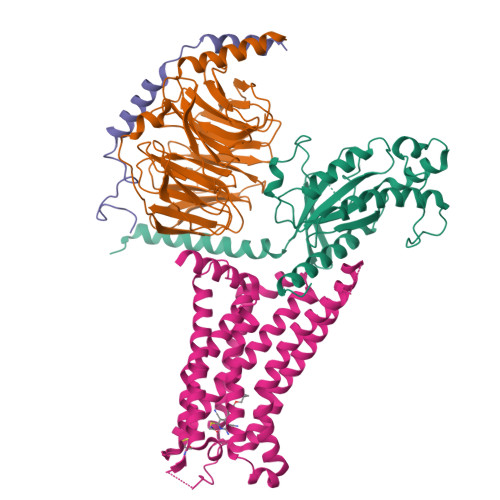
Gamma-aminobutyric acid receptor subunit alpha-1 structureClick to view 3D structureGamma-aminobutyric acid receptor subunit alpha-1P14867HumansKnownPentobarbital binds at a distinct binding site associated with a Cl- ionopore at the GABAA receptor, increasing the duration of time for which the Cl- ionopore is open. The post-synaptic inhibitory effect of GABA in the thalamus is, therefore, prolonged. All of these effects are associated with marked decreases in GABA-sensitive neuronal calcium conductance (gCa). The net result of barbiturate action is acute potentiation of inhibitory GABAergic tone. Barbiturates also act through potent (if less well characterized) and direct inhibition of excitatory AMPA-type glutamate receptors, resulting in a profound suppression of glutamatergic neurotransmission.
Neuronal acetylcholine receptor subunit alpha-4 structureClick to view 3D structureNeuronal acetylcholine receptor subunit alpha-4P43681HumansKnownNot Available
Neuronal acetylcholine receptor subunit alpha-7 structureClick to view 3D structureNeuronal acetylcholine receptor subunit alpha-7P36544HumansKnownNot Available
Gamma-aminobutyric acid receptor subunit alpha-2 structureClick to view 3D structureGamma-aminobutyric acid receptor subunit alpha-2P47869HumansKnownNot Available
Gamma-aminobutyric acid receptor subunit alpha-3 structureClick to view 3D structureGamma-aminobutyric acid receptor subunit alpha-3P34903HumansKnownNot Available
Gamma-aminobutyric acid receptor subunit alpha-5 structureClick to view 3D structureGamma-aminobutyric acid receptor subunit alpha-5P31644HumansKnownNot Available
Click to view 3D structureGamma-aminobutyric acid receptor subunit alpha-6Q16445HumansKnownNot Available
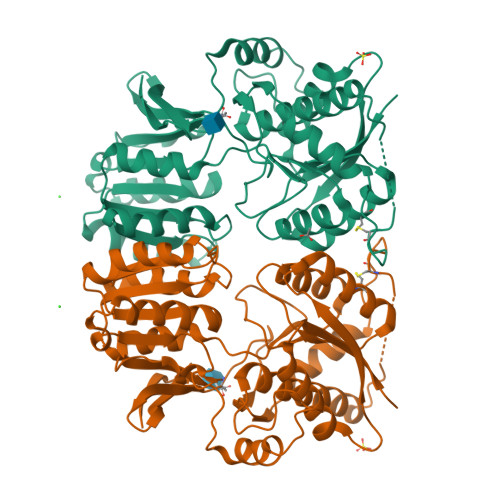
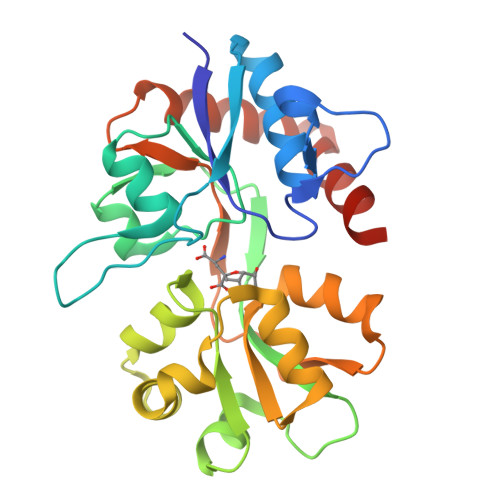
Glutamate receptor 2 structureClick to view 3D structureGlutamate receptor 2P42262HumansKnownNot Available
Glutamate receptor ionotropic, kainate 2 structureClick to view 3D structureGlutamate receptor ionotropic, kainate 2Q13002HumansKnownNot Available
Gamma-aminobutyric acid receptor subunit alpha-4 structureClick to view 3D structureGamma-aminobutyric acid receptor subunit alpha-4P48169HumansKnownNot Available
Gamma-aminobutyric acid receptor subunit beta-3 structureClick to view 3D structureGamma-aminobutyric acid receptor subunit beta-3P28472HumansKnownNot Available
Histamine H1 receptor structureClick to view 3D structureHistamine H1 receptorP35367HumansKnownNot Available
Nuclear receptor subfamily 1 group I member 2 structureClick to view 3D structureNuclear receptor subfamily 1 group I member 2O75469HumansKnownNot Available
Voltage-gated inwardly rectifying potassium channel KCNH2 structureClick to view 3D structureVoltage-gated inwardly rectifying potassium channel KCNH2Q12809HumansKnownNot Available
Concentrations
Not Available
External Links
DrugBank IDDB00312
HMDB IDHMDB0259667
FooDB IDNot Available
Phenol Explorer IDNot Available
KNApSAcK IDNot Available
BiGG IDNot Available
BioCyc IDNot Available
METLIN IDNot Available
PDB IDNot Available
Wikipedia LinkPentobarbital
Chemspider ID4575
ChEBI ID7983
PubChem Compound IDNot Available
Kegg Compound IDC07422
YMDB IDNot Available
ECMDB IDNot Available
References
Synthesis ReferenceNot Available
MSDSLink
General References
  1. Knodell RG, Spector MH, Brooks DA, Keller FX, Kyner WT: Alterations in pentobarbital pharmacokinetics in response to parenteral and enteral alimentation in the rat. Gastroenterology. 1980 Dec;79(6):1211-6. [PubMed: 6777235]
  2. Drugs.com - http://www.drugs.com/MTM/pentobarbital.html
  3. RxList: The Internet Drug Index (2009). - http://www.rxlist.com/