Some data may have been extracted from scientific literature using a pipeline that uses large language models (LLMs). Source articles are cited where applicable to help verify the extracted relationships.
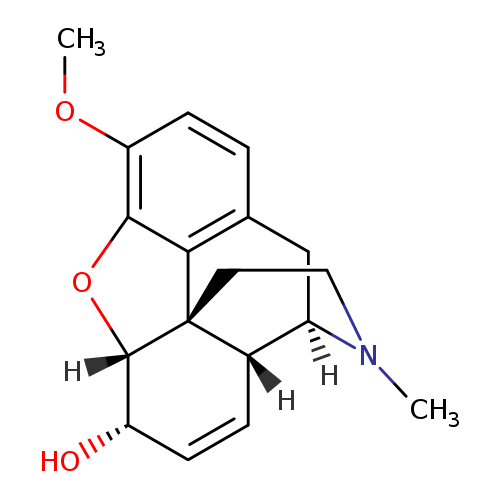
Codeine belongs to the morphinans, a class of alkaloids and derivatives within the organic compounds. It has the formula C18H21NO3, an average molecular weight of 299.36 g/mol, and exists as a solid at room temperature. This exogenous compound is an opioid analgesic, antitussive, opioid receptor agonist, and prodrug (PMC5357098 , PMC6644518 ). It is used as a treatment for pain (PMC6205722 , PMC6644518 ) and cough (PMC6205722 ). However, it is associated with lethargy and depression (PMC7012325 ).
Codeine targets five proteins: the Mu-type opioid receptor (OPRM1), Delta-type opioid receptor (OPRD1), Kappa-type opioid receptor (OPRK1), Cytochrome P450 2D6 (CYP2D6), and the Voltage-gated inwardly rectifying potassium channel KCNH2. Opiate receptors are coupled with G-protein receptors and function as both positive and negative regulators of synaptic transmission via G-proteins that activate effector proteins. Binding of the opiate stimulates the exchange of GTP for GDP on the G-protein complex; since the effector system is adenylate cyclase and cAMP located at the inner surface of the plasma membrane, opioids decrease intracellular cAMP by inhibiting adenylate cyclase, subsequently affecting the release of nociceptive neurotransmitter.
The compound has been detected in skin and hair. Recorded exposure routes include oral, subcutaneous, intramuscular, inhalation, and touch. It is found in 27 recorded sources, including healthcare, pharmaceuticals and veterinary products (analgesics, medical devices, cough and cold preparations), drinking water and water supply, indoor air, textiles, leather and furnishings, household cleaning and consumer products, and electrical and electronic equipment. Additionally, codeine is used in Low-Density Polyethylene, High-Density Polyethylene, and Polyamide plastics.
Belongs to the class of organic compounds known as morphinans. These are polycyclic compounds with a four-ring skeleton with three condensed six-member rings forming a partially hydrogenated phenanthrene moiety, one of which is aromatic while the two others are alicyclic.
Opiate receptors are coupled with G-protein receptors and function as both positive and negative regulators of synaptic transmission via G-proteins that activate effector proteins. Binding of the opiate stimulates the exchange of GTP for GDP on the G-protein complex. As the effector system is adenylate cyclase and cAMP located at the inner surface of the plasma membrane, opioids decrease intracellular cAMP by inhibiting adenylate cyclase. Subsequently, the release of nociceptive neurotransmitters such as substance P, GABA, dopamine, acetylcholine and noradrenaline is inhibited. Opioids also inhibit the release of vasopressin, somatostatin, insulin and glucagon. Codeine's analgesic activity is, most likely, due to its conversion to morphine. Opioids close N-type voltage-operated calcium channels (OP2-receptor agonist) and open calcium-dependent inwardly rectifying potassium channels (OP3 and OP1 receptor agonist). This results in hyperpolarization and reduced neuronal excitability.
No indication of carcinogenicity to humans (not listed by IARC).
Minimum Risk Level
Not Available
Symptoms
Respiratory depression, sedation and miosis and common symptoms of overdose. Other symptoms include nausea, vomiting, skeletal muscle flaccidity, bradycardia, hypotension, and cool, clammy skin. Apnea and death may ensue.
Treatment
Naloxone antagonizes most effects of codeine. Protect the airway as Naloxone may induce vomiting. Naloxone has a shorter duration of action than codeine; repeated doses may be needed. Protect the patient's airway and support ventilation and perfusion. Meticulously monitor and maintain, within acceptable limits, the patient's vital signs, blood gases, serum electrolytes, etc. Absorption of drugs from the gastrointestinal tract may be decreased by giving activated charcoal, which in many cases, is more effective than emesis or lavage; consider charcoal instead of or in addition to gastric emptying. Repeated doses of charcoal over time may hasten elimination of some drugs that have been absorbed. Safeguard the patient's airway when employing gastric emptying or charcoal. (25)
A sudden, often repetitive, spasmodic contraction of the thoracic cavity, resulting in violent release of air from the lungs and usually accompanied by a distinctive sound. (NCI CTCAE)
Indoor air?Indoor air can be a significant reservoir for synthetic chemical contaminants, which often originate from various sources within enclosed environments.
Stormwater runoff?Stormwater runoff refers to the flow of rainwater or melted snow that does not soak into the ground and instead collects pollutants as it travels over impervious surfaces such as roads and parking lots.
Drinking water?Drinking water can be a medium for synthetic chemical contamination, often originating from various industrial processes and agricultural practices.
Printed circuit boards?Printed circuit boards (PCBs) are essential components in the manufacturing of electronic devices, serving as the backbone for electrical connections and circuit pathways.
Semiconductors?Semiconductors are materials that possess electrical conductivity between that of conductors and insulators, making them essential for various electronic applications, including transistors, diodes, and integrated circuits.
Lubricants?Lubricants are synthetic or petroleum-derived substances used to reduce friction between surfaces in machinery and equipment, enhancing operational efficiency and longevity.
Food packaging?Food packaging often utilizes synthetic chemicals, such as plastics and coatings, to enhance durability, moisture resistance, and shelf life.
Brushes?Brushes used in personal care and cosmetics can be a source of synthetic chemical contamination due to the materials and coatings used in their manufacturing.
Medical devices?Medical devices often incorporate synthetic chemicals in their manufacturing processes, which can contribute to contamination in healthcare settings.
Cough and cold preparations?Cough and cold preparations often contain a variety of synthetic chemicals, including antihistamines, decongestants, and expectorants.
Carpets and Rugs?Carpets and rugs are commonly manufactured using synthetic fibers such as nylon, polyester, and polypropylene, which can be derived from petrochemical sources.
Synthetic textiles?Synthetic textiles are materials derived from man-made fibers, such as polyester, nylon, and acrylic, which are produced through chemical processes involving petrochemicals.
Cell phones?Cell phones contain a variety of synthetic chemicals and materials, including plastics, metals, and glass, which can contribute to environmental contamination.
Capacitors?Capacitors are electronic components that store and release electrical energy, often using dielectric materials that can include synthetic chemicals.
Ceilings?Ceilings in built environments can be a source of synthetic chemical contamination due to the materials used in their construction and finishes.
Antennas?Antennas, commonly used in communication technologies, can be a source of synthetic chemical contamination through the materials and coatings used in their construction.
Conductors Or Conductive Bodies Characterised By The Conductive Materials?Conductors, or conductive bodies, are materials that allow the flow of electrical current, typically made from metals such as copper, aluminum, or silver.
Electric Switches?Electric switches, integral components in numerous devices, can be a source of synthetic chemical contamination due to the materials and manufacturing processes involved in their production.
Electrically Stimulated Smoking Devices?Electrically stimulated smoking devices, commonly known as e-cigarettes or vape pens, utilize electrical components to heat a liquid solution, often containing nicotine, flavorings, and other additives, to produce an aerosol for inhalation.
Electrodes?Electrodes, used in various electrical and electronic applications, can be a source of synthetic chemical contamination due to the materials from which they are constructed and the processes involved in their manufacturing.
Hybrid Capacitors?Hybrid capacitors are energy storage devices that combine the properties of electrolytic and supercapacitors, utilizing a combination of electrochemical principles to achieve higher energy density and power density.
Line Transmission Systems?Line Transmission Systems, commonly used for the distribution of electrical energy, can be a source of synthetic chemical contamination through the insulation materials and coatings utilized in their construction.
Still Video Cameras?Still video cameras, which capture images in digital format, can be a source of synthetic chemical contamination due to the materials and components used in their production and operation.
Television Systems?Television systems can be a source of synthetic chemical contamination due to the various materials and components used in their manufacture and operation.
Food Preservation?Food preservation often involves the use of synthetic chemicals, such as preservatives, flavor enhancers, and color additives, to extend shelf life and enhance the sensory qualities of food products.
Bleaching Agents?Bleaching agents are chemical substances used to whiten or lighten materials, often employed in various cleaning products for their stain removal and disinfecting properties.
Non Electric Simulated Smoking Devices?Non-electric simulated smoking devices, often designed to mimic the experience of smoking without combustion, can be sources of synthetic chemical contamination due to the materials and chemicals used in their construction and operation.
Other Smoking Requisites?Other smoking requisites, including items such as lighters, matches, and rolling papers, can introduce synthetic chemical contamination through various components and additives.
Perfumes Within Detergents And Soaps?Perfumes within detergents and soaps are synthetic fragrance compounds added to enhance the sensory experience of cleaning products.
Pipe Accessories?Pipe accessories, such as fittings, connectors, and seals, are components used in plumbing systems to facilitate the flow of liquids and gases.
Soap Detergents?Soap detergents are synthetic surfactants designed to enhance the cleaning efficacy of water by reducing surface tension, allowing for better interaction with dirt and grease.
Tobacco Smoke Filters?Tobacco smoke filters are designed to reduce the inhalation of harmful substances in cigarette smoke, including tar and other particulate matter.
Manufacture Of Iron Or Steel?The manufacture of iron or steel involves various processes, including smelting, refining, and alloying, which can result in the release of synthetic chemicals and contaminants.
Manufacture Preparation Of Tobacco Products?The manufacture and preparation of tobacco products involve various processes that can result in the introduction of synthetic chemicals into the environment.
Nematocides?Nematocides are synthetic chemicals specifically designed to control nematodes, which are microscopic roundworms that can cause significant damage to crops and plants.
Aftersun Products?Aftersun products are designed to soothe and hydrate the skin after sun exposure, often containing various synthetic chemicals such as emollients, preservatives, and fragrances.
Anti Perspirants Or Body Deoderants?Antiperspirants and body deodorants commonly contain synthetic chemicals such as aluminum compounds, parabens, and synthetic fragrances.
Depilatories?Depilatories are products designed to remove unwanted hair through the application of synthetic chemicals that break down the protein structure of hair, facilitating its removal.
Essential Oils Or Perfumes?Essential oils and perfumes are complex mixtures of volatile compounds derived from natural or synthetic sources, commonly used for their aromatic properties.
Eye Makeup Products?Eye makeup products, including mascaras, eyeliners, and eyeshadows, often contain a variety of synthetic chemicals such as pigments, preservatives, and film-forming agents.
Lip Care Products?Lip care products, including lipsticks, balms, and glosses, often contain a variety of synthetic chemicals such as parabens, phthalates, and synthetic fragrances.
Lip Makeup Products?Lip makeup products, such as lipsticks, lip glosses, and lip liners, often contain a variety of synthetic chemicals, including pigments, preservatives, and emollients.
Footwear?Footwear production often involves the use of various synthetic chemicals, such as adhesives, dyes, and treatments, which can contribute to environmental contamination.
Headwear?Headwear made from synthetic materials often incorporates chemicals used in the manufacturing and finishing processes, such as dyes, flame retardants, and water repellents.
Purses Luggage Hand Bags?Purses, luggage, and handbags are often manufactured using synthetic materials such as polyvinyl chloride (PVC), polyurethane, and various types of nylon.
Purses Money Bags Wallets?Purses, money bags, and wallets are often manufactured using synthetic materials, including plastics, polyurethanes, and various treated fabrics.
Yarns Or Threads?Yarns or threads used in textiles can be a source of synthetic chemical contamination due to the production processes and treatments they undergo.
Gaseous Fire Fighting?Gaseous fire fighting systems utilize synthetic chemicals, such as halocarbons and inert gases, to suppress fires through chemical and physical processes.
Airplanes And Helicopters?Airplanes and helicopters are significant sources of synthetic chemical contamination primarily through the use of aviation fuels, lubricants, and de-icing agents.
Nitrogenous Fertilisers?Nitrogenous fertilizers are synthetic chemical compounds primarily used to enhance plant growth by supplying essential nitrogen, a crucial nutrient for photosynthesis and protein synthesis.
Clay Wares?Clay wares are ceramic products made from natural clay, often utilized in various construction applications such as tiles, bricks, and sanitary ware.
Silica Glass?Silica glass, primarily composed of silicon dioxide (SiO2), is widely used in various applications, including windows, glass facades, and insulation materials.
Nanotechnology?Nanotechnology involves the manipulation of materials at the molecular or atomic level, typically within the range of 1 to 100 nanometers.
Fountain Pens?Fountain pens utilize a liquid ink that often contains synthetic chemicals, including dyes, pigments, and solvents, which can contribute to environmental contamination.
Ink Reservoir Pens2?Ink reservoir pens are writing instruments that utilize a reservoir to store ink, which is often composed of synthetic dyes, solvents, and additives.
Coating Compositions?Coating compositions, which include paints, sealants, and varnishes, are formulated with a variety of synthetic chemicals such as solvents, resins, pigments, and additives.
Leather Tanning?Leather tanning is a process that transforms raw animal hides into durable leather through the application of various chemicals, including chromium salts, aldehydes, and vegetable tannins.
Water, Wastewater, & Sewage Treatment?Water, wastewater, and sewage treatment processes are critical for managing and mitigating pollutants in water systems.
Opiate receptors are coupled with G-protein receptors and function as both positive and negative regulators of synaptic transmission via G-proteins that activate effector proteins. Binding of the opiate stimulates the exchange of GTP for GDP on the G-protein complex. As the effector system is adenylate cyclase and cAMP located at the inner surface of the plasma membrane, opioids decrease intracellular cAMP by inhibiting adenylate cyclase. Subsequently, the release of nociceptive neurotransmitters such as substance P, GABA, dopamine, acetylcholine and noradrenaline is inhibited. Opioids also inhibit the release of vasopressin, somatostatin, insulin and glucagon. Codeine's analgesic activity is, most likely, due to its conversion to morphine. Opioids close N-type voltage-operated calcium channels (OP2-receptor agonist) and open calcium-dependent inwardly rectifying potassium channels (OP3 and OP1 receptor agonist). This results in hyperpolarization and reduced neuronal excitability.
Opiate receptors are coupled with G-protein receptors and function as both positive and negative regulators of synaptic transmission via G-proteins that activate effector proteins. Binding of the opiate stimulates the exchange of GTP for GDP on the G-protein complex. As the effector system is adenylate cyclase and cAMP located at the inner surface of the plasma membrane, opioids decrease intracellular cAMP by inhibiting adenylate cyclase. Subsequently, the release of nociceptive neurotransmitters such as substance P, GABA, dopamine, acetylcholine and noradrenaline is inhibited. Opioids also inhibit the release of vasopressin, somatostatin, insulin and glucagon. Codeine's analgesic activity is, most likely, due to its conversion to morphine. Opioids close N-type voltage-operated calcium channels (OP2-receptor agonist) and open calcium-dependent inwardly rectifying potassium channels (OP3 and OP1 receptor agonist). This results in hyperpolarization and reduced neuronal excitability.
Opiate receptors are coupled with G-protein receptors and function as both positive and negative regulators of synaptic transmission via G-proteins that activate effector proteins. Binding of the opiate stimulates the exchange of GTP for GDP on the G-protein complex. As the effector system is adenylate cyclase and cAMP located at the inner surface of the plasma membrane, opioids decrease intracellular cAMP by inhibiting adenylate cyclase. Subsequently, the release of nociceptive neurotransmitters such as substance P, GABA, dopamine, acetylcholine and noradrenaline is inhibited. Opioids also inhibit the release of vasopressin, somatostatin, insulin and glucagon. Codeine's analgesic activity is, most likely, due to its conversion to morphine. Opioids close N-type voltage-operated calcium channels (OP2-receptor agonist) and open calcium-dependent inwardly rectifying potassium channels (OP3 and OP1 receptor agonist). This results in hyperpolarization and reduced neuronal excitability.
Nagaraj R. Ayyangar, Anil R. Choudhary, Uttam R. Kalkote, Vasant K. Sharma, “Process for the preparation of codeine from morphine.” U.S. Patent US4764615, issued May, 1912.
Schroeder K, Fahey T: Over-the-counter medications for acute cough in children and adults in ambulatory settings. Cochrane Database Syst Rev. 2004 Oct 18;(4):CD001831. [PubMed: 15495019]
Vree TB, van Dongen RT, Koopman-Kimenai PM: Codeine analgesia is due to codeine-6-glucuronide, not morphine. Int J Clin Pract. 2000 Jul-Aug;54(6):395-8. [PubMed: 11092114]
Srinivasan V, Wielbo D, Tebbett IR: Analgesic effects of codeine-6-glucuronide after intravenous administration. Eur J Pain. 1997;1(3):185-90. [PubMed: 15102399]
Wilkins DG, Haughey HM, Krueger GG, Rollins DE: Disposition of codeine in female human hair after multiple-dose administration. J Anal Toxicol. 1995 Oct;19(6):492-8. [PubMed: 8926744]
Ammon S, von Richter O, Hofmann U, Thon KP, Eichelbaum M, Mikus G: In vitro interaction of codeine and diclofenac. Drug Metab Dispos. 2000 Oct;28(10):1149-52. [PubMed: 10997932]
Ropero-Miller JD, Lambing MK, Winecker RE: Simultaneous quantitation of opioids in blood by GC-EI-MS analysis following deproteination, detautomerization of keto analytes, solid-phase extraction, and trimethylsilyl derivatization. J Anal Toxicol. 2002 Oct;26(7):524-8. [PubMed: 12423011]
Joseph RE Jr, Hold KM, Wilkins DG, Rollins DE, Cone EJ: Drug testing with alternative matrices II. Mechanisms of cocaine and codeine deposition in hair. J Anal Toxicol. 1999 Oct;23(6):396-408. [PubMed: 10517543]
Paul BD, Shimomura ET, Smith ML: A practical approach to determine cutoff concentrations for opiate testing with simultaneous detection of codeine, morphine, and 6-acetylmorphine in urine. Clin Chem. 1999 Apr;45(4):510-9. [PubMed: 10102911]
Skopp G, Potsch L, Moeller MR: On cosmetically treated hair--aspects and pitfalls of interpretation. Forensic Sci Int. 1997 Jan 17;84(1-3):43-52. [PubMed: 9042709]
Piekoszewski W, Janowska E, Stanaszek R, Pach J, Winnik L, Karakiewicz B, Kozielec T: Determination of opiates in serum, saliva and hair addicted persons. Przegl Lek. 2001;58(4):287-9. [PubMed: 11450354]
Hebden JM, Gilchrist PJ, Perkins AC, Wilson CG, Spiller RC: Stool water content and colonic drug absorption: contrasting effects of lactulose and codeine. Pharm Res. 1999 Aug;16(8):1254-9. [PubMed: 10468028]
Huestis MA, Oyler JM, Cone EJ, Wstadik AT, Schoendorfer D, Joseph RE Jr: Sweat testing for cocaine, codeine and metabolites by gas chromatography-mass spectrometry. J Chromatogr B Biomed Sci Appl. 1999 Oct 15;733(1-2):247-64. [PubMed: 10572984]
Sindrup SH, Hofmann U, Asmussen J, Mikus G, Brosen K, Nielsen F, Ingwersen SH, Broen Christensen C: Impact of quinidine on plasma and cerebrospinal fluid concentrations of codeine and morphine after codeine intake. Eur J Clin Pharmacol. 1996;49(6):503-9. [PubMed: 8706777]
Klein G, Barkworth MF, Birkenfeld A, Dyde CJ, Rehm KD, Toberich H, Cierpka H: [Relative bioavailability of paracetamol from tablets and suppositories as well as of paracetamol and codeine in a combination tablet]. Arzneimittelforschung. 1986 Mar;36(3):496-9. [PubMed: 3518729]
O'Neal CL, Crouch DJ, Rollins DE, Fatah A, Cheever ML: Correlation of saliva codeine concentrations with plasma concentrations after oral codeine administration. J Anal Toxicol. 1999 Oct;23(6):452-9. [PubMed: 10517550]
Hill V, Cairns T, Cheng CC, Schaffer M: Multiple aspects of hair analysis for opiates: methodology, clinical and workplace populations, codeine, and poppy seed ingestion. J Anal Toxicol. 2005 Oct;29(7):696-703. [PubMed: 16419403]
Yue QY, Hasselstrom J, Svensson JO, Sawe J: Effect of codeine on oro-cecal transit time in Chinese healthy volunteers in comparison with Caucasian subjects. Eur J Clin Pharmacol. 1999 Jan;54(11):839-42. [PubMed: 10027657]
Jonasson U, Jonasson B, Saldeen T, Thuen F: The prevalence of analgesics containing dextropropoxyphene or codeine in individuals suspected of driving under the influence of drugs. Forensic Sci Int. 2000 Aug 14;112(2-3):163-9. [PubMed: 10940601]
Kintz P, Tracqui A, Mangin P: Analysis of opiates in fly larvae sampled on a putrefied cadaver. J Forensic Sci Soc. 1994 Apr-Jun;34(2):95-7. [PubMed: 8035160]
Hofmann U, Seefried S, Schweizer E, Ebner T, Mikus G, Eichelbaum M: Highly sensitive gas chromatographic-tandem mass spectrometric method for the determination of morphine and codeine in serum and urine in the femtomolar range. J Chromatogr B Biomed Sci Appl. 1999 Apr 30;727(1-2):81-8. [PubMed: 10360425]
Hepler BR, Sutheimer C, Sunshine I, Sebrosky GF: Combined enzyme immunoassay-LCEC method for the identification, confirmation, and quantitation of opiates in biological fluids. J Anal Toxicol. 1984 Mar-Apr;8(2):78-90. [PubMed: 6371380]
Joseph RE Jr, Oyler JM, Wstadik AT, Ohuoha C, Cone EJ: Drug testing with alternative matrices I. Pharmacological effects and disposition of cocaine and codeine in plasma, sebum, and stratum corneum. J Anal Toxicol. 1998 Jan-Feb;22(1):6-17. [PubMed: 9491963]
Pascual JA, Sanagustin J: Fully automated analytical method for codeine quantification in human plasma using on-line solid-phase extraction and high-performance liquid chromatography with ultraviolet detection. J Chromatogr B Biomed Sci Appl. 1999 Mar 19;724(2):295-302. [PubMed: 10219671]