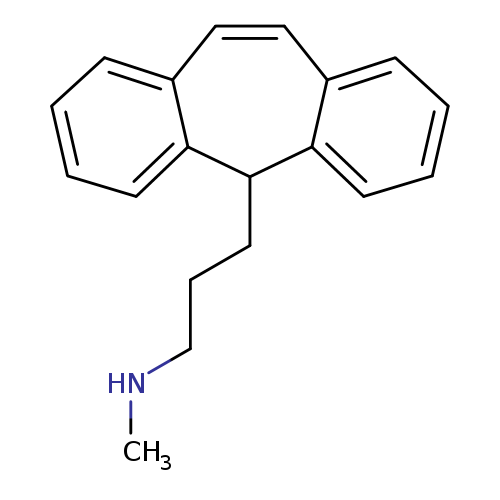
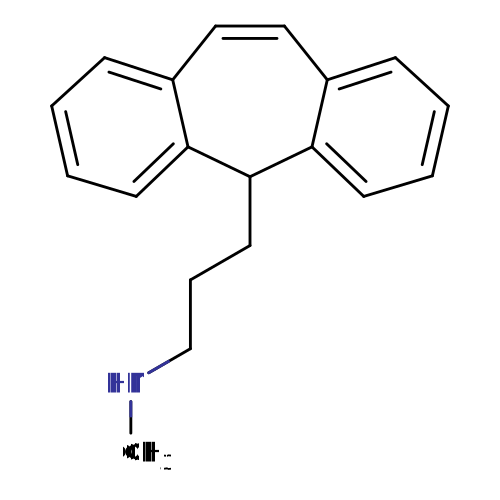
Protriptyline (CED0008061)

Record Information
Version1.0
Creation Date2009-07-21 20:26:40 UTC
Update Date2026-05-14 16:36:02 UTC
SynCED IDCED0008061
Secondary Accession Numbers
  • CHEM002178
  • T3D2759
Identification
Common NameProtriptyline
ClassSmall Molecule
Description
Protriptyline belongs to the dibenzocycloheptenes, a class of benzenoids within the organic compounds. This exogenous compound has the formula C19H21N and an average molecular weight of 263.38 g/mol. At room temperature, it exists as a solid. Protriptyline is used as an antidepressant and is associated with oral exposure. It is found in antidepressants, food preservation, and various household cleaning and consumer products, including tobacco smoke filters, other smoking requisites, and non-electric simulated smoking devices. It is also recorded in electrical and electronic equipment, such as radio transmission systems, antennas, and electrically stimulated smoking devices. The compound acts by decreasing the reuptake of norepinephrine and serotonin (5-HT). Its recorded protein targets include the sodium-dependent noradrenaline transporter (SLC6A2), the sodium-dependent serotonin transporter (SLC6A4), the sodium-dependent dopamine transporter (SLC6A3), and the adenosine receptor A3 (ADORA3).
Contaminant Type
  • Adrenergic Uptake Inhibitor
  • Amine
  • Antidepressant
  • Antidepressive Agent, Tricyclic
  • Drug
  • Metabolite
  • Norepinephrine Reuptake Inhibitor
  • Organic Compound
  • Synthetic Compound
Chemical Structure
Synonyms
ValueSource
3-(5H-Dibenzo[a,D]cyclohepten-5-yl)-N-methyl-1-propanamineChEBI
5-(3-Methylaminopropyl)-5H-dibenzo[a,D]cyclohepteneChEBI
7-(3-Methylaminopropyl)-1,2:5,6-dibenzocycloheptatrieneChEBI
AmimetilinaChEBI
N-Methyl-5H-dibenzo[a,D]cycloheptene-5-propanamineChEBI
N-Methyl-5H-dibenzo[a,D]cycloheptene-5-propylamineChEBI
ProtryptylineHMDB
Odyssey brand OF protriptyline hydrochlorideHMDB
Hydrochloride, protriptylineHMDB
VivactilHMDB
Protriptyline hydrochlorideHMDB
Chemical FormulaC19H21N
Average Molecular Mass263.377 g/mol
Monoisotopic Mass263.167 g/mol
CAS Registry Number438-60-8
IUPAC Namemethyl(3-{tricyclo[9.4.0.0³,⁸]pentadeca-1(15),3,5,7,9,11,13-heptaen-2-yl}propyl)amine
Traditional Nameprotriptyline
SMILESCNCCCC1C2=CC=CC=C2C=CC2=CC=CC=C12
InChI IdentifierInChI=1S/C19H21N/c1-20-14-6-11-19-17-9-4-2-7-15(17)12-13-16-8-3-5-10-18(16)19/h2-5,7-10,12-13,19-20H,6,11,14H2,1H3
InChI KeyBWPIARFWQZKAIA-UHFFFAOYSA-N
Chemical Taxonomy
Description Belongs to the class of organic compounds known as dibenzocycloheptenes. Dibenzocycloheptenes are compounds containing a dibenzocycloheptene moiety, which consists of two benzene rings connected by a cycloheptene ring.
KingdomOrganic compounds
Super ClassBenzenoids
ClassDibenzocycloheptenes
Sub ClassNot Available
Direct ParentDibenzocycloheptenes
Alternative Parents
Substituents
  • Dibenzocycloheptene
  • Aralkylamine
  • Secondary amine
  • Secondary aliphatic amine
  • Organic nitrogen compound
  • Organopnictogen compound
  • Hydrocarbon derivative
  • Organonitrogen compound
  • Amine
  • Aromatic homopolycyclic compound
Molecular FrameworkAromatic homopolycyclic compounds
External Descriptors
Biological Properties
StatusDetected and Not Quantified
OriginExogenous
Cellular Locations
  • Membrane
Biofluid LocationsNot Available
Tissue LocationsNot Available
Applications
Biological RolesNot Available
Chemical RolesNot Available
Organoleptic EffectsNot Available
Physical Properties
StateSolid
AppearanceWhite powder.
Experimental Properties
PropertyValue
Melting Point169-171°C (Protriptyline HCl)
Boiling PointNot Available
Solubility1.04 mg/L
Predicted Properties
PropertyValueSource
Water Solubility0.00023 g/LALOGPS
logP4.65ALOGPS
logP4.5ChemAxon
logS-6.1ALOGPS
pKa (Strongest Basic)10.54ChemAxon
Physiological Charge1ChemAxon
Hydrogen Acceptor Count1ChemAxon
Hydrogen Donor Count1ChemAxon
Polar Surface Area12.03 ŲChemAxon
Rotatable Bond Count4ChemAxon
Refractivity87.3 m³·mol⁻¹ChemAxon
Polarizability31.6 ųChemAxon
Number of Rings3ChemAxon
BioavailabilityYesChemAxon
Rule of FiveYesChemAxon
Ghose FilterYesChemAxon
Veber's RuleYesChemAxon
MDDR-like RuleNoChemAxon
Spectra
Spectra
Spectrum TypeDescriptionSplash KeyDeposition DateView
Predicted GC-MSPredicted GC-MS Spectrumsplash10-0006-9040000000-6498574fa1f4eead1816Not AvailableView Spectrum
Predicted GC-MSPredicted GC-MS SpectrumNot AvailableNot AvailableView Spectrum
Predicted LC-MS/MSPredicted LC-MS/MS Spectrumsplash10-03e9-0090000000-2ab870bf797378caf1c5Not AvailableView Spectrum
Predicted LC-MS/MSPredicted LC-MS/MS Spectrumsplash10-01q9-2190000000-b7468843989ba53316aaNot AvailableView Spectrum
Predicted LC-MS/MSPredicted LC-MS/MS Spectrumsplash10-052f-8890000000-d9505145b3d35ed27be8Not AvailableView Spectrum
Predicted LC-MS/MSPredicted LC-MS/MS Spectrumsplash10-03di-0090000000-13fe8faae8c2bed47e30Not AvailableView Spectrum
Predicted LC-MS/MSPredicted LC-MS/MS Spectrumsplash10-03di-1090000000-8781e71c0e0ae6ea19beNot AvailableView Spectrum
Predicted LC-MS/MSPredicted LC-MS/MS Spectrumsplash10-001l-5490000000-349b95c342d47d80f512Not AvailableView Spectrum
Predicted LC-MS/MSPredicted LC-MS/MS Spectrumsplash10-03di-0090000000-330f29be739abf456d25Not AvailableView Spectrum
Predicted LC-MS/MSPredicted LC-MS/MS Spectrumsplash10-03di-0090000000-45344afe501cffed83b8Not AvailableView Spectrum
Predicted LC-MS/MSPredicted LC-MS/MS Spectrumsplash10-0j6u-0590000000-16a1cb7e0b6aa13171c8Not AvailableView Spectrum
Predicted LC-MS/MSPredicted LC-MS/MS Spectrumsplash10-03di-0090000000-0f92e6ab1c1e69d00ae5Not AvailableView Spectrum
Predicted LC-MS/MSPredicted LC-MS/MS Spectrumsplash10-03di-0090000000-049efc86fef6b36591c4Not AvailableView Spectrum
Predicted LC-MS/MSPredicted LC-MS/MS Spectrumsplash10-0a4l-1690000000-6edf1174a6d682928acdNot AvailableView Spectrum
MSMS Spectrumsplash10-006x-8910000000-ec599ee02d998905757eNot AvailableView Spectrum
Toxicity Profile
Toxicity Values
Toxicity ValueOrganismDose DescriptorRoute of ExposurePredicted or ExperimentalToxicity RatingReference
239.0 Log mg/kg [130:420]RatLD50oralpredictedNot AvailableNot Available
Toxicity / Toxin ClassNot Available
Mechanism of ToxicityProtriptyline acts by decreasing the reuptake of norepinephrine and serotonin (5-HT).
Carcinogenicity (IARC Classification)No indication of carcinogenicity to humans (not listed by IARC).
Minimum Risk LevelNot Available
SymptomsWithdrawal symptoms include gastrointestinal disturbances, anxiety, and insomnia.
TreatmentDry mouth, if severe to the point of causing difficulty speaking or swallowing, may be managed by dosage reduction or temporary discontinuation of the drug. Patients may also chew sugarless gum or suck on sugarless candy in order to increase the flow of saliva. Some artificial saliva products may give temporary relief. Men with prostate enlargement who take protriptyline may be especially likely to have problems with urinary retention. Symptoms include having difficulty starting a urine flow and more difficulty than usual passing urine. In most cases, urinary retention is managed with dose reduction or by switching to another type of antidepressant. In extreme cases, patients may require treatment with bethanechol, a drug that reverses this particular side effect. As management of overdose is complex and changing, it is recommended that the physician contact a poison control center for current information on treatment. Signs and symptoms of toxicity develop rapidly after tricyclic antidepressant overdose, therefore, hospital monitoring is required as soon as possible. (Wikipedia)
Health Effects
Health EffectRelationshipDirectionDescriptionReference
Exposure Sources
Source IDSourceSectorReference
CEDs000377Antidepressants?Antidepressants, a class of synthetic chemicals designed to alleviate symptoms of depression and anxiety, can enter the environment through various pathways, leading to contamination of water systems.Healthcare, pharmaceuticals & veterinary productsNot Available
CEDs000506Antennas?Antennas, commonly used in communication technologies, can be a source of synthetic chemical contamination through the materials and coatings used in their construction.Electrical & Electronic EquipmentPubChem
CEDs000518Electrically Stimulated Smoking Devices?Electrically stimulated smoking devices, commonly known as e-cigarettes or vape pens, utilize electrical components to heat a liquid solution, often containing nicotine, flavorings, and other additives, to produce an aerosol for inhalation.Electrical & Electronic EquipmentPubChem
CEDs000530Radio Transmission Systems?Radio transmission systems utilize a variety of synthetic chemicals in their manufacturing and maintenance processes.Electrical & Electronic EquipmentPubChem
CEDs000545Food Preservation?Food preservation often involves the use of synthetic chemicals, such as preservatives, flavor enhancers, and color additives, to extend shelf life and enhance the sensory qualities of food products.Food, food processing & cookwarePubChem
CEDs000559Non Electric Simulated Smoking Devices?Non-electric simulated smoking devices, often designed to mimic the experience of smoking without combustion, can be sources of synthetic chemical contamination due to the materials and chemicals used in their construction and operation.Household cleaning & consumer productsPubChem
CEDs000560Other Smoking Requisites?Other smoking requisites, including items such as lighters, matches, and rolling papers, can introduce synthetic chemical contamination through various components and additives.Household cleaning & consumer productsPubChem
CEDs000569Tobacco Smoke Filters?Tobacco smoke filters are designed to reduce the inhalation of harmful substances in cigarette smoke, including tar and other particulate matter.Household cleaning & consumer productsPubChem
CEDs000580Manufacture Preparation Of Tobacco Products?The manufacture and preparation of tobacco products involve various processes that can result in the introduction of synthetic chemicals into the environment.Industrial manufacturing & chemical processingPubChem
CEDs000610Aftersun Products?Aftersun products are designed to soothe and hydrate the skin after sun exposure, often containing various synthetic chemicals such as emollients, preservatives, and fragrances.Personal care & cosmeticsPubChem
CEDs000611Anti Perspirants Or Body Deoderants?Antiperspirants and body deodorants commonly contain synthetic chemicals such as aluminum compounds, parabens, and synthetic fragrances.Personal care & cosmeticsPubChem
CEDs000614Essential Oils Or Perfumes?Essential oils and perfumes are complex mixtures of volatile compounds derived from natural or synthetic sources, commonly used for their aromatic properties.Personal care & cosmeticsPubChem
CEDs000615Eye Makeup Products?Eye makeup products, including mascaras, eyeliners, and eyeshadows, often contain a variety of synthetic chemicals such as pigments, preservatives, and film-forming agents.Personal care & cosmeticsPubChem
CEDs000618Lip Makeup Products?Lip makeup products, such as lipsticks, lip glosses, and lip liners, often contain a variety of synthetic chemicals, including pigments, preservatives, and emollients.Personal care & cosmeticsPubChem
CEDs000632Apparel?Apparel production often involves the use of various synthetic chemicals, including dyes, finishing agents, and preservatives.Textiles, leather & furnishingsPubChem
CEDs000642Footwear?Footwear production often involves the use of various synthetic chemicals, such as adhesives, dyes, and treatments, which can contribute to environmental contamination.Textiles, leather & furnishingsPubChem
CEDs000643Headwear?Headwear made from synthetic materials often incorporates chemicals used in the manufacturing and finishing processes, such as dyes, flame retardants, and water repellents.Textiles, leather & furnishingsPubChem
CEDs000650Purses Luggage Hand Bags?Purses, luggage, and handbags are often manufactured using synthetic materials such as polyvinyl chloride (PVC), polyurethane, and various types of nylon.Textiles, leather & furnishingsPubChem
CEDs000671Airplanes And Helicopters?Airplanes and helicopters are significant sources of synthetic chemical contamination primarily through the use of aviation fuels, lubricants, and de-icing agents.Aviation & AerospacePubChem
CEDs000679Phosphatic Fertilisers?Phosphatic fertilizers are synthetic chemical products primarily composed of phosphorus, which is essential for plant growth.Agriculture & land managementPubChem
CEDs000685Ceramics?Ceramics can be a source of synthetic chemical contamination through various additives and processing agents used in their production.Building & ConstructionPubChem
CEDs000696Nanotechnology?Nanotechnology involves the manipulation of materials at the molecular or atomic level, typically within the range of 1 to 100 nanometers.Industrial manufacturing & chemical processingPubChem
CEDs000735Explosives?Explosives are chemical compounds or mixtures designed to undergo rapid decomposition, releasing energy in the form of gas and heat.Defense & military infrastructurePubChem
CEDs000739Inks?Inks are complex mixtures composed of pigments or dyes, solvents, resins, and additives used primarily for printing and writing applications.Paper, pulp & fiber productsPubChem
CEDs000744Water, Wastewater, & Sewage Treatment?Water, wastewater, and sewage treatment processes are critical for managing and mitigating pollutants in water systems.Wastewater, sanitation & biosolidsPubChem
Pathways
1 pathwayPathway Source: PathBank
Targets
StructureProteinUniProt IDOrganismRelationshipDetails
Sodium-dependent noradrenaline transporter structureClick to view 3D structureSodium-dependent noradrenaline transporterP23975HumansPredicted (SEA)
Prediction Confidence Score
0.313
Applicability Domain
0.378
Statistical Significance
0.0269
Supporting Reference Compounds
451
E-value
209.804
5-hydroxytryptamine receptor 2A structureClick to view 3D structure5-hydroxytryptamine receptor 2AP28223HumansPredicted (SEA)
Prediction Confidence Score
0.304
Applicability Domain
0.378
Statistical Significance
0.074
Supporting Reference Compounds
955
E-value
576.318
Sodium-dependent dopamine transporter structureClick to view 3D structureSodium-dependent dopamine transporterQ01959HumansPredicted (SEA)
Prediction Confidence Score
0.298
Applicability Domain
0.378
Statistical Significance
0.0425
Supporting Reference Compounds
506
E-value
330.859
Click to view 3D structurePotassium channel subfamily K member 2Q920B6Rattus norvegicusPredicted (SEA)
Prediction Confidence Score
0.295
Applicability Domain
0.295 Low confidence
Statistical Significance
2.10e-04
Supporting Reference Compounds
1
E-value
1.63483
Click to view 3D structureAlpha-1A adrenergic receptorP43140Rattus norvegicusPredicted (SEA)
Prediction Confidence Score
0.293
Applicability Domain
0.378
Statistical Significance
0.0263
Supporting Reference Compounds
208
E-value
204.51
Histamine H1 receptor structureClick to view 3D structureHistamine H1 receptorP35367HumansPredicted (SEA)
Prediction Confidence Score
0.286
Applicability Domain
0.378
Statistical Significance
0.0688
Supporting Reference Compounds
507
E-value
535.68
5-hydroxytryptamine receptor 2C structureClick to view 3D structure5-hydroxytryptamine receptor 2CP28335HumansPredicted (SEA)
Prediction Confidence Score
0.284
Applicability Domain
0.378
Statistical Significance
0.1012
Supporting Reference Compounds
823
E-value
788.146
Alpha-2A adrenergic receptor structureClick to view 3D structureAlpha-2A adrenergic receptorP08913HumansPredicted (SEA)
Prediction Confidence Score
0.282
Applicability Domain
0.378
Statistical Significance
0.066
Supporting Reference Compounds
487
E-value
513.805
Alpha-2C adrenergic receptor structureClick to view 3D structureAlpha-2C adrenergic receptorP18825HumansPredicted (SEA)
Prediction Confidence Score
0.282
Applicability Domain
0.378
Statistical Significance
0.049
Supporting Reference Compounds
386
E-value
381.773
Histamine H3 receptor structureClick to view 3D structureHistamine H3 receptorQ9Y5N1HumansPredicted (SEA)
Prediction Confidence Score
0.282
Applicability Domain
0.378
Statistical Significance
0.0489
Supporting Reference Compounds
294
E-value
380.994
Click to view 3D structureSodium-dependent dopamine transporterP23977Rattus norvegicusPredicted (SEA)
Prediction Confidence Score
0.281
Applicability Domain
0.326
Statistical Significance
0.0293
Supporting Reference Compounds
203
E-value
228.487
Click to view 3D structureSodium-dependent serotonin transporterP31652Rattus norvegicusPredicted (SEA)
Prediction Confidence Score
0.281
Applicability Domain
0.326
Statistical Significance
0.0456
Supporting Reference Compounds
297
E-value
354.759
Click to view 3D structureNorepinephrine transporterQ9WTR4Rattus norvegicusPredicted (SEA)
Prediction Confidence Score
0.281
Applicability Domain
0.326
Statistical Significance
0.0153
Supporting Reference Compounds
112
E-value
119.187
Alpha-2B adrenergic receptor structureClick to view 3D structureAlpha-2B adrenergic receptorP18089HumansPredicted (SEA)
Prediction Confidence Score
0.279
Applicability Domain
0.378
Statistical Significance
0.0486
Supporting Reference Compounds
340
E-value
378.036
Muscarinic acetylcholine receptor M1 structureClick to view 3D structureMuscarinic acetylcholine receptor M1P11229HumansPredicted (SEA)
Prediction Confidence Score
0.279
Applicability Domain
0.378
Statistical Significance
0.0563
Supporting Reference Compounds
385
E-value
438.525
Muscarinic acetylcholine receptor M5 structureClick to view 3D structureMuscarinic acetylcholine receptor M5P08912HumansPredicted (SEA)
Prediction Confidence Score
0.279
Applicability Domain
0.378
Statistical Significance
0.0376
Supporting Reference Compounds
266
E-value
292.635
5-hydroxytryptamine receptor 6 structureClick to view 3D structure5-hydroxytryptamine receptor 6P50406HumansPredicted (SEA)
Prediction Confidence Score
0.278
Applicability Domain
0.378
Statistical Significance
0.0766
Supporting Reference Compounds
536
E-value
596.403
Muscarinic acetylcholine receptor M2 structureClick to view 3D structureMuscarinic acetylcholine receptor M2P08172HumansPredicted (SEA)
Prediction Confidence Score
0.276
Applicability Domain
0.378
Statistical Significance
0.0568
Supporting Reference Compounds
373
E-value
442.573
Muscarinic acetylcholine receptor M4 structureClick to view 3D structureMuscarinic acetylcholine receptor M4P08173HumansPredicted (SEA)
Prediction Confidence Score
0.276
Applicability Domain
0.378
Statistical Significance
0.0447
Supporting Reference Compounds
297
E-value
348.297
D(2) dopamine receptor structureClick to view 3D structureD(2) dopamine receptorP14416HumansPredicted (SEA)
Prediction Confidence Score
0.276
Applicability Domain
0.378
Statistical Significance
0.156
Supporting Reference Compounds
1103
E-value
1214.45
5-hydroxytryptamine receptor 2B structureClick to view 3D structure5-hydroxytryptamine receptor 2BP41595HumansPredicted (SEA)
Prediction Confidence Score
0.275
Applicability Domain
0.378
Statistical Significance
0.1065
Supporting Reference Compounds
686
E-value
829.406
Muscarinic acetylcholine receptor M3 structureClick to view 3D structureMuscarinic acetylcholine receptor M3P20309HumansPredicted (SEA)
Prediction Confidence Score
0.274
Applicability Domain
0.378
Statistical Significance
0.0485
Supporting Reference Compounds
310
E-value
377.724
Sodium-dependent serotonin transporter structureClick to view 3D structureSodium-dependent serotonin transporterP31645HumansPredicted (SEA)
Prediction Confidence Score
0.274
Applicability Domain
0.326
Statistical Significance
0.0949
Supporting Reference Compounds
593
E-value
738.945
Click to view 3D structureAlpha-1B adrenergic receptorP15823Rattus norvegicusPredicted (SEA)
Prediction Confidence Score
0.273
Applicability Domain
0.378
Statistical Significance
0.0255
Supporting Reference Compounds
130
E-value
198.671
D(3) dopamine receptor structureClick to view 3D structureD(3) dopamine receptorP35462HumansPredicted (SEA)
Prediction Confidence Score
0.273
Applicability Domain
0.378
Statistical Significance
0.1359
Supporting Reference Compounds
861
E-value
1057.66
Sodium-dependent noradrenaline transporter structureClick to view 3D structureSodium-dependent noradrenaline transporterP23975HumansKnownProtriptyline acts by decreasing the reuptake of norepinephrine and serotonin (5-HT).
Sodium-dependent serotonin transporter structureClick to view 3D structureSodium-dependent serotonin transporterP31645HumansKnownProtriptyline acts by decreasing the reuptake of norepinephrine and serotonin (5-HT).
Adenosine receptor A3 structureClick to view 3D structureAdenosine receptor A3P0DMS8HumansKnownNot Available
Sodium-dependent dopamine transporter structureClick to view 3D structureSodium-dependent dopamine transporterQ01959HumansKnownNot Available
Concentrations
Not Available
External Links
DrugBank IDDB00344
HMDB IDHMDB0014488
FooDB IDNot Available
Phenol Explorer IDNot Available
KNApSAcK IDNot Available
BiGG IDNot Available
BioCyc IDNot Available
METLIN IDNot Available
PDB IDNot Available
Wikipedia LinkProtriptyline
Chemspider ID4805
ChEBI ID8597
PubChem Compound ID4976
Kegg Compound IDC07408
YMDB IDNot Available
ECMDB IDNot Available
References
Synthesis ReferenceNot Available
MSDSNot Available
General References
  1. Drugs.com http://www.drugs.com/cons/Protriptyline.html