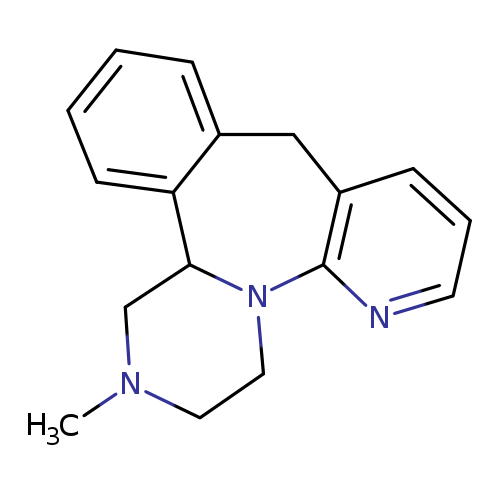
Click to view 3D structure Click to view 3D structure | 5-hydroxytryptamine receptor 2C | P08909 | Rat | Predicted (SEA) | - Prediction Confidence Score
- 0.635
- Applicability Domain
- 1.0
- Statistical Significance
- 2.20e-04
- Supporting Reference Compounds
- 185
- E-value
- 1.71268
|
 Click to view 3D structure Click to view 3D structure | 5-hydroxytryptamine receptor 2A | P14842 | Rattus norvegicus | Predicted (SEA) | - Prediction Confidence Score
- 0.635
- Applicability Domain
- 1.0
- Statistical Significance
- 3.70e-04
- Supporting Reference Compounds
- 380
- E-value
- 2.88042
|
 Click to view 3D structure Click to view 3D structure | D(2) dopamine receptor | P61169 | Rat | Predicted (SEA) | - Prediction Confidence Score
- 0.623
- Applicability Domain
- 1.0
- Statistical Significance
- 0.0012
- Supporting Reference Compounds
- 528
- E-value
- 9.57545
|
 Click to view 3D structure Click to view 3D structure | D(3) dopamine receptor | P35462 | Humans | Predicted (SEA) | - Prediction Confidence Score
- 0.618
- Applicability Domain
- 1.0
- Statistical Significance
- 0.0014
- Supporting Reference Compounds
- 861
- E-value
- 11.2881
|
 Click to view 3D structure Click to view 3D structure | D(4) dopamine receptor | P21917 | Humans | Predicted (SEA) | - Prediction Confidence Score
- 0.618
- Applicability Domain
- 1.0
- Statistical Significance
- 8.40e-04
- Supporting Reference Compounds
- 524
- E-value
- 6.53933
|
 Click to view 3D structure Click to view 3D structure | 5-hydroxytryptamine receptor 1A | P08908 | Humans | Predicted (SEA) | - Prediction Confidence Score
- 0.618
- Applicability Domain
- 1.0
- Statistical Significance
- 0.0016
- Supporting Reference Compounds
- 953
- E-value
- 12.1445
|
| Click to view 3D structure | Sodium-dependent serotonin transporter | P31652 | Rattus norvegicus | Predicted (SEA) | - Prediction Confidence Score
- 0.617
- Applicability Domain
- 1.0
- Statistical Significance
- 6.10e-04
- Supporting Reference Compounds
- 297
- E-value
- 4.7488
|
| Click to view 3D structure | Norepinephrine transporter | Q9WTR4 | Rattus norvegicus | Predicted (SEA) | - Prediction Confidence Score
- 0.603
- Applicability Domain
- 1.0
- Statistical Significance
- 2.40e-04
- Supporting Reference Compounds
- 112
- E-value
- 1.86838
|
| Click to view 3D structure | 5-hydroxytryptamine receptor 1A | P19327 | Rattus norvegicus | Predicted (SEA) | - Prediction Confidence Score
- 0.542
- Applicability Domain
- 1.0
- Statistical Significance
- 0.0029
- Supporting Reference Compounds
- 541
- E-value
- 22.4206
|
 Click to view 3D structure Click to view 3D structure | Histamine H1 receptor | P35367 | Humans | Predicted (SEA) | - Prediction Confidence Score
- 0.518
- Applicability Domain
- 1.0
- Statistical Significance
- 0.0016
- Supporting Reference Compounds
- 507
- E-value
- 12.6894
|
 Click to view 3D structure Click to view 3D structure | 5-hydroxytryptamine receptor 2C | P28335 | Humans | Predicted (SEA) | - Prediction Confidence Score
- 0.518
- Applicability Domain
- 1.0
- Statistical Significance
- 0.0026
- Supporting Reference Compounds
- 823
- E-value
- 20.63
|
 Click to view 3D structure Click to view 3D structure | 5-hydroxytryptamine receptor 2A | P28223 | Humans | Predicted (SEA) | - Prediction Confidence Score
- 0.518
- Applicability Domain
- 1.0
- Statistical Significance
- 0.0038
- Supporting Reference Compounds
- 955
- E-value
- 29.5827
|
 Click to view 3D structure Click to view 3D structure | D(2) dopamine receptor | P14416 | Humans | Predicted (SEA) | - Prediction Confidence Score
- 0.517
- Applicability Domain
- 1.0
- Statistical Significance
- 0.0065
- Supporting Reference Compounds
- 1103
- E-value
- 50.602
|
 Click to view 3D structure Click to view 3D structure | Alpha-2A adrenergic receptor | P08913 | Humans | Predicted (SEA) | - Prediction Confidence Score
- 0.516
- Applicability Domain
- 1.0
- Statistical Significance
- 0.0012
- Supporting Reference Compounds
- 487
- E-value
- 9.49761
|
 Click to view 3D structure Click to view 3D structure | Alpha-1A adrenergic receptor | P35348 | Humans | Predicted (SEA) | - Prediction Confidence Score
- 0.516
- Applicability Domain
- 1.0
- Statistical Significance
- 0.0019
- Supporting Reference Compounds
- 376
- E-value
- 14.7914
|
| Click to view 3D structure | D(1A) dopamine receptor | P18901 | Rattus norvegicus | Predicted (SEA) | - Prediction Confidence Score
- 0.509
- Applicability Domain
- 1.0
- Statistical Significance
- 0.0014
- Supporting Reference Compounds
- 206
- E-value
- 11.2881
|
 Click to view 3D structure Click to view 3D structure | Alpha-2C adrenergic receptor | P18825 | Humans | Predicted (SEA) | - Prediction Confidence Score
- 0.509
- Applicability Domain
- 1.0
- Statistical Significance
- 8.90e-04
- Supporting Reference Compounds
- 386
- E-value
- 6.92858
|
 Click to view 3D structure Click to view 3D structure | 5-hydroxytryptamine receptor 7 | P34969 | Humans | Predicted (SEA) | - Prediction Confidence Score
- 0.503
- Applicability Domain
- 1.0
- Statistical Significance
- 0.0028
- Supporting Reference Compounds
- 565
- E-value
- 22.187
|
 Click to view 3D structure Click to view 3D structure | Alpha-2B adrenergic receptor | P18089 | Humans | Predicted (SEA) | - Prediction Confidence Score
- 0.491
- Applicability Domain
- 1.0
- Statistical Significance
- 9.40e-04
- Supporting Reference Compounds
- 340
- E-value
- 7.31783
|
| Click to view 3D structure | Sodium-dependent dopamine transporter | P23977 | Rattus norvegicus | Predicted (SEA) | - Prediction Confidence Score
- 0.473
- Applicability Domain
- 1.0
- Statistical Significance
- 0.0019
- Supporting Reference Compounds
- 203
- E-value
- 14.5578
|
 Click to view 3D structure Click to view 3D structure | 5-hydroxytryptamine receptor 1D | P28221 | Humans | Predicted (SEA) | - Prediction Confidence Score
- 0.428
- Applicability Domain
- 0.651
- Statistical Significance
- 0.0033
- Supporting Reference Compounds
- 365
- E-value
- 25.5345
|
 Click to view 3D structure Click to view 3D structure | 5-hydroxytryptamine receptor 3A | P46098 | Humans | Predicted (SEA) | - Prediction Confidence Score
- 0.405
- Applicability Domain
- 1.0
- Statistical Significance
- 0.0022
- Supporting Reference Compounds
- 228
- E-value
- 17.2047
|
| Click to view 3D structure | 5-hydroxytryptamine receptor 1B | P28564 | Rattus norvegicus | Predicted (SEA) | - Prediction Confidence Score
- 0.399
- Applicability Domain
- 0.651
- Statistical Significance
- 0.0032
- Supporting Reference Compounds
- 154
- E-value
- 24.9118
|
 Click to view 3D structure Click to view 3D structure | Muscarinic acetylcholine receptor M1 | P11229 | Humans | Predicted (SEA) | - Prediction Confidence Score
- 0.37
- Applicability Domain
- 0.651
- Statistical Significance
- 0.0058
- Supporting Reference Compounds
- 385
- E-value
- 45.5418
|
 Click to view 3D structure Click to view 3D structure | 5-hydroxytryptamine receptor 6 | P50406 | Humans | Predicted (SEA) | - Prediction Confidence Score
- 0.36
- Applicability Domain
- 0.651
- Statistical Significance
- 0.0154
- Supporting Reference Compounds
- 536
- E-value
- 119.888
|
| Click to view 3D structure | 5-hydroxytryptamine receptor 1A | P08908 | Humans | Known | Mirtazapine acts as an antagonist at central pre-synaptic alpha(2)-receptors, inhibiting negative feedback to the presynaptic nerve and causing an increase in NE release. Blockade of heteroreceptors, alpha(2)-receptors contained in serotenergic neurons, enhances the release of 5-HT, increasing the interactions between 5-HT and 5-HT1 receptors and contributing to the anxiolytic effects of mirtazapine. Mirtazapine also acts as a weak antagonist at 5-HT1 receptors and as a potent antagonist at 5-HT2 (particularly subtypes 2A and 2C) and 5-HT3 receptors. Blockade of these receptors may explain the lower incidence of adverse effects such as anxiety, insomnia, and nausea. Mirtazapine also exhibits significant antagonism at H1-receptors, resulting in sedation. Mirtazapine has no effects on the reuptake of either NE or 5-HT and has only minimal activity at dopaminergic and muscarinic receptors. |
| Click to view 3D structure | 5-hydroxytryptamine receptor 2A | P28223 | Humans | Known | Mirtazapine acts as an antagonist at central pre-synaptic alpha(2)-receptors, inhibiting negative feedback to the presynaptic nerve and causing an increase in NE release. Blockade of heteroreceptors, alpha(2)-receptors contained in serotenergic neurons, enhances the release of 5-HT, increasing the interactions between 5-HT and 5-HT1 receptors and contributing to the anxiolytic effects of mirtazapine. Mirtazapine also acts as a weak antagonist at 5-HT1 receptors and as a potent antagonist at 5-HT2 (particularly subtypes 2A and 2C) and 5-HT3 receptors. Blockade of these receptors may explain the lower incidence of adverse effects such as anxiety, insomnia, and nausea. Mirtazapine also exhibits significant antagonism at H1-receptors, resulting in sedation. Mirtazapine has no effects on the reuptake of either NE or 5-HT and has only minimal activity at dopaminergic and muscarinic receptors. |
| Click to view 3D structure | 5-hydroxytryptamine receptor 2C | P28335 | Humans | Known | Mirtazapine acts as an antagonist at central pre-synaptic alpha(2)-receptors, inhibiting negative feedback to the presynaptic nerve and causing an increase in NE release. Blockade of heteroreceptors, alpha(2)-receptors contained in serotenergic neurons, enhances the release of 5-HT, increasing the interactions between 5-HT and 5-HT1 receptors and contributing to the anxiolytic effects of mirtazapine. Mirtazapine also acts as a weak antagonist at 5-HT1 receptors and as a potent antagonist at 5-HT2 (particularly subtypes 2A and 2C) and 5-HT3 receptors. Blockade of these receptors may explain the lower incidence of adverse effects such as anxiety, insomnia, and nausea. Mirtazapine also exhibits significant antagonism at H1-receptors, resulting in sedation. Mirtazapine has no effects on the reuptake of either NE or 5-HT and has only minimal activity at dopaminergic and muscarinic receptors. |
| Click to view 3D structure | 5-hydroxytryptamine receptor 3A | P46098 | Humans | Known | Mirtazapine acts as an antagonist at central pre-synaptic alpha(2)-receptors, inhibiting negative feedback to the presynaptic nerve and causing an increase in NE release. Blockade of heteroreceptors, alpha(2)-receptors contained in serotenergic neurons, enhances the release of 5-HT, increasing the interactions between 5-HT and 5-HT1 receptors and contributing to the anxiolytic effects of mirtazapine. Mirtazapine also acts as a weak antagonist at 5-HT1 receptors and as a potent antagonist at 5-HT2 (particularly subtypes 2A and 2C) and 5-HT3 receptors. Blockade of these receptors may explain the lower incidence of adverse effects such as anxiety, insomnia, and nausea. Mirtazapine also exhibits significant antagonism at H1-receptors, resulting in sedation. Mirtazapine has no effects on the reuptake of either NE or 5-HT and has only minimal activity at dopaminergic and muscarinic receptors. |
 Click to view 3D structure Click to view 3D structure | 5-hydroxytryptamine receptor 2B | P41595 | Humans | Known | Not Available |
 Click to view 3D structure Click to view 3D structure | Histamine H3 receptor | Q9Y5N1 | Humans | Known | Not Available |
| Click to view 3D structure | Alpha-2A adrenergic receptor | P08913 | Humans | Known | Mirtazapine acts as an antagonist at central pre-synaptic alpha(2)-receptors, inhibiting negative feedback to the presynaptic nerve and causing an increase in NE release. Blockade of heteroreceptors, alpha(2)-receptors contained in serotenergic neurons, enhances the release of 5-HT, increasing the interactions between 5-HT and 5-HT1 receptors and contributing to the anxiolytic effects of mirtazapine. Mirtazapine also acts as a weak antagonist at 5-HT1 receptors and as a potent antagonist at 5-HT2 (particularly subtypes 2A and 2C) and 5-HT3 receptors. Blockade of these receptors may explain the lower incidence of adverse effects such as anxiety, insomnia, and nausea. Mirtazapine also exhibits significant antagonism at H1-receptors, resulting in sedation. Mirtazapine has no effects on the reuptake of either NE or 5-HT and has only minimal activity at dopaminergic and muscarinic receptors. |
| Click to view 3D structure | Alpha-2C adrenergic receptor | P18825 | Humans | Known | Not Available |
| Click to view 3D structure | D(2) dopamine receptor | P14416 | Humans | Known | Not Available |
| Click to view 3D structure | D(3) dopamine receptor | P35462 | Humans | Known | Not Available |
| Click to view 3D structure | 5-hydroxytryptamine receptor 7 | P34969 | Humans | Known | Not Available |
| Click to view 3D structure | Alpha-1A adrenergic receptor | P35348 | Humans | Known | Not Available |
| Click to view 3D structure | Histamine H1 receptor | P35367 | Humans | Known | Mirtazapine acts as an antagonist at central pre-synaptic alpha(2)-receptors, inhibiting negative feedback to the presynaptic nerve and causing an increase in NE release. Blockade of heteroreceptors, alpha(2)-receptors contained in serotenergic neurons, enhances the release of 5-HT, increasing the interactions between 5-HT and 5-HT1 receptors and contributing to the anxiolytic effects of mirtazapine. Mirtazapine also acts as a weak antagonist at 5-HT1 receptors and as a potent antagonist at 5-HT2 (particularly subtypes 2A and 2C) and 5-HT3 receptors. Blockade of these receptors may explain the lower incidence of adverse effects such as anxiety, insomnia, and nausea. Mirtazapine also exhibits significant antagonism at H1-receptors, resulting in sedation. Mirtazapine has no effects on the reuptake of either NE or 5-HT and has only minimal activity at dopaminergic and muscarinic receptors. |
 Click to view 3D structure Click to view 3D structure | Sodium-dependent dopamine transporter | Q01959 | Humans | Known | Not Available |
 Click to view 3D structure Click to view 3D structure | Sodium-dependent noradrenaline transporter | P23975 | Humans | Known | Not Available |
 Click to view 3D structure Click to view 3D structure | Sodium-dependent serotonin transporter | P31645 | Humans | Known | Not Available |
| Click to view 3D structure | Alpha-2B adrenergic receptor | P18089 | Humans | Known | Not Available |
 Click to view 3D structure Click to view 3D structure | Beta-1 adrenergic receptor | P08588 | Humans | Known | Not Available |
 Click to view 3D structure Click to view 3D structure | Beta-2 adrenergic receptor | P07550 | Humans | Known | Not Available |
| Click to view 3D structure | D(4) dopamine receptor | P21917 | Humans | Known | Not Available |
 Click to view 3D structure Click to view 3D structure | Kappa-type opioid receptor | P41145 | Humans | Known | Mirtazapine acts as an antagonist at central pre-synaptic alpha(2)-receptors, inhibiting negative feedback to the presynaptic nerve and causing an increase in NE release. Blockade of heteroreceptors, alpha(2)-receptors contained in serotenergic neurons, enhances the release of 5-HT, increasing the interactions between 5-HT and 5-HT1 receptors and contributing to the anxiolytic effects of mirtazapine. Mirtazapine also acts as a weak antagonist at 5-HT1 receptors and as a potent antagonist at 5-HT2 (particularly subtypes 2A and 2C) and 5-HT3 receptors. Blockade of these receptors may explain the lower incidence of adverse effects such as anxiety, insomnia, and nausea. Mirtazapine also exhibits significant antagonism at H1-receptors, resulting in sedation. Mirtazapine has no effects on the reuptake of either NE or 5-HT and has only minimal activity at dopaminergic and muscarinic receptors. |