Trihexyphenidyl (CED0004997)

Record Information
Version1.0
Creation Date2009-07-21 20:26:45 UTC
Update Date2026-05-14 16:36:59 UTC
SynCED IDCED0004997
Secondary Accession Numbers
  • CHEM002183
  • T3D2770
Identification
Common NameTrihexyphenidyl
ClassSmall Molecule
Description
Trihexyphenidyl is an exogenous organic compound with the formula C20H31NO and an average molecular weight of 301.47 g/mol. It exists as a solid at room temperature. Trihexyphenidyl belongs to the amines, a subclass of organonitrogen compounds within the organic compounds. The compound is associated with seven recorded sources, including healthcare, pharmaceuticals, and veterinary products as anticholinergic agents; household cleaning and consumer products such as cigar cigarettes, tobacco smoke filters, other smoking requisites, and non-electric simulated smoking devices; electrically stimulated smoking devices within electrical and electronic equipment; and food preservation in food, food processing, and cookware. The recorded route of exposure is oral. Trihexyphenidyl interacts with six recorded protein targets. It is a selective M1 muscarinic acetylcholine receptor (CHRM1) antagonist capable of discriminating between the M1 (cortical or neuronal) and peripheral muscarinic subtypes, such as cardiac and glandular. In the central nervous system, it partially blocks cholinergic activity responsible for the symptoms of Parkinson's disease and is thought to increase the availability of dopamine, which is critical for the initiation and smooth control of voluntary muscle movement. Additionally, trihexyphenidyl acts as an agonist of the muscarinic acetylcholine receptors M2 (CHRM2), M3 (CHRM3), M4 (CHRM4), and M5 (CHRM5), as well as one other protein.
Contaminant Type
  • Amine
  • Antidyskinetic
  • Antiparkinson Agent
  • Drug
  • Metabolite
  • Muscarinic Antagonist
  • Organic Compound
  • Synthetic Compound
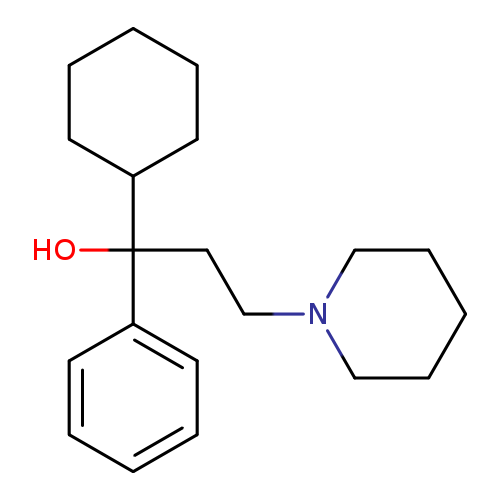
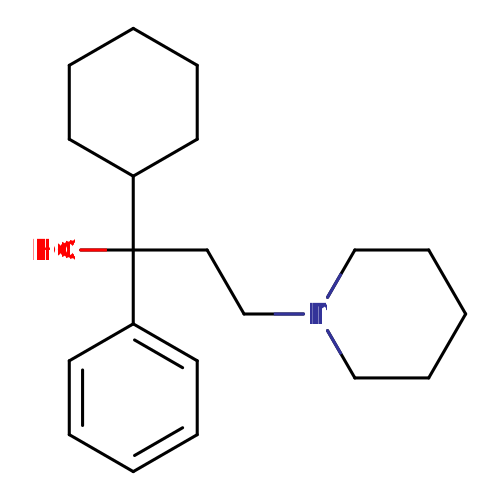
Chemical Structure
Synonyms
ValueSource
Apo-trihexKegg
TrihexylphenidylHMDB
TrihexylphenidyleHMDB
TrihexylphenizylHMDB
TrihexyphenidyleHMDB
TriphenidylHMDB
AHP brand OF trihexyphenidyl hydrochlorideMeSH, HMDB
ApoTrihexMeSH, HMDB
Eisai brand OF trihexyphenidyl hydrochlorideMeSH, HMDB
HipokinonMeSH, HMDB
ParkopanMeSH, HMDB
Trihexyphenidyl hydrochlorideMeSH, HMDB
Trihexyphenidyl wyeth brandMeSH, HMDB
apo TrihexMeSH, HMDB
ArtaneMeSH, HMDB
BenzhexolMeSH, HMDB
Cypress brand OF trihexyphenidyl hydrochlorideMeSH, HMDB
Lederle brand OF trihexyphenidyl hydrochlorideMeSH, HMDB
ParkinaneMeSH, HMDB
Psicofarma brand OF trihexyphenidyl hydrochlorideMeSH, HMDB
Rugby brand OF trihexyphenidyl hydrochlorideMeSH, HMDB
Trihexidyl hydrochlorideMeSH, HMDB
Wyeth brand OF trihexyphenidylMeSH, HMDB
Wyeth brand OF trihexyphenidyl hydrochlorideMeSH, HMDB
Apotex brand OF trihexyphenidyl hydrochlorideMeSH, HMDB
Aventis brand OF trihexyphenidyl hydrochlorideMeSH, HMDB
Schrein brand OF trihexyphenidyl hydrochlorideMeSH, HMDB
CyclodolMeSH, HMDB
Hexal brand OF trihexyphenidyl hydrochlorideMeSH, HMDB
Liquipharm brand OF trihexyphenidyl hydrochlorideMeSH, HMDB
Pharmaceutical associates brand OF trihexyphenidyl hydrochlorideMeSH, HMDB
TrihexaneMeSH, HMDB
Trihexyphenidyl hydrochloride elixirMeSH, HMDB
Chemical FormulaC20H31NO
Average Molecular Mass301.466 g/mol
Monoisotopic Mass301.241 g/mol
CAS Registry Number144-11-6
IUPAC Name1-cyclohexyl-1-phenyl-3-(piperidin-1-yl)propan-1-ol
Traditional Nametrihexyphenidyl
SMILESOC(CCN1CCCCC1)(C1CCCCC1)C1=CC=CC=C1
InChI IdentifierInChI=1S/C20H31NO/c22-20(18-10-4-1-5-11-18,19-12-6-2-7-13-19)14-17-21-15-8-3-9-16-21/h1,4-5,10-11,19,22H,2-3,6-9,12-17H2
InChI KeyHWHLPVGTWGOCJO-UHFFFAOYSA-N
Chemical Taxonomy
Description Belongs to the class of organic compounds known as aralkylamines. These are alkylamines in which the alkyl group is substituted at one carbon atom by an aromatic hydrocarbyl group.
KingdomOrganic compounds
Super ClassOrganic nitrogen compounds
ClassOrganonitrogen compounds
Sub ClassAmines
Direct ParentAralkylamines
Alternative Parents
Substituents
  • Aralkylamine
  • Monocyclic benzene moiety
  • Piperidine
  • Benzenoid
  • 1,3-aminoalcohol
  • Tertiary alcohol
  • Tertiary amine
  • Tertiary aliphatic amine
  • Azacycle
  • Organoheterocyclic compound
  • Alcohol
  • Organic oxygen compound
  • Hydrocarbon derivative
  • Organooxygen compound
  • Organopnictogen compound
  • Aromatic alcohol
  • Aromatic heteromonocyclic compound
Molecular FrameworkAromatic heteromonocyclic compounds
External Descriptors
Biological Properties
StatusDetected and Not Quantified
OriginExogenous
Cellular Locations
  • Membrane
Biofluid LocationsNot Available
Tissue LocationsNot Available
ApplicationsNot Available
Biological Roles
Chemical RolesNot Available
Organoleptic EffectsNot Available
Physical Properties
StateSolid
AppearanceWhite powder.
Experimental Properties
PropertyValue
Melting Point258.5°C
Boiling PointNot Available
Solubility3.14e-03 g/L
Predicted Properties
PropertyValueSource
Water Solubility0.0031 g/LALOGPS
logP4.93ALOGPS
logP4.23ChemAxon
logS-5ALOGPS
pKa (Strongest Acidic)13.84ChemAxon
pKa (Strongest Basic)9.32ChemAxon
Physiological Charge1ChemAxon
Hydrogen Acceptor Count2ChemAxon
Hydrogen Donor Count1ChemAxon
Polar Surface Area23.47 ŲChemAxon
Rotatable Bond Count5ChemAxon
Refractivity93.21 m³·mol⁻¹ChemAxon
Polarizability36.73 ųChemAxon
Number of Rings3ChemAxon
BioavailabilityYesChemAxon
Rule of FiveYesChemAxon
Ghose FilterYesChemAxon
Veber's RuleYesChemAxon
MDDR-like RuleNoChemAxon
Spectra
Spectra
Spectrum TypeDescriptionSplash KeyDeposition DateView
Predicted GC-MSPredicted GC-MS Spectrumsplash10-0a4j-9520000000-9a2c379908fc40e03fe2Not AvailableView Spectrum
Predicted GC-MSPredicted GC-MS Spectrumsplash10-08gm-8291000000-e91e4f7026454f2df547Not AvailableView Spectrum
Predicted GC-MSPredicted GC-MS SpectrumNot AvailableNot AvailableView Spectrum
LC-MS/MSLC-MS/MS Spectrumsplash10-0udi-4119000000-9ed82688d3c1b39f26ebNot AvailableView Spectrum
LC-MS/MSLC-MS/MS Spectrumsplash10-00di-1190000000-eb1d6e20e193aabe8331Not AvailableView Spectrum
LC-MS/MSLC-MS/MS Spectrumsplash10-004r-9440000000-9b8665d040c0679d223dNot AvailableView Spectrum
LC-MS/MSLC-MS/MS Spectrumsplash10-009i-6950000000-12b0f3e5468353070296Not AvailableView Spectrum
Predicted LC-MS/MSPredicted LC-MS/MS Spectrumsplash10-0f89-1096000000-d3df91688ef1945d673eNot AvailableView Spectrum
Predicted LC-MS/MSPredicted LC-MS/MS Spectrumsplash10-0002-9130000000-5c5ffd9794999341adecNot AvailableView Spectrum
Predicted LC-MS/MSPredicted LC-MS/MS Spectrumsplash10-05mn-9210000000-f0b1224b58d81bff09deNot AvailableView Spectrum
Predicted LC-MS/MSPredicted LC-MS/MS Spectrumsplash10-0udi-0019000000-7ed6535dacec03b4f64eNot AvailableView Spectrum
Predicted LC-MS/MSPredicted LC-MS/MS Spectrumsplash10-0f89-9145000000-5ef99bbb769978df62bdNot AvailableView Spectrum
Predicted LC-MS/MSPredicted LC-MS/MS Spectrumsplash10-001i-9010000000-ee7ed12c77da3bd0134fNot AvailableView Spectrum
Predicted LC-MS/MSPredicted LC-MS/MS Spectrumsplash10-0udi-3009000000-cd1bde8ffe3dde655051Not AvailableView Spectrum
Predicted LC-MS/MSPredicted LC-MS/MS Spectrumsplash10-0002-9001000000-edf90121115e0df0494dNot AvailableView Spectrum
Predicted LC-MS/MSPredicted LC-MS/MS Spectrumsplash10-0002-9020000000-c9173163c6667307ea2fNot AvailableView Spectrum
Predicted LC-MS/MSPredicted LC-MS/MS Spectrumsplash10-0udi-0009000000-2b5232fe5f3af3692a07Not AvailableView Spectrum
Predicted LC-MS/MSPredicted LC-MS/MS Spectrumsplash10-0udi-0319000000-5b77372872ee2d4b2758Not AvailableView Spectrum
Predicted LC-MS/MSPredicted LC-MS/MS Spectrumsplash10-0002-0390000000-a4123a20c113e31a331fNot AvailableView Spectrum
MSMS Spectrumsplash10-0002-9200000000-2092a098302f5e63b76cNot AvailableView Spectrum
Toxicity Profile
Toxicity Values
Toxicity ValueOrganismDose DescriptorRoute of ExposurePredicted or ExperimentalToxicity RatingReference
885.0 Log mg/kg [500:1600]RatLD50oralpredictedNot AvailableNot Available
10.0 mg/kg-day RatNOELinjectionexperimentalNot AvailableECOTOX - EPA ORD
10.0 mg/kg-day RatLOELinjectionexperimentalNot AvailableECOTOX - EPA ORD
Toxicity / Toxin ClassNot Available
Mechanism of ToxicityTrihexyphenidyl is a selective M1 muscarinic acetylcholine receptor antagonist. It is able to discriminate between the M1 (cortical or neuronal) and the peripheral muscarinic subtypes (cardiac and glandular). Trihexyphenidyl partially blocks cholinergic activity in the CNS, which is responsible for the symptoms of Parkinson's disease. It is also thought to increase the availability of dopamine, a brain chemical that is critical in the initiation and smooth control of voluntary muscle movement.
Carcinogenicity (IARC Classification)No indication of carcinogenicity to humans (not listed by IARC).
Minimum Risk LevelNot Available
SymptomsSymptoms of overdose include mydriasis, dryness of mucous membranes, red face, atonic states of bowels and bladder, and hyperthermia in high doses. Central consequences are agitation, confusion, and hallucinations.
TreatmentTreatment of acute overdose involves symptomatic and supportive therapy. Gastric lavage or other methods to limit absorption should be instituted. A small dose of diazepam or a short-acting barbiturate may be administered if CNS excitation is observed. Phenothiazines are contraindicated because the toxicity may be intensified due to their antimuscarinic action, causing coma. Respiratory support, artificial respiration or vasopressor agents may be necessary. Hyperpyrexia must be reversed, fluid volume replaced and acid-balance maintained. Urinary catheterization may be necessary. It is not known if Trihexyphenidyl is dialyzable. (2)
Health Effects
Health EffectRelationshipDirectionDescriptionReference
Parkinson's diseaseNot AvailableNot AvailableA long-term degenerative disorder of the central nervous system that mainly affects the motor system. The symptoms generally come on slowly over time.PMC6325674
Exposure Sources
Source IDSourceSectorReference
CEDs000010Insecticides?Insecticides are synthetic chemicals designed to control or eliminate insect pests that threaten crops and other agricultural products.Agriculture & land managementPubChem
CEDs000372Anticholinergic agents?Anticholinergic agents are a class of synthetic chemicals that inhibit the action of acetylcholine, a neurotransmitter involved in various physiological functions.Healthcare, pharmaceuticals & veterinary productsNot Available
CEDs000518Electrically Stimulated Smoking Devices?Electrically stimulated smoking devices, commonly known as e-cigarettes or vape pens, utilize electrical components to heat a liquid solution, often containing nicotine, flavorings, and other additives, to produce an aerosol for inhalation.Electrical & Electronic EquipmentPubChem
CEDs000545Food Preservation?Food preservation often involves the use of synthetic chemicals, such as preservatives, flavor enhancers, and color additives, to extend shelf life and enhance the sensory qualities of food products.Food, food processing & cookwarePubChem
CEDs000556Cigar Cigarettes?Cigar cigarettes are a source of synthetic chemical contamination due to the combustion of various tobacco blends and additives.Household cleaning & consumer productsPubChem
CEDs000559Non Electric Simulated Smoking Devices?Non-electric simulated smoking devices, often designed to mimic the experience of smoking without combustion, can be sources of synthetic chemical contamination due to the materials and chemicals used in their construction and operation.Household cleaning & consumer productsPubChem
CEDs000560Other Smoking Requisites?Other smoking requisites, including items such as lighters, matches, and rolling papers, can introduce synthetic chemical contamination through various components and additives.Household cleaning & consumer productsPubChem
CEDs000569Tobacco Smoke Filters?Tobacco smoke filters are designed to reduce the inhalation of harmful substances in cigarette smoke, including tar and other particulate matter.Household cleaning & consumer productsPubChem
CEDs000580Manufacture Preparation Of Tobacco Products?The manufacture and preparation of tobacco products involve various processes that can result in the introduction of synthetic chemicals into the environment.Industrial manufacturing & chemical processingPubChem
CEDs000609Aftershave?Aftershave is a grooming product typically used to soothe and protect the skin following shaving.Personal care & cosmeticsPubChem
CEDs000610Aftersun Products?Aftersun products are designed to soothe and hydrate the skin after sun exposure, often containing various synthetic chemicals such as emollients, preservatives, and fragrances.Personal care & cosmeticsPubChem
CEDs000611Anti Perspirants Or Body Deoderants?Antiperspirants and body deodorants commonly contain synthetic chemicals such as aluminum compounds, parabens, and synthetic fragrances.Personal care & cosmeticsPubChem
CEDs000614Essential Oils Or Perfumes?Essential oils and perfumes are complex mixtures of volatile compounds derived from natural or synthetic sources, commonly used for their aromatic properties.Personal care & cosmeticsPubChem
CEDs000615Eye Makeup Products?Eye makeup products, including mascaras, eyeliners, and eyeshadows, often contain a variety of synthetic chemicals such as pigments, preservatives, and film-forming agents.Personal care & cosmeticsPubChem
CEDs000617Lip Care Products?Lip care products, including lipsticks, balms, and glosses, often contain a variety of synthetic chemicals such as parabens, phthalates, and synthetic fragrances.Personal care & cosmeticsPubChem
CEDs000618Lip Makeup Products?Lip makeup products, such as lipsticks, lip glosses, and lip liners, often contain a variety of synthetic chemicals, including pigments, preservatives, and emollients.Personal care & cosmeticsPubChem
CEDs000642Footwear?Footwear production often involves the use of various synthetic chemicals, such as adhesives, dyes, and treatments, which can contribute to environmental contamination.Textiles, leather & furnishingsPubChem
CEDs000671Airplanes And Helicopters?Airplanes and helicopters are significant sources of synthetic chemical contamination primarily through the use of aviation fuels, lubricants, and de-icing agents.Aviation & AerospacePubChem
CEDs000685Ceramics?Ceramics can be a source of synthetic chemical contamination through various additives and processing agents used in their production.Building & ConstructionPubChem
CEDs000696Nanotechnology?Nanotechnology involves the manipulation of materials at the molecular or atomic level, typically within the range of 1 to 100 nanometers.Industrial manufacturing & chemical processingPubChem
CEDs000735Explosives?Explosives are chemical compounds or mixtures designed to undergo rapid decomposition, releasing energy in the form of gas and heat.Defense & military infrastructurePubChem
CEDs000741Pigment Pastes?Pigment pastes are concentrated dispersions of pigments used to impart color and properties to materials.Paper, pulp & fiber productsPubChem
CEDs000744Water, Wastewater, & Sewage Treatment?Water, wastewater, and sewage treatment processes are critical for managing and mitigating pollutants in water systems.Wastewater, sanitation & biosolidsPubChem
Pathways
2 pathwaysPathway Source: PathBank
Targets
StructureProteinUniProt IDOrganismRelationshipDetails
Sigma non-opioid intracellular receptor 1 structureClick to view 3D structureSigma non-opioid intracellular receptor 1Q99720HumansPredicted (SEA)
Prediction Confidence Score
0.388
Applicability Domain
0.561
Statistical Significance
0.0146
Supporting Reference Compounds
562
E-value
113.893
Click to view 3D structureAlpha-1B adrenergic receptorP15823Rattus norvegicusPredicted (SEA)
Prediction Confidence Score
0.379
Applicability Domain
0.561
Statistical Significance
0.003
Supporting Reference Compounds
130
E-value
23.0434
D(2) dopamine receptor structureClick to view 3D structureD(2) dopamine receptorP14416HumansPredicted (SEA)
Prediction Confidence Score
0.379
Applicability Domain
0.561
Statistical Significance
0.0268
Supporting Reference Compounds
1103
E-value
208.947
D(3) dopamine receptor structureClick to view 3D structureD(3) dopamine receptorP35462HumansPredicted (SEA)
Prediction Confidence Score
0.378
Applicability Domain
0.561
Statistical Significance
0.0201
Supporting Reference Compounds
861
E-value
156.788
Muscarinic acetylcholine receptor M1 structureClick to view 3D structureMuscarinic acetylcholine receptor M1P11229HumansPredicted (SEA)
Prediction Confidence Score
0.378
Applicability Domain
0.561
Statistical Significance
0.0051
Supporting Reference Compounds
385
E-value
39.5474
Click to view 3D structureSigma non-opioid intracellular receptor 1Q60492Cavia porcellusPredicted (SEA)
Prediction Confidence Score
0.372
Applicability Domain
0.425
Statistical Significance
0.0108
Supporting Reference Compounds
229
E-value
83.8436
5-hydroxytryptamine receptor 2A structureClick to view 3D structure5-hydroxytryptamine receptor 2AP28223HumansPredicted (SEA)
Prediction Confidence Score
0.37
Applicability Domain
0.561
Statistical Significance
0.0263
Supporting Reference Compounds
955
E-value
204.977
Histamine H3 receptor structureClick to view 3D structureHistamine H3 receptorQ9Y5N1HumansPredicted (SEA)
Prediction Confidence Score
0.369
Applicability Domain
0.383
Statistical Significance
0.0084
Supporting Reference Compounds
294
E-value
65.2376
Muscarinic acetylcholine receptor M2 structureClick to view 3D structureMuscarinic acetylcholine receptor M2P08172HumansPredicted (SEA)
Prediction Confidence Score
0.363
Applicability Domain
0.561
Statistical Significance
0.0052
Supporting Reference Compounds
373
E-value
40.1702
Muscarinic acetylcholine receptor M3 structureClick to view 3D structureMuscarinic acetylcholine receptor M3P20309HumansPredicted (SEA)
Prediction Confidence Score
0.363
Applicability Domain
0.561
Statistical Significance
0.0044
Supporting Reference Compounds
310
E-value
34.3315
Muscarinic acetylcholine receptor M4 structureClick to view 3D structureMuscarinic acetylcholine receptor M4P08173HumansPredicted (SEA)
Prediction Confidence Score
0.363
Applicability Domain
0.561
Statistical Significance
0.004
Supporting Reference Compounds
297
E-value
31.4511
Muscarinic acetylcholine receptor M5 structureClick to view 3D structureMuscarinic acetylcholine receptor M5P08912HumansPredicted (SEA)
Prediction Confidence Score
0.359
Applicability Domain
0.561
Statistical Significance
0.0038
Supporting Reference Compounds
266
E-value
29.7384
Voltage-gated inwardly rectifying potassium channel KCNH2 structureClick to view 3D structureVoltage-gated inwardly rectifying potassium channel KCNH2Q12809HumansPredicted (SEA)
Prediction Confidence Score
0.355
Applicability Domain
0.383
Statistical Significance
0.0589
Supporting Reference Compounds
1498
E-value
458.532
Histamine H1 receptor structureClick to view 3D structureHistamine H1 receptorP35367HumansPredicted (SEA)
Prediction Confidence Score
0.346
Applicability Domain
0.383
Statistical Significance
0.0206
Supporting Reference Compounds
507
E-value
160.058
Cytochrome P450 2D6 structureClick to view 3D structureCytochrome P450 2D6P10635HumansPredicted (SEA)
Prediction Confidence Score
0.343
Applicability Domain
0.561
Statistical Significance
0.0383
Supporting Reference Compounds
1130
E-value
298.396
Click to view 3D structureSigma intracellular receptor 2Q5U3Y7Rattus norvegicusPredicted (SEA)
Prediction Confidence Score
0.34
Applicability Domain
0.383
Statistical Significance
0.009
Supporting Reference Compounds
110
E-value
69.8307
Click to view 3D structureHistamine H1 receptorP31389Cavia porcellusPredicted (SEA)
Prediction Confidence Score
0.333
Applicability Domain
0.368
Statistical Significance
0.0076
Supporting Reference Compounds
101
E-value
59.399
Click to view 3D structureSigma non-opioid intracellular receptor 1Q9R0C9Rattus norvegicusPredicted (SEA)
Prediction Confidence Score
0.333
Applicability Domain
0.425
Statistical Significance
0.0109
Supporting Reference Compounds
207
E-value
84.8557
5-hydroxytryptamine receptor 2B structureClick to view 3D structure5-hydroxytryptamine receptor 2BP41595HumansPredicted (SEA)
Prediction Confidence Score
0.323
Applicability Domain
0.368
Statistical Significance
0.0312
Supporting Reference Compounds
686
E-value
243.279
Sodium-dependent dopamine transporter structureClick to view 3D structureSodium-dependent dopamine transporterQ01959HumansPredicted (SEA)
Prediction Confidence Score
0.321
Applicability Domain
0.368
Statistical Significance
0.0247
Supporting Reference Compounds
506
E-value
192.054
Histamine H2 receptor structureClick to view 3D structureHistamine H2 receptorP25021HumansPredicted (SEA)
Prediction Confidence Score
0.317
Applicability Domain
0.383
Statistical Significance
0.0138
Supporting Reference Compounds
256
E-value
107.821
Click to view 3D structureHistamine H3 receptorQ9QYN8Rattus norvegicusPredicted (SEA)
Prediction Confidence Score
0.316
Applicability Domain
0.34
Statistical Significance
0.0066
Supporting Reference Compounds
80
E-value
51.7697
Sodium-dependent noradrenaline transporter structureClick to view 3D structureSodium-dependent noradrenaline transporterP23975HumansPredicted (SEA)
Prediction Confidence Score
0.315
Applicability Domain
0.368
Statistical Significance
0.0261
Supporting Reference Compounds
451
E-value
203.109
Click to view 3D structureMuscarinic acetylcholine receptor M2P10980Rattus norvegicusPredicted (SEA)
Prediction Confidence Score
0.315
Applicability Domain
0.339
Statistical Significance
0.0034
Supporting Reference Compounds
98
E-value
26.7023
Alpha-2C adrenergic receptor structureClick to view 3D structureAlpha-2C adrenergic receptorP18825HumansPredicted (SEA)
Prediction Confidence Score
0.314
Applicability Domain
0.368
Statistical Significance
0.0225
Supporting Reference Compounds
386
E-value
175.083
Muscarinic acetylcholine receptor M2 structureClick to view 3D structureMuscarinic acetylcholine receptor M2P08172HumansKnownNot Available
Muscarinic acetylcholine receptor M3 structureClick to view 3D structureMuscarinic acetylcholine receptor M3P20309HumansKnownNot Available
Muscarinic acetylcholine receptor M1 structureClick to view 3D structureMuscarinic acetylcholine receptor M1P11229HumansKnownTrihexyphenidyl is a selective M1 muscarinic acetylcholine receptor antagonist. It is able to discriminate between the M1 (cortical or neuronal) and the peripheral muscarinic subtypes (cardiac and glandular). Trihexyphenidyl partially blocks cholinergic activity in the CNS, which is responsible for the symptoms of Parkinson's disease. It is also thought to increase the availability of dopamine, a brain chemical that is critical in the initiation and smooth control of voluntary muscle movement.
Muscarinic acetylcholine receptor M4 structureClick to view 3D structureMuscarinic acetylcholine receptor M4P08173HumansKnownNot Available
Muscarinic acetylcholine receptor M5 structureClick to view 3D structureMuscarinic acetylcholine receptor M5P08912HumansKnownNot Available
Concentrations
Not Available
External Links
DrugBank IDNot Available
HMDB IDNot Available
FooDB IDNot Available
Phenol Explorer IDNot Available
KNApSAcK IDNot Available
BiGG IDNot Available
BioCyc IDNot Available
METLIN IDNot Available
PDB IDNot Available
Wikipedia LinkNot Available
Chemspider ID5371
ChEBI IDNot Available
PubChem Compound IDNot Available
Kegg Compound IDC07171
YMDB IDNot Available
ECMDB IDNot Available
References
Synthesis ReferenceNot Available
MSDSNot Available
General References
  1. Drugs.com http://www.drugs.com/cons/Trihexyphenidyl.html
  2. RxList: The Internet Drug Index (2009). http://www.rxlist.com/