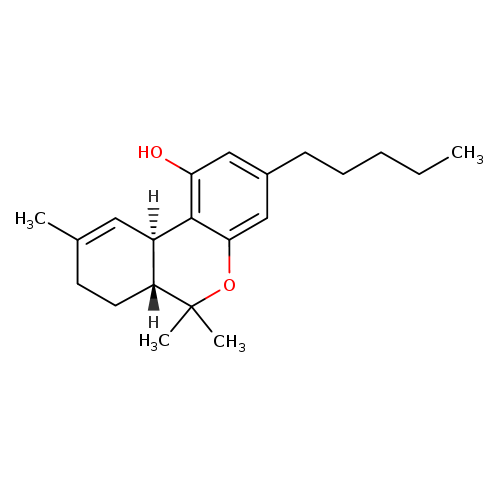
delta9-Tetrahydrocannabinol (CED0002609)

Record Information
Version1.0
Creation Date2009-07-21 20:26:58 UTC
Update Date2026-05-14 16:39:47 UTC
SynCED IDCED0002609
Secondary Accession Numbers
  • CHEM002203
  • T3D2801
Identification
Common Namedelta9-Tetrahydrocannabinol
ClassSmall Molecule
Description
delta9-Tetrahydrocannabinol is an exogenous organic compound with the formula C21H30O2 and an average molecular weight of 314.46 g/mol. It exists as a solid at room temperature. delta9-Tetrahydrocannabinol belongs to the 1-benzopyrans, a subclass of benzopyrans within the organic compounds. The compound is identified across 32 recorded sources, including healthcare, pharmaceuticals, and veterinary products such as antiemetics and antinauseants. Other sources include food, food processing, and cookware—specifically food preservation, the preparation of vinegar, processing fish, and fermentation processes for beer—as well as building and construction materials like tents or canopies. It is also found in household cleaning and consumer products, including perfumes within detergents and soaps, ash trays, and cigar cigarettes, and in electrical and electronic equipment, such as amplifiers, antennas, and electric hearing aids. Recorded exposure routes for the compound are oral and buccal. The compound interacts with three recorded protein targets: Cannabinoid receptor 1 (CNR1), Cannabinoid receptor 2 (CNR2), and G-protein coupled receptor 55 (GPR55). Regarding the mechanism of action for dronabinol, a synthetic form of delta-9-THC, it is not completely understood, though it is thought that cannabinoid receptors in neural tissues may mediate its effects. Animal studies involving other cannabinoids suggest that the antiemetic effects of dronabinol may result from the inhibition of the vomiting control mechanism located in the medulla oblongata.
Contaminant Type
  • Analgesic
  • Analgesic, Non-Narcotic
  • Antiemetic
  • Cannabinoid Receptor Agonist
  • Drug
  • Ether
  • Hallucinogen
  • Metabolite
  • Natural Compound
  • Organic Compound
  • Plant Toxin
  • Psychotropic Drug
Chemical Structure
Synonyms
ValueSource
(-)-delta9-trans-TetrahydrocannabinolChEBI
1-trans-delta-9-TetrahydrocannabinolChEBI
3-Pentyl-6,6,9-trimethyl-6a,7,8,10a-tetrahydro-6H-dibenzo(b,D)pyran-1-olChEBI
6,6,9-Trimethyl-3-pentyl-6a,7,8,10a-tetrahydro-6H-benzo[c]chromen-1-olChEBI
Delta(1)-TetrahydrocannabinolChEBI
delta9-TetrahydrocannabinolChEBI
Delta(9)-THCChEBI
DronabinolChEBI
DronabinolumChEBI
SyndrosChEBI
THCKegg
MarinolKegg
(-)-Δ9-trans-tetrahydrocannabinolGenerator
1-trans-Δ-9-tetrahydrocannabinolGenerator
Δ(1)-tetrahydrocannabinolGenerator
Δ9-tetrahydrocannabinolGenerator
Δ(9)-THCGenerator
DELTA-9-THCHMDB
DELTA-9-TETRAHYDROCANNABINOLHMDB
Δ-9-THCHMDB
Δ-9-tetrahydrocannabinolHMDB
Tetrahydrocannabinol, (6a-trans)-isomerHMDB
9-Ene-tetrahydrocannabinolHMDB
Tetrahydrocannabinol, (6ar-cis)-isomerHMDB
Tetrahydrocannabinol, (6as-cis)-isomerHMDB
Tetrahydrocannabinol, trans isomerHMDB
delta(9)-TetrahydrocannabinolHMDB
delta(1)-THCHMDB
9 Ene tetrahydrocannabinolHMDB
Solvay brand OF tetrahydrocannabinolHMDB
Tetrahydrocannabinol, trans-(+-)-isomerHMDB
Tetrahydrocannabinol, trans-isomerHMDB
delta 1-TetrahydrocannabinolHMDB
(-)- delta 9-TetrahydrocannabinolHMDB
(-)-delta 1-TetrahydrocannabinolHMDB
(-)-delta 9-THCHMDB
(-)-delta 9-trans-TetrahydrocannabinolHMDB
(-)-trans-delta 1-TetrahydrocannabinolHMDB
(-)-trans-delta 9-TetrahydrocannabinolHMDB
(-)-trans-delta 9-THCHMDB
(L)-delta 1-TetrahydrocannabinolHMDB
1-trans-delta 9-TetrahydrocannabinolHMDB
14C-delta 1-TetrahydrocannabinolHMDB
delta 1-THCHMDB
delta 9-TetrahydrocannabinolHMDB
delta 9-THCHMDB
delta 9-trans-TetrahydrocannabinolHMDB
Exocyclic delta (9)(11)-tetrahydrocannabiolHMDB
L-delta 1-trans-TetrahydrocannabinolHMDB
L-trans-delta 9-TetrahydrocannabinolHMDB
PrimolutHMDB
trans-delta (-)-9-TetrahydrocannabinolHMDB
trans-delta 9-TetrahydrocannabinolHMDB
TetrahydrocannabinolChEBI
(-)-3,4-trans-delta1-TetrahydrocannabinolPhytoBank
(-)-3,4-trans-Δ1-TetrahydrocannabinolPhytoBank
(-)-delta1-TetrahydrocannabinolPhytoBank
(-)-delta9-THCPhytoBank
(-)-delta9-TetrahydrocannabinolPhytoBank
(-)-trans-delta1-TetrahydrocannabinolPhytoBank
(-)-trans-delta9-THCPhytoBank
(-)-trans-delta9-TetrahydrocannabinolPhytoBank
(-)-trans-Δ1-TetrahydrocannabinolPhytoBank
(-)-trans-Δ9-THCPhytoBank
(-)-trans-Δ9-TetrahydrocannabinolPhytoBank
(-)-Δ1-TetrahydrocannabinolPhytoBank
(-)-Δ9-THCPhytoBank
(-)-Δ9-TetrahydrocannabinolPhytoBank
(l)-delta1-TetrahydrocannabinolPhytoBank
(l)-Δ1-TetrahydrocannabinolPhytoBank
delta1-THCPhytoBank
delta1-TetrahydrocannabinolPhytoBank
delta9-THCPhytoBank
delta9-trans-TetrahydrocannabinolPhytoBank
l-delta1-trans-TetrahydrocannabinolPhytoBank
l-trans-delta9-TetrahydrocannabinolPhytoBank
l-trans-Δ9-TetrahydrocannabinolPhytoBank
l-Δ1-trans-TetrahydrocannabinolPhytoBank
trans-(-)-delta9-TetrahydrocannabinolPhytoBank
trans-(-)-Δ9-TetrahydrocannabinolPhytoBank
trans-delta9-TetrahydrocannabinolPhytoBank
trans-Δ9-TetrahydrocannabinolPhytoBank
Δ1-THCPhytoBank
Δ1-TetrahydrocannabinolPhytoBank
Δ9-THCPhytoBank
Δ9-trans-TetrahydrocannabinolPhytoBank
Chemical FormulaC21H30O2
Average Molecular Mass314.462 g/mol
Monoisotopic Mass314.225 g/mol
CAS Registry Number1972-08-3
IUPAC Name(6aR,10aR)-6,6,9-trimethyl-3-pentyl-6H,6aH,7H,8H,10aH-benzo[c]isochromen-1-ol
Traditional NameTHC
SMILES[H][C@@]12C=C(C)CC[C@@]1([H])C(C)(C)OC1=C2C(O)=CC(CCCCC)=C1
InChI IdentifierInChI=1S/C21H30O2/c1-5-6-7-8-15-12-18(22)20-16-11-14(2)9-10-17(16)21(3,4)23-19(20)13-15/h11-13,16-17,22H,5-10H2,1-4H3/t16-,17-/m1/s1
InChI KeyCYQFCXCEBYINGO-IAGOWNOFSA-N
Chemical Taxonomy
Description Belongs to the class of organic compounds known as 2,2-dimethyl-1-benzopyrans. These are organic compounds containing a 1-benzopyran moiety that carries two methyl groups at the 2-position.
KingdomOrganic compounds
Super ClassOrganoheterocyclic compounds
ClassBenzopyrans
Sub Class1-benzopyrans
Direct Parent2,2-dimethyl-1-benzopyrans
Alternative Parents
Substituents
  • 2,2-dimethyl-1-benzopyran
  • 1-hydroxy-4-unsubstituted benzenoid
  • 1-hydroxy-2-unsubstituted benzenoid
  • Alkyl aryl ether
  • Benzenoid
  • Oxacycle
  • Ether
  • Organic oxygen compound
  • Hydrocarbon derivative
  • Organooxygen compound
  • Aromatic heteropolycyclic compound
Molecular FrameworkAromatic heteropolycyclic compounds
External Descriptors
Biological Properties
StatusDetected and Not Quantified
OriginExogenous
Cellular Locations
  • Membrane
Biofluid LocationsNot Available
Tissue LocationsNot Available
ApplicationsNot Available
Biological RolesNot Available
Chemical RolesNot Available
Organoleptic EffectsNot Available
Physical Properties
StateSolid
AppearanceWhite powder.
Experimental Properties
PropertyValue
Melting Point200°C at 2.00E-02 mm Hg
Boiling Point200°C
Solubility2800 mg/L (at 23°C)
Predicted Properties
PropertyValueSource
Water Solubility0.0026 g/LALOGPS
logP7.29ALOGPS
logP5.94ChemAxon
logS-5.1ALOGPS
pKa (Strongest Acidic)9.34ChemAxon
pKa (Strongest Basic)-4.9ChemAxon
Physiological Charge0ChemAxon
Hydrogen Acceptor Count2ChemAxon
Hydrogen Donor Count1ChemAxon
Polar Surface Area29.46 ŲChemAxon
Rotatable Bond Count4ChemAxon
Refractivity96.73 m³·mol⁻¹ChemAxon
Polarizability38.96 ųChemAxon
Number of Rings3ChemAxon
BioavailabilityYesChemAxon
Rule of FiveNoChemAxon
Ghose FilterNoChemAxon
Veber's RuleYesChemAxon
MDDR-like RuleNoChemAxon
Spectra
Spectra
Spectrum TypeDescriptionSplash KeyDeposition DateView
Predicted GC-MSPredicted GC-MS Spectrumsplash10-0597-4090000000-670e40c1592b93325e44Not AvailableView Spectrum
Predicted GC-MSPredicted GC-MS Spectrumsplash10-00dl-6009000000-735bce5abc1be2637810Not AvailableView Spectrum
Predicted GC-MSPredicted GC-MS SpectrumNot AvailableNot AvailableView Spectrum
LC-MS/MSLC-MS/MS Spectrumsplash10-014i-0219000000-1916f155ea706f1bfd78Not AvailableView Spectrum
LC-MS/MSLC-MS/MS Spectrumsplash10-05mx-3943000000-9b0e61162051930e030fNot AvailableView Spectrum
LC-MS/MSLC-MS/MS Spectrumsplash10-052f-3920000000-06615e927292d6b78f04Not AvailableView Spectrum
LC-MS/MSLC-MS/MS Spectrumsplash10-006x-5900000000-c44a1196b35ae31ac75cNot AvailableView Spectrum
LC-MS/MSLC-MS/MS Spectrumsplash10-00xu-7900000000-d06351b5900dfe483bd6Not AvailableView Spectrum
LC-MS/MSLC-MS/MS Spectrumsplash10-00tf-9600000000-14d6a1649ef828de05e3Not AvailableView Spectrum
LC-MS/MSLC-MS/MS Spectrumsplash10-00mo-9400000000-c1c5f46aa3925b6b440fNot AvailableView Spectrum
LC-MS/MSLC-MS/MS Spectrumsplash10-00ou-9300000000-fec356cc420b4d525c37Not AvailableView Spectrum
LC-MS/MSLC-MS/MS Spectrumsplash10-016u-9200000000-295f54d67e0fa9512778Not AvailableView Spectrum
LC-MS/MSLC-MS/MS Spectrumsplash10-0fvl-9200000000-92620f75edee11220267Not AvailableView Spectrum
LC-MS/MSLC-MS/MS Spectrumsplash10-053f-0980000000-c5e3986b120b13bf6cadNot AvailableView Spectrum
LC-MS/MSLC-MS/MS Spectrumsplash10-00dr-0900000000-71e91d90ab20dda21879Not AvailableView Spectrum
LC-MS/MSLC-MS/MS Spectrumsplash10-0002-9000000000-0c6530b23f4594b0199dNot AvailableView Spectrum
LC-MS/MSLC-MS/MS Spectrumsplash10-03di-0910000000-13e75d88a02fafe0bbe2Not AvailableView Spectrum
LC-MS/MSLC-MS/MS Spectrumsplash10-000j-0900000000-ae7ab2b9c0db456ba4d4Not AvailableView Spectrum
LC-MS/MSLC-MS/MS Spectrumsplash10-00lr-0490000000-aebf4a983943679cba93Not AvailableView Spectrum
LC-MS/MSLC-MS/MS Spectrumsplash10-004i-0910000000-13eb5c07bf46dbbbc6c3Not AvailableView Spectrum
Predicted LC-MS/MSPredicted LC-MS/MS Spectrumsplash10-014i-1239000000-dd0a437774bcd5f12cd9Not AvailableView Spectrum
Predicted LC-MS/MSPredicted LC-MS/MS Spectrumsplash10-0600-6291000000-48cdeee605af2033e358Not AvailableView Spectrum
Predicted LC-MS/MSPredicted LC-MS/MS Spectrumsplash10-0aou-9140000000-f6fc10c62a978b5bb9b0Not AvailableView Spectrum
Predicted LC-MS/MSPredicted LC-MS/MS Spectrumsplash10-03di-0009000000-1a8c2415357935328858Not AvailableView Spectrum
Predicted LC-MS/MSPredicted LC-MS/MS Spectrumsplash10-03di-0429000000-d0c2b14e825c4f547980Not AvailableView Spectrum
Predicted LC-MS/MSPredicted LC-MS/MS Spectrumsplash10-01re-3930000000-3f6ef979ec17030832a8Not AvailableView Spectrum
Predicted LC-MS/MSPredicted LC-MS/MS Spectrumsplash10-03di-0009000000-2514638890974c4f71f3Not AvailableView Spectrum
Predicted LC-MS/MSPredicted LC-MS/MS Spectrumsplash10-03di-0009000000-f9f1dddf06624032e0deNot AvailableView Spectrum
Predicted LC-MS/MSPredicted LC-MS/MS Spectrumsplash10-03di-0193000000-afac3cc996e586650779Not AvailableView Spectrum
Predicted LC-MS/MSPredicted LC-MS/MS Spectrumsplash10-014i-0009000000-d246e5a36c370d66b4f3Not AvailableView Spectrum
Predicted LC-MS/MSPredicted LC-MS/MS Spectrumsplash10-014i-2397000000-bcd25fa10321c4808b47Not AvailableView Spectrum
Predicted LC-MS/MSPredicted LC-MS/MS Spectrumsplash10-0006-9570000000-0a7f48bbc2e1dccac5a6Not AvailableView Spectrum
MSMS Spectrumsplash10-01pp-4792000000-06532e533cb7794b7c37Not AvailableView Spectrum
Toxicity Profile
Toxicity Values
Toxicity ValueOrganismDose DescriptorRoute of ExposurePredicted or ExperimentalToxicity RatingReference
700.0 Log mg/kg [390:1200]RatLD50oralpredictedNot AvailableNot Available
Toxicity / Toxin ClassNot Available
Mechanism of ToxicityThe mechanism of action of marinol is not completely understood. It is thought that cannabinoid receptors in neural tissues may mediate the effects of dronabinol and other cannabinoids. Animal studies with other cannabinoids suggest that marinol's antiemetic effects may be due to inhibition of the vomiting control mechanism in the medulla oblongata.
Carcinogenicity (IARC Classification)No indication of carcinogenicity to humans (not listed by IARC).
Minimum Risk LevelNot Available
SymptomsNot Available
TreatmentA potentially serious oral ingestion, if recent, should be managed with gut decontamination. In unconscious patients with a secure airway, instill activated charcoal (30 to 100 g in adults, 1 to 2 g/kg in infants) via a nasogastric tube. A saline cathartic or sorbitol may be added to the first dose of activated charcoal. Patients experiencing depressive, hallucinatory or psychotic reactions should be placed in a quiet area and offered reassurance. Benzodiazepines (5 to 10 mg diazepam po) may be used for treatment of extreme agitation. Hypotension usually responds to Trendelenburg position and IV fluids. Pressors are rarely required. (8)
Health Effects
Health EffectRelationshipDirectionDescriptionReference
Exposure Sources
Source IDSourceSectorReference
CEDs000010Insecticides?Insecticides are synthetic chemicals designed to control or eliminate insect pests that threaten crops and other agricultural products.Agriculture & land managementPubChem
CEDs000233Brushes?Brushes used in personal care and cosmetics can be a source of synthetic chemical contamination due to the materials and coatings used in their manufacturing.Personal care & cosmeticsPubChem
CEDs000249Antiemetics and antinauseants?Antiemetics and antinauseants are synthetic compounds used to prevent or alleviate nausea and vomiting, often resulting from various medical conditions, treatments, or medications.Healthcare, pharmaceuticals & veterinary productsNot Available
CEDs000503Tents Or Canopies?Tents and canopies used in various applications can be a source of synthetic chemical contamination primarily due to the materials from which they are made.Building & ConstructionPubChem
CEDs000505Amplifiers?Amplifiers, commonly used in various electronic devices to enhance signal strength, can be a source of synthetic chemical contamination due to the materials and processes involved in their production and disposal.Electrical & Electronic EquipmentPubChem
CEDs000506Antennas?Antennas, commonly used in communication technologies, can be a source of synthetic chemical contamination through the materials and coatings used in their construction.Electrical & Electronic EquipmentPubChem
CEDs000507Auxiliary Devices?Auxiliary devices, such as capacitors, transformers, and circuit breakers, are integral components in various electronic systems.Electrical & Electronic EquipmentPubChem
CEDs000511Conductors Or Conductive Bodies Characterised By The Conductive Materials?Conductors, or conductive bodies, are materials that allow the flow of electrical current, typically made from metals such as copper, aluminum, or silver.Electrical & Electronic EquipmentPubChem
CEDs000516Electric Hearing Aids?Electric hearing aids are small electronic devices designed to amplify sound for individuals with hearing loss.Electrical & Electronic EquipmentPubChem
CEDs000518Electrically Stimulated Smoking Devices?Electrically stimulated smoking devices, commonly known as e-cigarettes or vape pens, utilize electrical components to heat a liquid solution, often containing nicotine, flavorings, and other additives, to produce an aerosol for inhalation.Electrical & Electronic EquipmentPubChem
CEDs000519Electrodes?Electrodes, used in various electrical and electronic applications, can be a source of synthetic chemical contamination due to the materials from which they are constructed and the processes involved in their manufacturing.Electrical & Electronic EquipmentPubChem
CEDs000524Hybrid Capacitors?Hybrid capacitors are energy storage devices that combine the properties of electrolytic and supercapacitors, utilizing a combination of electrochemical principles to achieve higher energy density and power density.Electrical & Electronic EquipmentPubChem
CEDs000527Magnets?Magnets, commonly used in various electrical and electronic applications, can be a source of synthetic chemical contamination due to the materials used in their production.Electrical & Electronic EquipmentPubChem
CEDs000530Radio Transmission Systems?Radio transmission systems utilize a variety of synthetic chemicals in their manufacturing and maintenance processes.Electrical & Electronic EquipmentPubChem
CEDs000537Television Systems?Television systems can be a source of synthetic chemical contamination due to the various materials and components used in their manufacture and operation.Electrical & Electronic EquipmentPubChem
CEDs000539Video Games?Video games, through their production and disposal processes, can be a source of synthetic chemical contamination.Electrical & Electronic EquipmentPubChem
CEDs000544Fermentation Processes For Beer?Fermentation processes for beer involve the conversion of sugars into alcohol and carbon dioxide by yeast.Food, food processing & cookwarePubChem
CEDs000545Food Preservation?Food preservation often involves the use of synthetic chemicals, such as preservatives, flavor enhancers, and color additives, to extend shelf life and enhance the sensory qualities of food products.Food, food processing & cookwarePubChem
CEDs000548Preparation Of Vinegar?Vinegar is produced through the fermentation of ethanol by acetic acid bacteria, resulting in a solution that typically contains 4-8% acetic acid.Food, food processing & cookwarePubChem
CEDs000550Preparation Of Wort?The preparation of wort involves the extraction of sugars from malted grains, a crucial step in the brewing process.Food, food processing & cookwarePubChem
CEDs000551Processing Fish?Processing fish can lead to synthetic chemical contamination through various stages of production and preservation.Food, food processing & cookwarePubChem
CEDs000552Processing Meats?Processing meats can lead to synthetic chemical contamination primarily through the use of additives and preservatives.Food, food processing & cookwarePubChem
CEDs000553Treatment Of Hops?Hops, a key ingredient in brewing and food flavoring, can be a source of synthetic chemical contamination due to various agricultural practices.Food, food processing & cookwarePubChem
CEDs000554Ash Trays?Ash trays, commonly used for the disposal of cigarette butts and ash, can be a source of synthetic chemical contamination due to the presence of various toxic compounds in tobacco smoke.Household cleaning & consumer productsPubChem
CEDs000556Cigar Cigarettes?Cigar cigarettes are a source of synthetic chemical contamination due to the combustion of various tobacco blends and additives.Household cleaning & consumer productsPubChem
CEDs000559Non Electric Simulated Smoking Devices?Non-electric simulated smoking devices, often designed to mimic the experience of smoking without combustion, can be sources of synthetic chemical contamination due to the materials and chemicals used in their construction and operation.Household cleaning & consumer productsPubChem
CEDs000560Other Smoking Requisites?Other smoking requisites, including items such as lighters, matches, and rolling papers, can introduce synthetic chemical contamination through various components and additives.Household cleaning & consumer productsPubChem
CEDs000561Perfumes Within Detergents And Soaps?Perfumes within detergents and soaps are synthetic fragrance compounds added to enhance the sensory experience of cleaning products.Household cleaning & consumer productsPubChem
CEDs000562Pipe Accessories?Pipe accessories, such as fittings, connectors, and seals, are components used in plumbing systems to facilitate the flow of liquids and gases.Household cleaning & consumer productsPubChem
CEDs000563Soap Detergents?Soap detergents are synthetic surfactants designed to enhance the cleaning efficacy of water by reducing surface tension, allowing for better interaction with dirt and grease.Household cleaning & consumer productsPubChem
CEDs000565Stands For Smoker Requirsites?Stands For Smoker Requirements (SFSR) refers to a set of regulations and guidelines aimed at minimizing the impact of smoking-related chemicals in consumer products.Household cleaning & consumer productsPubChem
CEDs000566Tobacco Pipes?Tobacco pipes, often made from materials such as plastic, wood, or metal, can serve as sources of synthetic chemical contamination due to the residues left by tobacco products.Household cleaning & consumer productsPubChem
CEDs000567Tobacco Product Cases?Tobacco product cases can serve as a source of synthetic chemical contamination due to the presence of various additives and chemicals used in tobacco processing and product manufacturing.Household cleaning & consumer productsPubChem
CEDs000568Tobacco Product Moisture Control?Tobacco product moisture control involves the use of synthetic chemicals to manage the humidity levels in tobacco products, aiming to preserve flavor and extend shelf life.Household cleaning & consumer productsPubChem
CEDs000569Tobacco Smoke Filters?Tobacco smoke filters are designed to reduce the inhalation of harmful substances in cigarette smoke, including tar and other particulate matter.Household cleaning & consumer productsPubChem
CEDs000578Making Cigars?The process of making cigars involves several steps, including the cultivation of tobacco, fermentation, and the application of various additives to enhance flavor and preservation.Industrial manufacturing & chemical processingPubChem
CEDs000580Manufacture Preparation Of Tobacco Products?The manufacture and preparation of tobacco products involve various processes that can result in the introduction of synthetic chemicals into the environment.Industrial manufacturing & chemical processingPubChem
CEDs000581Paper Making Machines?Paper making machines utilize various synthetic chemicals throughout the production process, including additives, coatings, and bleaching agents.Industrial manufacturing & chemical processingPubChem
CEDs000596Acaricides?Acaricides are synthetic chemicals specifically designed to target and control mite populations that can damage crops and plants.Agriculture & land managementPubChem
CEDs000597Chemosterilants?Chemosterilants are synthetic chemicals designed to induce sterility in target pest populations, thereby controlling their reproduction and mitigating damage to crops.Agriculture & land managementPubChem
CEDs000600Herbicides And Algicides?Herbicides and algicides are synthetic chemicals primarily used to control unwanted plants and algae in various environments.Agriculture & land managementPubChem
CEDs000602Molluscicides?Molluscicides are synthetic chemicals specifically designed to control and eliminate mollusks, such as snails and slugs, which can be detrimental to crops and agricultural productivity.Agriculture & land managementPubChem
CEDs000603Nematocides?Nematocides are synthetic chemicals specifically designed to control nematodes, which are microscopic roundworms that can cause significant damage to crops and plants.Agriculture & land managementPubChem
CEDs000604Pest Attractants?Pest attractants are synthetic chemicals designed to lure specific pests for monitoring or control purposes.Agriculture & land managementPubChem
CEDs000605Pest Repellants?Pest repellents, often formulated from synthetic chemicals, are widely used to protect crops from insect infestations and other pests.Agriculture & land managementPubChem
CEDs000606Plant Growth Regulators?Plant Growth Regulators (PGRs) are synthetic chemicals designed to influence the growth and development of plants.Agriculture & land managementPubChem
CEDs000607Rodenticides(1)?Rodenticides are synthetic chemicals specifically formulated to control rodent populations, serving as a crucial tool in managing pests that can damage crops and spread diseases.Agriculture & land managementPubChem
CEDs000608Rodenticides?Rodenticides are chemical substances specifically designed to control rodent populations by causing death through various mechanisms, including anticoagulation or neurotoxicity.Agriculture & land managementPubChem
CEDs000609Aftershave?Aftershave is a grooming product typically used to soothe and protect the skin following shaving.Personal care & cosmeticsPubChem
CEDs000610Aftersun Products?Aftersun products are designed to soothe and hydrate the skin after sun exposure, often containing various synthetic chemicals such as emollients, preservatives, and fragrances.Personal care & cosmeticsPubChem
CEDs000611Anti Perspirants Or Body Deoderants?Antiperspirants and body deodorants commonly contain synthetic chemicals such as aluminum compounds, parabens, and synthetic fragrances.Personal care & cosmeticsPubChem
CEDs000614Essential Oils Or Perfumes?Essential oils and perfumes are complex mixtures of volatile compounds derived from natural or synthetic sources, commonly used for their aromatic properties.Personal care & cosmeticsPubChem
CEDs000615Eye Makeup Products?Eye makeup products, including mascaras, eyeliners, and eyeshadows, often contain a variety of synthetic chemicals such as pigments, preservatives, and film-forming agents.Personal care & cosmeticsPubChem
CEDs000616Face Mask Cosmetics?Face mask cosmetics often contain a variety of synthetic chemicals, including preservatives, emulsifiers, and fragrances, which can contribute to chemical contamination.Personal care & cosmeticsPubChem
CEDs000617Lip Care Products?Lip care products, including lipsticks, balms, and glosses, often contain a variety of synthetic chemicals such as parabens, phthalates, and synthetic fragrances.Personal care & cosmeticsPubChem
CEDs000618Lip Makeup Products?Lip makeup products, such as lipsticks, lip glosses, and lip liners, often contain a variety of synthetic chemicals, including pigments, preservatives, and emollients.Personal care & cosmeticsPubChem
CEDs000632Apparel?Apparel production often involves the use of various synthetic chemicals, including dyes, finishing agents, and preservatives.Textiles, leather & furnishingsPubChem
CEDs000642Footwear?Footwear production often involves the use of various synthetic chemicals, such as adhesives, dyes, and treatments, which can contribute to environmental contamination.Textiles, leather & furnishingsPubChem
CEDs000650Purses Luggage Hand Bags?Purses, luggage, and handbags are often manufactured using synthetic materials such as polyvinyl chloride (PVC), polyurethane, and various types of nylon.Textiles, leather & furnishingsPubChem
CEDs000662Yarns Or Threads?Yarns or threads used in textiles can be a source of synthetic chemical contamination due to the production processes and treatments they undergo.Textiles, leather & furnishingsPubChem
CEDs000664Fire Fighting Gels?Fire fighting gels are synthetic chemical formulations designed to enhance fire suppression effectiveness by creating a protective barrier against heat and flames.Fire suppression systems & agentsPubChem
CEDs000670Solid Fire Fighting Substances?Solid fire fighting substances, such as certain types of dry chemical powders, are used in fire suppression applications to extinguish flames and prevent fire spread.Fire suppression systems & agentsPubChem
CEDs000671Airplanes And Helicopters?Airplanes and helicopters are significant sources of synthetic chemical contamination primarily through the use of aviation fuels, lubricants, and de-icing agents.Aviation & AerospacePubChem
CEDs000672Light Than Air Aircraft?Light than air aircraft, such as dirigibles and airships, utilize lifting gases like helium or hydrogen for buoyancy.Aviation & AerospacePubChem
CEDs000678Nitrogenous Fertilisers?Nitrogenous fertilizers are synthetic chemical compounds primarily used to enhance plant growth by supplying essential nitrogen, a crucial nutrient for photosynthesis and protein synthesis.Agriculture & land managementPubChem
CEDs000679Phosphatic Fertilisers?Phosphatic fertilizers are synthetic chemical products primarily composed of phosphorus, which is essential for plant growth.Agriculture & land managementPubChem
CEDs000685Ceramics?Ceramics can be a source of synthetic chemical contamination through various additives and processing agents used in their production.Building & ConstructionPubChem
CEDs000686Clay Wares?Clay wares are ceramic products made from natural clay, often utilized in various construction applications such as tiles, bricks, and sanitary ware.Building & ConstructionPubChem
CEDs000691Non Oxide Glass?Non-oxide glass refers to a category of glasses primarily composed of materials other than silicon dioxide, such as boron oxide or phosphorous oxide.Building & ConstructionPubChem
CEDs000693Silica Glass?Silica glass, primarily composed of silicon dioxide (SiO2), is widely used in various applications, including windows, glass facades, and insulation materials.Building & ConstructionPubChem
CEDs000694Cheese Making?Cheese making involves the fermentation of milk, utilizing bacteria and enzymes to coagulate proteins and develop flavor.Food, food processing & cookwarePubChem
CEDs000696Nanotechnology?Nanotechnology involves the manipulation of materials at the molecular or atomic level, typically within the range of 1 to 100 nanometers.Industrial manufacturing & chemical processingPubChem
CEDs000698Jewellery?Jewellery production often involves the use of various synthetic chemicals during the extraction and processing of metals.Mining & metal processingPubChem
CEDs000727Printing Machines Or Presses?Printing machines or presses commonly utilize synthetic chemicals such as inks, solvents, and cleaning agents.Paper, pulp & fiber productsPubChem
CEDs000734Coating Compositions?Coating compositions, which include paints, sealants, and varnishes, are formulated with a variety of synthetic chemicals such as solvents, resins, pigments, and additives.Building & ConstructionPubChem
CEDs000735Explosives?Explosives are chemical compounds or mixtures designed to undergo rapid decomposition, releasing energy in the form of gas and heat.Defense & military infrastructurePubChem
CEDs000738Cooling Circuit Water?Cooling circuit water is utilized in various industrial processes to absorb and dissipate heat generated during operations.Industrial manufacturing & chemical processingPubChem
CEDs000739Inks?Inks are complex mixtures composed of pigments or dyes, solvents, resins, and additives used primarily for printing and writing applications.Paper, pulp & fiber productsPubChem
CEDs000740Paper?Paper production involves the processing of wood fibers and the use of various chemicals, which can lead to synthetic chemical contamination.Paper, pulp & fiber productsPubChem
CEDs000741Pigment Pastes?Pigment pastes are concentrated dispersions of pigments used to impart color and properties to materials.Paper, pulp & fiber productsPubChem
CEDs000743Sludge Treatment?Sludge treatment involves the processing of waste materials generated from wastewater treatment plants, which often contain a variety of organic and inorganic substances.Wastewater, sanitation & biosolidsPubChem
CEDs000744Water, Wastewater, & Sewage Treatment?Water, wastewater, and sewage treatment processes are critical for managing and mitigating pollutants in water systems.Wastewater, sanitation & biosolidsPubChem
Pathways
1 pathwayPathway Source: PathBank
Targets
StructureProteinUniProt IDOrganismRelationshipDetails
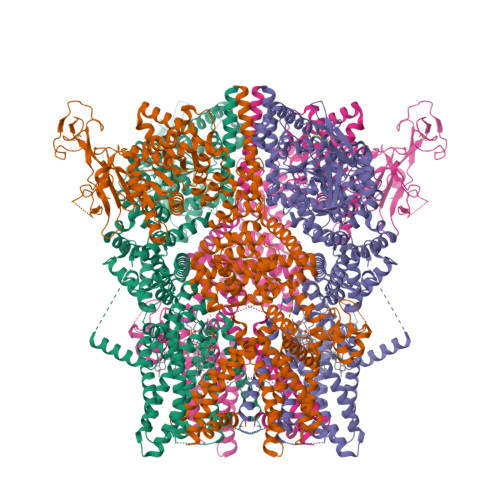
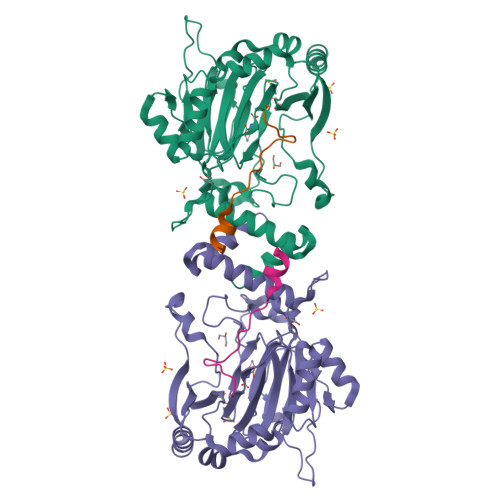
Cannabinoid receptor 2 structureClick to view 3D structureCannabinoid receptor 2P34972HumansPredicted (SEA)
Prediction Confidence Score
0.728
Applicability Domain
1.0
Statistical Significance
5.00e-05
Supporting Reference Compounds
175
E-value
0.389246
Cannabinoid receptor 1 structureClick to view 3D structureCannabinoid receptor 1P21554HumansPredicted (SEA)
Prediction Confidence Score
0.707
Applicability Domain
1.0
Statistical Significance
1.10e-04
Supporting Reference Compounds
200
E-value
0.856341
Transient receptor potential cation channel subfamily M member 8 structureClick to view 3D structureTransient receptor potential cation channel subfamily M member 8Q7Z2W7HumansPredicted (SEA)
Prediction Confidence Score
0.707
Applicability Domain
1.0
Statistical Significance
1.00e-05
Supporting Reference Compounds
43
E-value
0.0778492
G-protein coupled receptor 55 structureClick to view 3D structureG-protein coupled receptor 55Q9Y2T6HumansPredicted (SEA)
Prediction Confidence Score
0.637
Applicability Domain
1.0
Statistical Significance
1.00e-04
Supporting Reference Compounds
125
E-value
0.778492
Click to view 3D structureCannabinoid receptor 1P20272Rattus norvegicusPredicted (SEA)
Prediction Confidence Score
0.598
Applicability Domain
1.0
Statistical Significance
3.20e-04
Supporting Reference Compounds
83
E-value
2.49118
Click to view 3D structureCannabinoid receptor 1P47746Mus musculusPredicted (SEA)
Prediction Confidence Score
0.593
Applicability Domain
1.0
Statistical Significance
5.00e-05
Supporting Reference Compounds
42
E-value
0.389246
Transient receptor potential cation channel subfamily V member 1 structureClick to view 3D structureTransient receptor potential cation channel subfamily V member 1Q8NER1HumansPredicted (SEA)
Prediction Confidence Score
0.578
Applicability Domain
0.857
Statistical Significance
1.60e-04
Supporting Reference Compounds
104
E-value
1.24559
Click to view 3D structureTransient receptor potential cation channel subfamily A member 1Q6RI86Rattus norvegicusPredicted (SEA)
Prediction Confidence Score
0.577
Applicability Domain
1.0
Statistical Significance
3.00e-05
Supporting Reference Compounds
56
E-value
0.233548
Gamma-aminobutyric acid receptor subunit beta-2 structureClick to view 3D structureGamma-aminobutyric acid receptor subunit beta-2P47870HumansPredicted (SEA)
Prediction Confidence Score
0.571
Applicability Domain
0.571
Statistical Significance
1.00e-04
Supporting Reference Compounds
1
E-value
0.778492
Click to view 3D structureCannabinoid receptor 2P47936Mus musculusPredicted (SEA)
Prediction Confidence Score
0.556
Applicability Domain
1.0
Statistical Significance
2.00e-04
Supporting Reference Compounds
39
E-value
1.55698
Transient receptor potential cation channel subfamily V member 5 structureClick to view 3D structureTransient receptor potential cation channel subfamily V member 5Q9NQA5HumansPredicted (SEA)
Prediction Confidence Score
0.489
Applicability Domain
0.857
Statistical Significance
1.00e-05
Supporting Reference Compounds
2
E-value
0.0778492
Transient receptor potential cation channel subfamily V member 4 structureClick to view 3D structureTransient receptor potential cation channel subfamily V member 4Q9HBA0HumansPredicted (SEA)
Prediction Confidence Score
0.487
Applicability Domain
0.857
Statistical Significance
2.10e-04
Supporting Reference Compounds
32
E-value
1.63483
Transient receptor potential cation channel subfamily V member 3 structureClick to view 3D structureTransient receptor potential cation channel subfamily V member 3Q8NET8HumansPredicted (SEA)
Prediction Confidence Score
0.487
Applicability Domain
0.857
Statistical Significance
1.00e-05
Supporting Reference Compounds
15
E-value
0.0778492
Transient receptor potential cation channel subfamily A member 1 structureClick to view 3D structureTransient receptor potential cation channel subfamily A member 1O75762HumansPredicted (SEA)
Prediction Confidence Score
0.487
Applicability Domain
0.857
Statistical Significance
2.00e-05
Supporting Reference Compounds
70
E-value
0.155698
Mu-type opioid receptor structureClick to view 3D structureMu-type opioid receptorP35372HumansPredicted (SEA)
Prediction Confidence Score
0.486
Applicability Domain
0.571
Statistical Significance
0.011
Supporting Reference Compounds
527
E-value
86.0234
Transient receptor potential cation channel subfamily V member 2 structureClick to view 3D structureTransient receptor potential cation channel subfamily V member 2Q9Y5S1HumansPredicted (SEA)
Prediction Confidence Score
0.463
Applicability Domain
0.857
Statistical Significance
1.00e-05
Supporting Reference Compounds
6
E-value
0.0778492
Click to view 3D structureTransient receptor potential cation channel subfamily M member 8Q8R455Rattus norvegicusPredicted (SEA)
Prediction Confidence Score
0.46
Applicability Domain
0.571
Statistical Significance
6.00e-05
Supporting Reference Compounds
23
E-value
0.467095
Transient receptor potential cation channel subfamily V member 2 structureClick to view 3D structureTransient receptor potential cation channel subfamily V member 2Q9WUD2Rattus norvegicusPredicted (SEA)
Prediction Confidence Score
0.452
Applicability Domain
0.571
Statistical Significance
5.30e-04
Supporting Reference Compounds
21
E-value
4.12601
D(2) dopamine receptor structureClick to view 3D structureD(2) dopamine receptorP14416HumansPredicted (SEA)
Prediction Confidence Score
0.446
Applicability Domain
0.571
Statistical Significance
0.0134
Supporting Reference Compounds
1103
E-value
104.629
5-hydroxytryptamine receptor 2B structureClick to view 3D structure5-hydroxytryptamine receptor 2BP41595HumansPredicted (SEA)
Prediction Confidence Score
0.443
Applicability Domain
0.492
Statistical Significance
0.0047
Supporting Reference Compounds
686
E-value
36.7448
5-hydroxytryptamine receptor 1A structureClick to view 3D structure5-hydroxytryptamine receptor 1AP08908HumansPredicted (SEA)
Prediction Confidence Score
0.44
Applicability Domain
0.857
Statistical Significance
0.0116
Supporting Reference Compounds
953
E-value
90.3829
Click to view 3D structureTransient receptor potential cation channel subfamily V member 4Q9ERZ8Rattus norvegicusPredicted (SEA)
Prediction Confidence Score
0.432
Applicability Domain
0.571
Statistical Significance
1.30e-04
Supporting Reference Compounds
18
E-value
1.01204
D(3) dopamine receptor structureClick to view 3D structureD(3) dopamine receptorP35462HumansPredicted (SEA)
Prediction Confidence Score
0.42
Applicability Domain
1.0
Statistical Significance
0.0125
Supporting Reference Compounds
861
E-value
97.2337
Click to view 3D structureHeat sensitive channel TRPV3Q4QYD9Rattus norvegicusPredicted (SEA)
Prediction Confidence Score
0.405
Applicability Domain
0.571
Statistical Significance
1.20e-04
Supporting Reference Compounds
3
E-value
0.934191
Sodium-dependent noradrenaline transporter structureClick to view 3D structureSodium-dependent noradrenaline transporterP23975HumansPredicted (SEA)
Prediction Confidence Score
0.394
Applicability Domain
0.466
Statistical Significance
0.0058
Supporting Reference Compounds
451
E-value
45.0747
Cannabinoid receptor 2 structureClick to view 3D structureCannabinoid receptor 2P34972HumansKnownNot Available
Cannabinoid receptor 1 structureClick to view 3D structureCannabinoid receptor 1P21554HumansKnownThe mechanism of action of dronabinol is not completely understood. It is thought that cannabinoid receptors in neural tissues may mediate the effects of dronabinol and other cannabinoids. Animal studies with other cannabinoids suggest that dronabinol's antiemetic effects may be due to inhibition of the vomiting control mechanism in the medulla oblongata.
G-protein coupled receptor 55 structureClick to view 3D structureG-protein coupled receptor 55Q9Y2T6HumansKnownNot Available
Concentrations
Not Available
External Links
DrugBank IDDB00470
HMDB IDHMDB0014613
FooDB IDFDB031310
Phenol Explorer IDNot Available
KNApSAcK IDC00002675
BiGG IDNot Available
BioCyc IDCPD-7172
METLIN IDNot Available
PDB IDNot Available
Wikipedia LinkTetrahydrocannabinol
Chemspider ID15266
ChEBI ID66964
PubChem Compound ID16078
Kegg Compound IDC06972
YMDB IDNot Available
ECMDB IDNot Available
References
Synthesis Reference

Fabio E.S. SOUZA, Jason E. FIELD, Ming PAN, “INTERMEDIATE COMPOUNDS IN THE SYNTHESIS OF DRONABINOL.” U.S. Patent US20080312465, issued December 18, 2008.

MSDSLink
General References
  1. Gregg JM, Small EW, Moore R, Raft D, Toomey TC: Emotional response to intravenous delta9tetrahydrocannabinol during oral surgery. J Oral Surg. 1976 Apr;34(4):301-13. [PubMed: 1062533]
  2. Schuel H, Burkman LJ: A tale of two cells: endocannabinoid-signaling regulates functions of neurons and sperm. Biol Reprod. 2005 Dec;73(6):1078-86. Epub 2005 Aug 24. [PubMed: 16120829]
  3. Zhu W, Friedman H, Klein TW: Delta9-tetrahydrocannabinol induces apoptosis in macrophages and lymphocytes: involvement of Bcl-2 and caspase-1. J Pharmacol Exp Ther. 1998 Aug;286(2):1103-9. [PubMed: 9694974]
  4. Zangen A, Solinas M, Ikemoto S, Goldberg SR, Wise RA: Two brain sites for cannabinoid reward. J Neurosci. 2006 May 3;26(18):4901-7. [PubMed: 16672664]
  5. Consroe P, Martin P, Eisenstein D: Anticonvulsant drug antagonism of delta9tetrahydrocannabinol-induced seizures in rabbits. Res Commun Chem Pathol Pharmacol. 1977 Jan;16(1):1-13. [PubMed: 841172]
  6. Concheiro M, de Castro A, Quintela O, Cruz A, Lopez-Rivadulla M: Development and validation of a method for the quantitation of Delta9tetrahydrocannabinol in oral fluid by liquid chromatography electrospray-mass-spectrometry. J Chromatogr B Analyt Technol Biomed Life Sci. 2004 Oct 25;810(2):319-24. [PubMed: 15380731]
  7. Drugs.com - http://www.drugs.com/cons/Dronabinol.html
  8. RxList: The Internet Drug Index (2009). - http://www.rxlist.com/