Oxycodone (CED0002036)

Record Information
Version1.0
Creation Date2009-07-21 20:27:02 UTC
Update Date2026-05-14 16:40:30 UTC
SynCED IDCED0002036
Secondary Accession Numbers
  • CHEM002211
  • T3D2809
Identification
Common NameOxycodone
ClassSmall Molecule
Description
Oxycodone belongs to the phenanthrenes and derivatives, a class of benzenoids within the organic compounds. This exogenous compound has the formula C18H21NO4 and an average molecular weight of 315.36 g/mol. At room temperature, it exists as a solid. It is used as an opioid analgesic, mu-opioid receptor agonist, analgesic, and antitussive (PMC7941040 ). It is used as a treatment for pain (PMC7012325 ) and chronic pain (PMC6205722 ), though it is associated with lethargy and depression (PMC7012325 ). Oxycodone targets the mu-type opioid receptor (OPRM1), kappa-type opioid receptor (OPRK1), and delta-type opioid receptor (OPRD1), while also acting as an inhibitor of the voltage-dependent N-type calcium channel subunit alpha-1B (CACNA1B). Within the central nervous system (CNS), it acts as a weak agonist at the mu, kappa, and delta opioid receptors. It primarily affects mu-type opioid receptors, which are coupled with G-protein receptors and function as modulators of synaptic transmission via G-proteins that activate effector proteins. Binding stimulates the exchange of GTP for GDP on the G-protein complex. Because the effector system consists of cAMP and adenylate cyclase located at the inner surface of the plasma membrane, opioids decrease intracellular cAMP by inhibiting adenylate cyclase. Oxycodone is recorded in several sources, including analgesics, drinking water, the preparation of vinegar, and household cleaning and consumer products such as pipe accessories, other smoking requisites, and non-electric simulated smoking devices. It is also found in electrical and electronic equipment, including antennas, amplifiers, relays, auxiliary devices, and line transmission systems. Recorded exposure routes include oral and rectal administration.
Contaminant Type
  • Amine
  • Analgesic, Opioid
  • Antitussive Agent
  • Drug
  • Ether
  • Human Neurotoxin
  • Metabolite
  • Narcotic
  • Opiate Agonist
  • Organic Compound
  • Synthetic Compound
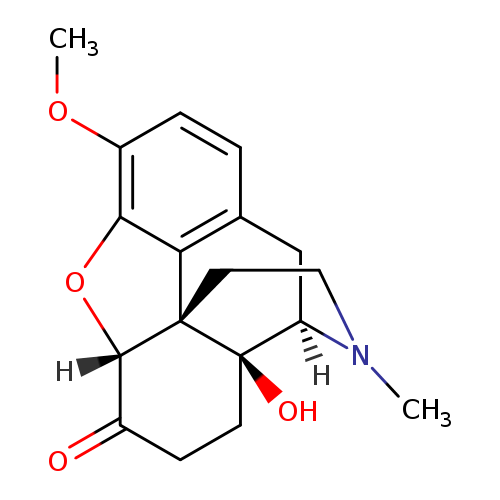
Chemical Structure
Synonyms
ValueSource
(-)-14-HydroxydihydrocodeinoneChEBI
4,5-Epoxy-14-hydroxy-3-methoxy-17-methylmorphinan-6-oneChEBI
4,5alpha-Epoxy-14-hydroxy-3-methoxy-17-methylmorphinan-6-oneChEBI
Dihydro-14-hydroxycodeinoneChEBI
DihydrohydroxycodeinoneChEBI
DihydroxycodeinoneChEBI
OxicodonaChEBI
OxycodonumChEBI
4,5a-Epoxy-14-hydroxy-3-methoxy-17-methylmorphinan-6-oneGenerator
4,5Α-epoxy-14-hydroxy-3-methoxy-17-methylmorphinan-6-oneGenerator
DihydrohydroxycondeinoneHMDB
DihydroneHMDB
PTI-821HMDB
DinarkonHMDB
OxiconumHMDB
OxyconeHMDB
OxycontinHMDB
TheocodinHMDB
EucodalHMDB
OxycodeinonHMDB
Oxycodone hydrochlorideHMDB
PancodineHMDB
Purdue frederick brand OF oxycodoneHMDB
Chemical FormulaC18H21NO4
Average Molecular Mass315.364 g/mol
Monoisotopic Mass315.147 g/mol
CAS Registry Number76-42-6
IUPAC Name(1S,5R,13R,17S)-17-hydroxy-10-methoxy-4-methyl-12-oxa-4-azapentacyclo[9.6.1.0^{1,13}.0^{5,17}.0^{7,18}]octadeca-7(18),8,10-trien-14-one
Traditional Name(1S,5R,13R,17S)-17-hydroxy-10-methoxy-4-methyl-12-oxa-4-azapentacyclo[9.6.1.0^{1,13}.0^{5,17}.0^{7,18}]octadeca-7(18),8,10-trien-14-one
SMILES[H][C@@]12OC3=C(OC)C=CC4=C3[C@@]11CCN(C)[C@]([H])(C4)[C@]1(O)CCC2=O
InChI IdentifierInChI=1S/C18H21NO4/c1-19-8-7-17-14-10-3-4-12(22-2)15(14)23-16(17)11(20)5-6-18(17,21)13(19)9-10/h3-4,13,16,21H,5-9H2,1-2H3/t13-,16+,17+,18-/m1/s1
InChI KeyBRUQQQPBMZOVGD-XFKAJCMBSA-N
Chemical Taxonomy
Description Belongs to the class of organic compounds known as phenanthrenes and derivatives. These are polycyclic compounds containing a phenanthrene moiety, which is a tricyclic aromatic compound with three non-linearly fused benzene.
KingdomOrganic compounds
Super ClassBenzenoids
ClassPhenanthrenes and derivatives
Sub ClassNot Available
Direct ParentPhenanthrenes and derivatives
Alternative Parents
Substituents
  • Phenanthrene
  • Isoquinolone
  • Tetralin
  • Coumaran
  • Anisole
  • Alkyl aryl ether
  • Aralkylamine
  • Piperidine
  • Cyclic alcohol
  • Tertiary alcohol
  • Tertiary aliphatic amine
  • Tertiary amine
  • 1,2-aminoalcohol
  • Ketone
  • Oxacycle
  • Azacycle
  • Organoheterocyclic compound
  • Ether
  • Alcohol
  • Organonitrogen compound
  • Organopnictogen compound
  • Organooxygen compound
  • Organic oxide
  • Carbonyl group
  • Organic oxygen compound
  • Amine
  • Organic nitrogen compound
  • Hydrocarbon derivative
  • Aromatic heteropolycyclic compound
Molecular FrameworkAromatic heteropolycyclic compounds
External Descriptors
Biological Properties
StatusDetected and Not Quantified
OriginExogenous
Cellular Locations
  • Cytoplasm
  • Extracellular
  • Membrane
Biofluid LocationsNot Available
Tissue LocationsNot Available
Applications
Biological Roles
Chemical RolesNot Available
Organoleptic EffectsNot Available
Physical Properties
StateSolid
AppearanceWhite powder.
Experimental Properties
PropertyValue
Melting Point219°C
Boiling PointNot Available
Solubility100 mg/ml
Predicted Properties
PropertyValueSource
Water Solubility5.59 g/LALOGPS
logP1.04ALOGPS
logP1.03ChemAxon
logS-1.8ALOGPS
pKa (Strongest Acidic)13.56ChemAxon
pKa (Strongest Basic)8.21ChemAxon
Physiological Charge1ChemAxon
Hydrogen Acceptor Count5ChemAxon
Hydrogen Donor Count1ChemAxon
Polar Surface Area59 ŲChemAxon
Rotatable Bond Count1ChemAxon
Refractivity84.04 m³·mol⁻¹ChemAxon
Polarizability32.79 ųChemAxon
Number of Rings5ChemAxon
BioavailabilityYesChemAxon
Rule of FiveYesChemAxon
Ghose FilterYesChemAxon
Veber's RuleNoChemAxon
MDDR-like RuleNoChemAxon
Spectra
Spectra
Spectrum TypeDescriptionSplash KeyDeposition DateView
Predicted GC-MSPredicted GC-MS Spectrumsplash10-0a4i-9061000000-5297e69aa2cc5152068fNot AvailableView Spectrum
Predicted GC-MSPredicted GC-MS Spectrumsplash10-00fr-9538000000-1b9bf2a9c0682b6738c4Not AvailableView Spectrum
Predicted GC-MSPredicted GC-MS SpectrumNot AvailableNot AvailableView Spectrum
LC-MS/MSLC-MS/MS Spectrumsplash10-014i-0009000000-d55749fa4d1f47ce2244Not AvailableView Spectrum
LC-MS/MSLC-MS/MS Spectrumsplash10-00kb-0095000000-83c78e9e15857145cc78Not AvailableView Spectrum
LC-MS/MSLC-MS/MS Spectrumsplash10-0002-0090000000-ad908ecfa38c7efce138Not AvailableView Spectrum
LC-MS/MSLC-MS/MS Spectrumsplash10-0006-0390000000-88d302b8770cb7121937Not AvailableView Spectrum
LC-MS/MSLC-MS/MS Spectrumsplash10-03fu-0790000000-4af50b834ee854320001Not AvailableView Spectrum
LC-MS/MSLC-MS/MS Spectrumsplash10-014i-0009000000-60bc25dea256a8ba83bbNot AvailableView Spectrum
LC-MS/MSLC-MS/MS Spectrumsplash10-0002-0090000000-fccf9384aae73d4c8009Not AvailableView Spectrum
LC-MS/MSLC-MS/MS Spectrumsplash10-03fu-0790000000-7931a551d5483e7067a3Not AvailableView Spectrum
LC-MS/MSLC-MS/MS Spectrumsplash10-03fu-0690000000-3d8d447a366cdf1fdb74Not AvailableView Spectrum
LC-MS/MSLC-MS/MS Spectrumsplash10-00kb-0096000000-55405b387941a889b750Not AvailableView Spectrum
LC-MS/MSLC-MS/MS Spectrumsplash10-0006-0390000000-1f6f5ca02d934d0d4537Not AvailableView Spectrum
LC-MS/MSLC-MS/MS Spectrumsplash10-0002-0093000000-a61df116baabe44f4c3aNot AvailableView Spectrum
LC-MS/MSLC-MS/MS Spectrumsplash10-03fu-0690000000-7dc7939fd86861c02ab4Not AvailableView Spectrum
LC-MS/MSLC-MS/MS Spectrumsplash10-0006-0390000000-fff1638b31b7719ed170Not AvailableView Spectrum
LC-MS/MSLC-MS/MS Spectrumsplash10-014i-0009000000-377e0e430e1a242d1475Not AvailableView Spectrum
LC-MS/MSLC-MS/MS Spectrumsplash10-00kb-0095000000-f6e8b2a3a26565536bcbNot AvailableView Spectrum
LC-MS/MSLC-MS/MS Spectrumsplash10-0006-0390000000-97492063e89cfb7228d2Not AvailableView Spectrum
LC-MS/MSLC-MS/MS Spectrumsplash10-03fu-0690000000-f855a40fc07061c8e49aNot AvailableView Spectrum
LC-MS/MSLC-MS/MS Spectrumsplash10-0002-0090000000-e6d1bf0cfddfd668c1e7Not AvailableView Spectrum
LC-MS/MSLC-MS/MS Spectrumsplash10-0006-0390000000-23ea760da624641941d9Not AvailableView Spectrum
LC-MS/MSLC-MS/MS Spectrumsplash10-0002-0090000000-263ed99e8027a31dffeaNot AvailableView Spectrum
LC-MS/MSLC-MS/MS Spectrumsplash10-0006-0390000000-d74e4902e1858436d186Not AvailableView Spectrum
LC-MS/MSLC-MS/MS Spectrumsplash10-0002-0090000000-8ab780e3f382a1cb1520Not AvailableView Spectrum
Predicted LC-MS/MSPredicted LC-MS/MS Spectrumsplash10-00kb-0095000000-187a15135033fe090084Not AvailableView Spectrum
Predicted LC-MS/MSPredicted LC-MS/MS Spectrumsplash10-0002-1091000000-36b41da08ca2b913a212Not AvailableView Spectrum
Predicted LC-MS/MSPredicted LC-MS/MS Spectrumsplash10-0a5c-5090000000-a251627d2dc7a2e0750cNot AvailableView Spectrum
Predicted LC-MS/MSPredicted LC-MS/MS Spectrumsplash10-03di-0029000000-9ffd2b473cfe2ec06b32Not AvailableView Spectrum
Predicted LC-MS/MSPredicted LC-MS/MS Spectrumsplash10-01ot-1096000000-a01cf940a0da1fca0ffdNot AvailableView Spectrum
Predicted LC-MS/MSPredicted LC-MS/MS Spectrumsplash10-052g-2090000000-da3286e89dfed1ee6a32Not AvailableView Spectrum
Predicted LC-MS/MSPredicted LC-MS/MS Spectrumsplash10-014i-0009000000-135924c69299cfc5fa80Not AvailableView Spectrum
Predicted LC-MS/MSPredicted LC-MS/MS Spectrumsplash10-014j-0049000000-917515e0916ba20e2965Not AvailableView Spectrum
Predicted LC-MS/MSPredicted LC-MS/MS Spectrumsplash10-07vr-0092000000-d7bf1aff2cea78cb32c0Not AvailableView Spectrum
Predicted LC-MS/MSPredicted LC-MS/MS Spectrumsplash10-03di-0009000000-a9f6ec6e6fe2a282293cNot AvailableView Spectrum
Predicted LC-MS/MSPredicted LC-MS/MS Spectrumsplash10-03dj-0095000000-9186eea3c2994138ab39Not AvailableView Spectrum
MSMS Spectrumsplash10-014i-6975000000-ecd49efa58246c903e23Not AvailableView Spectrum
1D NMR1H NMR Spectrum (1D, D2O, predicted)Not AvailableNot AvailableView Spectrum
1D NMR13C NMR Spectrum (1D, D2O, predicted)Not AvailableNot AvailableView Spectrum
Toxicity Profile
Toxicity Values
Toxicity ValueOrganismDose DescriptorRoute of ExposurePredicted or ExperimentalToxicity RatingReference
421.0 Log mg/kg [240:750]RatLD50oralpredictedNot AvailableNot Available
Toxicity / Toxin ClassNot Available
Mechanism of ToxicityOxycodone acts as a weak agonist at mu, kappa, and delta opioid receptors within the central nervous system (CNS). Oxycodone primarily affects mu-type opioid receptors, which are coupled with G-protein receptors and function as modulators, both positive and negative, of synaptic transmission via G-proteins that activate effector proteins. Binding of the opiate stimulates the exchange of GTP for GDP on the G-protein complex. As the effector system is adenylate cyclase and cAMP located at the inner surface of the plasma membrane, opioids decrease intracellular cAMP by inhibiting adenylate cyclase. Subsequently, the release of nociceptive neurotransmitters such as substance P, GABA, dopamine, acetylcholine, and noradrenaline is inhibited. Opioids such as oxycodone also inhibit the release of vasopressin, somatostatin, insulin, and glucagon. Opioids close N-type voltage-operated calcium channels (kappa-receptor agonist) and open calcium-dependent inwardly rectifying potassium channels (mu and delta receptor agonist). This results in hyperpolarization and reduced neuronal excitability.
Carcinogenicity (IARC Classification)No indication of carcinogenicity to humans (not listed by IARC).
Minimum Risk LevelNot Available
SymptomsSymptoms of overdose include respiratory depression, somnolence progressing to stupor or coma, skeletal muscle flaccidity, cold and clammy skin, constricted pupils, bradycardia, hypotension, and death.
TreatmentTo treat Oxycodone overdose, primary attention should be given to the reestablishment of a patent airway and institution of assisted or controlled ventilation. Supportive measures (including oxygen and vasopressors) should be employed in the management of circulatory shock and pulmonary edema accompanying overdose as indicated. Cardiac arrest or arrhythmias may require cardiac massage or defibrillation. The narcotic antagonists, naloxone or nalmefene, are specific antidotes for opioid overdose. Opioid antagonists should not be administered in the absence of clinically significant respiratory or circulatory depression secondary to Oxycodone overdose. If needed the appropriate dose of naloxone hydrochloride or nalmefene should be administered simultaneously with efforts at respiratory resuscitation (see package insert for each drug for the details). Since the duration of action of oxycodone may exceed that of the antagonist, the patient should be kept under continued surveillance and repeated doses of the antagonist should be administered as needed to maintain adequate respiration. Gastric emptying may be useful in removing unabsorbed drug. (4)
Health Effects
Health EffectRelationshipDirectionDescriptionReference
hypertensionAssociated With?decreaseA disorder characterized by a pathological increase in blood pressure; a repeatedly elevation in the blood pressure exceeding 140 over 90 mm Hg. (NCI CTCAE)PMC12888292
drowsinessAssociated With?Not AvailableA state of sleepiness or lethargy.PMC7012325
painNot AvailableNot AvailableA disorder characterized by the sensation of marked discomfort, distress or agony. (NCI CTCAE)PMC7012325 , PMC4133035
chronic painNot AvailableNot AvailableA state in which pain lasts for several weeks or months and may increase in severity.PMC6205722 , PMC8675278
depressionAssociated With?Not AvailableNot AvailablePMC7012325
nauseaAssociated With?Not AvailableA disorder characterized by a queasy sensation and/or the urge to vomit. (NCI CTCAE)PMC12888292
vomitingAssociated With?Not AvailableA disorder characterized by the reflexive act of ejecting the contents of the stomach through the mouth. (NCI CTCAE)PMC12888292
lethargyAssociated With?Not AvailableA disorder characterized by a decrease in consciousness characterized by mental and physical inertness. (NCI CTCAE)PMC7012325
tachycardiaHas Therapeutic Effect OnNot AvailableA disorder characterized as a type of heart rhythm disorder in which the heart beats faster than normal while at rest.PMC12888292
tachycardiaAssociated With?decreaseA disorder characterized as a type of heart rhythm disorder in which the heart beats faster than normal while at rest.PMC12888292
depressive disorderAssociated With?Not AvailableNot AvailablePMC7012325
Opiate OverdoseAssociated With?Not AvailableNot AvailablePMC7027962
RetchingHas Therapeutic Effect OnNot AvailableNot AvailablePMC12888292
Breakthrough painNot AvailableNot AvailableNot AvailablePMC7914202
Exposure Sources
Source IDSourceSectorReference
CEDs000010Insecticides?Insecticides are synthetic chemicals designed to control or eliminate insect pests that threaten crops and other agricultural products.Agriculture & land managementPubChem
CEDs000115Drinking water?Drinking water can be a medium for synthetic chemical contamination, often originating from various industrial processes and agricultural practices.Drinking water & water supplyNot Available
CEDs000370Analgesics?Analgesics are a class of synthetic chemicals designed to alleviate pain.Healthcare, pharmaceuticals & veterinary productsNot Available
CEDs000505Amplifiers?Amplifiers, commonly used in various electronic devices to enhance signal strength, can be a source of synthetic chemical contamination due to the materials and processes involved in their production and disposal.Electrical & Electronic EquipmentPubChem
CEDs000506Antennas?Antennas, commonly used in communication technologies, can be a source of synthetic chemical contamination through the materials and coatings used in their construction.Electrical & Electronic EquipmentPubChem
CEDs000507Auxiliary Devices?Auxiliary devices, such as capacitors, transformers, and circuit breakers, are integral components in various electronic systems.Electrical & Electronic EquipmentPubChem
CEDs000511Conductors Or Conductive Bodies Characterised By The Conductive Materials?Conductors, or conductive bodies, are materials that allow the flow of electrical current, typically made from metals such as copper, aluminum, or silver.Electrical & Electronic EquipmentPubChem
CEDs000517Electric Switches?Electric switches, integral components in numerous devices, can be a source of synthetic chemical contamination due to the materials and manufacturing processes involved in their production.Electrical & Electronic EquipmentPubChem
CEDs000518Electrically Stimulated Smoking Devices?Electrically stimulated smoking devices, commonly known as e-cigarettes or vape pens, utilize electrical components to heat a liquid solution, often containing nicotine, flavorings, and other additives, to produce an aerosol for inhalation.Electrical & Electronic EquipmentPubChem
CEDs000519Electrodes?Electrodes, used in various electrical and electronic applications, can be a source of synthetic chemical contamination due to the materials from which they are constructed and the processes involved in their manufacturing.Electrical & Electronic EquipmentPubChem
CEDs000525Line Transmission Systems?Line Transmission Systems, commonly used for the distribution of electrical energy, can be a source of synthetic chemical contamination through the insulation materials and coatings utilized in their construction.Electrical & Electronic EquipmentPubChem
CEDs000530Radio Transmission Systems?Radio transmission systems utilize a variety of synthetic chemicals in their manufacturing and maintenance processes.Electrical & Electronic EquipmentPubChem
CEDs000531Relays?Relays are electromechanical switches used to control circuits and manage electrical loads.Electrical & Electronic EquipmentPubChem
CEDs000534Still Video Cameras?Still video cameras, which capture images in digital format, can be a source of synthetic chemical contamination due to the materials and components used in their production and operation.Electrical & Electronic EquipmentPubChem
CEDs000537Television Systems?Television systems can be a source of synthetic chemical contamination due to the various materials and components used in their manufacture and operation.Electrical & Electronic EquipmentPubChem
CEDs000539Video Games?Video games, through their production and disposal processes, can be a source of synthetic chemical contamination.Electrical & Electronic EquipmentPubChem
CEDs000545Food Preservation?Food preservation often involves the use of synthetic chemicals, such as preservatives, flavor enhancers, and color additives, to extend shelf life and enhance the sensory qualities of food products.Food, food processing & cookwarePubChem
CEDs000548Preparation Of Vinegar?Vinegar is produced through the fermentation of ethanol by acetic acid bacteria, resulting in a solution that typically contains 4-8% acetic acid.Food, food processing & cookwarePubChem
CEDs000555Bleaching Agents?Bleaching agents are chemical substances used to whiten or lighten materials, often employed in various cleaning products for their stain removal and disinfecting properties.Household cleaning & consumer productsPubChem
CEDs000556Cigar Cigarettes?Cigar cigarettes are a source of synthetic chemical contamination due to the combustion of various tobacco blends and additives.Household cleaning & consumer productsPubChem
CEDs000559Non Electric Simulated Smoking Devices?Non-electric simulated smoking devices, often designed to mimic the experience of smoking without combustion, can be sources of synthetic chemical contamination due to the materials and chemicals used in their construction and operation.Household cleaning & consumer productsPubChem
CEDs000560Other Smoking Requisites?Other smoking requisites, including items such as lighters, matches, and rolling papers, can introduce synthetic chemical contamination through various components and additives.Household cleaning & consumer productsPubChem
CEDs000561Perfumes Within Detergents And Soaps?Perfumes within detergents and soaps are synthetic fragrance compounds added to enhance the sensory experience of cleaning products.Household cleaning & consumer productsPubChem
CEDs000562Pipe Accessories?Pipe accessories, such as fittings, connectors, and seals, are components used in plumbing systems to facilitate the flow of liquids and gases.Household cleaning & consumer productsPubChem
CEDs000569Tobacco Smoke Filters?Tobacco smoke filters are designed to reduce the inhalation of harmful substances in cigarette smoke, including tar and other particulate matter.Household cleaning & consumer productsPubChem
CEDs000580Manufacture Preparation Of Tobacco Products?The manufacture and preparation of tobacco products involve various processes that can result in the introduction of synthetic chemicals into the environment.Industrial manufacturing & chemical processingPubChem
CEDs000581Paper Making Machines?Paper making machines utilize various synthetic chemicals throughout the production process, including additives, coatings, and bleaching agents.Industrial manufacturing & chemical processingPubChem
CEDs000583Anchoring Equipment?Anchoring equipment, commonly used in marine applications, can be a source of synthetic chemical contamination due to the materials and coatings utilized in their manufacturing.Marine, shipping & aquaculturePubChem
CEDs000592Marine Propulsion Or Steering?Marine propulsion and steering systems often rely on various synthetic chemicals, including lubricants, fuels, and hydraulic fluids.Marine, shipping & aquaculturePubChem
CEDs000596Acaricides?Acaricides are synthetic chemicals specifically designed to target and control mite populations that can damage crops and plants.Agriculture & land managementPubChem
CEDs000600Herbicides And Algicides?Herbicides and algicides are synthetic chemicals primarily used to control unwanted plants and algae in various environments.Agriculture & land managementPubChem
CEDs000606Plant Growth Regulators?Plant Growth Regulators (PGRs) are synthetic chemicals designed to influence the growth and development of plants.Agriculture & land managementPubChem
CEDs000610Aftersun Products?Aftersun products are designed to soothe and hydrate the skin after sun exposure, often containing various synthetic chemicals such as emollients, preservatives, and fragrances.Personal care & cosmeticsPubChem
CEDs000611Anti Perspirants Or Body Deoderants?Antiperspirants and body deodorants commonly contain synthetic chemicals such as aluminum compounds, parabens, and synthetic fragrances.Personal care & cosmeticsPubChem
CEDs000613Depilatories?Depilatories are products designed to remove unwanted hair through the application of synthetic chemicals that break down the protein structure of hair, facilitating its removal.Personal care & cosmeticsPubChem
CEDs000615Eye Makeup Products?Eye makeup products, including mascaras, eyeliners, and eyeshadows, often contain a variety of synthetic chemicals such as pigments, preservatives, and film-forming agents.Personal care & cosmeticsPubChem
CEDs000616Face Mask Cosmetics?Face mask cosmetics often contain a variety of synthetic chemicals, including preservatives, emulsifiers, and fragrances, which can contribute to chemical contamination.Personal care & cosmeticsPubChem
CEDs000617Lip Care Products?Lip care products, including lipsticks, balms, and glosses, often contain a variety of synthetic chemicals such as parabens, phthalates, and synthetic fragrances.Personal care & cosmeticsPubChem
CEDs000618Lip Makeup Products?Lip makeup products, such as lipsticks, lip glosses, and lip liners, often contain a variety of synthetic chemicals, including pigments, preservatives, and emollients.Personal care & cosmeticsPubChem
CEDs000630Toys?Toys, particularly those made from synthetic materials such as plastics, can be a source of chemical contamination due to the presence of various additives and compounds used in their production.Recreation & sports surfacesPubChem
CEDs000632Apparel?Apparel production often involves the use of various synthetic chemicals, including dyes, finishing agents, and preservatives.Textiles, leather & furnishingsPubChem
CEDs000642Footwear?Footwear production often involves the use of various synthetic chemicals, such as adhesives, dyes, and treatments, which can contribute to environmental contamination.Textiles, leather & furnishingsPubChem
CEDs000650Purses Luggage Hand Bags?Purses, luggage, and handbags are often manufactured using synthetic materials such as polyvinyl chloride (PVC), polyurethane, and various types of nylon.Textiles, leather & furnishingsPubChem
CEDs000651Purses Money Bags Wallets?Purses, money bags, and wallets are often manufactured using synthetic materials, including plastics, polyurethanes, and various treated fabrics.Textiles, leather & furnishingsPubChem
CEDs000662Yarns Or Threads?Yarns or threads used in textiles can be a source of synthetic chemical contamination due to the production processes and treatments they undergo.Textiles, leather & furnishingsPubChem
CEDs000671Airplanes And Helicopters?Airplanes and helicopters are significant sources of synthetic chemical contamination primarily through the use of aviation fuels, lubricants, and de-icing agents.Aviation & AerospacePubChem
CEDs000679Phosphatic Fertilisers?Phosphatic fertilizers are synthetic chemical products primarily composed of phosphorus, which is essential for plant growth.Agriculture & land managementPubChem
CEDs000685Ceramics?Ceramics can be a source of synthetic chemical contamination through various additives and processing agents used in their production.Building & ConstructionPubChem
CEDs000693Silica Glass?Silica glass, primarily composed of silicon dioxide (SiO2), is widely used in various applications, including windows, glass facades, and insulation materials.Building & ConstructionPubChem
CEDs000694Cheese Making?Cheese making involves the fermentation of milk, utilizing bacteria and enzymes to coagulate proteins and develop flavor.Food, food processing & cookwarePubChem
CEDs000696Nanotechnology?Nanotechnology involves the manipulation of materials at the molecular or atomic level, typically within the range of 1 to 100 nanometers.Industrial manufacturing & chemical processingPubChem
CEDs000727Printing Machines Or Presses?Printing machines or presses commonly utilize synthetic chemicals such as inks, solvents, and cleaning agents.Paper, pulp & fiber productsPubChem
CEDs000729Stamps?Stamps, particularly those produced using synthetic inks and adhesives, can contribute to chemical contamination when disposed of improperly.Paper, pulp & fiber productsPubChem
CEDs000735Explosives?Explosives are chemical compounds or mixtures designed to undergo rapid decomposition, releasing energy in the form of gas and heat.Defense & military infrastructurePubChem
CEDs000739Inks?Inks are complex mixtures composed of pigments or dyes, solvents, resins, and additives used primarily for printing and writing applications.Paper, pulp & fiber productsPubChem
CEDs000740Paper?Paper production involves the processing of wood fibers and the use of various chemicals, which can lead to synthetic chemical contamination.Paper, pulp & fiber productsPubChem
CEDs000743Sludge Treatment?Sludge treatment involves the processing of waste materials generated from wastewater treatment plants, which often contain a variety of organic and inorganic substances.Wastewater, sanitation & biosolidsPubChem
CEDs000744Water, Wastewater, & Sewage Treatment?Water, wastewater, and sewage treatment processes are critical for managing and mitigating pollutants in water systems.Wastewater, sanitation & biosolidsPubChem
CEDs01081TabletsHealthcare, pharmaceuticals & veterinary productsPMC11162896
CEDs03009Waste WaterWastewater, sanitation & biosolidsPMC7456777 , PMC7456777
Pathways
4 pathwaysPathway Source: PathBank
Targets
StructureProteinUniProt IDOrganismRelationshipDetails
Cytochrome P450 3A4 structureClick to view 3D structureCytochrome P450 3A4P08684HumansKnownNot Available
Cytochrome P450 2D6 structureClick to view 3D structureCytochrome P450 2D6P10635HumansKnownNot Available
Mu-type opioid receptor structureClick to view 3D structureMu-type opioid receptorP35372HumansPredicted (SEA)
Prediction Confidence Score
0.694
Applicability Domain
1.0
Statistical Significance
6.00e-04
Supporting Reference Compounds
527
E-value
4.67095
Delta-type opioid receptor structureClick to view 3D structureDelta-type opioid receptorP41143HumansPredicted (SEA)
Prediction Confidence Score
0.694
Applicability Domain
1.0
Statistical Significance
8.50e-04
Supporting Reference Compounds
427
E-value
6.61718
Click to view 3D structureMu-type opioid receptorP33535Rattus norvegicusPredicted (SEA)
Prediction Confidence Score
0.694
Applicability Domain
1.0
Statistical Significance
8.10e-04
Supporting Reference Compounds
229
E-value
6.30579
Click to view 3D structureKappa-type opioid receptorP41144Cavia porcellusPredicted (SEA)
Prediction Confidence Score
0.694
Applicability Domain
1.0
Statistical Significance
5.00e-04
Supporting Reference Compounds
199
E-value
3.89246
Click to view 3D structureDelta-type opioid receptorP33533Rattus norvegicusPredicted (SEA)
Prediction Confidence Score
0.694
Applicability Domain
1.0
Statistical Significance
4.40e-04
Supporting Reference Compounds
164
E-value
3.42537
Click to view 3D structureKappa-type opioid receptorP34975Rattus norvegicusPredicted (SEA)
Prediction Confidence Score
0.691
Applicability Domain
1.0
Statistical Significance
2.20e-04
Supporting Reference Compounds
66
E-value
1.71268
Mu-type opioid receptor structureClick to view 3D structureMu-type opioid receptorP42866Mus musculusPredicted (SEA)
Prediction Confidence Score
0.691
Applicability Domain
1.0
Statistical Significance
1.80e-04
Supporting Reference Compounds
107
E-value
1.40129
Kappa-type opioid receptor structureClick to view 3D structureKappa-type opioid receptorP41145HumansPredicted (SEA)
Prediction Confidence Score
0.598
Applicability Domain
0.768
Statistical Significance
0.0027
Supporting Reference Compounds
532
E-value
21.0971
Click to view 3D structureMu-type opioid receptorP97266Cavia porcellusPredicted (SEA)
Prediction Confidence Score
0.598
Applicability Domain
0.768
Statistical Significance
0.0025
Supporting Reference Compounds
186
E-value
19.7737
Delta-type opioid receptor structureClick to view 3D structureDelta-type opioid receptorP32300Mus musculusPredicted (SEA)
Prediction Confidence Score
0.598
Applicability Domain
0.768
Statistical Significance
0.0022
Supporting Reference Compounds
166
E-value
17.4382
Click to view 3D structureKappa-type opioid receptorP33534Mus musculusPredicted (SEA)
Prediction Confidence Score
0.513
Applicability Domain
0.591
Statistical Significance
0.0014
Supporting Reference Compounds
61
E-value
11.1324
Voltage-gated inwardly rectifying potassium channel KCNH2 structureClick to view 3D structureVoltage-gated inwardly rectifying potassium channel KCNH2Q12809HumansPredicted (SEA)
Prediction Confidence Score
0.45
Applicability Domain
1.0
Statistical Significance
0.0131
Supporting Reference Compounds
1498
E-value
101.671
Sigma non-opioid intracellular receptor 1 structureClick to view 3D structureSigma non-opioid intracellular receptor 1Q99720HumansPredicted (SEA)
Prediction Confidence Score
0.418
Applicability Domain
1.0
Statistical Significance
0.0088
Supporting Reference Compounds
562
E-value
68.7409
Click to view 3D structureMu-type opioid receptorP79350Bos taurusPredicted (SEA)
Prediction Confidence Score
0.418
Applicability Domain
0.591
Statistical Significance
7.60e-04
Supporting Reference Compounds
17
E-value
5.91654
Cytochrome P450 2D6 structureClick to view 3D structureCytochrome P450 2D6P10635HumansPredicted (SEA)
Prediction Confidence Score
0.377
Applicability Domain
0.591
Statistical Significance
0.0202
Supporting Reference Compounds
1130
E-value
157.567
Nociceptin receptor structureClick to view 3D structureNociceptin receptorP41146HumansPredicted (SEA)
Prediction Confidence Score
0.37
Applicability Domain
0.576
Statistical Significance
0.0113
Supporting Reference Compounds
73
E-value
88.0475
Click to view 3D structureAcetylcholinesteraseO42275Electrophorus electricusPredicted (SEA)
Prediction Confidence Score
0.323
Applicability Domain
0.375
Statistical Significance
0.0154
Supporting Reference Compounds
206
E-value
120.044
Acetylcholinesterase structureClick to view 3D structureAcetylcholinesteraseP22303HumansPredicted (SEA)
Prediction Confidence Score
0.318
Applicability Domain
0.375
Statistical Significance
0.0273
Supporting Reference Compounds
406
E-value
212.918
Orexin/Hypocretin receptor type 1 structureClick to view 3D structureOrexin/Hypocretin receptor type 1O43613HumansPredicted (SEA)
Prediction Confidence Score
0.317
Applicability Domain
0.4
Statistical Significance
0.0049
Supporting Reference Compounds
70
E-value
38.1461
Click to view 3D structureSigma non-opioid intracellular receptor 1Q9R0C9Rattus norvegicusPredicted (SEA)
Prediction Confidence Score
0.316
Applicability Domain
0.591
Statistical Significance
0.0158
Supporting Reference Compounds
207
E-value
123.002
Acetylcholinesterase structureClick to view 3D structureAcetylcholinesteraseP04058Torpedo californicaPredicted (SEA)
Prediction Confidence Score
0.305
Applicability Domain
0.375
Statistical Significance
0.0036
Supporting Reference Compounds
30
E-value
27.9479
Click to view 3D structureCholinesteraseP81908Equus caballusPredicted (SEA)
Prediction Confidence Score
0.292
Applicability Domain
0.375
Statistical Significance
0.0307
Supporting Reference Compounds
201
E-value
238.997
Click to view 3D structureAcetylcholinesteraseP37136Rattus norvegicusPredicted (SEA)
Prediction Confidence Score
0.278
Applicability Domain
0.375
Statistical Significance
0.0206
Supporting Reference Compounds
95
E-value
160.525
D(1A) dopamine receptor structureClick to view 3D structureD(1A) dopamine receptorP21728HumansPredicted (SEA)
Prediction Confidence Score
0.268
Applicability Domain
0.273 Low confidence
Statistical Significance
0.0827
Supporting Reference Compounds
425
E-value
643.735
Tissue factor structureClick to view 3D structureTissue factorP13726HumansPredicted (SEA)
Prediction Confidence Score
0.267
Applicability Domain
0.273 Low confidence
Statistical Significance
0.0076
Supporting Reference Compounds
29
E-value
59.1654
Cytochrome P450 3A7 structureClick to view 3D structureCytochrome P450 3A7P24462HumansKnownNot Available
Cytochrome P450 3A5 structureClick to view 3D structureCytochrome P450 3A5P20815HumansKnownNot Available
Kappa-type opioid receptor structureClick to view 3D structureKappa-type opioid receptorP41145HumansKnownOxycodone acts as a weak agonist at mu, kappa, and delta opioid receptors within the central nervous system (CNS). Oxycodone primarily affects mu-type opioid receptors, which are coupled with G-protein receptors and function as modulators, both positive and negative, of synaptic transmission via G-proteins that activate effector proteins. Binding of the opiate stimulates the exchange of GTP for GDP on the G-protein complex. As the effector system is adenylate cyclase and cAMP located at the inner surface of the plasma membrane, opioids decrease intracellular cAMP by inhibiting adenylate cyclase. Subsequently, the release of nociceptive neurotransmitters such as substance P, GABA, dopamine, acetylcholine, and noradrenaline is inhibited. Opioids such as oxycodone also inhibit the release of vasopressin, somatostatin, insulin, and glucagon. Opioids close N-type voltage-operated calcium channels (kappa-receptor agonist) and open calcium-dependent inwardly rectifying potassium channels (mu and delta receptor agonist). This results in hyperpolarization and reduced neuronal excitability.
Mu-type opioid receptor structureClick to view 3D structureMu-type opioid receptorP35372HumansKnownOxycodone acts as a weak agonist at mu, kappa, and delta opioid receptors within the central nervous system (CNS). Oxycodone primarily affects mu-type opioid receptors, which are coupled with G-protein receptors and function as modulators, both positive and negative, of synaptic transmission via G-proteins that activate effector proteins. Binding of the opiate stimulates the exchange of GTP for GDP on the G-protein complex. As the effector system is adenylate cyclase and cAMP located at the inner surface of the plasma membrane, opioids decrease intracellular cAMP by inhibiting adenylate cyclase. Subsequently, the release of nociceptive neurotransmitters such as substance P, GABA, dopamine, acetylcholine, and noradrenaline is inhibited. Opioids such as oxycodone also inhibit the release of vasopressin, somatostatin, insulin, and glucagon. Opioids close N-type voltage-operated calcium channels (kappa-receptor agonist) and open calcium-dependent inwardly rectifying potassium channels (mu and delta receptor agonist). This results in hyperpolarization and reduced neuronal excitability.
Delta-type opioid receptor structureClick to view 3D structureDelta-type opioid receptorP41143HumansKnownOxycodone acts as a weak agonist at mu, kappa, and delta opioid receptors within the central nervous system (CNS). Oxycodone primarily affects mu-type opioid receptors, which are coupled with G-protein receptors and function as modulators, both positive and negative, of synaptic transmission via G-proteins that activate effector proteins. Binding of the opiate stimulates the exchange of GTP for GDP on the G-protein complex. As the effector system is adenylate cyclase and cAMP located at the inner surface of the plasma membrane, opioids decrease intracellular cAMP by inhibiting adenylate cyclase. Subsequently, the release of nociceptive neurotransmitters such as substance P, GABA, dopamine, acetylcholine, and noradrenaline is inhibited. Opioids such as oxycodone also inhibit the release of vasopressin, somatostatin, insulin, and glucagon. Opioids close N-type voltage-operated calcium channels (kappa-receptor agonist) and open calcium-dependent inwardly rectifying potassium channels (mu and delta receptor agonist). This results in hyperpolarization and reduced neuronal excitability.
Concentrations
Not Available
External Links
DrugBank IDDB00497
HMDB IDHMDB0014640
FooDB IDNot Available
Phenol Explorer IDNot Available
KNApSAcK IDNot Available
BiGG IDNot Available
BioCyc IDNot Available
METLIN IDNot Available
PDB IDNot Available
Wikipedia LinkOxycodone
Chemspider ID4447649
ChEBI ID7852
PubChem Compound ID5284603
Kegg Compound IDC08018
YMDB IDNot Available
ECMDB IDNot Available
References
Synthesis Reference

Bao-Shan Huang, Yansong Lu, Ben-Yi Ji, Aris P Christodoulou, “Preparation of oxycodone from codeine.” U.S. Patent US6008355, issued March, 1990.

MSDSLink
General References
  1. Ordonez Gallego A, Gonzalez Baron M, Espinosa Arranz E: Oxycodone: a pharmacological and clinical review. Clin Transl Oncol. 2007 May;9(5):298-307. [PubMed: 17525040]
  2. Riley J, Eisenberg E, Muller-Schwefe G, Drewes AM, Arendt-Nielsen L: Oxycodone: a review of its use in the management of pain. Curr Med Res Opin. 2008 Jan;24(1):175-92. [PubMed: 18039433]
  3. Drugs.com - http://www.drugs.com/cons/Oxycodone.html
  4. RxList: The Internet Drug Index (2009). - http://www.rxlist.com/