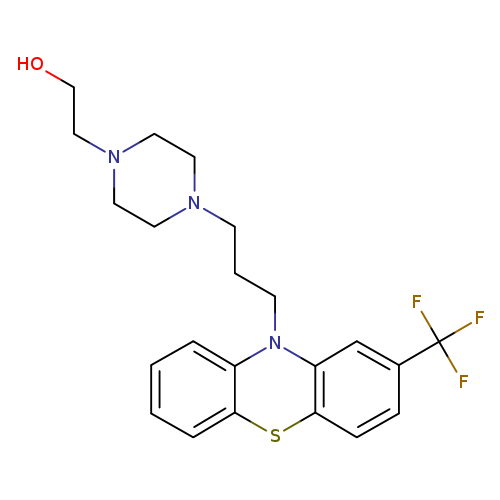
Fluphenazine (CED0004304)

Record Information
Version1.0
Creation Date2009-07-21 20:27:16 UTC
Update Date2026-05-14 16:44:23 UTC
SynCED IDCED0004304
Secondary Accession Numbers
  • CHEM002232
  • T3D2840
Identification
Common NameFluphenazine
ClassSmall Molecule
Description
Fluphenazine is an exogenous compound with the formula C22H26F3N3OS and an average molecular weight of 437.52 g/mol. It exists as a solid at room temperature. Fluphenazine belongs to the phenothiazines, a subclass of benzothiazines within the organic compounds. It is used as a phenothiazine antipsychotic drug and functions biologically as a dopaminergic antagonist. Recorded exposure routes for this compound include oral, subcutaneous, and intramuscular administration. The compound is found in several recorded sources, including healthcare, pharmaceuticals, and veterinary products as antipsychotics. Other recorded sources include food preservation and the preparation of wine or sparkling wine, household cleaning and consumer products such as tobacco smoke filters, perfumes within detergents and soaps, and non-electric simulated smoking devices, cigar cigarettes, and other smoking requisites. It is also associated with electrical and electronic equipment, including radio transmission systems, antennas, conductors or conductive bodies characterised by the conductive materials, electrically stimulated smoking devices, and superconductive or hyperconductive conductors cables or transmission lines. Fluphenazine interacts with 20 recorded protein targets, including the D(1A) dopamine receptor (DRD1) and D(2) dopamine receptor (DRD2). It blocks postsynaptic mesolimbic dopaminergic D1 and D2 receptors in the brain, depresses the release of hypothalamic and hypophyseal hormones, and is believed to depress the reticular activating system, thus affecting emesis, vasomotor tone, wakefulness, body temperature, and basal metabolism. Additionally, it acts as an inhibitor or modulator of NADPH oxidase 1 (NOX1), Muscarinic acetylcholine receptor M2 (CHRM2), ATP-dependent translocase ABCB1, and Solute carrier family 22 member 1 (SLC22A1), among 14 other proteins.
Contaminant Type
  • Amine
  • Antipsychotic Agent
  • Dopamine Antagonist
  • Drug
  • Ether
  • Human Neurotoxin
  • Metabolite
  • Organic Compound
  • Organofluoride
  • Phenothiazine
  • Synthetic Compound
Chemical Structure
Synonyms
ValueSource
1-(2-Hydroxyethyl)-4-(3-(trifluoromethyl-10-phenothiazinyl)propyl)-piperazineChEBI
10-(3'-(4''-(beta-Hydroxyethyl)-1''-piperazinyl)-propyl)-3-trifluoromethylphenothiazineChEBI
10-(3-(2-Hydroxyethyl)piperazinopropyl)-2-(trifluoromethyl)phenothiazineChEBI
2-(4-(3-[2-(Trifluoromethyl)-10H-phenothiazin-10-yl]propyl)-1-piperazinyl)ethanolChEBI
2-(Trifluoromethyl)-10-(3-(1-(beta-hydroxyethyl)-4-piperazinyl)propyl)phenothiazineChEBI
4-(3-(-Trifluoromethyl-10-phenothiazyl)-propyl)-1-piperazineethanolChEBI
4-(3-(2-(Trifluoromethyl)-10H-phenothiazin-10-yl)propyl)-1-piperazineethanolChEBI
4-(3-(2-Trifluoromethyl-10-phenothiazyl)-propyl)-1-piperazineethanolChEBI
FlufenazinaChEBI
FluorfenazineChEBI
FluorophenazineChEBI
FluorphenazineChEBI
FluphenazinumChEBI
TriflumethazineChEBI
ModitenKegg
10-(3'-(4''-(b-Hydroxyethyl)-1''-piperazinyl)-propyl)-3-trifluoromethylphenothiazineGenerator
10-(3'-(4''-(Β-hydroxyethyl)-1''-piperazinyl)-propyl)-3-trifluoromethylphenothiazineGenerator
2-(Trifluoromethyl)-10-(3-(1-(b-hydroxyethyl)-4-piperazinyl)propyl)phenothiazineGenerator
2-(Trifluoromethyl)-10-(3-(1-(β-hydroxyethyl)-4-piperazinyl)propyl)phenothiazineGenerator
Fluphenazine decanoateHMDB
Fluphenazine hydrochlorideHMDB
LyogenHMDB
ProlixinHMDB
Hydrochloride, fluphenazineHMDB
FlufenazinHMDB
Chemical FormulaC22H26F3N3OS
Average Molecular Mass437.522 g/mol
Monoisotopic Mass437.175 g/mol
CAS Registry Number69-23-8
IUPAC Name2-(4-{3-[2-(trifluoromethyl)-10H-phenothiazin-10-yl]propyl}piperazin-1-yl)ethan-1-ol
Traditional Namefluphenazine
SMILESOCCN1CCN(CCCN2C3=CC=CC=C3SC3=C2C=C(C=C3)C(F)(F)F)CC1
InChI IdentifierInChI=1S/C22H26F3N3OS/c23-22(24,25)17-6-7-21-19(16-17)28(18-4-1-2-5-20(18)30-21)9-3-8-26-10-12-27(13-11-26)14-15-29/h1-2,4-7,16,29H,3,8-15H2
InChI KeyPLDUPXSUYLZYBN-UHFFFAOYSA-N
Chemical Taxonomy
Description Belongs to the class of organic compounds known as phenothiazines. These are polycyclic aromatic compounds containing a phenothiazine moiety, which is a linear tricyclic system that consists of a two benzene rings joined by a para-thiazine ring.
KingdomOrganic compounds
Super ClassOrganoheterocyclic compounds
ClassBenzothiazines
Sub ClassPhenothiazines
Direct ParentPhenothiazines
Alternative Parents
Substituents
  • Phenothiazine
  • Alkyldiarylamine
  • Diarylthioether
  • Aryl thioether
  • Tertiary aliphatic/aromatic amine
  • N-alkylpiperazine
  • Para-thiazine
  • 1,4-diazinane
  • Benzenoid
  • Piperazine
  • 1,2-aminoalcohol
  • Tertiary aliphatic amine
  • Tertiary amine
  • Alkanolamine
  • Azacycle
  • Thioether
  • Organic nitrogen compound
  • Primary alcohol
  • Organooxygen compound
  • Organonitrogen compound
  • Organofluoride
  • Organohalogen compound
  • Hydrocarbon derivative
  • Amine
  • Alkyl halide
  • Alkyl fluoride
  • Organopnictogen compound
  • Alcohol
  • Organic oxygen compound
  • Aromatic heteropolycyclic compound
Molecular FrameworkAromatic heteropolycyclic compounds
External Descriptors
Biological Properties
StatusDetected and Not Quantified
OriginExogenous
Cellular Locations
  • Membrane
Biofluid LocationsNot Available
Tissue LocationsNot Available
Applications
Biological Roles
Chemical RolesNot Available
Organoleptic EffectsNot Available
Physical Properties
StateSolid
AppearanceWhite powder.
Experimental Properties
PropertyValue
Melting Point224-226°C (Salt)
Boiling Point268-274°C at 5.00E-01 mm Hg
Solubility31.1 mg/L (at 37°C)
Predicted Properties
PropertyValueSource
Water Solubility0.019 g/LALOGPS
logP4.4ALOGPS
logP3.97ChemAxon
logS-4.4ALOGPS
pKa (Strongest Acidic)15.59ChemAxon
pKa (Strongest Basic)8.21ChemAxon
Physiological Charge1ChemAxon
Hydrogen Acceptor Count4ChemAxon
Hydrogen Donor Count1ChemAxon
Polar Surface Area29.95 ŲChemAxon
Rotatable Bond Count7ChemAxon
Refractivity117.27 m³·mol⁻¹ChemAxon
Polarizability44.92 ųChemAxon
Number of Rings4ChemAxon
BioavailabilityYesChemAxon
Rule of FiveYesChemAxon
Ghose FilterYesChemAxon
Veber's RuleYesChemAxon
MDDR-like RuleYesChemAxon
Spectra
Spectra
Spectrum TypeDescriptionSplash KeyDeposition DateView
GC-MSGC-MS Spectrumsplash10-0bu4-9430100000-8ccf208ff236ff33462cNot AvailableView Spectrum
Predicted GC-MSPredicted GC-MS Spectrumsplash10-0a4l-5545900000-cdc372e9bc4eddfcf306Not AvailableView Spectrum
Predicted GC-MSPredicted GC-MS Spectrumsplash10-0kfx-7374900000-19e721adf0c41ac35702Not AvailableView Spectrum
Predicted GC-MSPredicted GC-MS SpectrumNot AvailableNot AvailableView Spectrum
LC-MS/MSLC-MS/MS Spectrumsplash10-014i-0190000000-cf20413d597a3759305dNot AvailableView Spectrum
LC-MS/MSLC-MS/MS Spectrumsplash10-000i-0310900000-a2a4be9e30f6506c9359Not AvailableView Spectrum
LC-MS/MSLC-MS/MS Spectrumsplash10-014i-0190000000-cf20413d597a3759305dNot AvailableView Spectrum
LC-MS/MSLC-MS/MS Spectrumsplash10-007c-0911400000-e777fb408b0f7c2a2c88Not AvailableView Spectrum
LC-MS/MSLC-MS/MS Spectrumsplash10-0udi-0000900000-f3e326fb412f9c344ad9Not AvailableView Spectrum
Predicted LC-MS/MSPredicted LC-MS/MS Spectrumsplash10-000i-0101900000-fb12e05240ff28e3f762Not AvailableView Spectrum
Predicted LC-MS/MSPredicted LC-MS/MS Spectrumsplash10-05g0-3714900000-faf32fabda604029301cNot AvailableView Spectrum
Predicted LC-MS/MSPredicted LC-MS/MS Spectrumsplash10-0a4i-7934100000-f37950a800425ffc5ec8Not AvailableView Spectrum
Predicted LC-MS/MSPredicted LC-MS/MS Spectrumsplash10-000i-0000900000-d99d8367eb6a2ea7f9a8Not AvailableView Spectrum
Predicted LC-MS/MSPredicted LC-MS/MS Spectrumsplash10-05r9-0198700000-1fae13d1c97088459b86Not AvailableView Spectrum
Predicted LC-MS/MSPredicted LC-MS/MS Spectrumsplash10-014i-4490000000-017cae32ebc88bd742e0Not AvailableView Spectrum
Predicted LC-MS/MSPredicted LC-MS/MS Spectrumsplash10-000i-0000900000-1e7f5c7b20d4dd89afecNot AvailableView Spectrum
Predicted LC-MS/MSPredicted LC-MS/MS Spectrumsplash10-000i-0201900000-1ca0886fa19d2ddcb4e2Not AvailableView Spectrum
Predicted LC-MS/MSPredicted LC-MS/MS Spectrumsplash10-02p0-2925100000-3b2029bac39308857df0Not AvailableView Spectrum
Predicted LC-MS/MSPredicted LC-MS/MS Spectrumsplash10-000i-0000900000-1cfdc24aa6524056f3c6Not AvailableView Spectrum
Predicted LC-MS/MSPredicted LC-MS/MS Spectrumsplash10-052r-0001900000-1c043e72b51e2f5a44dcNot AvailableView Spectrum
Predicted LC-MS/MSPredicted LC-MS/MS Spectrumsplash10-014i-0195100000-b2cce57b45399e5b895aNot AvailableView Spectrum
MSMS Spectrumsplash10-001i-2391100000-6928faa0b341426b2c11Not AvailableView Spectrum
Toxicity Profile
Toxicity Values
Toxicity ValueOrganismDose DescriptorRoute of ExposurePredicted or ExperimentalToxicity RatingReference
262.0 Log mg/kg [150:470]RatLD50oralpredictedNot AvailableNot Available
Toxicity / Toxin ClassNot Available
Mechanism of ToxicityFluphenazine blocks postsynaptic mesolimbic dopaminergic D1 and D2 receptors in the brain; depresses the release of hypothalamic and hypophyseal hormones and is believed to depress the reticular activating system thus affecting basal metabolism, body temperature, wakefulness, vasomotor tone, and emesis.
Carcinogenicity (IARC Classification)No indication of carcinogenicity to humans (not listed by IARC).
Minimum Risk LevelNot Available
SymptomsNot Available
TreatmentNot Available
Health Effects
Health EffectRelationshipDirectionDescriptionReference
melanomaHas Therapeutic Effect OnNot AvailableA cell type cancer that has material basis in abnormally proliferating cells derives from melanocytes which are found in skin, the bowel and the eye. (DO)PMC12297022 , PMC12297022
colon cancerHas Therapeutic Effect OnNot AvailableNot AvailablePMC12297022
triple-negative breast cancerHas Therapeutic Effect OnNot AvailableNot AvailablePMC12297022
Cell DeathAssociated With?increaseNot AvailablePMC8363839
Exposure Sources
Source IDSourceSectorReference
CEDs000010Insecticides?Insecticides are synthetic chemicals designed to control or eliminate insect pests that threaten crops and other agricultural products.Agriculture & land managementPubChem
CEDs000374Antipsychotics?Antipsychotics are a class of synthetic chemicals used primarily for the treatment of psychiatric disorders, including schizophrenia and bipolar disorder.Healthcare, pharmaceuticals & veterinary productsNot Available
CEDs000506Antennas?Antennas, commonly used in communication technologies, can be a source of synthetic chemical contamination through the materials and coatings used in their construction.Electrical & Electronic EquipmentPubChem
CEDs000511Conductors Or Conductive Bodies Characterised By The Conductive Materials?Conductors, or conductive bodies, are materials that allow the flow of electrical current, typically made from metals such as copper, aluminum, or silver.Electrical & Electronic EquipmentPubChem
CEDs000518Electrically Stimulated Smoking Devices?Electrically stimulated smoking devices, commonly known as e-cigarettes or vape pens, utilize electrical components to heat a liquid solution, often containing nicotine, flavorings, and other additives, to produce an aerosol for inhalation.Electrical & Electronic EquipmentPubChem
CEDs000530Radio Transmission Systems?Radio transmission systems utilize a variety of synthetic chemicals in their manufacturing and maintenance processes.Electrical & Electronic EquipmentPubChem
CEDs000536Superconductive Or Hyperconductive Conductors Cables Or Transmission Lines?Superconductive or hyperconductive conductors, including cables and transmission lines, are materials that exhibit zero electrical resistance under specific conditions, typically at low temperatures.Electrical & Electronic EquipmentPubChem
CEDs000537Television Systems?Television systems can be a source of synthetic chemical contamination due to the various materials and components used in their manufacture and operation.Electrical & Electronic EquipmentPubChem
CEDs000545Food Preservation?Food preservation often involves the use of synthetic chemicals, such as preservatives, flavor enhancers, and color additives, to extend shelf life and enhance the sensory qualities of food products.Food, food processing & cookwarePubChem
CEDs000549Preparation Of Wine Or Sparkling Wine?The preparation of wine or sparkling wine involves various stages, including fermentation, aging, and bottling, which can introduce potential sources of synthetic chemical contamination.Food, food processing & cookwarePubChem
CEDs000556Cigar Cigarettes?Cigar cigarettes are a source of synthetic chemical contamination due to the combustion of various tobacco blends and additives.Household cleaning & consumer productsPubChem
CEDs000559Non Electric Simulated Smoking Devices?Non-electric simulated smoking devices, often designed to mimic the experience of smoking without combustion, can be sources of synthetic chemical contamination due to the materials and chemicals used in their construction and operation.Household cleaning & consumer productsPubChem
CEDs000560Other Smoking Requisites?Other smoking requisites, including items such as lighters, matches, and rolling papers, can introduce synthetic chemical contamination through various components and additives.Household cleaning & consumer productsPubChem
CEDs000561Perfumes Within Detergents And Soaps?Perfumes within detergents and soaps are synthetic fragrance compounds added to enhance the sensory experience of cleaning products.Household cleaning & consumer productsPubChem
CEDs000569Tobacco Smoke Filters?Tobacco smoke filters are designed to reduce the inhalation of harmful substances in cigarette smoke, including tar and other particulate matter.Household cleaning & consumer productsPubChem
CEDs000580Manufacture Preparation Of Tobacco Products?The manufacture and preparation of tobacco products involve various processes that can result in the introduction of synthetic chemicals into the environment.Industrial manufacturing & chemical processingPubChem
CEDs000596Acaricides?Acaricides are synthetic chemicals specifically designed to target and control mite populations that can damage crops and plants.Agriculture & land managementPubChem
CEDs000600Herbicides And Algicides?Herbicides and algicides are synthetic chemicals primarily used to control unwanted plants and algae in various environments.Agriculture & land managementPubChem
CEDs000602Molluscicides?Molluscicides are synthetic chemicals specifically designed to control and eliminate mollusks, such as snails and slugs, which can be detrimental to crops and agricultural productivity.Agriculture & land managementPubChem
CEDs000603Nematocides?Nematocides are synthetic chemicals specifically designed to control nematodes, which are microscopic roundworms that can cause significant damage to crops and plants.Agriculture & land managementPubChem
CEDs000605Pest Repellants?Pest repellents, often formulated from synthetic chemicals, are widely used to protect crops from insect infestations and other pests.Agriculture & land managementPubChem
CEDs000606Plant Growth Regulators?Plant Growth Regulators (PGRs) are synthetic chemicals designed to influence the growth and development of plants.Agriculture & land managementPubChem
CEDs000609Aftershave?Aftershave is a grooming product typically used to soothe and protect the skin following shaving.Personal care & cosmeticsPubChem
CEDs000610Aftersun Products?Aftersun products are designed to soothe and hydrate the skin after sun exposure, often containing various synthetic chemicals such as emollients, preservatives, and fragrances.Personal care & cosmeticsPubChem
CEDs000611Anti Perspirants Or Body Deoderants?Antiperspirants and body deodorants commonly contain synthetic chemicals such as aluminum compounds, parabens, and synthetic fragrances.Personal care & cosmeticsPubChem
CEDs000613Depilatories?Depilatories are products designed to remove unwanted hair through the application of synthetic chemicals that break down the protein structure of hair, facilitating its removal.Personal care & cosmeticsPubChem
CEDs000614Essential Oils Or Perfumes?Essential oils and perfumes are complex mixtures of volatile compounds derived from natural or synthetic sources, commonly used for their aromatic properties.Personal care & cosmeticsPubChem
CEDs000615Eye Makeup Products?Eye makeup products, including mascaras, eyeliners, and eyeshadows, often contain a variety of synthetic chemicals such as pigments, preservatives, and film-forming agents.Personal care & cosmeticsPubChem
CEDs000618Lip Makeup Products?Lip makeup products, such as lipsticks, lip glosses, and lip liners, often contain a variety of synthetic chemicals, including pigments, preservatives, and emollients.Personal care & cosmeticsPubChem
CEDs000631Anthraquinone Dyes?Anthraquinone dyes are a class of synthetic organic compounds characterized by their vibrant colors and stability, making them widely used in various applications, particularly in coloring textiles and leather.Textiles, leather & furnishingsPubChem
CEDs000633Azo Dyes?Azo dyes are synthetic organic compounds characterized by the presence of one or more azo groups (-N=N-), which are widely used for coloring textiles, leather, and furnishings.Textiles, leather & furnishingsPubChem
CEDs000635Buttons?Buttons, often made from synthetic materials such as polyester, nylon, or polycarbonate, can be a source of synthetic chemical contamination during their production, use, and disposal.Textiles, leather & furnishingsPubChem
CEDs000638Decorating Textiles?Decorating textiles often involves the use of synthetic chemicals such as dyes, finishes, and coatings.Textiles, leather & furnishingsPubChem
CEDs000640Embroidering And Tufting?Embroidering and tufting processes often involve the use of synthetic chemicals such as dyes, adhesives, and finishing agents.Textiles, leather & furnishingsPubChem
CEDs000641Foam Dyeing?Foam dyeing is a textile dyeing technique that utilizes a foaming agent to create a dye solution in a gaseous form, allowing for the application of dyes onto fabrics.Textiles, leather & furnishingsPubChem
CEDs000642Footwear?Footwear production often involves the use of various synthetic chemicals, such as adhesives, dyes, and treatments, which can contribute to environmental contamination.Textiles, leather & furnishingsPubChem
CEDs000647Multicolour Dyeing?Multicolour dyeing involves the application of multiple synthetic dyes to textiles and other materials to achieve vibrant, diverse color patterns.Textiles, leather & furnishingsPubChem
CEDs000648Nitro Dyes?Nitro dyes are synthetic colorants that contain nitro groups (-NO2) in their chemical structure.Textiles, leather & furnishingsPubChem
CEDs000650Purses Luggage Hand Bags?Purses, luggage, and handbags are often manufactured using synthetic materials such as polyvinyl chloride (PVC), polyurethane, and various types of nylon.Textiles, leather & furnishingsPubChem
CEDs000651Purses Money Bags Wallets?Purses, money bags, and wallets are often manufactured using synthetic materials, including plastics, polyurethanes, and various treated fabrics.Textiles, leather & furnishingsPubChem
CEDs000655Slide Fasteners?Slide fasteners, commonly known as zippers, are mechanical devices used to join two edges of fabric or other materials.Textiles, leather & furnishingsPubChem
CEDs000659Transfer Printing?Transfer printing is a process used to apply designs and patterns onto various substrates, commonly utilizing synthetic dyes and inks that can contain hazardous chemicals.Textiles, leather & furnishingsPubChem
CEDs000662Yarns Or Threads?Yarns or threads used in textiles can be a source of synthetic chemical contamination due to the production processes and treatments they undergo.Textiles, leather & furnishingsPubChem
CEDs000671Airplanes And Helicopters?Airplanes and helicopters are significant sources of synthetic chemical contamination primarily through the use of aviation fuels, lubricants, and de-icing agents.Aviation & AerospacePubChem
CEDs000678Nitrogenous Fertilisers?Nitrogenous fertilizers are synthetic chemical compounds primarily used to enhance plant growth by supplying essential nitrogen, a crucial nutrient for photosynthesis and protein synthesis.Agriculture & land managementPubChem
CEDs000679Phosphatic Fertilisers?Phosphatic fertilizers are synthetic chemical products primarily composed of phosphorus, which is essential for plant growth.Agriculture & land managementPubChem
CEDs000685Ceramics?Ceramics can be a source of synthetic chemical contamination through various additives and processing agents used in their production.Building & ConstructionPubChem
CEDs000693Silica Glass?Silica glass, primarily composed of silicon dioxide (SiO2), is widely used in various applications, including windows, glass facades, and insulation materials.Building & ConstructionPubChem
CEDs000696Nanotechnology?Nanotechnology involves the manipulation of materials at the molecular or atomic level, typically within the range of 1 to 100 nanometers.Industrial manufacturing & chemical processingPubChem
CEDs000727Printing Machines Or Presses?Printing machines or presses commonly utilize synthetic chemicals such as inks, solvents, and cleaning agents.Paper, pulp & fiber productsPubChem
CEDs000735Explosives?Explosives are chemical compounds or mixtures designed to undergo rapid decomposition, releasing energy in the form of gas and heat.Defense & military infrastructurePubChem
CEDs000739Inks?Inks are complex mixtures composed of pigments or dyes, solvents, resins, and additives used primarily for printing and writing applications.Paper, pulp & fiber productsPubChem
CEDs000741Pigment Pastes?Pigment pastes are concentrated dispersions of pigments used to impart color and properties to materials.Paper, pulp & fiber productsPubChem
CEDs000744Water, Wastewater, & Sewage Treatment?Water, wastewater, and sewage treatment processes are critical for managing and mitigating pollutants in water systems.Wastewater, sanitation & biosolidsPubChem
CEDs02255WaterAquatic systems & sedimentsPMC5306312
Pathways
2 pathwaysPathway Source: PathBank
Targets
StructureProteinUniProt IDOrganismRelationshipDetails
Pleiotropic ABC efflux transporter of multiple drugs structureClick to view 3D structurePleiotropic ABC efflux transporter of multiple drugsP33302Saccharomyces cerevisiae S288cPredicted (SEA)
Prediction Confidence Score
0.742
Applicability Domain
1.0
Statistical Significance
1.00e-05
Supporting Reference Compounds
10
E-value
0.0778492
Sigma non-opioid intracellular receptor 1 structureClick to view 3D structureSigma non-opioid intracellular receptor 1Q99720HumansPredicted (SEA)
Prediction Confidence Score
0.7
Applicability Domain
1.0
Statistical Significance
1.80e-04
Supporting Reference Compounds
562
E-value
1.40129
Voltage-gated inwardly rectifying potassium channel KCNH2 structureClick to view 3D structureVoltage-gated inwardly rectifying potassium channel KCNH2Q12809HumansPredicted (SEA)
Prediction Confidence Score
0.699
Applicability Domain
1.0
Statistical Significance
2.80e-04
Supporting Reference Compounds
1498
E-value
2.17978
Click to view 3D structure5-hydroxytryptamine receptor 1AP19327Rattus norvegicusPredicted (SEA)
Prediction Confidence Score
0.656
Applicability Domain
1.0
Statistical Significance
6.00e-04
Supporting Reference Compounds
541
E-value
4.67095
D(2) dopamine receptor structureClick to view 3D structureD(2) dopamine receptorP14416HumansPredicted (SEA)
Prediction Confidence Score
0.634
Applicability Domain
1.0
Statistical Significance
0.0017
Supporting Reference Compounds
1103
E-value
13.3122
Alpha-2A adrenergic receptor structureClick to view 3D structureAlpha-2A adrenergic receptorP08913HumansPredicted (SEA)
Prediction Confidence Score
0.634
Applicability Domain
1.0
Statistical Significance
3.20e-04
Supporting Reference Compounds
487
E-value
2.49118
Histamine H1 receptor structureClick to view 3D structureHistamine H1 receptorP35367HumansPredicted (SEA)
Prediction Confidence Score
0.572
Applicability Domain
1.0
Statistical Significance
8.00e-04
Supporting Reference Compounds
507
E-value
6.22794
5-hydroxytryptamine receptor 2C structureClick to view 3D structure5-hydroxytryptamine receptor 2CP28335HumansPredicted (SEA)
Prediction Confidence Score
0.572
Applicability Domain
1.0
Statistical Significance
0.0013
Supporting Reference Compounds
823
E-value
10.1204
D(3) dopamine receptor structureClick to view 3D structureD(3) dopamine receptorP35462HumansPredicted (SEA)
Prediction Confidence Score
0.572
Applicability Domain
1.0
Statistical Significance
0.0023
Supporting Reference Compounds
861
E-value
17.7496
5-hydroxytryptamine receptor 2A structureClick to view 3D structure5-hydroxytryptamine receptor 2AP28223HumansPredicted (SEA)
Prediction Confidence Score
0.572
Applicability Domain
1.0
Statistical Significance
0.0018
Supporting Reference Compounds
955
E-value
14.0907
5-hydroxytryptamine receptor 6 structureClick to view 3D structure5-hydroxytryptamine receptor 6P50406HumansPredicted (SEA)
Prediction Confidence Score
0.572
Applicability Domain
1.0
Statistical Significance
7.00e-04
Supporting Reference Compounds
536
E-value
5.44945
Sodium-dependent serotonin transporter structureClick to view 3D structureSodium-dependent serotonin transporterP31645HumansPredicted (SEA)
Prediction Confidence Score
0.572
Applicability Domain
1.0
Statistical Significance
0.0011
Supporting Reference Compounds
593
E-value
8.32987
Alpha-2B adrenergic receptor structureClick to view 3D structureAlpha-2B adrenergic receptorP18089HumansPredicted (SEA)
Prediction Confidence Score
0.572
Applicability Domain
1.0
Statistical Significance
3.40e-04
Supporting Reference Compounds
340
E-value
2.64687
D(1A) dopamine receptor structureClick to view 3D structureD(1A) dopamine receptorP21728HumansPredicted (SEA)
Prediction Confidence Score
0.572
Applicability Domain
1.0
Statistical Significance
0.0011
Supporting Reference Compounds
425
E-value
8.95266
Sodium-dependent noradrenaline transporter structureClick to view 3D structureSodium-dependent noradrenaline transporterP23975HumansPredicted (SEA)
Prediction Confidence Score
0.572
Applicability Domain
1.0
Statistical Significance
4.30e-04
Supporting Reference Compounds
451
E-value
3.34752
Alpha-2C adrenergic receptor structureClick to view 3D structureAlpha-2C adrenergic receptorP18825HumansPredicted (SEA)
Prediction Confidence Score
0.572
Applicability Domain
1.0
Statistical Significance
4.00e-04
Supporting Reference Compounds
386
E-value
3.11397
5-hydroxytryptamine receptor 2B structureClick to view 3D structure5-hydroxytryptamine receptor 2BP41595HumansPredicted (SEA)
Prediction Confidence Score
0.572
Applicability Domain
1.0
Statistical Significance
7.80e-04
Supporting Reference Compounds
686
E-value
6.07224
Click to view 3D structureAlpha-1A adrenergic receptorP43140Rattus norvegicusPredicted (SEA)
Prediction Confidence Score
0.572
Applicability Domain
1.0
Statistical Significance
5.00e-04
Supporting Reference Compounds
208
E-value
3.89246
Click to view 3D structureAlpha-1D adrenergic receptorP25100HumansPredicted (SEA)
Prediction Confidence Score
0.572
Applicability Domain
1.0
Statistical Significance
4.10e-04
Supporting Reference Compounds
258
E-value
3.19182
Click to view 3D structureAlpha-1B adrenergic receptorP15823Rattus norvegicusPredicted (SEA)
Prediction Confidence Score
0.572
Applicability Domain
1.0
Statistical Significance
1.40e-04
Supporting Reference Compounds
130
E-value
1.08989
5-hydroxytryptamine receptor 7 structureClick to view 3D structure5-hydroxytryptamine receptor 7P34969HumansPredicted (SEA)
Prediction Confidence Score
0.567
Applicability Domain
1.0
Statistical Significance
0.0011
Supporting Reference Compounds
565
E-value
8.48557
Click to view 3D structure5-hydroxytryptamine receptor 1BP28564Rattus norvegicusPredicted (SEA)
Prediction Confidence Score
0.553
Applicability Domain
1.0
Statistical Significance
2.90e-04
Supporting Reference Compounds
154
E-value
2.25763
Muscarinic acetylcholine receptor M1 structureClick to view 3D structureMuscarinic acetylcholine receptor M1P11229HumansPredicted (SEA)
Prediction Confidence Score
0.547
Applicability Domain
1.0
Statistical Significance
5.80e-04
Supporting Reference Compounds
385
E-value
4.51525
Muscarinic acetylcholine receptor M2 structureClick to view 3D structureMuscarinic acetylcholine receptor M2P08172HumansPredicted (SEA)
Prediction Confidence Score
0.547
Applicability Domain
1.0
Statistical Significance
3.00e-04
Supporting Reference Compounds
373
E-value
2.33548
Muscarinic acetylcholine receptor M4 structureClick to view 3D structureMuscarinic acetylcholine receptor M4P08173HumansPredicted (SEA)
Prediction Confidence Score
0.547
Applicability Domain
1.0
Statistical Significance
3.70e-04
Supporting Reference Compounds
297
E-value
2.88042
D(2) dopamine receptor structureClick to view 3D structureD(2) dopamine receptorP14416HumansKnownFluphenazine blocks postsynaptic mesolimbic dopaminergic D1 and D2 receptors in the brain; depresses the release of hypothalamic and hypophyseal hormones and is believed to depress the reticular activating system thus affecting basal metabolism, body temperature, wakefulness, vasomotor tone, and emesis.
D(1A) dopamine receptor structureClick to view 3D structureD(1A) dopamine receptorP21728HumansKnownFluphenazine blocks postsynaptic mesolimbic dopaminergic D1 and D2 receptors in the brain; depresses the release of hypothalamic and hypophyseal hormones and is believed to depress the reticular activating system thus affecting basal metabolism, body temperature, wakefulness, vasomotor tone, and emesis.
5-hydroxytryptamine receptor 2A structureClick to view 3D structure5-hydroxytryptamine receptor 2AP28223HumansKnownNot Available
5-hydroxytryptamine receptor 2C structureClick to view 3D structure5-hydroxytryptamine receptor 2CP28335HumansKnownNot Available
D(1B) dopamine receptor structureClick to view 3D structureD(1B) dopamine receptorP21918HumansKnownNot Available
Histamine H1 receptor structureClick to view 3D structureHistamine H1 receptorP35367HumansKnownNot Available
5-hydroxytryptamine receptor 1A structureClick to view 3D structure5-hydroxytryptamine receptor 1AP08908HumansKnownNot Available
5-hydroxytryptamine receptor 6 structureClick to view 3D structure5-hydroxytryptamine receptor 6P50406HumansKnownNot Available
Alpha-2A adrenergic receptor structureClick to view 3D structureAlpha-2A adrenergic receptorP08913HumansKnownNot Available
Androgen receptor structureClick to view 3D structureAndrogen receptorP10275HumansKnownNot Available
D(3) dopamine receptor structureClick to view 3D structureD(3) dopamine receptorP35462HumansKnownNot Available
Histamine H3 receptor structureClick to view 3D structureHistamine H3 receptorQ9Y5N1HumansKnownNot Available
ATP-dependent translocase ABCB1 structureClick to view 3D structureATP-dependent translocase ABCB1P08183HumansKnownNot Available
Muscarinic acetylcholine receptor M2 structureClick to view 3D structureMuscarinic acetylcholine receptor M2P08172HumansKnownNot Available
Click to view 3D structureNADPH oxidase 1Q9Y5S8HumansKnownNot Available
Solute carrier family 22 member 1 structureClick to view 3D structureSolute carrier family 22 member 1O15245HumansKnownNot Available
Concentrations
Not Available
External Links
DrugBank IDDB00623
HMDB IDHMDB0014761
FooDB IDNot Available
Phenol Explorer IDNot Available
KNApSAcK IDNot Available
BiGG IDNot Available
BioCyc IDNot Available
METLIN IDNot Available
PDB IDNot Available
Wikipedia LinkFluphenazine
Chemspider ID3255
ChEBI ID5123
PubChem Compound ID3372
Kegg Compound IDC07010
YMDB IDNot Available
ECMDB IDNot Available
References
Synthesis Reference

Ullyot, G.E.; U.S. Patent 3,058,979; October 16, 1962; assigned to Smith Kline & French
Laboratories.

MSDSNot Available
General References
  1. Drugs.com http://www.drugs.com/cons/Fluphenazine.html