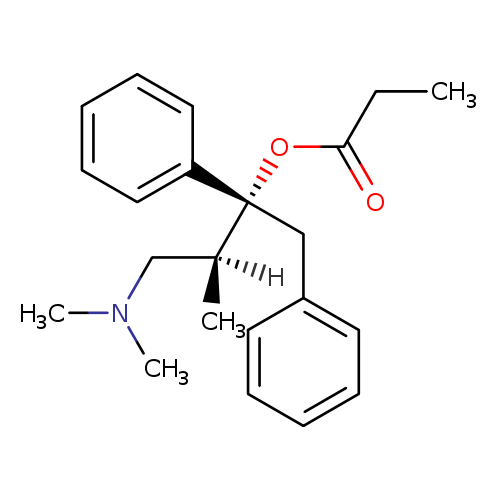
Click to view 3D structure Click to view 3D structure | Mu-type opioid receptor | P35372 | Humans | Predicted (SEA) | - Prediction Confidence Score
- 0.303
- Applicability Domain
- 0.385
- Statistical Significance
- 0.0678
- Supporting Reference Compounds
- 527
- E-value
- 528.207
|
 Click to view 3D structure Click to view 3D structure | Procathepsin L | P07711 | Humans | Predicted (SEA) | - Prediction Confidence Score
- 0.293
- Applicability Domain
- 0.317
- Statistical Significance
- 0.0314
- Supporting Reference Compounds
- 167
- E-value
- 244.68
|
 Click to view 3D structure Click to view 3D structure | Protein-glutamine gamma-glutamyltransferase | Q7M0F8 | Cavia porcellus | Predicted (SEA) | - Prediction Confidence Score
- 0.292
- Applicability Domain
- 0.309
- Statistical Significance
- 9.60e-04
- Supporting Reference Compounds
- 2
- E-value
- 7.47353
|
 Click to view 3D structure Click to view 3D structure | Cathepsin K | P43235 | Humans | Predicted (SEA) | - Prediction Confidence Score
- 0.289
- Applicability Domain
- 0.317
- Statistical Significance
- 0.0273
- Supporting Reference Compounds
- 129
- E-value
- 212.84
|
 Click to view 3D structure Click to view 3D structure | Delta-type opioid receptor | P41143 | Humans | Predicted (SEA) | - Prediction Confidence Score
- 0.287
- Applicability Domain
- 0.385
- Statistical Significance
- 0.0721
- Supporting Reference Compounds
- 427
- E-value
- 561.215
|
 Click to view 3D structure Click to view 3D structure | Voltage-gated inwardly rectifying potassium channel KCNH2 | Q12809 | Humans | Predicted (SEA) | - Prediction Confidence Score
- 0.284
- Applicability Domain
- 0.385
- Statistical Significance
- 0.2395
- Supporting Reference Compounds
- 1498
- E-value
- 1864.8
|
 Click to view 3D structure Click to view 3D structure | Sigma non-opioid intracellular receptor 1 | Q99720 | Humans | Predicted (SEA) | - Prediction Confidence Score
- 0.284
- Applicability Domain
- 0.306
- Statistical Significance
- 0.0887
- Supporting Reference Compounds
- 562
- E-value
- 690.445
|
 Click to view 3D structure Click to view 3D structure | Cathepsin S | P25774 | Humans | Predicted (SEA) | - Prediction Confidence Score
- 0.281
- Applicability Domain
- 0.29 Low confidence
- Statistical Significance
- 0.0301
- Supporting Reference Compounds
- 141
- E-value
- 234.56
|
 Click to view 3D structure Click to view 3D structure | Cathepsin B | P07858 | Humans | Predicted (SEA) | - Prediction Confidence Score
- 0.281
- Applicability Domain
- 0.317
- Statistical Significance
- 0.0385
- Supporting Reference Compounds
- 173
- E-value
- 299.642
|
 Click to view 3D structure Click to view 3D structure | Muscarinic acetylcholine receptor M2 | P08172 | Humans | Predicted (SEA) | - Prediction Confidence Score
- 0.281
- Applicability Domain
- 0.304
- Statistical Significance
- 0.0486
- Supporting Reference Compounds
- 373
- E-value
- 378.503
|
| Click to view 3D structure | Peptidyl-glycine alpha-amidating monooxygenase | P19021 | Humans | Predicted (SEA) | - Prediction Confidence Score
- 0.281
- Applicability Domain
- 0.281 Low confidence
- Statistical Significance
- 0.0084
- Supporting Reference Compounds
- 1
- E-value
- 65.3933
|
 Click to view 3D structure Click to view 3D structure | Kappa-type opioid receptor | P41145 | Humans | Predicted (SEA) | - Prediction Confidence Score
- 0.279
- Applicability Domain
- 0.385
- Statistical Significance
- 0.1005
- Supporting Reference Compounds
- 532
- E-value
- 782.774
|
 Click to view 3D structure Click to view 3D structure | D(3) dopamine receptor | P35462 | Humans | Predicted (SEA) | - Prediction Confidence Score
- 0.278
- Applicability Domain
- 0.385
- Statistical Significance
- 0.1182
- Supporting Reference Compounds
- 861
- E-value
- 920.567
|
| Click to view 3D structure | Pancreatic alpha-amylase | P00689 | Rattus norvegicus | Predicted (SEA) | - Prediction Confidence Score
- 0.277
- Applicability Domain
- 0.304
- Statistical Significance
- 5.20e-04
- Supporting Reference Compounds
- 2
- E-value
- 4.04816
|
| Click to view 3D structure | Mu-type opioid receptor | P33535 | Rattus norvegicus | Predicted (SEA) | - Prediction Confidence Score
- 0.277
- Applicability Domain
- 0.313
- Statistical Significance
- 0.0572
- Supporting Reference Compounds
- 229
- E-value
- 445.064
|
 Click to view 3D structure Click to view 3D structure | Muscarinic acetylcholine receptor M1 | P11229 | Humans | Predicted (SEA) | - Prediction Confidence Score
- 0.276
- Applicability Domain
- 0.304
- Statistical Significance
- 0.062
- Supporting Reference Compounds
- 385
- E-value
- 482.977
|
 Click to view 3D structure Click to view 3D structure | Muscarinic acetylcholine receptor M3 | P20309 | Humans | Predicted (SEA) | - Prediction Confidence Score
- 0.276
- Applicability Domain
- 0.304
- Statistical Significance
- 0.0466
- Supporting Reference Compounds
- 310
- E-value
- 362.855
|
 Click to view 3D structure Click to view 3D structure | Muscarinic acetylcholine receptor M4 | P08173 | Humans | Predicted (SEA) | - Prediction Confidence Score
- 0.276
- Applicability Domain
- 0.304
- Statistical Significance
- 0.0456
- Supporting Reference Compounds
- 297
- E-value
- 354.681
|
| Click to view 3D structure | Pol polyprotein | Q72874 | Human immunodeficiency virus 1 | Predicted (SEA) | - Prediction Confidence Score
- 0.275
- Applicability Domain
- 0.362
- Statistical Significance
- 0.0138
- Supporting Reference Compounds
- 54
- E-value
- 107.432
|
| Click to view 3D structure | Sigma non-opioid intracellular receptor 1 | Q60492 | Cavia porcellus | Predicted (SEA) | - Prediction Confidence Score
- 0.273
- Applicability Domain
- 0.313
- Statistical Significance
- 0.0638
- Supporting Reference Compounds
- 229
- E-value
- 497.067
|
 Click to view 3D structure Click to view 3D structure | ATP-dependent translocase ABCB1 | P08183 | Humans | Predicted (SEA) | - Prediction Confidence Score
- 0.273
- Applicability Domain
- 0.385
- Statistical Significance
- 0.0454
- Supporting Reference Compounds
- 139
- E-value
- 353.202
|
| Click to view 3D structure | Procathepsin L | P25975 | Bos taurus | Predicted (SEA) | - Prediction Confidence Score
- 0.271
- Applicability Domain
- 0.29 Low confidence
- Statistical Significance
- 0.0128
- Supporting Reference Compounds
- 12
- E-value
- 99.8027
|
 Click to view 3D structure Click to view 3D structure | Sodium-dependent noradrenaline transporter | P23975 | Humans | Predicted (SEA) | - Prediction Confidence Score
- 0.271
- Applicability Domain
- 0.302
- Statistical Significance
- 0.0806
- Supporting Reference Compounds
- 451
- E-value
- 627.776
|
 Click to view 3D structure Click to view 3D structure | Papain | P00784 | Carica papaya | Predicted (SEA) | - Prediction Confidence Score
- 0.27
- Applicability Domain
- 0.29 Low confidence
- Statistical Significance
- 0.0227
- Supporting Reference Compounds
- 35
- E-value
- 176.406
|
| Click to view 3D structure | Calpain-2 catalytic subunit | Q27971 | Bos taurus | Predicted (SEA) | - Prediction Confidence Score
- 0.269
- Applicability Domain
- 0.269 Low confidence
- Statistical Significance
- 0.0176
- Supporting Reference Compounds
- 1
- E-value
- 137.326
|
| Click to view 3D structure | Delta-type opioid receptor | P41143 | Humans | Known | Propoxyphene acts as a weak agonist at OP1, OP2, and OP3 opiate receptors within the central nervous system (CNS). Propoxyphene primarily affects OP3 receptors, which are coupled with G-protein receptors and function as modulators, both positive and negative, of synaptic transmission via G-proteins that activate effector proteins. Binding of the opiate stimulates the exchange of GTP for GDP on the G-protein complex. As the effector system is adenylate cyclase and cAMP located at the inner surface of the plasma membrane, opioids decrease intracellular cAMP by inhibiting adenylate cyclase. Subsequently, the release of nociceptive neurotransmitters such as substance P, GABA, dopamine, acetylcholine, and noradrenaline is inhibited. Opioids such as propoxyphene also inhibit the release of vasopressin, somatostatin, insulin, and glucagon. Opioids close N-type voltage-operated calcium channels (OP2-receptor agonist) and open calcium-dependent inwardly rectifying potassium channels (OP3 and OP1 receptor agonist). This results in hyperpolarization and reduced neuronal excitability. |
| Click to view 3D structure | Mu-type opioid receptor | P35372 | Humans | Known | Propoxyphene acts as a weak agonist at OP1, OP2, and OP3 opiate receptors within the central nervous system (CNS). Propoxyphene primarily affects OP3 receptors, which are coupled with G-protein receptors and function as modulators, both positive and negative, of synaptic transmission via G-proteins that activate effector proteins. Binding of the opiate stimulates the exchange of GTP for GDP on the G-protein complex. As the effector system is adenylate cyclase and cAMP located at the inner surface of the plasma membrane, opioids decrease intracellular cAMP by inhibiting adenylate cyclase. Subsequently, the release of nociceptive neurotransmitters such as substance P, GABA, dopamine, acetylcholine, and noradrenaline is inhibited. Opioids such as propoxyphene also inhibit the release of vasopressin, somatostatin, insulin, and glucagon. Opioids close N-type voltage-operated calcium channels (OP2-receptor agonist) and open calcium-dependent inwardly rectifying potassium channels (OP3 and OP1 receptor agonist). This results in hyperpolarization and reduced neuronal excitability. |
| Click to view 3D structure | Kappa-type opioid receptor | P41145 | Humans | Known | Propoxyphene acts as a weak agonist at OP1, OP2, and OP3 opiate receptors within the central nervous system (CNS). Propoxyphene primarily affects OP3 receptors, which are coupled with G-protein receptors and function as modulators, both positive and negative, of synaptic transmission via G-proteins that activate effector proteins. Binding of the opiate stimulates the exchange of GTP for GDP on the G-protein complex. As the effector system is adenylate cyclase and cAMP located at the inner surface of the plasma membrane, opioids decrease intracellular cAMP by inhibiting adenylate cyclase. Subsequently, the release of nociceptive neurotransmitters such as substance P, GABA, dopamine, acetylcholine, and noradrenaline is inhibited. Opioids such as propoxyphene also inhibit the release of vasopressin, somatostatin, insulin, and glucagon. Opioids close N-type voltage-operated calcium channels (OP2-receptor agonist) and open calcium-dependent inwardly rectifying potassium channels (OP3 and OP1 receptor agonist). This results in hyperpolarization and reduced neuronal excitability. |