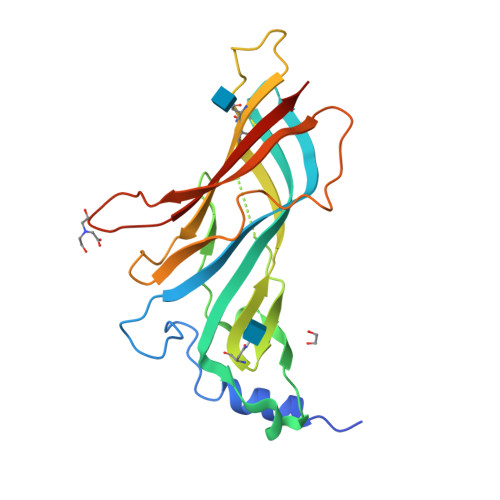
Galantamine (CED0002855)

Record Information
Version1.0
Creation Date2009-07-21 20:27:24 UTC
Update Date2026-05-14 16:45:43 UTC
SynCED IDCED0002855
Secondary Accession Numbers
  • CHEM002245
  • T3D2857
Identification
Common NameGalantamine
ClassSmall Molecule
Description
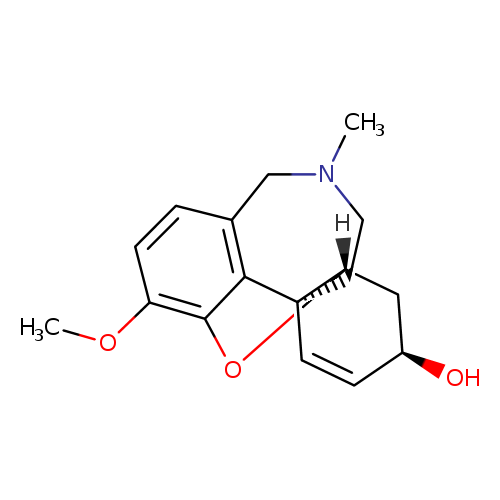
Galantamine is an exogenous solid with the formula C17H21NO3 and an average molecular weight of 287.35 g/mol. Galantamine belongs to the galanthamine-type amaryllidaceae alkaloids, a subclass of amaryllidaceae alkaloids within the organic compounds. This plant metabolite acts as a cholinergic drug and functions as an inhibitor of cholinesterase (EC 3.1.1.8) and acetylcholinesterase (EC 3.1.1.7). Its proposed mechanism of action involves increasing the concentration of acetylcholine through the reversible inhibition of its hydrolysis by acetylcholinesterase. In addition to acetylcholinesterase, it serves as an allosteric modulator of the acetylcholine receptor subunits alpha (CHRNA1), beta (CHRNB1), delta (CHRND), and gamma (CHRNG), among 14 other protein targets. Galantamine is used as an antidote to curare poisoning. It is found in 17 recorded sources across several sectors, including healthcare, pharmaceuticals and veterinary products (anti-dementia drugs and medical devices), electrical and electronic equipment (cell phones, capacitors, wires and cables, batteries, and printed circuit boards), textiles, leather and furnishings (synthetic textiles, carpets and rugs), food, food processing and cookware (food packaging), and lubricants within the energy, oil and gas and industrial manufacturing and chemical processing sectors. Recorded routes of exposure for the compound include oral, inhalation, and touch.
Contaminant Type
  • Amine
  • Cholinesterase Inhibitor
  • Drug
  • Ether
  • Human Neurotoxin
  • Metabolite
  • Nootropic Agent
  • Organic Compound
  • PFAS
  • Parasympathomimetic
  • Phytotoxin
  • Synthetic Compound
Chemical Structure
Synonyms
ValueSource
(-)-GALANTHAMINEChEBI
ReminylKegg
GalanthamineHMDB
Galanthamine hydrobromideHMDB
LycoremineHMDB
GalantaminHMDB
RazadyneHMDB
NivalinHMDB
NivalineHMDB
Ortho mcneil neurologics brand OF galantamineHMDB
Ortho-mcneil neurologics brand OF galantamineHMDB
GalantamineChEBI
Chemical FormulaC17H21NO3
Average Molecular Mass287.354 g/mol
Monoisotopic Mass287.152 g/mol
CAS Registry Number357-70-0
IUPAC Name(1S,12S,14R)-9-methoxy-4-methyl-11-oxa-4-azatetracyclo[8.6.1.0¹,¹².0⁶,¹⁷]heptadeca-6(17),7,9,15-tetraen-14-ol
Traditional Namegalantamine
SMILES[H][C@]12C[C@@H](O)C=C[C@]11CCN(C)CC3=C1C(O2)=C(OC)C=C3
InChI IdentifierInChI=1S/C17H21NO3/c1-18-8-7-17-6-5-12(19)9-14(17)21-16-13(20-2)4-3-11(10-18)15(16)17/h3-6,12,14,19H,7-10H2,1-2H3/t12-,14-,17-/m0/s1
InChI KeyASUTZQLVASHGKV-JDFRZJQESA-N
Chemical Taxonomy
Description Belongs to the class of organic compounds known as galanthamine-type amaryllidaceae alkaloids. These are amaryllidaceae alkaloids with a structure characterized a tetracyclic skeleton with two ortho aromatic protons in ring A.
KingdomOrganic compounds
Super ClassAlkaloids and derivatives
ClassAmaryllidaceae alkaloids
Sub ClassGalanthamine-type amaryllidaceae alkaloids
Direct ParentGalanthamine-type amaryllidaceae alkaloids
Alternative Parents
Substituents
  • Galanthamine-type amaryllidaceae alkaloid
  • Benzazepine
  • Coumaran
  • Anisole
  • Alkyl aryl ether
  • Azepine
  • Aralkylamine
  • Benzenoid
  • Secondary alcohol
  • Tertiary amine
  • Tertiary aliphatic amine
  • Ether
  • Oxacycle
  • Organoheterocyclic compound
  • Azacycle
  • Amine
  • Organic nitrogen compound
  • Alcohol
  • Organooxygen compound
  • Organonitrogen compound
  • Hydrocarbon derivative
  • Organopnictogen compound
  • Organic oxygen compound
  • Aromatic heteropolycyclic compound
Molecular FrameworkAromatic heteropolycyclic compounds
External Descriptors
Biological Properties
StatusDetected and Not Quantified
OriginExogenous
Cellular Locations
  • Cytoplasm
  • Extracellular
  • Membrane
Biofluid LocationsNot Available
Tissue LocationsNot Available
Applications
Biological Roles
  • EC 3.1.1.7 (acetylcholinesterase) inhibitor ?An EC 3.1.1.* (carboxylic ester hydrolase) inhibitor that interferes with the action of enzyme acetylcholinesterase (EC 3.1.1.7), which helps breaking down of acetylcholine into choline and acetic acid.
  • EC 3.1.1.8 (cholinesterase) inhibitor ?An EC 3.1.1.* (carboxylic ester hydrolase) inhibitor that interferes with the action of cholinesterase (EC 3.1.1.8).
  • plant metabolite ?Any eukaryotic metabolite produced during a metabolic reaction in plants, the kingdom that include flowering plants, conifers and other gymnosperms
  • cholinergic drug ?
Chemical Roles
Organoleptic EffectsNot Available
Physical Properties
StateSolid
AppearanceWhite powder.
Experimental Properties
PropertyValue
Melting Point269-270°C (HBr salt)
Boiling PointNot Available
Solubility10 mg/mL (HBr salt)
Predicted Properties
PropertyValueSource
Water Solubility1.7 g/LALOGPS
logP1.39ALOGPS
logP1.16ChemAxon
logS-2.2ALOGPS
pKa (Strongest Acidic)14.81ChemAxon
pKa (Strongest Basic)8.91ChemAxon
Physiological Charge1ChemAxon
Hydrogen Acceptor Count4ChemAxon
Hydrogen Donor Count1ChemAxon
Polar Surface Area41.93 ŲChemAxon
Rotatable Bond Count1ChemAxon
Refractivity82.3 m³·mol⁻¹ChemAxon
Polarizability31.4 ųChemAxon
Number of Rings4ChemAxon
BioavailabilityYesChemAxon
Rule of FiveYesChemAxon
Ghose FilterYesChemAxon
Veber's RuleNoChemAxon
MDDR-like RuleNoChemAxon
Spectra
Spectra
Spectrum TypeDescriptionSplash KeyDeposition DateView
Predicted GC-MSPredicted GC-MS Spectrumsplash10-010u-2090000000-ce0fee33e6fee456fb64Not AvailableView Spectrum
Predicted GC-MSPredicted GC-MS Spectrumsplash10-00fu-9137000000-e759a1bc34f489765011Not AvailableView Spectrum
Predicted GC-MSPredicted GC-MS SpectrumNot AvailableNot AvailableView Spectrum
LC-MS/MSLC-MS/MS Spectrumsplash10-000i-0390000000-f4f443a7f842d92dec39Not AvailableView Spectrum
LC-MS/MSLC-MS/MS Spectrumsplash10-03ei-0390000000-5f20c8cd1421554a2365Not AvailableView Spectrum
Predicted LC-MS/MSPredicted LC-MS/MS Spectrumsplash10-00dr-0090000000-c09fea1137eb040ccff3Not AvailableView Spectrum
Predicted LC-MS/MSPredicted LC-MS/MS Spectrumsplash10-00dr-1090000000-e8fc73122c750f4a8b29Not AvailableView Spectrum
Predicted LC-MS/MSPredicted LC-MS/MS Spectrumsplash10-1000-4190000000-4e6f34da3d49bbf029b4Not AvailableView Spectrum
Predicted LC-MS/MSPredicted LC-MS/MS Spectrumsplash10-000i-0090000000-d57ff615302227895e9bNot AvailableView Spectrum
Predicted LC-MS/MSPredicted LC-MS/MS Spectrumsplash10-000i-0090000000-084d311da94f251627ebNot AvailableView Spectrum
Predicted LC-MS/MSPredicted LC-MS/MS Spectrumsplash10-0w2c-1490000000-3ee999f09979ab3820f1Not AvailableView Spectrum
Predicted LC-MS/MSPredicted LC-MS/MS Spectrumsplash10-000i-0090000000-8e23f9bfe8905382513aNot AvailableView Spectrum
Predicted LC-MS/MSPredicted LC-MS/MS Spectrumsplash10-0079-0090000000-a9adf4464f8392bb18adNot AvailableView Spectrum
Predicted LC-MS/MSPredicted LC-MS/MS Spectrumsplash10-000l-1090000000-cd82eceaf8d38fd37298Not AvailableView Spectrum
Predicted LC-MS/MSPredicted LC-MS/MS Spectrumsplash10-000i-0090000000-32affc6af32f5da1d257Not AvailableView Spectrum
Predicted LC-MS/MSPredicted LC-MS/MS Spectrumsplash10-000i-0090000000-6b6acbca4d5713d4973fNot AvailableView Spectrum
Predicted LC-MS/MSPredicted LC-MS/MS Spectrumsplash10-02u3-0090000000-5c86743e445ac6cabb6aNot AvailableView Spectrum
MSMS Spectrumsplash10-000l-5980000000-928ad889466b6a2b3827Not AvailableView Spectrum
Toxicity Profile
Toxicity Values
Toxicity ValueOrganismDose DescriptorRoute of ExposurePredicted or ExperimentalToxicity RatingReference
75.0 mg/kg RatLD50Not AvailableexperimentalNot Available1
153.0 Log mg/kg [90:270]RatLD50oralpredictedNot AvailableNot Available
Toxicity / Toxin ClassNot Available
Mechanism of ToxicityGalantamine is a cholinesterase or acetylcholinesterase (AChE) inhibitor. A cholinesterase inhibitor (or 'anticholinesterase') suppresses the action of acetylcholinesterase. Because of its essential function, chemicals that interfere with the action of acetylcholinesterase are potent neurotoxins, causing excessive salivation and eye-watering in low doses, followed by muscle spasms and ultimately death. Nerve gases and many substances used in insecticides have been shown to act by binding a serine in the active site of acetylcholine esterase, inhibiting the enzyme completely. Acetylcholine esterase breaks down the neurotransmitter acetylcholine, which is released at nerve and muscle junctions, in order to allow the muscle or organ to relax. The result of acetylcholine esterase inhibition is that acetylcholine builds up and continues to act so that any nerve impulses are continually transmitted and muscle contractions do not stop. Among the most common acetylcholinesterase inhibitors are phosphorus-based compounds, which are designed to bind to the active site of the enzyme. The structural requirements are a phosphorus atom bearing two lipophilic groups, a leaving group (such as a halide or thiocyanate), and a terminal oxygen.
Carcinogenicity (IARC Classification)No indication of carcinogenicity to humans (not listed by IARC).
Minimum Risk LevelNot Available
SymptomsSymptoms of low dose exposure include excessive salivation and eye-watering. Acute dose symptoms include severe nausea/vomiting, salivation, sweating, bradycardia, hypotension, collapse, and convulsions. Increasing muscle weakness is a possibility and may result in death if respiratory muscles are involved. Hypertension, hypoglycemia, anxiety, headache, tremor and ataxia may also result.
TreatmentIf the compound has been ingested, rapid gastric lavage should be performed using 5% sodium bicarbonate. For skin contact, the skin should be washed with soap and water. If the compound has entered the eyes, they should be washed with large quantities of isotonic saline or water. In serious cases, atropine and/or pralidoxime should be administered. Anti-cholinergic drugs work to counteract the effects of excess acetylcholine and reactivate AChE. Atropine can be used as an antidote in conjunction with pralidoxime or other pyridinium oximes (such as trimedoxime or obidoxime), though the use of '-oximes' has been found to be of no benefit, or possibly harmful, in at least two meta-analyses. Atropine is a muscarinic antagonist, and thus blocks the action of acetylcholine peripherally.
Health Effects
Health EffectRelationshipDirectionReference
Exposure Sources
Source IDSourceSectorReference
CEDs000007Pesticides?Pesticides are synthetic chemicals designed to prevent, destroy, or control pests that threaten crops and agricultural productivity.Agriculture & land managementNot Available
CEDs000120Wires and cables?Wires and cables are integral components in the transmission of electrical power and signals.Electrical & Electronic EquipmentNot Available
CEDs000121Printed circuit boards?Printed circuit boards (PCBs) are essential components in the manufacturing of electronic devices, serving as the backbone for electrical connections and circuit pathways.Electrical & Electronic EquipmentNot Available
CEDs000125Batteries?Batteries are devices that store and release electrical energy through electrochemical reactions.Electrical & Electronic EquipmentNot Available
CEDs000130Semiconductors?Semiconductors are materials that possess electrical conductivity between that of conductors and insulators, making them essential for various electronic applications, including transistors, diodes, and integrated circuits.Electrical & Electronic EquipmentNot Available
CEDs000138Lubricants?Lubricants are synthetic or petroleum-derived substances used to reduce friction between surfaces in machinery and equipment, enhancing operational efficiency and longevity.Energy, oil & gasNot Available
CEDs000147Food packaging?Food packaging often utilizes synthetic chemicals, such as plastics and coatings, to enhance durability, moisture resistance, and shelf life.Food, food processing & cookwareNot Available
CEDs000174Lubricants?Lubricants are synthetic or petroleum-based substances used to reduce friction and wear between moving parts in machinery and equipment.Industrial manufacturing & chemical processingNot Available
CEDs000234Medical devices?Medical devices often incorporate synthetic chemicals in their manufacturing processes, which can contribute to contamination in healthcare settings.Healthcare, pharmaceuticals & veterinary productsNot Available
CEDs000380Anti-dementia drugs?Anti-dementia drugs, primarily used to manage symptoms of cognitive decline in conditions such as Alzheimer's disease, include cholinesterase inhibitors and NMDA receptor antagonists.Healthcare, pharmaceuticals & veterinary productsNot Available
CEDs000451Carpets and Rugs?Carpets and rugs are commonly manufactured using synthetic fibers such as nylon, polyester, and polypropylene, which can be derived from petrochemical sources.Textiles, leather & furnishingsNot Available
CEDs000454Synthetic textiles?Synthetic textiles are materials derived from man-made fibers, such as polyester, nylon, and acrylic, which are produced through chemical processes involving petrochemicals.Textiles, leather & furnishingsNot Available
CEDs000490Personal care & cosmeticsNot Available
CEDs000492Cell phones?Cell phones contain a variety of synthetic chemicals and materials, including plastics, metals, and glass, which can contribute to environmental contamination.Electrical & Electronic EquipmentNot Available
CEDs000493Capacitors?Capacitors are electronic components that store and release electrical energy, often using dielectric materials that can include synthetic chemicals.Electrical & Electronic EquipmentNot Available
CEDs000497Floors?Floors in built environments can be a significant source of synthetic chemical contamination due to the materials and finishes used in their construction.Building & ConstructionNot Available
CEDs000505Amplifiers?Amplifiers, commonly used in various electronic devices to enhance signal strength, can be a source of synthetic chemical contamination due to the materials and processes involved in their production and disposal.Electrical & Electronic EquipmentNot Available
CEDs000506Antennas?Antennas, commonly used in communication technologies, can be a source of synthetic chemical contamination through the materials and coatings used in their construction.Electrical & Electronic EquipmentNot Available
CEDs000671Airplanes And Helicopters?Airplanes and helicopters are significant sources of synthetic chemical contamination primarily through the use of aviation fuels, lubricants, and de-icing agents.Aviation & AerospaceNot Available
CEDs000685Ceramics?Ceramics can be a source of synthetic chemical contamination through various additives and processing agents used in their production.Building & ConstructionNot Available
CEDs000696Nanotechnology?Nanotechnology involves the manipulation of materials at the molecular or atomic level, typically within the range of 1 to 100 nanometers.Industrial manufacturing & chemical processingNot Available
CEDs000735Explosives?Explosives are chemical compounds or mixtures designed to undergo rapid decomposition, releasing energy in the form of gas and heat.Defense & military infrastructureNot Available
CEDs000740Paper?Paper production involves the processing of wood fibers and the use of various chemicals, which can lead to synthetic chemical contamination.Paper, pulp & fiber productsNot Available
CEDs000743Sludge Treatment?Sludge treatment involves the processing of waste materials generated from wastewater treatment plants, which often contain a variety of organic and inorganic substances.Wastewater, sanitation & biosolidsNot Available
CEDs000744Water, Wastewater, & Sewage Treatment?Water, wastewater, and sewage treatment processes are critical for managing and mitigating pollutants in water systems.Wastewater, sanitation & biosolidsNot Available
Pathways
2 pathwaysPathway Source: PathBank
Targets
StructureProteinUniProt IDOrganismRelationshipDetails
Acetylcholinesterase structureClick to view 3D structureAcetylcholinesteraseP22303HumansPredicted (SEA)
Prediction Confidence Score
0.696
Applicability Domain
1.0
Statistical Significance
3.80e-04
Supporting Reference Compounds
406
E-value
2.95827
Click to view 3D structureAcetylcholinesteraseO42275Electrophorus electricusPredicted (SEA)
Prediction Confidence Score
0.629
Applicability Domain
1.0
Statistical Significance
2.80e-04
Supporting Reference Compounds
206
E-value
2.17978
Acetylcholinesterase structureClick to view 3D structureAcetylcholinesteraseP04058Torpedo californicaPredicted (SEA)
Prediction Confidence Score
0.611
Applicability Domain
1.0
Statistical Significance
3.00e-05
Supporting Reference Compounds
30
E-value
0.233548
Click to view 3D structureCholinesteraseP81908Equus caballusPredicted (SEA)
Prediction Confidence Score
0.527
Applicability Domain
1.0
Statistical Significance
0.0014
Supporting Reference Compounds
201
E-value
11.2881
Click to view 3D structureAcetylcholinesteraseP37136Rattus norvegicusPredicted (SEA)
Prediction Confidence Score
0.512
Applicability Domain
1.0
Statistical Significance
0.0012
Supporting Reference Compounds
95
E-value
9.57545
Cholinesterase structureClick to view 3D structureCholinesteraseP06276HumansPredicted (SEA)
Prediction Confidence Score
0.349
Applicability Domain
1.0
Statistical Significance
0.009
Supporting Reference Compounds
234
E-value
69.7529
Click to view 3D structureButyrylcholinesteraseQ9N1N9Equus caballusPredicted (SEA)
Prediction Confidence Score
0.347
Applicability Domain
1.0
Statistical Significance
0.0023
Supporting Reference Compounds
44
E-value
18.2167
Acetylcholinesterase structureClick to view 3D structureAcetylcholinesteraseP21836Mus musculusPredicted (SEA)
Prediction Confidence Score
0.346
Applicability Domain
1.0
Statistical Significance
0.0045
Supporting Reference Compounds
58
E-value
35.0322
Click to view 3D structureButyrylcholinesteraseQ9JKC1Rattus norvegicusPredicted (SEA)
Prediction Confidence Score
0.345
Applicability Domain
1.0
Statistical Significance
0.0028
Supporting Reference Compounds
32
E-value
21.7978
Click to view 3D structureAcetylcholinesteraseP23795Bos taurusPredicted (SEA)
Prediction Confidence Score
0.343
Applicability Domain
1.0
Statistical Significance
0.0023
Supporting Reference Compounds
50
E-value
18.2946
Mu-type opioid receptor structureClick to view 3D structureMu-type opioid receptorP35372HumansPredicted (SEA)
Prediction Confidence Score
0.337
Applicability Domain
0.4
Statistical Significance
0.0422
Supporting Reference Compounds
527
E-value
328.679
Delta-type opioid receptor structureClick to view 3D structureDelta-type opioid receptorP41143HumansPredicted (SEA)
Prediction Confidence Score
0.337
Applicability Domain
0.4
Statistical Significance
0.0384
Supporting Reference Compounds
427
E-value
298.863
Glutamate receptor ionotropic, NMDA 2B structureClick to view 3D structureGlutamate receptor ionotropic, NMDA 2BQ00960Rattus norvegicusPredicted (SEA)
Prediction Confidence Score
0.318
Applicability Domain
0.579
Statistical Significance
0.0019
Supporting Reference Compounds
36
E-value
14.7914
Mu-type opioid receptor structureClick to view 3D structureMu-type opioid receptorP42866Mus musculusPredicted (SEA)
Prediction Confidence Score
0.316
Applicability Domain
0.4
Statistical Significance
0.0217
Supporting Reference Compounds
107
E-value
168.933
Click to view 3D structureDelta-type opioid receptorP33533Rattus norvegicusPredicted (SEA)
Prediction Confidence Score
0.305
Applicability Domain
0.375
Statistical Significance
0.0366
Supporting Reference Compounds
164
E-value
285.162
Click to view 3D structureMu-type opioid receptorP33535Rattus norvegicusPredicted (SEA)
Prediction Confidence Score
0.297
Applicability Domain
0.375
Statistical Significance
0.0456
Supporting Reference Compounds
229
E-value
355.304
Kappa-type opioid receptor structureClick to view 3D structureKappa-type opioid receptorP41145HumansPredicted (SEA)
Prediction Confidence Score
0.296
Applicability Domain
0.325
Statistical Significance
0.0703
Supporting Reference Compounds
532
E-value
547.047
Click to view 3D structureKappa-type opioid receptorP41144Cavia porcellusPredicted (SEA)
Prediction Confidence Score
0.294
Applicability Domain
0.375
Statistical Significance
0.0405
Supporting Reference Compounds
199
E-value
315.679
Click to view 3D structureKappa-type opioid receptorP34975Rattus norvegicusPredicted (SEA)
Prediction Confidence Score
0.275
Applicability Domain
0.375
Statistical Significance
0.0375
Supporting Reference Compounds
66
E-value
292.012
Sigma non-opioid intracellular receptor 1 structureClick to view 3D structureSigma non-opioid intracellular receptor 1Q99720HumansPredicted (SEA)
Prediction Confidence Score
0.269
Applicability Domain
0.375
Statistical Significance
0.1264
Supporting Reference Compounds
562
E-value
983.781
Voltage-gated inwardly rectifying potassium channel KCNH2 structureClick to view 3D structureVoltage-gated inwardly rectifying potassium channel KCNH2Q12809HumansPredicted (SEA)
Prediction Confidence Score
0.267
Applicability Domain
0.375
Statistical Significance
0.369
Supporting Reference Compounds
1498
E-value
2872.87
Click to view 3D structureMu-type opioid receptorP97266Cavia porcellusPredicted (SEA)
Prediction Confidence Score
0.264
Applicability Domain
0.274 Low confidence
Statistical Significance
0.058
Supporting Reference Compounds
186
E-value
451.214
Click to view 3D structureKappa-type opioid receptorP33534Mus musculusPredicted (SEA)
Prediction Confidence Score
0.259
Applicability Domain
0.28 Low confidence
Statistical Significance
0.032
Supporting Reference Compounds
61
E-value
249.195
5-hydroxytryptamine receptor 1A structureClick to view 3D structure5-hydroxytryptamine receptor 1AP08908HumansPredicted (SEA)
Prediction Confidence Score
0.255
Applicability Domain
0.261 Low confidence
Statistical Significance
0.2323
Supporting Reference Compounds
953
E-value
1808.52
Delta-type opioid receptor structureClick to view 3D structureDelta-type opioid receptorP32300Mus musculusPredicted (SEA)
Prediction Confidence Score
0.249
Applicability Domain
0.27 Low confidence
Statistical Significance
0.0636
Supporting Reference Compounds
166
E-value
495.277
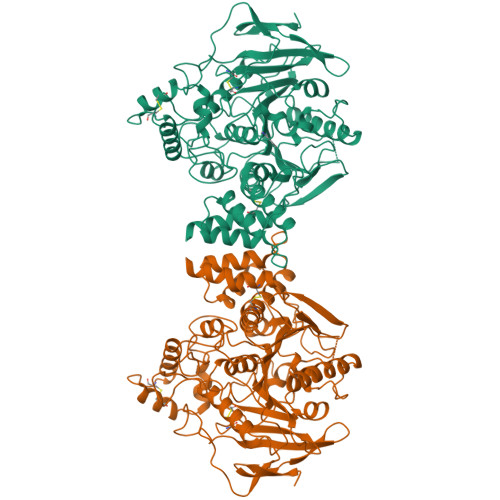
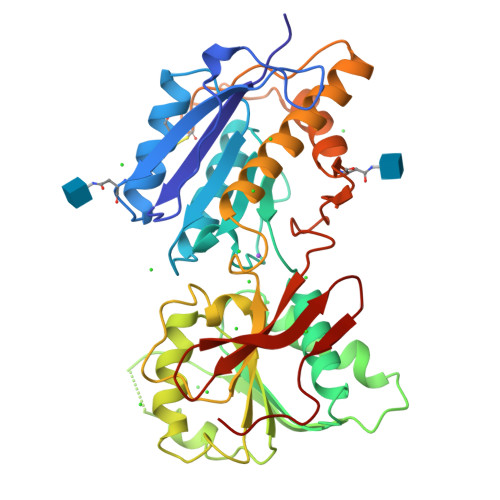
Acetylcholinesterase structureClick to view 3D structureAcetylcholinesteraseP22303HumansKnownGalantamine's proposed mechanism of action involves the increase of the concentration of acetylcholine through reversible inhibition of its hydrolysis by acetylcholinesterase.
Acetylcholine receptor subunit alpha structureClick to view 3D structureAcetylcholine receptor subunit alphaP02708HumansKnownNot Available
Click to view 3D structureAcetylcholine receptor subunit betaP11230HumansKnownNot Available
Click to view 3D structureAcetylcholine receptor subunit deltaQ07001HumansKnownNot Available
Click to view 3D structureAcetylcholine receptor subunit epsilonQ04844HumansKnownNot Available
Click to view 3D structureAcetylcholine receptor subunit gammaP07510HumansKnownNot Available
Click to view 3D structureNeuronal acetylcholine receptor subunit alpha-10Q9GZZ6HumansKnownNot Available
Neuronal acetylcholine receptor subunit alpha-2 structureClick to view 3D structureNeuronal acetylcholine receptor subunit alpha-2Q15822HumansKnownNot Available
Neuronal acetylcholine receptor subunit alpha-3 structureClick to view 3D structureNeuronal acetylcholine receptor subunit alpha-3P32297HumansKnownNot Available
Neuronal acetylcholine receptor subunit alpha-4 structureClick to view 3D structureNeuronal acetylcholine receptor subunit alpha-4P43681HumansKnownNot Available
Click to view 3D structureNeuronal acetylcholine receptor subunit alpha-5P30532HumansKnownNot Available
Click to view 3D structureNeuronal acetylcholine receptor subunit alpha-6Q15825HumansKnownNot Available
Neuronal acetylcholine receptor subunit alpha-7 structureClick to view 3D structureNeuronal acetylcholine receptor subunit alpha-7P36544HumansKnownNot Available
Neuronal acetylcholine receptor subunit alpha-9 structureClick to view 3D structureNeuronal acetylcholine receptor subunit alpha-9Q9UGM1HumansKnownNot Available
Neuronal acetylcholine receptor subunit beta-2 structureClick to view 3D structureNeuronal acetylcholine receptor subunit beta-2P17787HumansKnownNot Available
Neuronal acetylcholine receptor subunit beta-3 structureClick to view 3D structureNeuronal acetylcholine receptor subunit beta-3Q05901HumansKnownNot Available
Neuronal acetylcholine receptor subunit beta-4 structureClick to view 3D structureNeuronal acetylcholine receptor subunit beta-4P30926HumansKnownNot Available
Cholinesterase structureClick to view 3D structureCholinesteraseP06276HumansKnownNot Available
Acetylcholinesterase structureClick to view 3D structureAcetylcholinesteraseP22303HumansKnownGalantamine's proposed mechanism of action involves the increase of the concentration of acetylcholine through reversible inhibition of its hydrolysis by acetylcholinesterase.
Concentrations
Not Available
External Links
DrugBank IDDB00674
HMDB IDHMDB0014812
FooDB IDNot Available
Phenol Explorer IDNot Available
KNApSAcK IDC00001570
BiGG IDNot Available
BioCyc IDNot Available
METLIN IDNot Available
PDB IDNot Available
Wikipedia LinkGalantamine
Chemspider ID9272
ChEBI ID42944
PubChem Compound ID9651
Kegg Compound IDC08526
YMDB IDNot Available
ECMDB IDNot Available
References
Synthesis Reference

Vijaya Bolugoddu, Sanjay Shukla, Mukunda Jambula, Rajeshwar Sagyam, Ramchandra Pingili, Ananda Thirunavakarasu, “Preparation of (-)-galantamine hydrobromide.” U.S. Patent US20060009640, issued January 12, 2006.

MSDSLink
General References
  1. Wishart DS, Knox C, Guo AC, Cheng D, Shrivastava S, Tzur D, Gautam B, Hassanali M: DrugBank: a knowledgebase for drugs, drug actions and drug targets. Nucleic Acids Res. 2008 Jan;36(Database issue):D901-6. Epub 2007 Nov 29. [PubMed: 18048412]
  2. Scott LJ, Goa KL: Galantamine: a review of its use in Alzheimer's disease. Drugs. 2000 Nov;60(5):1095-122. [PubMed: 11129124]
  3. Greenblatt HM, Kryger G, Lewis T, Silman I, Sussman JL: Structure of acetylcholinesterase complexed with (-)-galanthamine at 2.3 A resolution. FEBS Lett. 1999 Dec 17;463(3):321-6. [PubMed: 10606746]
  4. Woodruff-Pak DS, Vogel RW 3rd, Wenk GL: Galantamine: effect on nicotinic receptor binding, acetylcholinesterase inhibition, and learning. Proc Natl Acad Sci U S A. 2001 Feb 13;98(4):2089-94. Epub 2001 Feb 6. [PubMed: 11172080]
  5. Birks J: Cholinesterase inhibitors for Alzheimer's disease. Cochrane Database Syst Rev. 2006 Jan 25;(1):CD005593. [PubMed: 16437532]
  6. Olin J, Schneider L: Galantamine for Alzheimer's disease. Cochrane Database Syst Rev. 2002;(3):CD001747. [PubMed: 12137632]
  7. Drugs.com - http://www.drugs.com/cons/Galantamine.html