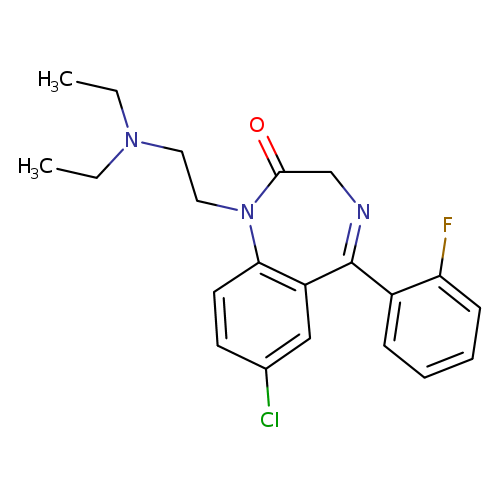
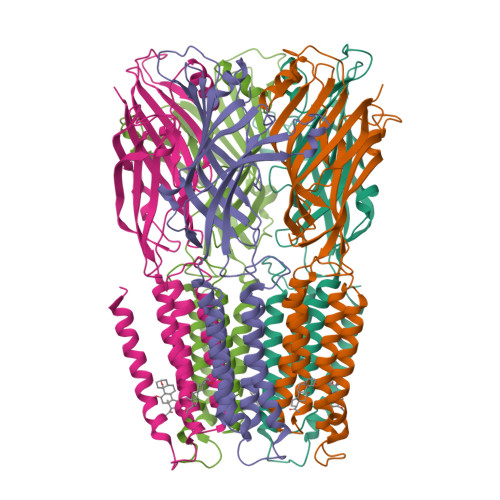
 Click to view 3D structure Click to view 3D structure | Gamma-aminobutyric acid receptor subunit alpha-1 | P14867 | Humans | Predicted (SEA) | - Prediction Confidence Score
- 0.332
- Applicability Domain
- 0.492
- Statistical Significance
- 1.50e-04
- Supporting Reference Compounds
- 43
- E-value
- 1.16774
|
 Click to view 3D structure Click to view 3D structure | Translocator protein | P16257 | Rattus norvegicus | Predicted (SEA) | - Prediction Confidence Score
- 0.326
- Applicability Domain
- 0.508
- Statistical Significance
- 4.30e-04
- Supporting Reference Compounds
- 34
- E-value
- 3.34752
|
 Click to view 3D structure Click to view 3D structure | Cytochrome P450 3A4 | P08684 | Humans | Predicted (SEA) | - Prediction Confidence Score
- 0.322
- Applicability Domain
- 0.508
- Statistical Significance
- 0.0992
- Supporting Reference Compounds
- 1538
- E-value
- 772.576
|
| Click to view 3D structure | Cholinesterase | P81908 | Equus caballus | Predicted (SEA) | - Prediction Confidence Score
- 0.32
- Applicability Domain
- 0.492
- Statistical Significance
- 0.0167
- Supporting Reference Compounds
- 201
- E-value
- 130.164
|
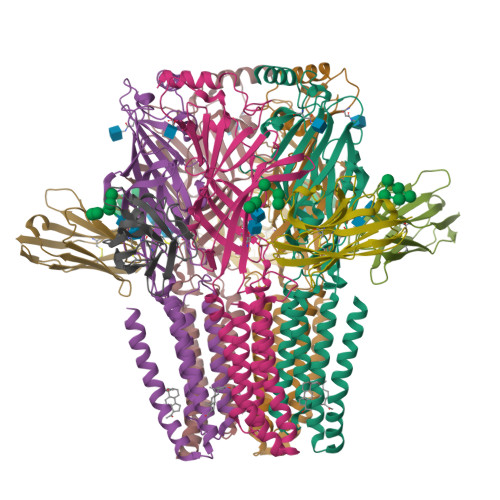 Click to view 3D structure Click to view 3D structure | Gamma-aminobutyric acid receptor subunit alpha-5 | P31644 | Humans | Predicted (SEA) | - Prediction Confidence Score
- 0.312
- Applicability Domain
- 0.492
- Statistical Significance
- 3.30e-04
- Supporting Reference Compounds
- 14
- E-value
- 2.56902
|
| Click to view 3D structure | Translocator protein | P30535 | Bos taurus | Predicted (SEA) | - Prediction Confidence Score
- 0.305
- Applicability Domain
- 0.492
- Statistical Significance
- 3.00e-05
- Supporting Reference Compounds
- 2
- E-value
- 0.233548
|
 Click to view 3D structure Click to view 3D structure | Gamma-aminobutyric acid receptor subunit alpha-2 | P47869 | Humans | Predicted (SEA) | - Prediction Confidence Score
- 0.303
- Applicability Domain
- 0.492
- Statistical Significance
- 9.00e-05
- Supporting Reference Compounds
- 14
- E-value
- 0.700643
|
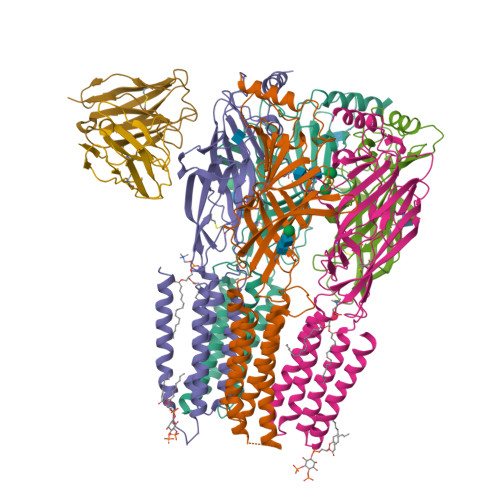 Click to view 3D structure Click to view 3D structure | Gamma-aminobutyric acid receptor subunit alpha-3 | P34903 | Humans | Predicted (SEA) | - Prediction Confidence Score
- 0.303
- Applicability Domain
- 0.492
- Statistical Significance
- 9.00e-05
- Supporting Reference Compounds
- 13
- E-value
- 0.700643
|
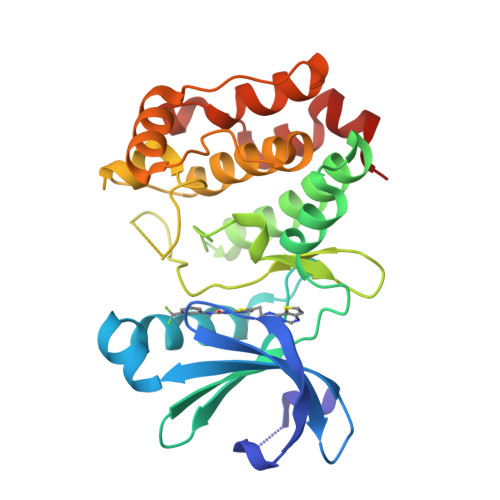 Click to view 3D structure Click to view 3D structure | Aurora kinase A | P97477 | Mus musculus | Predicted (SEA) | - Prediction Confidence Score
- 0.302
- Applicability Domain
- 0.397
- Statistical Significance
- 1.30e-04
- Supporting Reference Compounds
- 4
- E-value
- 1.01204
|
 Click to view 3D structure Click to view 3D structure | Aurora kinase A | O14965 | Humans | Predicted (SEA) | - Prediction Confidence Score
- 0.295
- Applicability Domain
- 0.397
- Statistical Significance
- 0.1272
- Supporting Reference Compounds
- 996
- E-value
- 990.631
|
 Click to view 3D structure Click to view 3D structure | Aurora kinase B | Q96GD4 | Humans | Predicted (SEA) | - Prediction Confidence Score
- 0.295
- Applicability Domain
- 0.397
- Statistical Significance
- 0.1284
- Supporting Reference Compounds
- 1017
- E-value
- 999.74
|
| Click to view 3D structure | Acetylcholinesterase | O42275 | Electrophorus electricus | Predicted (SEA) | - Prediction Confidence Score
- 0.293
- Applicability Domain
- 0.323
- Statistical Significance
- 0.0289
- Supporting Reference Compounds
- 206
- E-value
- 224.984
|
| Click to view 3D structure | Acetylcholinesterase | P37136 | Rattus norvegicus | Predicted (SEA) | - Prediction Confidence Score
- 0.293
- Applicability Domain
- 0.323
- Statistical Significance
- 0.0147
- Supporting Reference Compounds
- 95
- E-value
- 114.438
|
 Click to view 3D structure Click to view 3D structure | Acetylcholinesterase | P22303 | Humans | Predicted (SEA) | - Prediction Confidence Score
- 0.29
- Applicability Domain
- 0.323
- Statistical Significance
- 0.053
- Supporting Reference Compounds
- 406
- E-value
- 412.445
|
 Click to view 3D structure Click to view 3D structure | Solute carrier family 22 member 1 | O15245 | Humans | Predicted (SEA) | - Prediction Confidence Score
- 0.286
- Applicability Domain
- 0.508
- Statistical Significance
- 7.00e-04
- Supporting Reference Compounds
- 30
- E-value
- 5.44945
|
 Click to view 3D structure Click to view 3D structure | Muscarinic acetylcholine receptor M1 | P11229 | Humans | Predicted (SEA) | - Prediction Confidence Score
- 0.285
- Applicability Domain
- 0.324
- Statistical Significance
- 0.0467
- Supporting Reference Compounds
- 385
- E-value
- 363.789
|
 Click to view 3D structure Click to view 3D structure | Kappa-type opioid receptor | P41145 | Humans | Predicted (SEA) | - Prediction Confidence Score
- 0.284
- Applicability Domain
- 0.333
- Statistical Significance
- 0.0886
- Supporting Reference Compounds
- 532
- E-value
- 689.511
|
 Click to view 3D structure Click to view 3D structure | Delta-type opioid receptor | P41143 | Humans | Predicted (SEA) | - Prediction Confidence Score
- 0.284
- Applicability Domain
- 0.333
- Statistical Significance
- 0.0754
- Supporting Reference Compounds
- 427
- E-value
- 586.983
|
![Amine oxidase [flavin-containing] B structure](https://cdn.rcsb.org/images/structures/1gos_assembly-1.jpeg) Click to view 3D structure Click to view 3D structure | Amine oxidase [flavin-containing] B | P27338 | Humans | Predicted (SEA) | - Prediction Confidence Score
- 0.282
- Applicability Domain
- 0.323
- Statistical Significance
- 0.0534
- Supporting Reference Compounds
- 315
- E-value
- 416.026
|
 Click to view 3D structure Click to view 3D structure | Histamine H1 receptor | P35367 | Humans | Predicted (SEA) | - Prediction Confidence Score
- 0.282
- Applicability Domain
- 0.294 Low confidence
- Statistical Significance
- 0.0768
- Supporting Reference Compounds
- 507
- E-value
- 597.726
|
 Click to view 3D structure Click to view 3D structure | Serine/threonine-protein kinase PAK 1 | Q13153 | Humans | Predicted (SEA) | - Prediction Confidence Score
- 0.281
- Applicability Domain
- 0.338
- Statistical Significance
- 0.1183
- Supporting Reference Compounds
- 595
- E-value
- 921.112
|
 Click to view 3D structure Click to view 3D structure | Muscarinic acetylcholine receptor M5 | P08912 | Humans | Predicted (SEA) | - Prediction Confidence Score
- 0.281
- Applicability Domain
- 0.324
- Statistical Significance
- 0.0352
- Supporting Reference Compounds
- 266
- E-value
- 273.874
|
 Click to view 3D structure Click to view 3D structure | 5-hydroxytryptamine receptor 2B | P41595 | Humans | Predicted (SEA) | - Prediction Confidence Score
- 0.278
- Applicability Domain
- 0.3
- Statistical Significance
- 0.0948
- Supporting Reference Compounds
- 686
- E-value
- 738.4
|
 Click to view 3D structure Click to view 3D structure | 5-hydroxytryptamine receptor 2A | P28223 | Humans | Predicted (SEA) | - Prediction Confidence Score
- 0.277
- Applicability Domain
- 0.294 Low confidence
- Statistical Significance
- 0.1435
- Supporting Reference Compounds
- 955
- E-value
- 1116.82
|
 Click to view 3D structure Click to view 3D structure | 5-hydroxytryptamine receptor 6 | P50406 | Humans | Predicted (SEA) | - Prediction Confidence Score
- 0.276
- Applicability Domain
- 0.294 Low confidence
- Statistical Significance
- 0.0792
- Supporting Reference Compounds
- 536
- E-value
- 616.488
|
| Click to view 3D structure | Gamma-aminobutyric acid receptor subunit alpha-2 | P47869 | Humans | Known | Benzodiazepines bind nonspecifically to bezodiazepine receptors BNZ1, which mediates sleep, and BNZ2, which affects affects muscle relaxation, anticonvulsant activity, motor coordination, and memory. As benzodiazepine receptors are thought to be coupled to gamma-aminobutyric acid-A (GABAA) receptors, this enhances the effects of GABA by increasing GABA affinity for the GABA receptor. Binding of GABA to the site opens the chloride channel, resulting in a hyperpolarized cell membrane that prevents further excitation of the cell. |
| Click to view 3D structure | Gamma-aminobutyric acid receptor subunit alpha-3 | P34903 | Humans | Known | Benzodiazepines bind nonspecifically to bezodiazepine receptors BNZ1, which mediates sleep, and BNZ2, which affects affects muscle relaxation, anticonvulsant activity, motor coordination, and memory. As benzodiazepine receptors are thought to be coupled to gamma-aminobutyric acid-A (GABAA) receptors, this enhances the effects of GABA by increasing GABA affinity for the GABA receptor. Binding of GABA to the site opens the chloride channel, resulting in a hyperpolarized cell membrane that prevents further excitation of the cell. |
| Click to view 3D structure | Gamma-aminobutyric acid receptor subunit alpha-5 | P31644 | Humans | Known | Benzodiazepines bind nonspecifically to bezodiazepine receptors BNZ1, which mediates sleep, and BNZ2, which affects affects muscle relaxation, anticonvulsant activity, motor coordination, and memory. As benzodiazepine receptors are thought to be coupled to gamma-aminobutyric acid-A (GABAA) receptors, this enhances the effects of GABA by increasing GABA affinity for the GABA receptor. Binding of GABA to the site opens the chloride channel, resulting in a hyperpolarized cell membrane that prevents further excitation of the cell. |
 Click to view 3D structure Click to view 3D structure | Gamma-aminobutyric acid receptor subunit beta-1 | P18505 | Humans | Known | Benzodiazepines bind nonspecifically to bezodiazepine receptors BNZ1, which mediates sleep, and BNZ2, which affects affects muscle relaxation, anticonvulsant activity, motor coordination, and memory. As benzodiazepine receptors are thought to be coupled to gamma-aminobutyric acid-A (GABAA) receptors, this enhances the effects of GABA by increasing GABA affinity for the GABA receptor. Binding of GABA to the site opens the chloride channel, resulting in a hyperpolarized cell membrane that prevents further excitation of the cell. |
 Click to view 3D structure Click to view 3D structure | Gamma-aminobutyric acid receptor subunit beta-2 | P47870 | Humans | Known | Benzodiazepines bind nonspecifically to bezodiazepine receptors BNZ1, which mediates sleep, and BNZ2, which affects affects muscle relaxation, anticonvulsant activity, motor coordination, and memory. As benzodiazepine receptors are thought to be coupled to gamma-aminobutyric acid-A (GABAA) receptors, this enhances the effects of GABA by increasing GABA affinity for the GABA receptor. Binding of GABA to the site opens the chloride channel, resulting in a hyperpolarized cell membrane that prevents further excitation of the cell. |
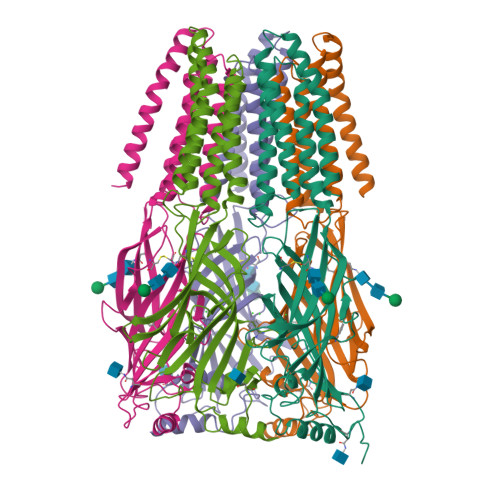 Click to view 3D structure Click to view 3D structure | Gamma-aminobutyric acid receptor subunit beta-3 | P28472 | Humans | Known | Benzodiazepines bind nonspecifically to bezodiazepine receptors BNZ1, which mediates sleep, and BNZ2, which affects affects muscle relaxation, anticonvulsant activity, motor coordination, and memory. As benzodiazepine receptors are thought to be coupled to gamma-aminobutyric acid-A (GABAA) receptors, this enhances the effects of GABA by increasing GABA affinity for the GABA receptor. Binding of GABA to the site opens the chloride channel, resulting in a hyperpolarized cell membrane that prevents further excitation of the cell. |
 Click to view 3D structure Click to view 3D structure | Gamma-aminobutyric acid receptor subunit delta | O14764 | Humans | Known | Not Available |
| Click to view 3D structure | Gamma-aminobutyric acid receptor subunit epsilon | P78334 | Humans | Known | Not Available |
| Click to view 3D structure | Gamma-aminobutyric acid receptor subunit gamma-1 | Q8N1C3 | Humans | Known | Not Available |
| Click to view 3D structure | Gamma-aminobutyric acid receptor subunit gamma-2 | P18507 | Humans | Known | Not Available |
| Click to view 3D structure | Gamma-aminobutyric acid receptor subunit gamma-3 | Q99928 | Humans | Known | Not Available |
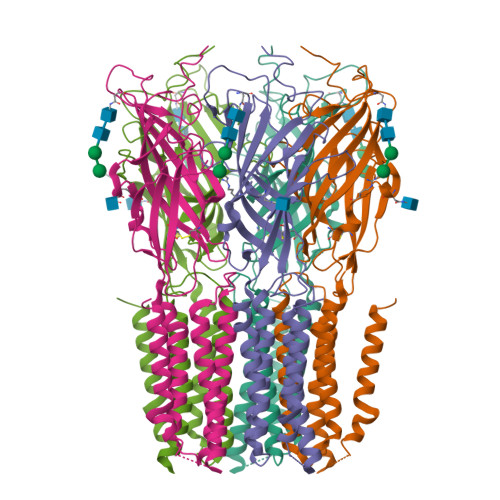 Click to view 3D structure Click to view 3D structure | Gamma-aminobutyric acid receptor subunit pi | O00591 | Humans | Known | Not Available |
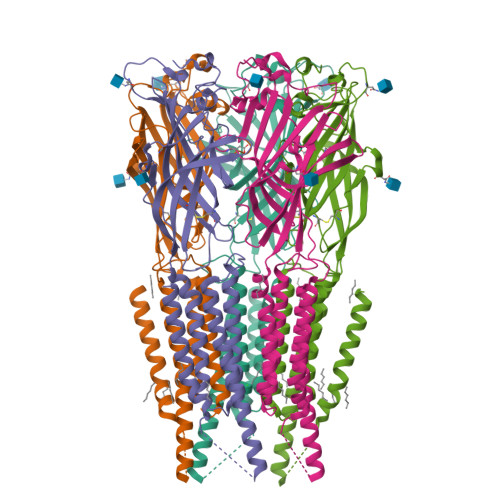 Click to view 3D structure Click to view 3D structure | Gamma-aminobutyric acid receptor subunit rho-1 | P24046 | Humans | Known | Not Available |
| Click to view 3D structure | Gamma-aminobutyric acid receptor subunit rho-2 | P28476 | Humans | Known | Not Available |
| Click to view 3D structure | Gamma-aminobutyric acid receptor subunit rho-3 | A8MPY1 | Humans | Known | Not Available |
| Click to view 3D structure | Gamma-aminobutyric acid receptor subunit alpha-1 | P14867 | Humans | Known | Benzodiazepines bind nonspecifically to bezodiazepine receptors BNZ1, which mediates sleep, and BNZ2, which affects affects muscle relaxation, anticonvulsant activity, motor coordination, and memory. As benzodiazepine receptors are thought to be coupled to gamma-aminobutyric acid-A (GABAA) receptors, this enhances the effects of GABA by increasing GABA affinity for the GABA receptor. Binding of GABA to the site opens the chloride channel, resulting in a hyperpolarized cell membrane that prevents further excitation of the cell. |
| Click to view 3D structure | Gamma-aminobutyric acid receptor subunit alpha-4 | P48169 | Humans | Known | Benzodiazepines bind nonspecifically to bezodiazepine receptors BNZ1, which mediates sleep, and BNZ2, which affects affects muscle relaxation, anticonvulsant activity, motor coordination, and memory. As benzodiazepine receptors are thought to be coupled to gamma-aminobutyric acid-A (GABAA) receptors, this enhances the effects of GABA by increasing GABA affinity for the GABA receptor. Binding of GABA to the site opens the chloride channel, resulting in a hyperpolarized cell membrane that prevents further excitation of the cell. |
| Click to view 3D structure | Gamma-aminobutyric acid receptor subunit alpha-6 | Q16445 | Humans | Known | Benzodiazepines bind nonspecifically to bezodiazepine receptors BNZ1, which mediates sleep, and BNZ2, which affects affects muscle relaxation, anticonvulsant activity, motor coordination, and memory. As benzodiazepine receptors are thought to be coupled to gamma-aminobutyric acid-A (GABAA) receptors, this enhances the effects of GABA by increasing GABA affinity for the GABA receptor. Binding of GABA to the site opens the chloride channel, resulting in a hyperpolarized cell membrane that prevents further excitation of the cell. |
| Click to view 3D structure | Gamma-aminobutyric acid receptor subunit theta | Q9UN88 | Humans | Known | Not Available |
| Click to view 3D structure | Translocator protein | P30536 | Humans | Known | Not Available |