Record Information
Version1.0
Creation Date2009-07-21 20:27:25 UTC
Update Date2026-05-14 16:46:17 UTC
Accession NumberCHEM002249
Identification
Common NameDaunorubicin
ClassSmall Molecule
Description
Daunorubicin is only found in individuals that have used or taken this drug. It is a very toxic anthracycline aminoglycoside antineoplastic isolated from Streptomyces peucetius and others, used in treatment of leukemia and other neoplasms. [PubChem]Daunorubicin has antimitotic and cytotoxic activity through a number of proposed mechanisms of action: Daunorubicin forms complexes with DNA by intercalation between base pairs, and it inhibits topoisomerase II activity by stabilizing the DNA-topoisomerase II complex, preventing the religation portion of the ligation-religation reaction that topoisomerase II catalyzes.
Contaminant Sources
  • Clean Air Act Chemicals
  • HMDB Contaminants - Urine
  • IARC Carcinogens Group 2B
  • STOFF IDENT Compounds
  • T3DB toxins
  • ToxCast & Tox21 Chemicals
Contaminant Type
  • Amine
  • Antibiotic
  • Antibiotic, Antineoplastic
  • Antineoplastic Agent
  • Drug
  • Ester
  • Ether
  • Metabolite
  • Organic Compound
  • Synthetic Compound
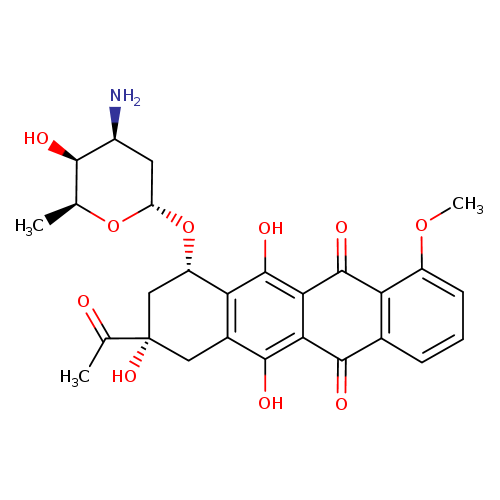
Chemical Structure
Synonyms
ValueSource
(+)-DaunomycinChEBI
(8S-cis)-8-Acetyl-10-((3-amino-2,3,6-trideoxy-alpha-L-lyxo-hexopyrannosyl)oxy)-7,8,9,10-tetrahydro-6,8,11-trihydroxy-1-methoxy-5,12-napthacenedioneChEBI
AcetyladriamycinChEBI
DaunomycinChEBI
DaunorubicinumChEBI
Leukaemomycin CChEBI
DMKegg
DaunoXomeKegg
(8S-cis)-8-Acetyl-10-((3-amino-2,3,6-trideoxy-a-L-lyxo-hexopyrannosyl)oxy)-7,8,9,10-tetrahydro-6,8,11-trihydroxy-1-methoxy-5,12-napthacenedioneGenerator
(8S-cis)-8-Acetyl-10-((3-amino-2,3,6-trideoxy-α-L-lyxo-hexopyrannosyl)oxy)-7,8,9,10-tetrahydro-6,8,11-trihydroxy-1-methoxy-5,12-napthacenedioneGenerator
Dauno rubidomycineHMDB
DaunoblastineHMDB
Daunorubicin hydrochlorideHMDB
CerubidineHMDB
RubidomycinHMDB
Dauno-rubidomycineHMDB
DaunoblastinHMDB
Hydrochloride, daunorubicinHMDB
RubomycinHMDB
Chemical FormulaC27H29NO10
Average Molecular Mass527.520 g/mol
Monoisotopic Mass527.179 g/mol
CAS Registry Number20830-81-3
IUPAC Name(8S,10S)-8-acetyl-10-{[(2R,4S,5S,6S)-4-amino-5-hydroxy-6-methyloxan-2-yl]oxy}-6,8,11-trihydroxy-1-methoxy-5,7,8,9,10,12-hexahydrotetracene-5,12-dione
Traditional Namedaunorubicin
SMILESCOC1=CC=CC2=C1C(=O)C1=C(O)C3=C(C[C@](O)(C[C@@H]3O[C@H]3C[C@H](N)[C@H](O)[C@H](C)O3)C(C)=O)C(O)=C1C2=O
InChI IdentifierInChI=1S/C27H29NO10/c1-10-22(30)14(28)7-17(37-10)38-16-9-27(35,11(2)29)8-13-19(16)26(34)21-20(24(13)32)23(31)12-5-4-6-15(36-3)18(12)25(21)33/h4-6,10,14,16-17,22,30,32,34-35H,7-9,28H2,1-3H3/t10-,14-,16-,17-,22+,27-/m0/s1
InChI KeySTQGQHZAVUOBTE-VGBVRHCVSA-N
Chemical Taxonomy
Description Belongs to the class of organic compounds known as anthracyclines. These are polyketides containing a tetracenequinone ring structure with a sugar attached by glycosidic linkage.
KingdomOrganic compounds
Super ClassPhenylpropanoids and polyketides
ClassAnthracyclines
Sub ClassNot Available
Direct ParentAnthracyclines
Alternative Parents
Substituents
  • Anthracycline
  • Anthracyclinone-skeleton
  • Aminoglycoside core
  • Tetracenequinone
  • 9,10-anthraquinone
  • 1,4-anthraquinone
  • Anthracene
  • Hexose monosaccharide
  • Glycosyl compound
  • O-glycosyl compound
  • Tetralin
  • Aryl ketone
  • Anisole
  • Amino saccharide
  • Alkyl aryl ether
  • Benzenoid
  • Oxane
  • Monosaccharide
  • Vinylogous acid
  • Tertiary alcohol
  • Alpha-hydroxy ketone
  • Secondary alcohol
  • 1,2-aminoalcohol
  • Ketone
  • Organoheterocyclic compound
  • Acetal
  • Ether
  • Polyol
  • Oxacycle
  • Primary amine
  • Hydrocarbon derivative
  • Organic oxide
  • Organopnictogen compound
  • Organic oxygen compound
  • Organonitrogen compound
  • Organic nitrogen compound
  • Amine
  • Organooxygen compound
  • Carbonyl group
  • Alcohol
  • Primary aliphatic amine
  • Aromatic heteropolycyclic compound
Molecular FrameworkAromatic heteropolycyclic compounds
External Descriptors
Biological Properties
StatusDetected and Not Quantified
OriginExogenous
Cellular Locations
  • Cytoplasm
  • Extracellular
  • Membrane
Biofluid LocationsNot Available
Tissue LocationsNot Available
PathwaysNot Available
Applications
Biological Roles
Chemical RolesNot Available
Physical Properties
StateSolid
AppearanceWhite powder.
Experimental Properties
PropertyValue
Melting Point208-209°C
Boiling PointNot Available
Solubility39.2 mg/L
Predicted Properties
PropertyValueSource
Water Solubility0.63 g/LALOGPS
logP1.68ALOGPS
logP1.73ChemAxon
logS-2.9ALOGPS
pKa (Strongest Acidic)9.53ChemAxon
pKa (Strongest Basic)8.94ChemAxon
Physiological Charge1ChemAxon
Hydrogen Acceptor Count11ChemAxon
Hydrogen Donor Count5ChemAxon
Polar Surface Area185.84 ŲChemAxon
Rotatable Bond Count4ChemAxon
Refractivity132.89 m³·mol⁻¹ChemAxon
Polarizability52.94 ųChemAxon
Number of Rings5ChemAxon
BioavailabilityNoChemAxon
Rule of FiveNoChemAxon
Ghose FilterNoChemAxon
Veber's RuleNoChemAxon
MDDR-like RuleNoChemAxon
Spectra
Spectra
Toxicity Profile
Route of ExposureIntravenous
Mechanism of ToxicityDaunorubicin has antimitotic and cytotoxic activity through a number of proposed mechanisms of action: Daunorubicin forms complexes with DNA by intercalation between base pairs, and it inhibits topoisomerase II activity by stabilizing the DNA-topoisomerase II complex, preventing the religation portion of the ligation-religation reaction that topoisomerase II catalyzes.
MetabolismHepatic Route of Elimination: Twenty-five percent of an administered dose of daunorubicin hydrochloride is eliminated in an active form by urinary excretion and an estimated 40% by biliary excretion. Half Life: 18.5 hours
Toxicity ValuesLD50=20 mg/kg (mice, IV); LD50=13 mg/kg (rat, IV)
Lethal DoseNot Available
Carcinogenicity (IARC Classification)2B, possibly carcinogenic to humans. (3)
Uses/SourcesFor remission induction in acute nonlymphocytic leukemia (myelogenous, monocytic, erythroid) of adults and for remission induction in acute lymphocytic leukemia of children and adults.
Minimum Risk LevelNot Available
Health EffectsAntibiotic resistance. Toxic manifestations of Daunorubicin include bone marrow depression, stomatitis, alopecia, gastrointestinal disturbances, and dermatological manifestations. Cardiac toxicity is a pecular effect. (2)
Symptomssymptoms include gastrointestinal disturbances. (2)
TreatmentInfuse 10 to 20 mL/kg isotonic fluid. If hypotension persists, administer dopamine. (1)

Concentrations
Not Available
External Links
DrugBank IDDB00694
HMDB IDHMDB0014832
FooDB IDNot Available
Phenol Explorer IDNot Available
KNApSAcK IDC00043440
BiGG IDNot Available
BioCyc IDNot Available
METLIN IDNot Available
PDB IDDM1
Wikipedia LinkDaunorubicin
Chemspider ID28163
ChEBI ID41977
PubChem Compound ID30323
Kegg Compound IDC01907
YMDB IDNot Available
ECMDB IDNot Available
References
Synthesis Reference

Sylvie Pinnert, Leon Ninet, Jean Preud’Homme, “Antibiotic daunorubicin and its preparation.” U.S. Patent US3989598, issued March, 1965.

MSDSLink
General References
1. https://www.ncbi.nlm.nih.gov/pubmed/?term=10820108
2. https://www.ncbi.nlm.nih.gov/pubmed/?term=23414337
3. https://www.ncbi.nlm.nih.gov/pubmed/?term=23900905
4. https://www.ncbi.nlm.nih.gov/pubmed/?term=24396448