Tranylcypromine (CED0004725)

Record Information
Version1.0
Creation Date2009-07-21 20:27:35 UTC
Update Date2026-05-14 16:47:55 UTC
Accession NumberCHEM002265
Identification
Common NameTranylcypromine
ClassSmall Molecule
Description
Tranylcypromine is an exogenous organic compound with the formula C9H11N and an average molecular weight of 133.19 g/mol. It exists as a solid at room temperature. Tranylcypromine belongs to the amines, a subclass of organonitrogen compounds within the organic compounds. This compound is found in antidepressants, as well as in other smoking requisites and pipe accessories within household cleaning and consumer products. The recorded route of exposure is oral. Tranylcypromine irreversibly inhibits monoamine oxidase (MAO), specifically targeting amine oxidase [flavin-containing] A (MAOA) and amine oxidase [flavin-containing] B (MAOB). Other protein targets include the D(2) dopamine receptor (DRD2) and the 5-hydroxytryptamine receptor 2A (HTR2A). Within neurons, MAO appears to regulate the levels of monoamines released upon synaptic firing. Because depression is associated with low levels of monoamines, the inhibition of MAO serves to ease depressive symptoms. Consequently, tranylcypromine is effective in the treatment of major depression, atypical depression, and dysthymic disorder. Additionally, it is useful in the treatment of phobic and panic disorders.
Contaminant Type
  • Amine
  • Anti-Anxiety Agent
  • Antidepressant
  • Antidepressive Agent
  • Drug
  • Human Neurotoxin
  • Metabolite
  • Monoamine Oxidase Inhibitor
  • Organic Compound
  • Synthetic Compound
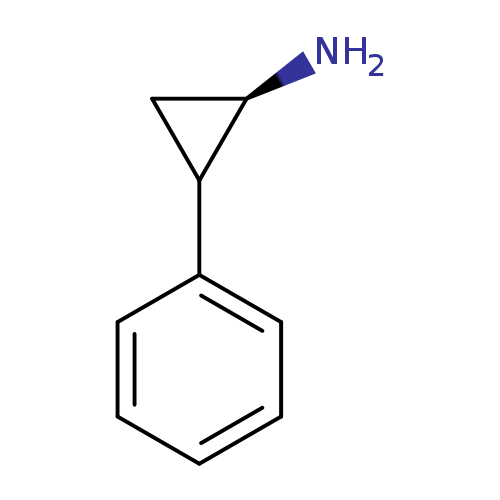
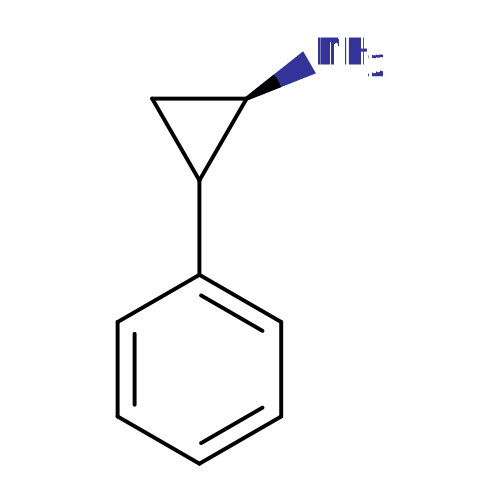
Chemical Structure
Synonyms
ValueSource
ParnateKegg
Parnic acidGenerator
Allphar brand OF tranylcypromine sulfateHMDB
GlaxoSmithKline brand OF tranylcypromine sulfateHMDB
Goldshield brand OF tranylcypromine sulfateHMDB
JatrosomHMDB
Link brand OF tranylcypromine sulfateHMDB
SmithKline brand OF tranylcypromine sulfateHMDB
Sulfate, tranylcypromineHMDB
TransamineHMDB
Tranylcypromine sulfateHMDB
Esparma brand OF tranylcypromine sulfateHMDB
trans 2 PhenylcyclopropylamineHMDB
trans-2-PhenylcyclopropylamineHMDB
Chemical FormulaC9H11N
Average Molecular Mass133.190 g/mol
Monoisotopic Mass133.089 g/mol
CAS Registry Number155-09-9
IUPAC Name(1R)-2-phenylcyclopropan-1-amine
Traditional Nametranylcypromine sulfate
SMILESN[C@@H]1CC1C1=CC=CC=C1
InChI IdentifierInChI=1S/C9H11N/c10-9-6-8(9)7-4-2-1-3-5-7/h1-5,8-9H,6,10H2/t8?,9-/m1/s1
InChI KeyAELCINSCMGFISI-YGPZHTELSA-N
Chemical Taxonomy
Description Belongs to the class of organic compounds known as aralkylamines. These are alkylamines in which the alkyl group is substituted at one carbon atom by an aromatic hydrocarbyl group.
KingdomOrganic compounds
Super ClassOrganic nitrogen compounds
ClassOrganonitrogen compounds
Sub ClassAmines
Direct ParentAralkylamines
Alternative Parents
Substituents
  • Aralkylamine
  • Benzenoid
  • Monocyclic benzene moiety
  • Organopnictogen compound
  • Hydrocarbon derivative
  • Primary amine
  • Primary aliphatic amine
  • Aromatic homomonocyclic compound
Molecular FrameworkAromatic homomonocyclic compounds
External DescriptorsNot Available
Biological Properties
StatusDetected and Not Quantified
OriginExogenous
Cellular Locations
  • Cytoplasm
  • Extracellular
  • Membrane
Biofluid LocationsNot Available
Tissue LocationsNot Available
ApplicationsNot Available
Biological RolesNot Available
Chemical RolesNot Available
Organoleptic EffectsNot Available
Physical Properties
StateSolid
AppearanceWhite powder.
Experimental Properties
PropertyValue
Melting Point79-80°C at 1.50E+00 mm Hg
Boiling PointNot Available
Solubility4.86E+004 mg/L
Predicted Properties
PropertyValueSource
Water Solubility1.49 g/LALOGPS
logP1.5ALOGPS
logP1.34ChemAxon
logS-2ALOGPS
pKa (Strongest Basic)9.62ChemAxon
Physiological Charge1ChemAxon
Hydrogen Acceptor Count1ChemAxon
Hydrogen Donor Count1ChemAxon
Polar Surface Area26.02 ŲChemAxon
Rotatable Bond Count1ChemAxon
Refractivity41.7 m³·mol⁻¹ChemAxon
Polarizability15.33 ųChemAxon
Number of Rings2ChemAxon
BioavailabilityYesChemAxon
Rule of FiveYesChemAxon
Ghose FilterNoChemAxon
Veber's RuleYesChemAxon
MDDR-like RuleNoChemAxon
Spectra
Spectra
Spectrum TypeDescriptionSplash KeyDeposition DateView
Predicted GC-MSPredicted GC-MS Spectrumsplash10-0f6x-9800000000-230ec64c0c4e335281c3Not AvailableView Spectrum
Predicted GC-MSPredicted GC-MS SpectrumNot AvailableNot AvailableView Spectrum
Predicted LC-MS/MSPredicted LC-MS/MS Spectrumsplash10-00lr-0900000000-747bd6c24d23e0dc3b30Not AvailableView Spectrum
Predicted LC-MS/MSPredicted LC-MS/MS Spectrumsplash10-00lr-3900000000-07e0a486860af42efca8Not AvailableView Spectrum
Predicted LC-MS/MSPredicted LC-MS/MS Spectrumsplash10-0zi3-9700000000-7ce3af5a04eec9a5a1d2Not AvailableView Spectrum
Predicted LC-MS/MSPredicted LC-MS/MS Spectrumsplash10-001i-0900000000-387ae3c4508041ed7f03Not AvailableView Spectrum
Predicted LC-MS/MSPredicted LC-MS/MS Spectrumsplash10-001i-0900000000-ff5149796df2404afa22Not AvailableView Spectrum
Predicted LC-MS/MSPredicted LC-MS/MS Spectrumsplash10-00ou-9300000000-a90e0e8ff4d27cddf576Not AvailableView Spectrum
Predicted LC-MS/MSPredicted LC-MS/MS Spectrumsplash10-014i-0900000000-f88420912e5970f9665bNot AvailableView Spectrum
Predicted LC-MS/MSPredicted LC-MS/MS Spectrumsplash10-014l-6900000000-612bebf2afd4a2d06608Not AvailableView Spectrum
Predicted LC-MS/MSPredicted LC-MS/MS Spectrumsplash10-002f-9100000000-5ab488145ab6cf0850b9Not AvailableView Spectrum
Predicted LC-MS/MSPredicted LC-MS/MS Spectrumsplash10-0159-0900000000-f25847cc17ac78de452aNot AvailableView Spectrum
Predicted LC-MS/MSPredicted LC-MS/MS Spectrumsplash10-014i-0900000000-d180e1330ea80a51da49Not AvailableView Spectrum
Predicted LC-MS/MSPredicted LC-MS/MS Spectrumsplash10-00or-9700000000-372b2fa84e615277aebfNot AvailableView Spectrum
MSMS Spectrumsplash10-00lr-4900000000-a7221eab5a5f5d286c2aNot AvailableView Spectrum
1D NMR13C NMR Spectrum (1D, D2O, predicted)Not AvailableNot AvailableView Spectrum
1D NMR1H NMR Spectrum (1D, D2O, predicted)Not AvailableNot AvailableView Spectrum
Toxicity Profile
Mechanism of ToxicityTranylcypromine irreversibly and nonselectively inhibits monoamine oxidase (MAO). Within neurons, MAO appears to regulate the levels of monoamines released upon synaptic firing. Since depression is associated with low levels of monoamines, the inhibition of MAO serves to ease depressive symptoms, as this results in an increase in the concentrations of these amines within the CNS.
Carcinogenicity (IARC Classification)No indication of carcinogenicity to humans (not listed by IARC).
Minimum Risk LevelNot Available
SymptomsIn overdosage, some patients exhibit insomnia, restlessness and anxiety, progressing in severe cases to agitation, mental confusion and incoherence. Hypotension, dizziness, weakness and drowsiness may occur, progressing in severe cases to extreme dizziness and shock. A few patients have displayed hypertension with severe headache and other symptoms. Rare instances have been reported in which hypertension was accompanied by twitching or myoclonic fibrillation of skeletal muscles with hyperpyrexia, sometimes progressing to generalized rigidity and coma.
TreatmentTreatment should normally consist of general supportive measures, close observation of vital signs and steps to counteract specific symptoms as they occur, since MAO inhibition may persist. External cooling is recommended if hyperpyrexia occurs. Barbiturates have been reported to help relieve myoclonic reactions, but frequency of administration should be controlled carefully because Tranylcypromine may prolong barbiturate activity. When hypotension requires treatment, the standard measures for managing circulatory shock should be initiated. If pressor agents are used, the rate of infusion should be regulated by careful observation of the patient because an exaggerated pressor response sometimes occurs in the presence of MAO inhibition. (4)
Toxicity Values
Toxicity ValueUnitValue RangeOrganismDose DescriptorRoute of ExposurePredicted or ExperimentalReference
257.0Log mg/kg[140:460]RatLD50oralpredictedNot Available
Health Effects
Health EffectRelationshipDirectionReference
Exposure Sources
Source IDSourceSectorReference
377AntidepressantsHealthcare, pharmaceuticals & veterinary productsNot Available
560Other Smoking RequisitesHousehold cleaning & consumer productsNot Available
562Pipe AccessoriesHousehold cleaning & consumer productsNot Available
Pathways
5 pathways
Targets
StructureProteinUniProt IDOrganismRelationshipDetails
Amine oxidase [flavin-containing] B structureClick to view 3D structureAmine oxidase [flavin-containing] BP27338HumansPredicted (SEA)0.0778492
Amine oxidase [flavin-containing] A structureClick to view 3D structureAmine oxidase [flavin-containing] AP21397HumansPredicted (SEA)0.0778492
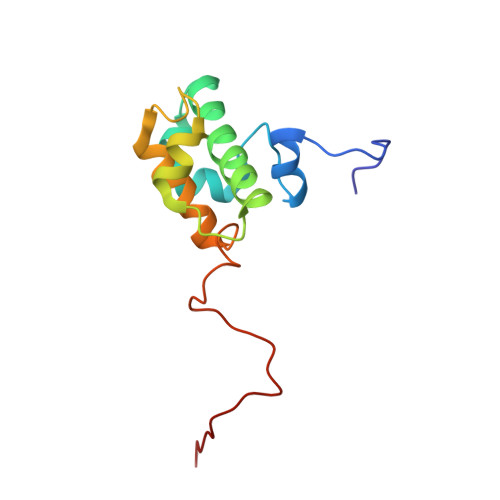
Lysine-specific histone demethylase 1A structureClick to view 3D structureLysine-specific histone demethylase 1AO60341HumansPredicted (SEA)0.0778492
Cytochrome P450 2C19 structureClick to view 3D structureCytochrome P450 2C19P33261HumansPredicted (SEA)0.700643
Cytochrome P450 2B6 structureClick to view 3D structureCytochrome P450 2B6P20813HumansPredicted (SEA)0.0778492
Trace amine-associated receptor 1 structureClick to view 3D structureTrace amine-associated receptor 1Q96RJ0HumansPredicted (SEA)0.544945
5-hydroxytryptamine receptor 2C structureClick to view 3D structure5-hydroxytryptamine receptor 2CP28335HumansPredicted (SEA)26.4687
5-hydroxytryptamine receptor 2B structureClick to view 3D structure5-hydroxytryptamine receptor 2BP41595HumansPredicted (SEA)17.5161
Click to view 3D structureSigma non-opioid intracellular receptor 1Q60492Cavia porcellusPredicted (SEA)54.8059
Cytochrome P450 2A6 structureClick to view 3D structureCytochrome P450 2A6P11509HumansPredicted (SEA)1.32344
Click to view 3D structureAmine oxidase [flavin-containing] AP21396Rattus norvegicusPredicted (SEA)10.1982
Click to view 3D structureSigma intracellular receptor 2Q5U3Y7Rattus norvegicusPredicted (SEA)40.5594
5-hydroxytryptamine receptor 2A structureClick to view 3D structure5-hydroxytryptamine receptor 2AP28223HumansPredicted (SEA)209.882
Replicase polyprotein 1ab structureClick to view 3D structureReplicase polyprotein 1abP0DTD1SARS-CoV-2Predicted (SEA)49.9792
Click to view 3D structureAmine oxidase [flavin-containing] BP19643Rattus norvegicusPredicted (SEA)16.5819
Cytochrome P450 2A13 structureClick to view 3D structureCytochrome P450 2A13Q16696HumansPredicted (SEA)0.0778492
Click to view 3D structureSodium-dependent dopamine transporterP23977Rattus norvegicusPredicted (SEA)133.901
Protein deacetylase HDAC6 structureClick to view 3D structureProtein deacetylase HDAC6Q9UBN7HumansPredicted (SEA)452.615
Click to view 3D structure5-hydroxytryptamine receptor 1AP19327Rattus norvegicusPredicted (SEA)397.887
Sodium-dependent serotonin transporter structureClick to view 3D structureSodium-dependent serotonin transporterP31645HumansPredicted (SEA)411.433
Click to view 3D structureNorepinephrine transporterQ9WTR4Rattus norvegicusPredicted (SEA)95.9102
Histone deacetylase 1 structureClick to view 3D structureHistone deacetylase 1Q13547HumansPredicted (SEA)862.647
Click to view 3D structureD(2) dopamine receptorP61169RatPredicted (SEA)651.754
Histone deacetylase 2 structureClick to view 3D structureHistone deacetylase 2Q92769HumansPredicted (SEA)561.838
Click to view 3D structureSodium-dependent serotonin transporterP31652Rattus norvegicusPredicted (SEA)399.055
5-hydroxytryptamine receptor 2A structureClick to view 3D structure5-hydroxytryptamine receptor 2AP28223HumansKnownTranylcypromine irreversibly inhibits monoamine oxidase (MAO). Within neurons, MAO appears to regulate the levels of monoamines released upon synaptic firing. Since depression is associated with low levels of monoamines, the inhibition of MAO serves to ease depressive symptoms.
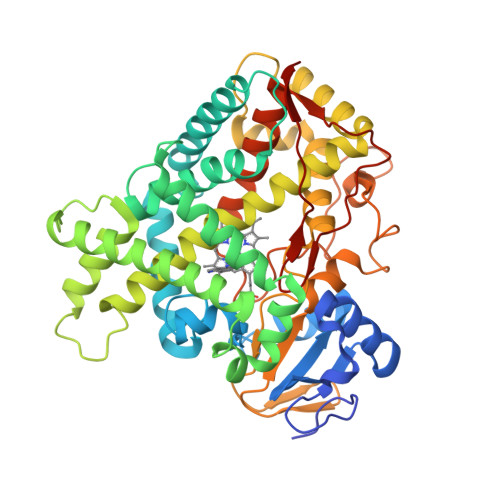
Amine oxidase [flavin-containing] A structureClick to view 3D structureAmine oxidase [flavin-containing] AP21397HumansKnownTranylcypromine irreversibly inhibits monoamine oxidase (MAO). Within neurons, MAO appears to regulate the levels of monoamines released upon synaptic firing. Since depression is associated with low levels of monoamines, the inhibition of MAO serves to ease depressive symptoms.
Amine oxidase [flavin-containing] B structureClick to view 3D structureAmine oxidase [flavin-containing] BP27338HumansKnownTranylcypromine irreversibly inhibits monoamine oxidase (MAO). Within neurons, MAO appears to regulate the levels of monoamines released upon synaptic firing. Since depression is associated with low levels of monoamines, the inhibition of MAO serves to ease depressive symptoms.
D(2) dopamine receptor structureClick to view 3D structureD(2) dopamine receptorP14416HumansKnownTranylcypromine irreversibly inhibits monoamine oxidase (MAO). Within neurons, MAO appears to regulate the levels of monoamines released upon synaptic firing. Since depression is associated with low levels of monoamines, the inhibition of MAO serves to ease depressive symptoms.
Concentrations
Not Available
External Links
DrugBank IDNot Available
HMDB IDHMDB0014890
FooDB IDNot Available
Phenol Explorer IDNot Available
KNApSAcK IDNot Available
BiGG IDNot Available
BioCyc IDNot Available
METLIN IDNot Available
PDB IDNot Available
Wikipedia LinkTranylcypromine
Chemspider ID390008
ChEBI IDNot Available
PubChem Compound ID441233
Kegg Compound IDC07155
YMDB IDNot Available
ECMDB IDNot Available
References
Synthesis ReferenceNot Available
MSDSLink
General References
1. Nolen WA: [Classical monoamine oxidase inhibitor: not registered for, but still a place in the treatment of depression]. Ned Tijdschr Geneeskd. 2003 Oct 4;147(40):1940-3.
2. Frieling H, Bleich S: Tranylcypromine: new perspectives on an "old" drug. Eur Arch Psychiatry Clin Neurosci. 2006 Aug;256(5):268-73.