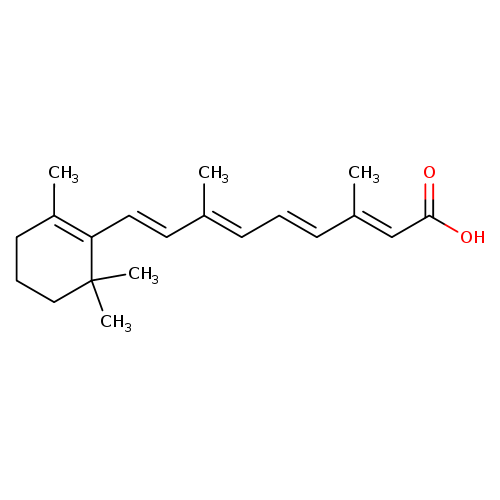
Click to view 3D structure Click to view 3D structure | Retinoic acid receptor alpha | P11416 | Mus musculus | Predicted (SEA) | - Prediction Confidence Score
- 0.9
- Applicability Domain
- 1.0
- Statistical Significance
- 1.00e-05
- Supporting Reference Compounds
- 16
- E-value
- 0.0778492
|
| Click to view 3D structure | Retinoic acid receptor gamma | P18911 | Mus musculus | Predicted (SEA) | - Prediction Confidence Score
- 0.881
- Applicability Domain
- 1.0
- Statistical Significance
- 1.00e-05
- Supporting Reference Compounds
- 14
- E-value
- 0.0778492
|
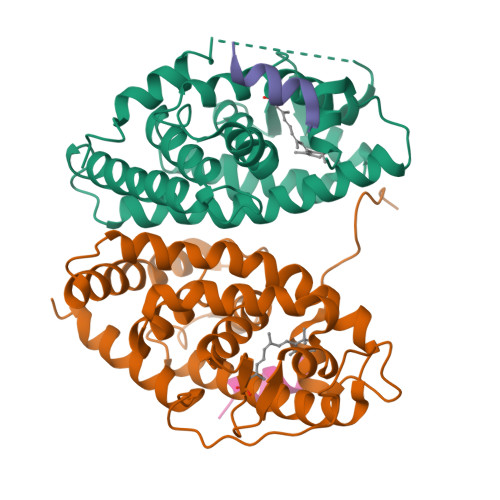 Click to view 3D structure Click to view 3D structure | Retinoic acid receptor beta | P22605 | Mus musculus | Predicted (SEA) | - Prediction Confidence Score
- 0.881
- Applicability Domain
- 1.0
- Statistical Significance
- 1.00e-05
- Supporting Reference Compounds
- 14
- E-value
- 0.0778492
|
 Click to view 3D structure Click to view 3D structure | Cytochrome P450 2B6 | P20813 | Humans | Known | Not Available |
 Click to view 3D structure Click to view 3D structure | Retinoic acid receptor RXR-alpha | P19793 | Humans | Predicted (SEA) | - Prediction Confidence Score
- 0.833
- Applicability Domain
- 1.0
- Statistical Significance
- 1.00e-05
- Supporting Reference Compounds
- 82
- E-value
- 0.0778492
|
 Click to view 3D structure Click to view 3D structure | Retinoic acid receptor gamma | P13631 | Humans | Predicted (SEA) | - Prediction Confidence Score
- 0.806
- Applicability Domain
- 1.0
- Statistical Significance
- 1.00e-05
- Supporting Reference Compounds
- 52
- E-value
- 0.0778492
|
 Click to view 3D structure Click to view 3D structure | Retinoic acid receptor RXR-alpha | P28700 | Mus musculus | Predicted (SEA) | - Prediction Confidence Score
- 0.787
- Applicability Domain
- 1.0
- Statistical Significance
- 1.00e-05
- Supporting Reference Compounds
- 17
- E-value
- 0.0778492
|
 Click to view 3D structure Click to view 3D structure | Cellular retinoic acid-binding protein 1 | P62965 | Mus musculus | Predicted (SEA) | - Prediction Confidence Score
- 0.787
- Applicability Domain
- 1.0
- Statistical Significance
- 1.00e-05
- Supporting Reference Compounds
- 7
- E-value
- 0.0778492
|
| Click to view 3D structure | Cellular retinoic acid-binding protein 2 | P22935 | Mus musculus | Predicted (SEA) | - Prediction Confidence Score
- 0.787
- Applicability Domain
- 1.0
- Statistical Significance
- 1.00e-05
- Supporting Reference Compounds
- 7
- E-value
- 0.0778492
|
 Click to view 3D structure Click to view 3D structure | Catalase | P04040 | Humans | Known | Not Available |
| Click to view 3D structure | Aldehyde dehydrogenase 1A1 | P27463 | Gallus gallus | Predicted (SEA) | - Prediction Confidence Score
- 0.766
- Applicability Domain
- 0.766
- Statistical Significance
- 1.00e-05
- Supporting Reference Compounds
- 1
- E-value
- 0.0778492
|
| Click to view 3D structure | Cellular retinoic acid-binding protein 1 | P40220 | Gallus gallus | Predicted (SEA) | - Prediction Confidence Score
- 0.746
- Applicability Domain
- 1.0
- Statistical Significance
- 1.00e-05
- Supporting Reference Compounds
- 5
- E-value
- 0.0778492
|
 Click to view 3D structure Click to view 3D structure | Retinoic acid receptor beta | P10826 | Humans | Predicted (SEA) | - Prediction Confidence Score
- 0.738
- Applicability Domain
- 1.0
- Statistical Significance
- 1.00e-05
- Supporting Reference Compounds
- 47
- E-value
- 0.0778492
|
| Click to view 3D structure | Retinoic acid receptor alpha | P10276 | Humans | Predicted (SEA) | - Prediction Confidence Score
- 0.738
- Applicability Domain
- 1.0
- Statistical Significance
- 1.00e-05
- Supporting Reference Compounds
- 53
- E-value
- 0.0778492
|
 Click to view 3D structure Click to view 3D structure | Retinoic acid receptor RXR-gamma | P48443 | Humans | Predicted (SEA) | - Prediction Confidence Score
- 0.671
- Applicability Domain
- 1.0
- Statistical Significance
- 1.00e-05
- Supporting Reference Compounds
- 31
- E-value
- 0.0778492
|
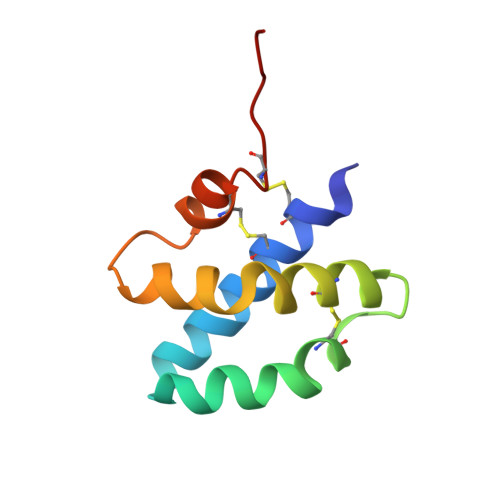 Click to view 3D structure Click to view 3D structure | Prosaposin | P07602 | Humans | Predicted (SEA) | - Prediction Confidence Score
- 0.667
- Applicability Domain
- 0.667
- Statistical Significance
- 2.00e-05
- Supporting Reference Compounds
- 1
- E-value
- 0.155698
|
 Click to view 3D structure Click to view 3D structure | Retinoic acid receptor RXR-beta | P28702 | Humans | Predicted (SEA) | - Prediction Confidence Score
- 0.652
- Applicability Domain
- 1.0
- Statistical Significance
- 1.00e-05
- Supporting Reference Compounds
- 31
- E-value
- 0.0778492
|
 Click to view 3D structure Click to view 3D structure | Beta-lactoglobulin | P02754 | Bos taurus | Predicted (SEA) | - Prediction Confidence Score
- 0.613
- Applicability Domain
- 0.696
- Statistical Significance
- 1.00e-05
- Supporting Reference Compounds
- 2
- E-value
- 0.0778492
|
| Click to view 3D structure | Retinoic acid receptor RXR-gamma | P28705 | Mus musculus | Predicted (SEA) | - Prediction Confidence Score
- 0.601
- Applicability Domain
- 1.0
- Statistical Significance
- 1.00e-05
- Supporting Reference Compounds
- 20
- E-value
- 0.0778492
|
| Click to view 3D structure | Retinoic acid receptor RXR-beta | P28704 | Mus musculus | Predicted (SEA) | - Prediction Confidence Score
- 0.571
- Applicability Domain
- 1.0
- Statistical Significance
- 3.00e-05
- Supporting Reference Compounds
- 19
- E-value
- 0.233548
|
 Click to view 3D structure Click to view 3D structure | Alpha-synuclein | P37840 | Humans | Predicted (SEA) | - Prediction Confidence Score
- 0.552
- Applicability Domain
- 1.0
- Statistical Significance
- 6.00e-05
- Supporting Reference Compounds
- 38
- E-value
- 0.467095
|
 Click to view 3D structure Click to view 3D structure | Amyloid-beta precursor protein | P05067 | Humans | Predicted (SEA) | - Prediction Confidence Score
- 0.552
- Applicability Domain
- 1.0
- Statistical Significance
- 2.30e-04
- Supporting Reference Compounds
- 109
- E-value
- 1.79053
|
| Click to view 3D structure | Retinoic acid receptor gamma | P13631 | Humans | Known | Not Available |
 Click to view 3D structure Click to view 3D structure | 5-hydroxytryptamine receptor 2B | P41595 | Humans | Predicted (SEA) | - Prediction Confidence Score
- 0.493
- Applicability Domain
- 1.0
- Statistical Significance
- 0.0025
- Supporting Reference Compounds
- 686
- E-value
- 19.618
|
 Click to view 3D structure Click to view 3D structure | Adenosine receptor A3 | P0DMS8 | Humans | Predicted (SEA) | - Prediction Confidence Score
- 0.493
- Applicability Domain
- 1.0
- Statistical Significance
- 0.0039
- Supporting Reference Compounds
- 391
- E-value
- 30.2055
|
 Click to view 3D structure Click to view 3D structure | Mitogen-activated protein kinase 1 | P28482 | Humans | Predicted (SEA) | - Prediction Confidence Score
- 0.479
- Applicability Domain
- 1.0
- Statistical Significance
- 0.0042
- Supporting Reference Compounds
- 763
- E-value
- 33.0081
|
 Click to view 3D structure Click to view 3D structure | Bile salt export pump | O95342 | Humans | Predicted (SEA) | - Prediction Confidence Score
- 0.45
- Applicability Domain
- 1.0
- Statistical Significance
- 3.40e-04
- Supporting Reference Compounds
- 104
- E-value
- 2.64687
|
| Click to view 3D structure | Retinoic acid receptor RXR-alpha | Q05343 | Rattus norvegicus | Predicted (SEA) | - Prediction Confidence Score
- 0.424
- Applicability Domain
- 1.0
- Statistical Significance
- 3.00e-05
- Supporting Reference Compounds
- 7
- E-value
- 0.233548
|
 Click to view 3D structure Click to view 3D structure | Serine/threonine-protein kinase mTOR | P42345 | Humans | Known | Not Available |
| Click to view 3D structure | Cytochrome P450 1A1 | P00185 | Rat | Known | Not Available |
| Click to view 3D structure | Cytochrome P450 2S1 | Q96SQ9 | Humans | Known | Not Available |
| Click to view 3D structure | Cytochrome P450 26B1 | Q9NR63 | Humans | Known | Not Available |
 Click to view 3D structure Click to view 3D structure | Isocitrate lyase | P9WKK7 | Mycobacterium tuberculosis (strain ATCC 25618 / H37Rv) | Known | Not Available |
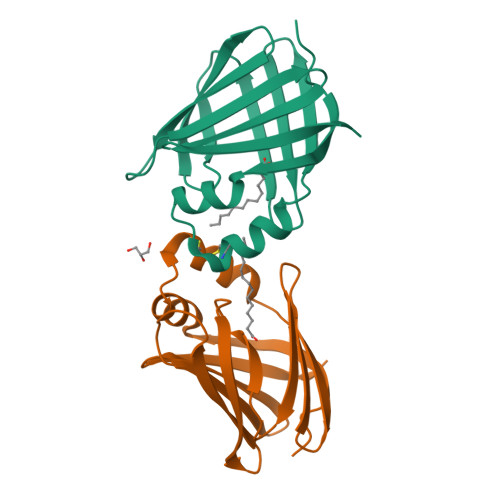 Click to view 3D structure Click to view 3D structure | Cellular retinoic acid-binding protein 1 | P29762 | Humans | Known | Not Available |
 Click to view 3D structure Click to view 3D structure | Cellular retinoic acid-binding protein 2 | P29373 | Humans | Known | Not Available |
 Click to view 3D structure Click to view 3D structure | Cytochrome P450 3A4 | P08684 | Humans | Known | Not Available |
 Click to view 3D structure Click to view 3D structure | Cytochrome P450 2C8 | P10632 | Humans | Known | Not Available |
| Click to view 3D structure | Cytochrome P450 26C1 | Q6V0L0 | Humans | Known | Not Available |
 Click to view 3D structure Click to view 3D structure | Endoglucanase | P19424 | Bacillus sp. (strain KSM-635) | Known | Not Available |
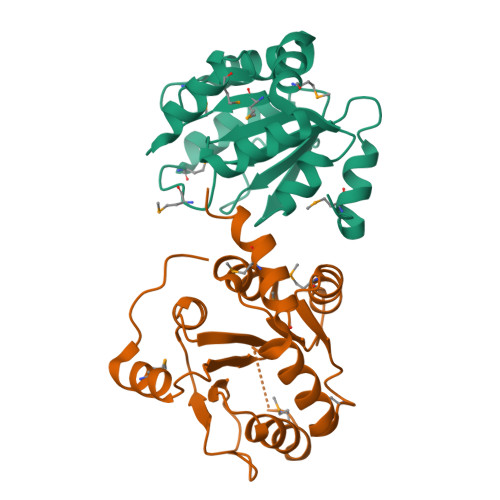 Click to view 3D structure Click to view 3D structure | UDP-glucuronosyltransferase 2B7 | P16662 | Humans | Known | Not Available |
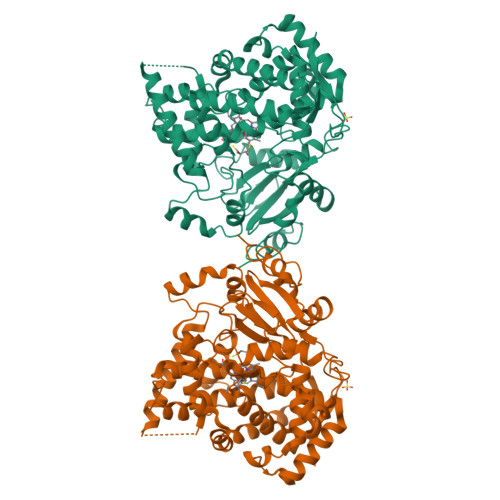 Click to view 3D structure Click to view 3D structure | Cytochrome P450 3A7 | P24462 | Humans | Known | Not Available |
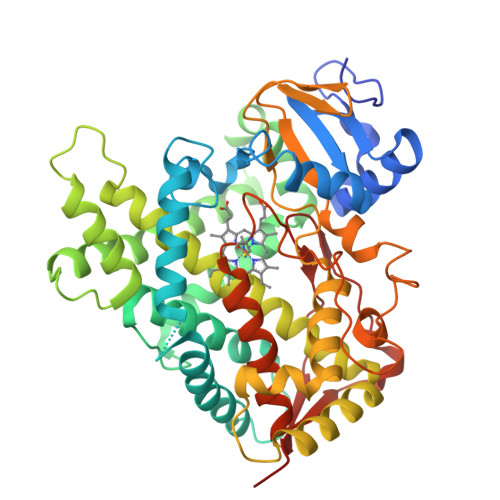 Click to view 3D structure Click to view 3D structure | Cytochrome P450 2E1 | P05181 | Humans | Known | Not Available |
 Click to view 3D structure Click to view 3D structure | Aldehyde dehydrogenase 1A1 | P00352 | Humans | Known | Not Available |
 Click to view 3D structure Click to view 3D structure | Retinal dehydrogenase 2 | O94788 | Humans | Known | Not Available |
 Click to view 3D structure Click to view 3D structure | Hexokinase-4 | P35557 | Humans | Known | Not Available |
 Click to view 3D structure Click to view 3D structure | Vascular endothelial growth factor A, long form | P15692 | Humans | Known | Not Available |
 Click to view 3D structure Click to view 3D structure | Cytochrome P450 1B1 | Q16678 | Humans | Known | Not Available |
 Click to view 3D structure Click to view 3D structure | Cytochrome P450 7A1 | P22680 | Humans | Known | Not Available |
 Click to view 3D structure Click to view 3D structure | Glutathione S-transferase | Q59721 | Burkholderia xenovorans (strain LB400) | Known | Not Available |
| Click to view 3D structure | UDP-glucuronosyltransferase 1A9 | O60656 | Humans | Known | Not Available |
 Click to view 3D structure Click to view 3D structure | Aldo-keto reductase family 1 member B10 | O60218 | Humans | Known | Not Available |
 Click to view 3D structure Click to view 3D structure | Aldo-keto reductase family 1 member C2 | P52895 | Humans | Known | Not Available |
 Click to view 3D structure Click to view 3D structure | Albumin | P02768 | Humans | Known | Not Available |
| Click to view 3D structure | Cytochrome P450 26A1 | O43174 | Humans | Known | Not Available |
 Click to view 3D structure Click to view 3D structure | Retinaldehyde dehydrogenase 3 | P47895 | Humans | Known | Not Available |
| Click to view 3D structure | Retinoic acid receptor RXR-alpha | P19793 | Humans | Known | Not Available |
| Click to view 3D structure | Retinoic acid receptor alpha | P10276 | Humans | Known | Not Available |
| Click to view 3D structure | Retinoic acid receptor RXR-beta | P28702 | Humans | Known | Tretinoin binds to alpha, beta, and gamma retinoic acid receptors (RARs). RAR-alpha and RAR-beta have been associated with the development of acute promyelocytic leukemia and squamous cell cancers, respectively. RAR-gamma is associated with retinoid effects on mucocutaneous tissues and bone. Although the exact mechanism of action of tretinoin is unknown, current evidence suggests that the effectiveness of tretinoin in acne is due primarily to its ability to modify abnormal follicular keratinization. Comedones form in follicles with an excess of keratinized epithelial cells. Tretinoin promotes detachment of cornified cells and the enhanced shedding of corneocytes from the follicle. By increasing the mitotic activity of follicular epithelia, tretinoin also increases the turnover rate of thin, loosely-adherent corneocytes. Through these actions, the comedo contents are extruded and the formation of the microcomedo, the precursor lesion of acne vulgaris, is reduced. Tretinoin is not a cytolytic agent but instead induces cytodifferentiation and decreased proliferation of APL cells in culture and in vivo. When Tretinoin is given systemically to APL patients, tretinoin treatment produces an initial maturation of the primitive promyelocytes derived from the leukemic clone, followed by a repopulation of the bone marrow and peripheral blood by normal, polyclonal hematopoietic cells in patients achieving complete remission (CR). The exact mechanism of action of tretinoin in APL is unknown. |
| Click to view 3D structure | Retinoic acid receptor gamma | P13631 | Humans | Known | Tretinoin binds to alpha, beta, and gamma retinoic acid receptors (RARs). RAR-alpha and RAR-beta have been associated with the development of acute promyelocytic leukemia and squamous cell cancers, respectively. RAR-gamma is associated with retinoid effects on mucocutaneous tissues and bone. Although the exact mechanism of action of tretinoin is unknown, current evidence suggests that the effectiveness of tretinoin in acne is due primarily to its ability to modify abnormal follicular keratinization. Comedones form in follicles with an excess of keratinized epithelial cells. Tretinoin promotes detachment of cornified cells and the enhanced shedding of corneocytes from the follicle. By increasing the mitotic activity of follicular epithelia, tretinoin also increases the turnover rate of thin, loosely-adherent corneocytes. Through these actions, the comedo contents are extruded and the formation of the microcomedo, the precursor lesion of acne vulgaris, is reduced. Tretinoin is not a cytolytic agent but instead induces cytodifferentiation and decreased proliferation of APL cells in culture and in vivo. When Tretinoin is given systemically to APL patients, tretinoin treatment produces an initial maturation of the primitive promyelocytes derived from the leukemic clone, followed by a repopulation of the bone marrow and peripheral blood by normal, polyclonal hematopoietic cells in patients achieving complete remission (CR). The exact mechanism of action of tretinoin in APL is unknown. |
| Click to view 3D structure | Retinoic acid receptor RXR-gamma | P48443 | Humans | Known | Tretinoin binds to alpha, beta, and gamma retinoic acid receptors (RARs). RAR-alpha and RAR-beta have been associated with the development of acute promyelocytic leukemia and squamous cell cancers, respectively. RAR-gamma is associated with retinoid effects on mucocutaneous tissues and bone. Although the exact mechanism of action of tretinoin is unknown, current evidence suggests that the effectiveness of tretinoin in acne is due primarily to its ability to modify abnormal follicular keratinization. Comedones form in follicles with an excess of keratinized epithelial cells. Tretinoin promotes detachment of cornified cells and the enhanced shedding of corneocytes from the follicle. By increasing the mitotic activity of follicular epithelia, tretinoin also increases the turnover rate of thin, loosely-adherent corneocytes. Through these actions, the comedo contents are extruded and the formation of the microcomedo, the precursor lesion of acne vulgaris, is reduced. Tretinoin is not a cytolytic agent but instead induces cytodifferentiation and decreased proliferation of APL cells in culture and in vivo. When Tretinoin is given systemically to APL patients, tretinoin treatment produces an initial maturation of the primitive promyelocytes derived from the leukemic clone, followed by a repopulation of the bone marrow and peripheral blood by normal, polyclonal hematopoietic cells in patients achieving complete remission (CR). The exact mechanism of action of tretinoin in APL is unknown. |
| Click to view 3D structure | Retinoic acid receptor beta | P10826 | Humans | Known | Not Available |
| Click to view 3D structure | Aldehyde dehydrogenase 1A1 | P00352 | Humans | Known | Tretinoin binds to alpha, beta, and gamma retinoic acid receptors (RARs). RAR-alpha and RAR-beta have been associated with the development of acute promyelocytic leukemia and squamous cell cancers, respectively. RAR-gamma is associated with retinoid effects on mucocutaneous tissues and bone. Although the exact mechanism of action of tretinoin is unknown, current evidence suggests that the effectiveness of tretinoin in acne is due primarily to its ability to modify abnormal follicular keratinization. Comedones form in follicles with an excess of keratinized epithelial cells. Tretinoin promotes detachment of cornified cells and the enhanced shedding of corneocytes from the follicle. By increasing the mitotic activity of follicular epithelia, tretinoin also increases the turnover rate of thin, loosely-adherent corneocytes. Through these actions, the comedo contents are extruded and the formation of the microcomedo, the precursor lesion of acne vulgaris, is reduced. Tretinoin is not a cytolytic agent but instead induces cytodifferentiation and decreased proliferation of APL cells in culture and in vivo. When Tretinoin is given systemically to APL patients, tretinoin treatment produces an initial maturation of the primitive promyelocytes derived from the leukemic clone, followed by a repopulation of the bone marrow and peripheral blood by normal, polyclonal hematopoietic cells in patients achieving complete remission (CR). The exact mechanism of action of tretinoin in APL is unknown. |
| Click to view 3D structure | Retinal dehydrogenase 2 | O94788 | Humans | Known | Tretinoin binds to alpha, beta, and gamma retinoic acid receptors (RARs). RAR-alpha and RAR-beta have been associated with the development of acute promyelocytic leukemia and squamous cell cancers, respectively. RAR-gamma is associated with retinoid effects on mucocutaneous tissues and bone. Although the exact mechanism of action of tretinoin is unknown, current evidence suggests that the effectiveness of tretinoin in acne is due primarily to its ability to modify abnormal follicular keratinization. Comedones form in follicles with an excess of keratinized epithelial cells. Tretinoin promotes detachment of cornified cells and the enhanced shedding of corneocytes from the follicle. By increasing the mitotic activity of follicular epithelia, tretinoin also increases the turnover rate of thin, loosely-adherent corneocytes. Through these actions, the comedo contents are extruded and the formation of the microcomedo, the precursor lesion of acne vulgaris, is reduced. Tretinoin is not a cytolytic agent but instead induces cytodifferentiation and decreased proliferation of APL cells in culture and in vivo. When Tretinoin is given systemically to APL patients, tretinoin treatment produces an initial maturation of the primitive promyelocytes derived from the leukemic clone, followed by a repopulation of the bone marrow and peripheral blood by normal, polyclonal hematopoietic cells in patients achieving complete remission (CR). The exact mechanism of action of tretinoin in APL is unknown. |
 Click to view 3D structure Click to view 3D structure | Nuclear receptor subfamily 0 group B member 1 | P51843 | Humans | Known | Tretinoin binds to alpha, beta, and gamma retinoic acid receptors (RARs). RAR-alpha and RAR-beta have been associated with the development of acute promyelocytic leukemia and squamous cell cancers, respectively. RAR-gamma is associated with retinoid effects on mucocutaneous tissues and bone. Although the exact mechanism of action of tretinoin is unknown, current evidence suggests that the effectiveness of tretinoin in acne is due primarily to its ability to modify abnormal follicular keratinization. Comedones form in follicles with an excess of keratinized epithelial cells. Tretinoin promotes detachment of cornified cells and the enhanced shedding of corneocytes from the follicle. By increasing the mitotic activity of follicular epithelia, tretinoin also increases the turnover rate of thin, loosely-adherent corneocytes. Through these actions, the comedo contents are extruded and the formation of the microcomedo, the precursor lesion of acne vulgaris, is reduced. Tretinoin is not a cytolytic agent but instead induces cytodifferentiation and decreased proliferation of APL cells in culture and in vivo. When Tretinoin is given systemically to APL patients, tretinoin treatment produces an initial maturation of the primitive promyelocytes derived from the leukemic clone, followed by a repopulation of the bone marrow and peripheral blood by normal, polyclonal hematopoietic cells in patients achieving complete remission (CR). The exact mechanism of action of tretinoin in APL is unknown. |
| Click to view 3D structure | Retinoic acid receptor responder protein 1 | P49788 | Humans | Known | Tretinoin binds to alpha, beta, and gamma retinoic acid receptors (RARs). RAR-alpha and RAR-beta have been associated with the development of acute promyelocytic leukemia and squamous cell cancers, respectively. RAR-gamma is associated with retinoid effects on mucocutaneous tissues and bone. Although the exact mechanism of action of tretinoin is unknown, current evidence suggests that the effectiveness of tretinoin in acne is due primarily to its ability to modify abnormal follicular keratinization. Comedones form in follicles with an excess of keratinized epithelial cells. Tretinoin promotes detachment of cornified cells and the enhanced shedding of corneocytes from the follicle. By increasing the mitotic activity of follicular epithelia, tretinoin also increases the turnover rate of thin, loosely-adherent corneocytes. Through these actions, the comedo contents are extruded and the formation of the microcomedo, the precursor lesion of acne vulgaris, is reduced. Tretinoin is not a cytolytic agent but instead induces cytodifferentiation and decreased proliferation of APL cells in culture and in vivo. When Tretinoin is given systemically to APL patients, tretinoin treatment produces an initial maturation of the primitive promyelocytes derived from the leukemic clone, followed by a repopulation of the bone marrow and peripheral blood by normal, polyclonal hematopoietic cells in patients achieving complete remission (CR). The exact mechanism of action of tretinoin in APL is unknown. |
| Click to view 3D structure | Retinoic acid-induced protein 3 | Q8NFJ5 | Humans | Known | Tretinoin binds to alpha, beta, and gamma retinoic acid receptors (RARs). RAR-alpha and RAR-beta have been associated with the development of acute promyelocytic leukemia and squamous cell cancers, respectively. RAR-gamma is associated with retinoid effects on mucocutaneous tissues and bone. Although the exact mechanism of action of tretinoin is unknown, current evidence suggests that the effectiveness of tretinoin in acne is due primarily to its ability to modify abnormal follicular keratinization. Comedones form in follicles with an excess of keratinized epithelial cells. Tretinoin promotes detachment of cornified cells and the enhanced shedding of corneocytes from the follicle. By increasing the mitotic activity of follicular epithelia, tretinoin also increases the turnover rate of thin, loosely-adherent corneocytes. Through these actions, the comedo contents are extruded and the formation of the microcomedo, the precursor lesion of acne vulgaris, is reduced. Tretinoin is not a cytolytic agent but instead induces cytodifferentiation and decreased proliferation of APL cells in culture and in vivo. When Tretinoin is given systemically to APL patients, tretinoin treatment produces an initial maturation of the primitive promyelocytes derived from the leukemic clone, followed by a repopulation of the bone marrow and peripheral blood by normal, polyclonal hematopoietic cells in patients achieving complete remission (CR). The exact mechanism of action of tretinoin in APL is unknown. |
| Click to view 3D structure | Cellular retinoic acid-binding protein 2 | P29373 | Humans | Known | Not Available |
 Click to view 3D structure Click to view 3D structure | Lipocalin-1 | P31025 | Humans | Known | Not Available |
 Click to view 3D structure Click to view 3D structure | Odorant-binding protein 2a | Q9NY56 | Humans | Known | Not Available |
 Click to view 3D structure Click to view 3D structure | Protein AMBP | P02760 | Humans | Known | Not Available |
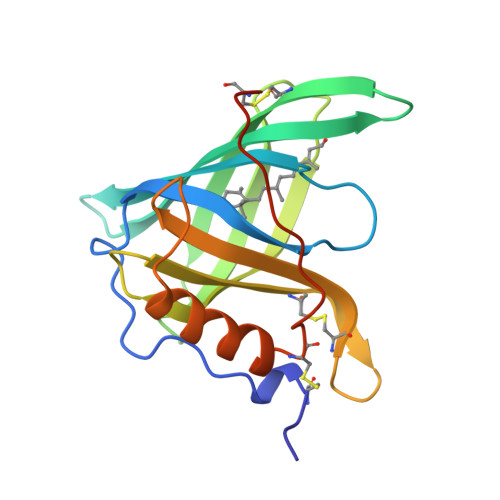 Click to view 3D structure Click to view 3D structure | Retinol-binding protein 4 | P02753 | Humans | Known | Not Available |
 Click to view 3D structure Click to view 3D structure | Peroxisome proliferator-activated receptor gamma | P37231 | Humans | Known | Not Available |
 Click to view 3D structure Click to view 3D structure | Estrogen receptor | P03372 | Humans | Known | Not Available |
 Click to view 3D structure Click to view 3D structure | Bile acid receptor | Q96RI1 | Humans | Known | Not Available |
 Click to view 3D structure Click to view 3D structure | D(4) dopamine receptor | P21917 | Humans | Known | Not Available |
 Click to view 3D structure Click to view 3D structure | Cytochrome P450 1A1 | P04798 | Humans | Known | Not Available |