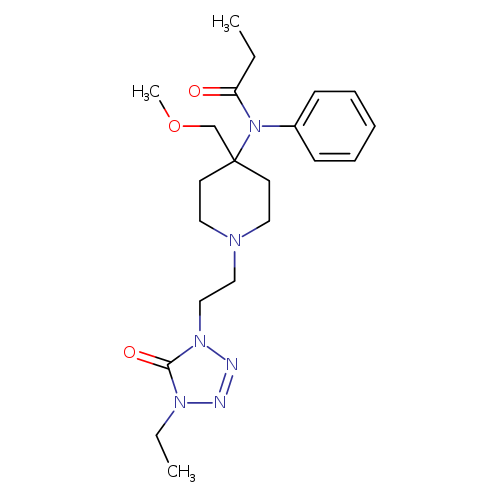
Click to view 3D structure Click to view 3D structure | Cytochrome P450 3A4 | P08684 | Humans | Known | Not Available |
 Click to view 3D structure Click to view 3D structure | Sigma non-opioid intracellular receptor 1 | Q60492 | Cavia porcellus | Predicted (SEA) | - Prediction Confidence Score
- 0.518
- Applicability Domain
- 1.0
- Statistical Significance
- 0.0015
- Supporting Reference Compounds
- 229
- E-value
- 11.6774
|
| Click to view 3D structure | Mu-type opioid receptor | P33535 | Rattus norvegicus | Predicted (SEA) | - Prediction Confidence Score
- 0.512
- Applicability Domain
- 1.0
- Statistical Significance
- 0.0077
- Supporting Reference Compounds
- 229
- E-value
- 59.6325
|
| Click to view 3D structure | Mu-type opioid receptor | P97266 | Cavia porcellus | Predicted (SEA) | - Prediction Confidence Score
- 0.434
- Applicability Domain
- 1.0
- Statistical Significance
- 0.015
- Supporting Reference Compounds
- 186
- E-value
- 116.54
|
| Click to view 3D structure | Kappa-type opioid receptor | P41144 | Cavia porcellus | Predicted (SEA) | - Prediction Confidence Score
- 0.408
- Applicability Domain
- 1.0
- Statistical Significance
- 0.0161
- Supporting Reference Compounds
- 199
- E-value
- 125.415
|
 Click to view 3D structure Click to view 3D structure | Mu-type opioid receptor | P35372 | Humans | Predicted (SEA) | - Prediction Confidence Score
- 0.38
- Applicability Domain
- 0.615
- Statistical Significance
- 0.027
- Supporting Reference Compounds
- 527
- E-value
- 210.193
|
 Click to view 3D structure Click to view 3D structure | ATP-dependent translocase ABCB1 | P08183 | Humans | Predicted (SEA) | - Prediction Confidence Score
- 0.345
- Applicability Domain
- 0.615
- Statistical Significance
- 0.0058
- Supporting Reference Compounds
- 139
- E-value
- 45.1525
|
 Click to view 3D structure Click to view 3D structure | Sigma non-opioid intracellular receptor 1 | Q99720 | Humans | Predicted (SEA) | - Prediction Confidence Score
- 0.298
- Applicability Domain
- 0.348
- Statistical Significance
- 0.0658
- Supporting Reference Compounds
- 562
- E-value
- 512.481
|
 Click to view 3D structure Click to view 3D structure | Delta-type opioid receptor | P41143 | Humans | Predicted (SEA) | - Prediction Confidence Score
- 0.29
- Applicability Domain
- 0.348
- Statistical Significance
- 0.068
- Supporting Reference Compounds
- 427
- E-value
- 529.063
|
 Click to view 3D structure Click to view 3D structure | Kappa-type opioid receptor | P41145 | Humans | Predicted (SEA) | - Prediction Confidence Score
- 0.288
- Applicability Domain
- 0.348
- Statistical Significance
- 0.0811
- Supporting Reference Compounds
- 532
- E-value
- 631.435
|
 Click to view 3D structure Click to view 3D structure | Voltage-gated inwardly rectifying potassium channel KCNH2 | Q12809 | Humans | Predicted (SEA) | - Prediction Confidence Score
- 0.284
- Applicability Domain
- 0.348
- Statistical Significance
- 0.2399
- Supporting Reference Compounds
- 1498
- E-value
- 1867.91
|
 Click to view 3D structure Click to view 3D structure | D(4) dopamine receptor | P21917 | Humans | Predicted (SEA) | - Prediction Confidence Score
- 0.282
- Applicability Domain
- 0.348
- Statistical Significance
- 0.0861
- Supporting Reference Compounds
- 524
- E-value
- 670.671
|
| Click to view 3D structure | Alpha-1B adrenergic receptor | P35368 | Humans | Predicted (SEA) | - Prediction Confidence Score
- 0.278
- Applicability Domain
- 0.348
- Statistical Significance
- 0.0482
- Supporting Reference Compounds
- 298
- E-value
- 375.389
|
 Click to view 3D structure Click to view 3D structure | Alpha-1A adrenergic receptor | P35348 | Humans | Predicted (SEA) | - Prediction Confidence Score
- 0.278
- Applicability Domain
- 0.348
- Statistical Significance
- 0.0616
- Supporting Reference Compounds
- 376
- E-value
- 479.473
|
| Click to view 3D structure | Sigma non-opioid intracellular receptor 1 | Q9R0C9 | Rattus norvegicus | Predicted (SEA) | - Prediction Confidence Score
- 0.275
- Applicability Domain
- 0.348
- Statistical Significance
- 0.0408
- Supporting Reference Compounds
- 207
- E-value
- 317.936
|
 Click to view 3D structure Click to view 3D structure | 5-hydroxytryptamine receptor 2A | P28223 | Humans | Predicted (SEA) | - Prediction Confidence Score
- 0.266
- Applicability Domain
- 0.286 Low confidence
- Statistical Significance
- 0.1887
- Supporting Reference Compounds
- 955
- E-value
- 1469.4
|
| Click to view 3D structure | Alpha-1A adrenergic receptor | P43140 | Rattus norvegicus | Predicted (SEA) | - Prediction Confidence Score
- 0.264
- Applicability Domain
- 0.275 Low confidence
- Statistical Significance
- 0.0541
- Supporting Reference Compounds
- 208
- E-value
- 421.164
|
| Click to view 3D structure | Sodium-dependent serotonin transporter | P31652 | Rattus norvegicus | Predicted (SEA) | - Prediction Confidence Score
- 0.264
- Applicability Domain
- 0.299 Low confidence
- Statistical Significance
- 0.0685
- Supporting Reference Compounds
- 297
- E-value
- 533.111
|
 Click to view 3D structure Click to view 3D structure | D(2) dopamine receptor | P14416 | Humans | Predicted (SEA) | - Prediction Confidence Score
- 0.263
- Applicability Domain
- 0.275 Low confidence
- Statistical Significance
- 0.2143
- Supporting Reference Compounds
- 1103
- E-value
- 1668.46
|
 Click to view 3D structure Click to view 3D structure | D(3) dopamine receptor | P35462 | Humans | Predicted (SEA) | - Prediction Confidence Score
- 0.262
- Applicability Domain
- 0.275 Low confidence
- Statistical Significance
- 0.1853
- Supporting Reference Compounds
- 861
- E-value
- 1442.39
|
| Click to view 3D structure | 5-hydroxytryptamine receptor 1A | P19327 | Rattus norvegicus | Predicted (SEA) | - Prediction Confidence Score
- 0.262
- Applicability Domain
- 0.268 Low confidence
- Statistical Significance
- 0.1355
- Supporting Reference Compounds
- 541
- E-value
- 1055.17
|
 Click to view 3D structure Click to view 3D structure | 5-hydroxytryptamine receptor 7 | P34969 | Humans | Predicted (SEA) | - Prediction Confidence Score
- 0.261
- Applicability Domain
- 0.286 Low confidence
- Statistical Significance
- 0.1344
- Supporting Reference Compounds
- 565
- E-value
- 1046.45
|
| Click to view 3D structure | D(2) dopamine receptor | P61169 | Rat | Predicted (SEA) | - Prediction Confidence Score
- 0.261
- Applicability Domain
- 0.275 Low confidence
- Statistical Significance
- 0.1306
- Supporting Reference Compounds
- 528
- E-value
- 1016.63
|
| Click to view 3D structure | Delta-type opioid receptor | P33533 | Rattus norvegicus | Predicted (SEA) | - Prediction Confidence Score
- 0.26
- Applicability Domain
- 0.348
- Statistical Significance
- 0.063
- Supporting Reference Compounds
- 164
- E-value
- 490.684
|
 Click to view 3D structure Click to view 3D structure | Nociceptin receptor | P41146 | Humans | Predicted (SEA) | - Prediction Confidence Score
- 0.26
- Applicability Domain
- 0.348
- Statistical Significance
- 0.0417
- Supporting Reference Compounds
- 73
- E-value
- 324.32
|
 Click to view 3D structure Click to view 3D structure | 5-hydroxytryptamine receptor 2B | P41595 | Humans | Predicted (SEA) | - Prediction Confidence Score
- 0.259
- Applicability Domain
- 0.266 Low confidence
- Statistical Significance
- 0.1738
- Supporting Reference Compounds
- 686
- E-value
- 1352.71
|
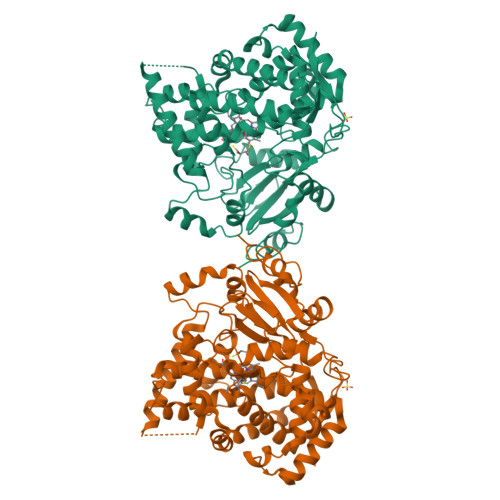 Click to view 3D structure Click to view 3D structure | Cytochrome P450 3A7 | P24462 | Humans | Known | Not Available |
| Click to view 3D structure | Mu-type opioid receptor | P35372 | Humans | Known | Opiate receptors are coupled with G-protein receptors and function as both positive and negative regulators of synaptic transmission via G-proteins that activate effector proteins. Binding of the opiate stimulates the exchange of GTP for GDP on the G-protein complex. As the effector system is adenylate cyclase and cAMP located at the inner surface of the plasma membrane, opioids decrease intracellular cAMP by inhibiting adenylate cyclase. Subsequently, the release of nociceptive neurotransmitters such as substance P, GABA, dopamine, acetylcholine and noradrenaline is inhibited. Opioids also inhibit the release of vasopressin, somatostatin, insulin and glucagon. Alfentanil's analgesic activity is, most likely, due to its conversion to morphine. Opioids close N-type voltage-operated calcium channels (OP2-receptor agonist) and open calcium-dependent inwardly rectifying potassium channels (OP3 and OP1 receptor agonist). This results in hyperpolarization and reduced neuronal excitability. |
 Click to view 3D structure Click to view 3D structure | Alpha-1-acid glycoprotein 1 | P02763 | Humans | Known | Opiate receptors are coupled with G-protein receptors and function as both positive and negative regulators of synaptic transmission via G-proteins that activate effector proteins. Binding of the opiate stimulates the exchange of GTP for GDP on the G-protein complex. As the effector system is adenylate cyclase and cAMP located at the inner surface of the plasma membrane, opioids decrease intracellular cAMP by inhibiting adenylate cyclase. Subsequently, the release of nociceptive neurotransmitters such as substance P, GABA, dopamine, acetylcholine and noradrenaline is inhibited. Opioids also inhibit the release of vasopressin, somatostatin, insulin and glucagon. Alfentanil's analgesic activity is, most likely, due to its conversion to morphine. Opioids close N-type voltage-operated calcium channels (OP2-receptor agonist) and open calcium-dependent inwardly rectifying potassium channels (OP3 and OP1 receptor agonist). This results in hyperpolarization and reduced neuronal excitability. |
 Click to view 3D structure Click to view 3D structure | Cytochrome P450 3A5 | P20815 | Humans | Known | Opiate receptors are coupled with G-protein receptors and function as both positive and negative regulators of synaptic transmission via G-proteins that activate effector proteins. Binding of the opiate stimulates the exchange of GTP for GDP on the G-protein complex. As the effector system is adenylate cyclase and cAMP located at the inner surface of the plasma membrane, opioids decrease intracellular cAMP by inhibiting adenylate cyclase. Subsequently, the release of nociceptive neurotransmitters such as substance P, GABA, dopamine, acetylcholine and noradrenaline is inhibited. Opioids also inhibit the release of vasopressin, somatostatin, insulin and glucagon. Alfentanil's analgesic activity is, most likely, due to its conversion to morphine. Opioids close N-type voltage-operated calcium channels (OP2-receptor agonist) and open calcium-dependent inwardly rectifying potassium channels (OP3 and OP1 receptor agonist). This results in hyperpolarization and reduced neuronal excitability. |
 Click to view 3D structure Click to view 3D structure | Albumin | P02768 | Humans | Known | Opiate receptors are coupled with G-protein receptors and function as both positive and negative regulators of synaptic transmission via G-proteins that activate effector proteins. Binding of the opiate stimulates the exchange of GTP for GDP on the G-protein complex. As the effector system is adenylate cyclase and cAMP located at the inner surface of the plasma membrane, opioids decrease intracellular cAMP by inhibiting adenylate cyclase. Subsequently, the release of nociceptive neurotransmitters such as substance P, GABA, dopamine, acetylcholine and noradrenaline is inhibited. Opioids also inhibit the release of vasopressin, somatostatin, insulin and glucagon. Alfentanil's analgesic activity is, most likely, due to its conversion to morphine. Opioids close N-type voltage-operated calcium channels (OP2-receptor agonist) and open calcium-dependent inwardly rectifying potassium channels (OP3 and OP1 receptor agonist). This results in hyperpolarization and reduced neuronal excitability. |
| Click to view 3D structure | ATP-dependent translocase ABCB1 | P08183 | Humans | Known | Opiate receptors are coupled with G-protein receptors and function as both positive and negative regulators of synaptic transmission via G-proteins that activate effector proteins. Binding of the opiate stimulates the exchange of GTP for GDP on the G-protein complex. As the effector system is adenylate cyclase and cAMP located at the inner surface of the plasma membrane, opioids decrease intracellular cAMP by inhibiting adenylate cyclase. Subsequently, the release of nociceptive neurotransmitters such as substance P, GABA, dopamine, acetylcholine and noradrenaline is inhibited. Opioids also inhibit the release of vasopressin, somatostatin, insulin and glucagon. Alfentanil's analgesic activity is, most likely, due to its conversion to morphine. Opioids close N-type voltage-operated calcium channels (OP2-receptor agonist) and open calcium-dependent inwardly rectifying potassium channels (OP3 and OP1 receptor agonist). This results in hyperpolarization and reduced neuronal excitability. |
| Click to view 3D structure | Kappa-type opioid receptor | P41145 | Humans | Known | Not Available |