Click to view 3D structure Click to view 3D structure | Muscarinic acetylcholine receptor M1 | P08482 | Rattus norvegicus | Predicted (SEA) | - Prediction Confidence Score
- 0.302
- Applicability Domain
- 0.313
- Statistical Significance
- 0.0061
- Supporting Reference Compounds
- 109
- E-value
- 47.4102
|
| Click to view 3D structure | Muscarinic acetylcholine receptor M2 | P10980 | Rattus norvegicus | Predicted (SEA) | - Prediction Confidence Score
- 0.302
- Applicability Domain
- 0.313
- Statistical Significance
- 0.0045
- Supporting Reference Compounds
- 98
- E-value
- 35.1878
|
 Click to view 3D structure Click to view 3D structure | Sodium-dependent dopamine transporter | Q01959 | Humans | Predicted (SEA) | - Prediction Confidence Score
- 0.3
- Applicability Domain
- 0.444
- Statistical Significance
- 0.0405
- Supporting Reference Compounds
- 506
- E-value
- 315.367
|
 Click to view 3D structure Click to view 3D structure | 5-hydroxytryptamine receptor 2A | P28223 | Humans | Predicted (SEA) | - Prediction Confidence Score
- 0.299
- Applicability Domain
- 0.367
- Statistical Significance
- 0.0822
- Supporting Reference Compounds
- 955
- E-value
- 640.154
|
 Click to view 3D structure Click to view 3D structure | Histone deacetylase 4 | P56524 | Humans | Predicted (SEA) | - Prediction Confidence Score
- 0.296
- Applicability Domain
- 0.353
- Statistical Significance
- 0.0241
- Supporting Reference Compounds
- 185
- E-value
- 187.539
|
| Click to view 3D structure | 5-hydroxytryptamine receptor 1A | P19327 | Rattus norvegicus | Predicted (SEA) | - Prediction Confidence Score
- 0.292
- Applicability Domain
- 0.37
- Statistical Significance
- 0.0627
- Supporting Reference Compounds
- 541
- E-value
- 488.27
|
 Click to view 3D structure Click to view 3D structure | Kynureninase | Q16719 | Humans | Predicted (SEA) | - Prediction Confidence Score
- 0.291
- Applicability Domain
- 0.302
- Statistical Significance
- 3.00e-04
- Supporting Reference Compounds
- 2
- E-value
- 2.33548
|
| Click to view 3D structure | Muscarinic acetylcholine receptor M3 | Q8VH26 | Cavia porcellus | Predicted (SEA) | - Prediction Confidence Score
- 0.29
- Applicability Domain
- 0.313
- Statistical Significance
- 0.0029
- Supporting Reference Compounds
- 52
- E-value
- 22.5763
|
| Click to view 3D structure | Peptidyl-glycine alpha-amidating monooxygenase | P19021 | Humans | Predicted (SEA) | - Prediction Confidence Score
- 0.289
- Applicability Domain
- 0.289 Low confidence
- Statistical Significance
- 0.0067
- Supporting Reference Compounds
- 1
- E-value
- 51.9254
|
 Click to view 3D structure Click to view 3D structure | D(2) dopamine receptor | P14416 | Humans | Predicted (SEA) | - Prediction Confidence Score
- 0.289
- Applicability Domain
- 0.444
- Statistical Significance
- 0.1146
- Supporting Reference Compounds
- 1103
- E-value
- 892.074
|
| Click to view 3D structure | Muscarinic receptor 4 | Q8VH25 | Cavia porcellus | Predicted (SEA) | - Prediction Confidence Score
- 0.288
- Applicability Domain
- 0.288 Low confidence
- Statistical Significance
- 1.80e-04
- Supporting Reference Compounds
- 1
- E-value
- 1.40129
|
 Click to view 3D structure Click to view 3D structure | Cytochrome P450 2D6 | P10635 | Humans | Predicted (SEA) | - Prediction Confidence Score
- 0.288
- Applicability Domain
- 0.313
- Statistical Significance
- 0.1537
- Supporting Reference Compounds
- 1130
- E-value
- 1196.62
|
 Click to view 3D structure Click to view 3D structure | Glutamate receptor ionotropic, kainate 3 | P42264 | Rattus norvegicus | Predicted (SEA) | - Prediction Confidence Score
- 0.288
- Applicability Domain
- 0.368
- Statistical Significance
- 9.60e-04
- Supporting Reference Compounds
- 26
- E-value
- 7.47353
|
 Click to view 3D structure Click to view 3D structure | Coagulation factor X | P00742 | Humans | Predicted (SEA) | - Prediction Confidence Score
- 0.287
- Applicability Domain
- 0.3
- Statistical Significance
- 0.0466
- Supporting Reference Compounds
- 284
- E-value
- 362.544
|
 Click to view 3D structure Click to view 3D structure | Mandelate racemase | P11444 | Pseudomonas putida | Predicted (SEA) | - Prediction Confidence Score
- 0.324
- Applicability Domain
- 0.324
- Statistical Significance
- 1.50e-04
- Supporting Reference Compounds
- 1
- E-value
- 1.16774
|
 Click to view 3D structure Click to view 3D structure | Muscarinic acetylcholine receptor M1 | P11229 | Humans | Predicted (SEA) | - Prediction Confidence Score
- 0.321
- Applicability Domain
- 0.357
- Statistical Significance
- 0.0173
- Supporting Reference Compounds
- 385
- E-value
- 135.068
|
 Click to view 3D structure Click to view 3D structure | Muscarinic acetylcholine receptor M3 | P20309 | Humans | Predicted (SEA) | - Prediction Confidence Score
- 0.321
- Applicability Domain
- 0.357
- Statistical Significance
- 0.0116
- Supporting Reference Compounds
- 310
- E-value
- 90.2272
|
 Click to view 3D structure Click to view 3D structure | Muscarinic acetylcholine receptor M4 | P08173 | Humans | Predicted (SEA) | - Prediction Confidence Score
- 0.317
- Applicability Domain
- 0.357
- Statistical Significance
- 0.0129
- Supporting Reference Compounds
- 297
- E-value
- 100.27
|
 Click to view 3D structure Click to view 3D structure | 5-hydroxytryptamine receptor 2A | P14842 | Rattus norvegicus | Predicted (SEA) | - Prediction Confidence Score
- 0.315
- Applicability Domain
- 0.37
- Statistical Significance
- 0.0293
- Supporting Reference Compounds
- 380
- E-value
- 228.41
|
 Click to view 3D structure Click to view 3D structure | Serine racemase | Q9GZT4 | Humans | Predicted (SEA) | - Prediction Confidence Score
- 0.31
- Applicability Domain
- 0.31
- Statistical Significance
- 0.0016
- Supporting Reference Compounds
- 1
- E-value
- 12.378
|
 Click to view 3D structure Click to view 3D structure | Muscarinic acetylcholine receptor M5 | P08912 | Humans | Predicted (SEA) | - Prediction Confidence Score
- 0.309
- Applicability Domain
- 0.313
- Statistical Significance
- 0.0146
- Supporting Reference Compounds
- 266
- E-value
- 113.816
|
 Click to view 3D structure Click to view 3D structure | Muscarinic acetylcholine receptor M2 | P08172 | Humans | Predicted (SEA) | - Prediction Confidence Score
- 0.309
- Applicability Domain
- 0.313
- Statistical Significance
- 0.0217
- Supporting Reference Compounds
- 373
- E-value
- 169.322
|
| Click to view 3D structure | Sodium-dependent dopamine transporter | P23977 | Rattus norvegicus | Predicted (SEA) | - Prediction Confidence Score
- 0.308
- Applicability Domain
- 0.444
- Statistical Significance
- 0.0168
- Supporting Reference Compounds
- 203
- E-value
- 130.553
|
 Click to view 3D structure Click to view 3D structure | Muscarinic acetylcholine receptor M3 | P08483 | Rattus norvegicus | Predicted (SEA) | - Prediction Confidence Score
- 0.304
- Applicability Domain
- 0.313
- Statistical Significance
- 0.0017
- Supporting Reference Compounds
- 55
- E-value
- 13.0008
|
| Click to view 3D structure | Kynureninase | P70712 | Rattus norvegicus | Predicted (SEA) | - Prediction Confidence Score
- 0.302
- Applicability Domain
- 0.302
- Statistical Significance
- 4.00e-04
- Supporting Reference Compounds
- 1
- E-value
- 3.11397
|
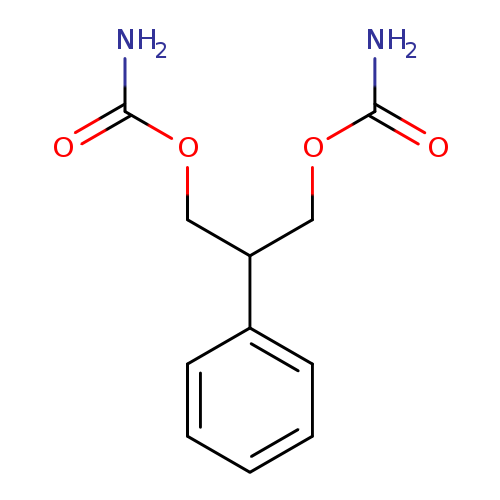
 Click to view 3D structure Click to view 3D structure | Glutamate receptor ionotropic, NMDA 2B | Q13224 | Humans | Known | The mechanism by which felbamate exerts its anticonvulsant activity is unknown, but in animal test systems designed to detect anticonvulsant activity, felbamate has properties in common with other marketed anticonvulsants. In vitro receptor binding studies suggest that felbamate may be an antagonist at the strychnine-insensitive glycine-recognition site of the N-methyl-D-aspartate (NMDA) receptor-ionophore complex. Antagonism of the NMDA receptor glycine binding site may block the effects of the excitatory amino acids and suppress seizure activity. Animal studies indicate that felbamate may increase the seizure threshold and may decrease seizure spread. |
 Click to view 3D structure Click to view 3D structure | Glutamate receptor ionotropic, NMDA 3A | Q8TCU5 | Humans | Known | The mechanism by which felbamate exerts its anticonvulsant activity is unknown, but in animal test systems designed to detect anticonvulsant activity, felbamate has properties in common with other marketed anticonvulsants. In vitro receptor binding studies suggest that felbamate may be an antagonist at the strychnine-insensitive glycine-recognition site of the N-methyl-D-aspartate (NMDA) receptor-ionophore complex. Antagonism of the NMDA receptor glycine binding site may block the effects of the excitatory amino acids and suppress seizure activity. Animal studies indicate that felbamate may increase the seizure threshold and may decrease seizure spread. |
 Click to view 3D structure Click to view 3D structure | Glutamate receptor ionotropic, NMDA 2A | Q12879 | Humans | Known | The mechanism by which felbamate exerts its anticonvulsant activity is unknown, but in animal test systems designed to detect anticonvulsant activity, felbamate has properties in common with other marketed anticonvulsants. In vitro receptor binding studies suggest that felbamate may be an antagonist at the strychnine-insensitive glycine-recognition site of the N-methyl-D-aspartate (NMDA) receptor-ionophore complex. Antagonism of the NMDA receptor glycine binding site may block the effects of the excitatory amino acids and suppress seizure activity. Animal studies indicate that felbamate may increase the seizure threshold and may decrease seizure spread. |