Methoxyflurane (CED0005451)

Record Information
Version1.0
Creation Date2009-07-21 20:28:12 UTC
Update Date2026-05-14 16:56:12 UTC
SynCED IDCED0005451
Secondary Accession Numbers
  • CHEM002325
  • T3D2962
Identification
Common NameMethoxyflurane
ClassSmall Molecule
Description
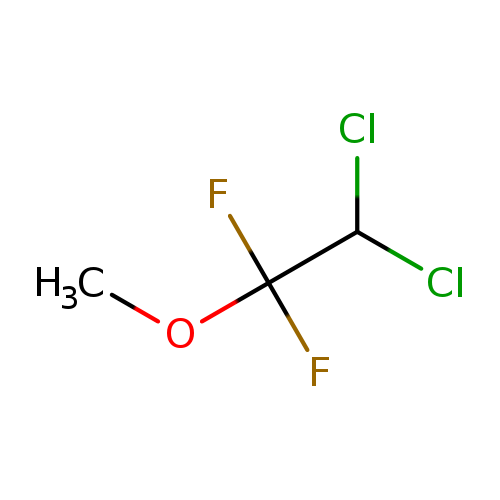
Methoxyflurane belongs to the ethers, a subclass of organooxygen compounds within the organic compounds. This exogenous liquid has the formula C3H4Cl2F2O and an average molecular weight of 164.97 g/mol. It is utilized as an inhalation anaesthetic and a non-narcotic analgesic. Biologically, the compound acts as a hepatotoxic agent and a nephrotoxic agent. Recorded exposure occurs via the respiratory route, with the compound found in analgesics, electrically stimulated smoking devices, conductors or conductive bodies characterised by the conductive materials, tobacco smoke filters, perfumes within detergents and soaps, non electric simulated smoking devices, and cigar cigarettes. The compound interacts with 24 recorded protein targets, including Gamma-aminobutyric acid receptor subunits alpha-1 (GABRA1), pi (GABRP), delta (GABRD), and beta-1 (GABRB1), as well as Calcium-transporting ATPase type 2C member 1 (ATP2C1). It acts as a positive allosteric modulator of Transient receptor potential cation channel subfamily A member 1 (TRPA1). Methoxyflurane binds to the GABA receptor, the glutamate receptor, and the large conductance Ca2+ activated potassium channel. It also appears to bind the D subunit of ATP synthase (ATP5F1D) and NADH dehydogenase (MT-ND1). Furthermore, methoxyflurane activates calcium dependent ATPase in the sarcoplasmic reticulum by increasing the fluidity of the lipid membrane. It induces a reduction in junctional conductance by increasing gap junction channel closing times and decreasing gap junction channel opening times.
Contaminant Type
  • Anesthetic, Inhalation
  • Drug
  • Ether
  • Human Neurotoxin
  • Lachrymator
  • Metabolite
  • Organic Compound
  • Organochloride
  • Organofluoride
  • Synthetic Compound
Chemical Structure
Synonyms
ValueSource
MethofluraneChEBI
MethoxyfluoranChEBI
MethoxyfluranChEBI
MethoxyfluranumChEBI
Methyl 1,1-difluoro-2,2-dichloroethyl etherChEBI
MetoxifluranoChEBI
PenthraneChEBI
MethoxifluraneHMDB
MethoxifluranumHMDB
MethoxyfluoraneHMDB
MetossifluranoHMDB
MetoxfluranHMDB
MetoxifluranHMDB
MethofluranumHMDB
AnecotanHMDB
PentraneHMDB
Chemical FormulaC3H4Cl2F2O
Average Molecular Mass164.966 g/mol
Monoisotopic Mass163.961 g/mol
CAS Registry Number76-38-0
IUPAC Name2,2-dichloro-1,1-difluoro-1-methoxyethane
Traditional Namemethoxyflurane
SMILESCOC(F)(F)C(Cl)Cl
InChI IdentifierInChI=1S/C3H4Cl2F2O/c1-8-3(6,7)2(4)5/h2H,1H3
InChI KeyRFKMCNOHBTXSMU-UHFFFAOYSA-N
Chemical Taxonomy
Description Belongs to the class of organic compounds known as dialkyl ethers. These are organic compounds containing the dialkyl ether functional group, with the formula ROR', where R and R' are alkyl groups.
KingdomOrganic compounds
Super ClassOrganic oxygen compounds
ClassOrganooxygen compounds
Sub ClassEthers
Direct ParentDialkyl ethers
Alternative Parents
Substituents
  • Dialkyl ether
  • Hydrocarbon derivative
  • Organofluoride
  • Organochloride
  • Organohalogen compound
  • Alkyl halide
  • Alkyl fluoride
  • Alkyl chloride
  • Aliphatic acyclic compound
Molecular FrameworkAliphatic acyclic compounds
External Descriptors
Biological Properties
StatusDetected and Not Quantified
OriginExogenous
Cellular Locations
  • Cytoplasm
  • Membrane
Biofluid LocationsNot Available
Tissue LocationsNot Available
Applications
Biological Roles
Chemical RolesNot Available
Organoleptic EffectsNot Available
Physical Properties
StateLiquid
AppearanceNot Available
Experimental Properties
PropertyValue
Melting Point-35°C
Boiling Point105°C
Solubility2.83E+004 mg/L (at 37°C)
Predicted Properties
PropertyValueSource
Water Solubility6.46 g/LALOGPS
logP2.01ALOGPS
logP2.31ChemAxon
logS-1.4ALOGPS
pKa (Strongest Basic)-4.5ChemAxon
Physiological Charge0ChemAxon
Hydrogen Acceptor Count1ChemAxon
Hydrogen Donor Count0ChemAxon
Polar Surface Area9.23 ŲChemAxon
Rotatable Bond Count2ChemAxon
Refractivity27.98 m³·mol⁻¹ChemAxon
Polarizability11.46 ųChemAxon
Number of Rings0ChemAxon
BioavailabilityYesChemAxon
Rule of FiveYesChemAxon
Ghose FilterNoChemAxon
Veber's RuleYesChemAxon
MDDR-like RuleNoChemAxon
Spectra
Spectra
Spectrum TypeDescriptionSplash KeyDeposition DateView
Predicted GC-MSPredicted GC-MS Spectrumsplash10-001i-9300000000-2b014e075c584d7d00e8Not AvailableView Spectrum
Predicted GC-MSPredicted GC-MS SpectrumNot AvailableNot AvailableView Spectrum
Predicted LC-MS/MSPredicted LC-MS/MS Spectrumsplash10-03e9-0900000000-31aa3948ca3dc3167617Not AvailableView Spectrum
Predicted LC-MS/MSPredicted LC-MS/MS Spectrumsplash10-03di-0900000000-286e18d415df7a2ecce2Not AvailableView Spectrum
Predicted LC-MS/MSPredicted LC-MS/MS Spectrumsplash10-001i-1900000000-a0e34ecec1f1427e9b36Not AvailableView Spectrum
Predicted LC-MS/MSPredicted LC-MS/MS Spectrumsplash10-03di-0900000000-5826e7c4a8fc419eecaaNot AvailableView Spectrum
Predicted LC-MS/MSPredicted LC-MS/MS Spectrumsplash10-03dl-0900000000-38434e069c688783ff1cNot AvailableView Spectrum
Predicted LC-MS/MSPredicted LC-MS/MS Spectrumsplash10-03ec-0900000000-f972b01b9fa825e56f30Not AvailableView Spectrum
Predicted LC-MS/MSPredicted LC-MS/MS Spectrumsplash10-03di-0900000000-c2759436c4d32d8702ceNot AvailableView Spectrum
Predicted LC-MS/MSPredicted LC-MS/MS Spectrumsplash10-03di-0900000000-f4a5c266171cbb5ab6fbNot AvailableView Spectrum
Predicted LC-MS/MSPredicted LC-MS/MS Spectrumsplash10-001i-8900000000-fbf5bd1b60bed06b6fa7Not AvailableView Spectrum
Predicted LC-MS/MSPredicted LC-MS/MS Spectrumsplash10-001i-9100000000-f375f8e7cda89aed201fNot AvailableView Spectrum
Predicted LC-MS/MSPredicted LC-MS/MS Spectrumsplash10-01q9-9500000000-8e6af6b8d5c2905c7078Not AvailableView Spectrum
Predicted LC-MS/MSPredicted LC-MS/MS Spectrumsplash10-03di-0900000000-d7dee0ac770c9b80f6d9Not AvailableView Spectrum
MSMS Spectrumsplash10-001i-9100000000-e9387eb71a01da84865eNot AvailableView Spectrum
1D NMR1H NMR Spectrum (1D, D2O, predicted)Not AvailableNot AvailableView Spectrum
1D NMR13C NMR Spectrum (1D, D2O, predicted)Not AvailableNot AvailableView Spectrum
Toxicity Profile
Toxicity Values
Toxicity ValueOrganismDose DescriptorRoute of ExposurePredicted or ExperimentalToxicity RatingReference
3600.0 mg/kg RatLD50OralexperimentalNot Available1
2102.0 Log mg/kg [1200:3700]RatLD50oralpredictedNot AvailableNot Available
Toxicity / Toxin ClassNot Available
Mechanism of ToxicityMethoxyflurane induces a reduction in junctional conductance by decreasing gap junction channel opening times and increasing gap junction channel closing times. Methoxyflurane also activates calcium dependent ATPase in the sarcoplasmic reticulum by increasing the fluidity of the lipid membrane. It also appears to bind the D subunit of ATP synthase and NADH dehydogenase. Methoxyflurane also binds to the GABA receptor, the large conductance Ca2+ activated potassium channel, the glutamate receptor and the glycine receptor.
Carcinogenicity (IARC Classification)No indication of carcinogenicity to humans (not listed by IARC).
Minimum Risk LevelNot Available
SymptomsSymptoms of overexposure include eye irritation, CNS depression, analgesia, anesthesia, seizures, respiratory depression, and liver and kidney damage.
TreatmentNot Available
Health Effects
Health EffectRelationshipDirectionDescriptionReference
AnesthesiaAssociated With?Not AvailableNot AvailablePMC12919125
acute kidney injuryAssociated With?Not AvailableNot AvailablePMC1858334
Exposure Sources
Source IDSourceSectorReference
CEDs000010Insecticides?Insecticides are synthetic chemicals designed to control or eliminate insect pests that threaten crops and other agricultural products.Agriculture & land managementPubChem
CEDs000370Analgesics?Analgesics are a class of synthetic chemicals designed to alleviate pain.Healthcare, pharmaceuticals & veterinary productsNot Available
CEDs000511Conductors Or Conductive Bodies Characterised By The Conductive Materials?Conductors, or conductive bodies, are materials that allow the flow of electrical current, typically made from metals such as copper, aluminum, or silver.Electrical & Electronic EquipmentPubChem
CEDs000518Electrically Stimulated Smoking Devices?Electrically stimulated smoking devices, commonly known as e-cigarettes or vape pens, utilize electrical components to heat a liquid solution, often containing nicotine, flavorings, and other additives, to produce an aerosol for inhalation.Electrical & Electronic EquipmentPubChem
CEDs000556Cigar Cigarettes?Cigar cigarettes are a source of synthetic chemical contamination due to the combustion of various tobacco blends and additives.Household cleaning & consumer productsPubChem
CEDs000559Non Electric Simulated Smoking Devices?Non-electric simulated smoking devices, often designed to mimic the experience of smoking without combustion, can be sources of synthetic chemical contamination due to the materials and chemicals used in their construction and operation.Household cleaning & consumer productsPubChem
CEDs000561Perfumes Within Detergents And Soaps?Perfumes within detergents and soaps are synthetic fragrance compounds added to enhance the sensory experience of cleaning products.Household cleaning & consumer productsPubChem
CEDs000569Tobacco Smoke Filters?Tobacco smoke filters are designed to reduce the inhalation of harmful substances in cigarette smoke, including tar and other particulate matter.Household cleaning & consumer productsPubChem
CEDs000580Manufacture Preparation Of Tobacco Products?The manufacture and preparation of tobacco products involve various processes that can result in the introduction of synthetic chemicals into the environment.Industrial manufacturing & chemical processingPubChem
CEDs000596Acaricides?Acaricides are synthetic chemicals specifically designed to target and control mite populations that can damage crops and plants.Agriculture & land managementPubChem
CEDs000605Pest Repellants?Pest repellents, often formulated from synthetic chemicals, are widely used to protect crops from insect infestations and other pests.Agriculture & land managementPubChem
CEDs000610Aftersun Products?Aftersun products are designed to soothe and hydrate the skin after sun exposure, often containing various synthetic chemicals such as emollients, preservatives, and fragrances.Personal care & cosmeticsPubChem
CEDs000611Anti Perspirants Or Body Deoderants?Antiperspirants and body deodorants commonly contain synthetic chemicals such as aluminum compounds, parabens, and synthetic fragrances.Personal care & cosmeticsPubChem
CEDs000615Eye Makeup Products?Eye makeup products, including mascaras, eyeliners, and eyeshadows, often contain a variety of synthetic chemicals such as pigments, preservatives, and film-forming agents.Personal care & cosmeticsPubChem
CEDs000618Lip Makeup Products?Lip makeup products, such as lipsticks, lip glosses, and lip liners, often contain a variety of synthetic chemicals, including pigments, preservatives, and emollients.Personal care & cosmeticsPubChem
CEDs000632Apparel?Apparel production often involves the use of various synthetic chemicals, including dyes, finishing agents, and preservatives.Textiles, leather & furnishingsPubChem
CEDs000642Footwear?Footwear production often involves the use of various synthetic chemicals, such as adhesives, dyes, and treatments, which can contribute to environmental contamination.Textiles, leather & furnishingsPubChem
CEDs000650Purses Luggage Hand Bags?Purses, luggage, and handbags are often manufactured using synthetic materials such as polyvinyl chloride (PVC), polyurethane, and various types of nylon.Textiles, leather & furnishingsPubChem
CEDs000651Purses Money Bags Wallets?Purses, money bags, and wallets are often manufactured using synthetic materials, including plastics, polyurethanes, and various treated fabrics.Textiles, leather & furnishingsPubChem
CEDs000671Airplanes And Helicopters?Airplanes and helicopters are significant sources of synthetic chemical contamination primarily through the use of aviation fuels, lubricants, and de-icing agents.Aviation & AerospacePubChem
CEDs000685Ceramics?Ceramics can be a source of synthetic chemical contamination through various additives and processing agents used in their production.Building & ConstructionPubChem
CEDs000688Glass Coatings?Glass coatings are synthetic chemical formulations applied to glass surfaces to enhance properties such as durability, UV resistance, and aesthetic appeal.Building & ConstructionPubChem
CEDs000696Nanotechnology?Nanotechnology involves the manipulation of materials at the molecular or atomic level, typically within the range of 1 to 100 nanometers.Industrial manufacturing & chemical processingPubChem
CEDs000699Mining Or Quarrying?Mining and quarrying operations can lead to synthetic chemical contamination through the release of various pollutants associated with the extraction and processing of minerals.Mining & metal processingPubChem
CEDs000739Inks?Inks are complex mixtures composed of pigments or dyes, solvents, resins, and additives used primarily for printing and writing applications.Paper, pulp & fiber productsPubChem
CEDs000740Paper?Paper production involves the processing of wood fibers and the use of various chemicals, which can lead to synthetic chemical contamination.Paper, pulp & fiber productsPubChem
CEDs000743Sludge Treatment?Sludge treatment involves the processing of waste materials generated from wastewater treatment plants, which often contain a variety of organic and inorganic substances.Wastewater, sanitation & biosolidsPubChem
CEDs000744Water, Wastewater, & Sewage Treatment?Water, wastewater, and sewage treatment processes are critical for managing and mitigating pollutants in water systems.Wastewater, sanitation & biosolidsPubChem
CEDs01920Silicon RubberIndustrial manufacturing & chemical processingPMC9026426
Pathways
2 pathwaysPathway Source: PathBank
Targets
StructureProteinUniProt IDOrganismRelationshipDetails
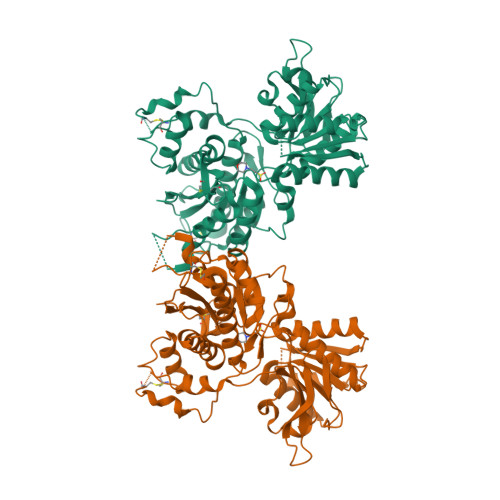
Albumin structureClick to view 3D structureAlbuminP02768HumansKnownNot Available
Inward rectifier potassium channel 2 structureClick to view 3D structureInward rectifier potassium channel 2P35561Mus musculusPredicted (SEA)
Prediction Confidence Score
0.154
Applicability Domain
0.154 Low confidence
Statistical Significance
0.2501
Supporting Reference Compounds
1
E-value
1947.32
5-hydroxytryptamine receptor 2C structureClick to view 3D structure5-hydroxytryptamine receptor 2CP28335HumansPredicted (SEA)
Prediction Confidence Score
0.139
Applicability Domain
0.158 Low confidence
Statistical Significance
0.9968
Supporting Reference Compounds
823
E-value
7759.7
Click to view 3D structureACCaseH9BT73Alopecurus japonicusPredicted (SEA)
Prediction Confidence Score
0.137
Applicability Domain
0.137 Low confidence
Statistical Significance
0.3565
Supporting Reference Compounds
1
E-value
2775.01
5-hydroxytryptamine receptor 2A structureClick to view 3D structure5-hydroxytryptamine receptor 2AP28223HumansPredicted (SEA)
Prediction Confidence Score
0.137
Applicability Domain
0.158 Low confidence
Statistical Significance
0.9978
Supporting Reference Compounds
955
E-value
7767.64
Liver carboxylesterase structureClick to view 3D structureLiver carboxylesteraseQ29550Sus scrofaPredicted (SEA)
Prediction Confidence Score
0.135
Applicability Domain
0.154 Low confidence
Statistical Significance
0.4338
Supporting Reference Compounds
20
E-value
3377.25
5-hydroxytryptamine receptor 6 structureClick to view 3D structure5-hydroxytryptamine receptor 6P50406HumansPredicted (SEA)
Prediction Confidence Score
0.131
Applicability Domain
0.143 Low confidence
Statistical Significance
0.9965
Supporting Reference Compounds
536
E-value
7757.75
Click to view 3D structureCholesteryl ester transfer proteinP22687Oryctolagus cuniculusPredicted (SEA)
Prediction Confidence Score
0.128
Applicability Domain
0.129 Low confidence
Statistical Significance
0.186
Supporting Reference Compounds
2
E-value
1448.38
Click to view 3D structureCocaine esteraseO00748HumansPredicted (SEA)
Prediction Confidence Score
0.128
Applicability Domain
0.143 Low confidence
Statistical Significance
0.8356
Supporting Reference Compounds
40
E-value
6505.16
5-hydroxytryptamine receptor 2B structureClick to view 3D structure5-hydroxytryptamine receptor 2BP41595HumansPredicted (SEA)
Prediction Confidence Score
0.126
Applicability Domain
0.143 Low confidence
Statistical Significance
0.999
Supporting Reference Compounds
686
E-value
7776.98
Acylcarnitine hydrolase structureClick to view 3D structureAcylcarnitine hydrolaseQ91WG0Mus musculusPredicted (SEA)
Prediction Confidence Score
0.125
Applicability Domain
0.143 Low confidence
Statistical Significance
0.0351
Supporting Reference Compounds
2
E-value
273.562
Sodium-dependent serotonin transporter structureClick to view 3D structureSodium-dependent serotonin transporterP31645HumansPredicted (SEA)
Prediction Confidence Score
0.125
Applicability Domain
0.133 Low confidence
Statistical Significance
0.9986
Supporting Reference Compounds
593
E-value
7774.02
Voltage-gated inwardly rectifying potassium channel KCNH2 structureClick to view 3D structureVoltage-gated inwardly rectifying potassium channel KCNH2Q12809HumansPredicted (SEA)
Prediction Confidence Score
0.124
Applicability Domain
0.133 Low confidence
Statistical Significance
0.9994
Supporting Reference Compounds
1498
E-value
7780.41
Acetylcholinesterase structureClick to view 3D structureAcetylcholinesteraseP22303HumansPredicted (SEA)
Prediction Confidence Score
0.123
Applicability Domain
0.154 Low confidence
Statistical Significance
0.9983
Supporting Reference Compounds
406
E-value
7772.0
Liver carboxylesterase 1 structureClick to view 3D structureLiver carboxylesterase 1P23141HumansPredicted (SEA)
Prediction Confidence Score
0.122
Applicability Domain
0.14 Low confidence
Statistical Significance
0.8724
Supporting Reference Compounds
55
E-value
6791.64
Cytochrome P450 2C9 structureClick to view 3D structureCytochrome P450 2C9P11712HumansPredicted (SEA)
Prediction Confidence Score
0.122
Applicability Domain
0.143 Low confidence
Statistical Significance
0.9993
Supporting Reference Compounds
1245
E-value
7779.55
5-hydroxytryptamine receptor 7 structureClick to view 3D structure5-hydroxytryptamine receptor 7P34969HumansPredicted (SEA)
Prediction Confidence Score
0.122
Applicability Domain
0.143 Low confidence
Statistical Significance
0.9984
Supporting Reference Compounds
565
E-value
7772.23
5-hydroxytryptamine receptor 1A structureClick to view 3D structure5-hydroxytryptamine receptor 1AP08908HumansPredicted (SEA)
Prediction Confidence Score
0.121
Applicability Domain
0.143 Low confidence
Statistical Significance
0.999
Supporting Reference Compounds
953
E-value
7777.29
Click to view 3D structureCG8425-PA [Drosophila melanogaster]A1ZA98Drosophila melanogasterPredicted (SEA)
Prediction Confidence Score
0.121
Applicability Domain
0.143 Low confidence
Statistical Significance
0.0417
Supporting Reference Compounds
4
E-value
324.709
Metabotropic glutamate receptor 7 structureClick to view 3D structureMetabotropic glutamate receptor 7P35400Rattus norvegicusPredicted (SEA)
Prediction Confidence Score
0.121
Applicability Domain
0.13 Low confidence
Statistical Significance
0.9369
Supporting Reference Compounds
27
E-value
7294.0
Click to view 3D structureSodium-dependent serotonin transporterP31652Rattus norvegicusPredicted (SEA)
Prediction Confidence Score
0.12
Applicability Domain
0.133 Low confidence
Statistical Significance
0.9949
Supporting Reference Compounds
297
E-value
7745.37
Click to view 3D structureMetabotropic glutamate receptor 8P70579Rattus norvegicusPredicted (SEA)
Prediction Confidence Score
0.12
Applicability Domain
0.13 Low confidence
Statistical Significance
0.8592
Supporting Reference Compounds
28
E-value
6688.81
Cytochrome P450 2D6 structureClick to view 3D structureCytochrome P450 2D6P10635HumansPredicted (SEA)
Prediction Confidence Score
0.12
Applicability Domain
0.133 Low confidence
Statistical Significance
0.9995
Supporting Reference Compounds
1130
E-value
7780.8
Click to view 3D structureFatty-acid amide hydrolase 1O08914Mus musculusPredicted (SEA)
Prediction Confidence Score
0.119
Applicability Domain
0.128 Low confidence
Statistical Significance
0.9472
Supporting Reference Compounds
46
E-value
7373.64
Cytochrome P450 3A4 structureClick to view 3D structureCytochrome P450 3A4P08684HumansPredicted (SEA)
Prediction Confidence Score
0.118
Applicability Domain
0.133 Low confidence
Statistical Significance
0.9996
Supporting Reference Compounds
1538
E-value
7781.96
Cytochrome P450 1A2 structureClick to view 3D structureCytochrome P450 1A2P05177HumansPredicted (SEA)
Prediction Confidence Score
0.118
Applicability Domain
0.122 Low confidence
Statistical Significance
0.9992
Supporting Reference Compounds
793
E-value
7778.93
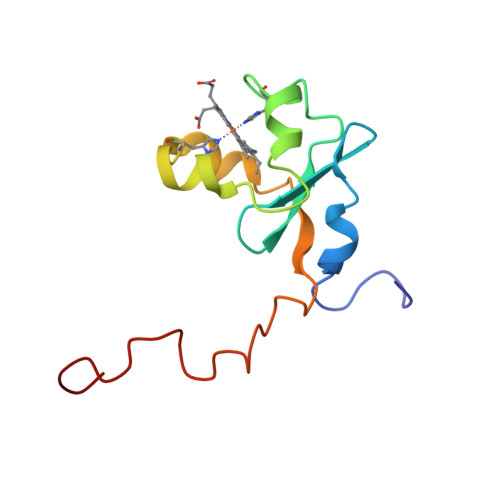
Cytochrome b5 structureClick to view 3D structureCytochrome b5P00167HumansKnownMethoxyflurane induces a reduction in junctional conductance by decreasing gap junction channel opening times and increasing gap junction channel closing times. Methoxyflurane also activates calcium dependent ATPase in the sarcoplasmic reticulum by increasing the fluidity of the lipid membrane. It also appears to bind the D subunit of ATP synthase and NADH dehydogenase. Methoxyflurane also binds to the GABA receptor, the large conductance Ca2+ activated potassium channel, the glutamate receptor and the glycine receptor.
ATP synthase F(1) complex subunit delta, mitochondrial structureClick to view 3D structureATP synthase F(1) complex subunit delta, mitochondrialP30049HumansKnownMethoxyflurane induces a reduction in junctional conductance by decreasing gap junction channel opening times and increasing gap junction channel closing times. Methoxyflurane also activates calcium dependent ATPase in the sarcoplasmic reticulum by increasing the fluidity of the lipid membrane. It also appears to bind the D subunit of ATP synthase and NADH dehydogenase. Methoxyflurane also binds to the GABA receptor, the large conductance Ca2+ activated potassium channel, the glutamate receptor and the glycine receptor.
Calcium-transporting ATPase type 2C member 1 structureClick to view 3D structureCalcium-transporting ATPase type 2C member 1P98194HumansKnownMethoxyflurane induces a reduction in junctional conductance by decreasing gap junction channel opening times and increasing gap junction channel closing times. Methoxyflurane also activates calcium dependent ATPase in the sarcoplasmic reticulum by increasing the fluidity of the lipid membrane. It also appears to bind the D subunit of ATP synthase and NADH dehydogenase. Methoxyflurane also binds to the GABA receptor, the large conductance Ca2+ activated potassium channel, the glutamate receptor and the glycine receptor.
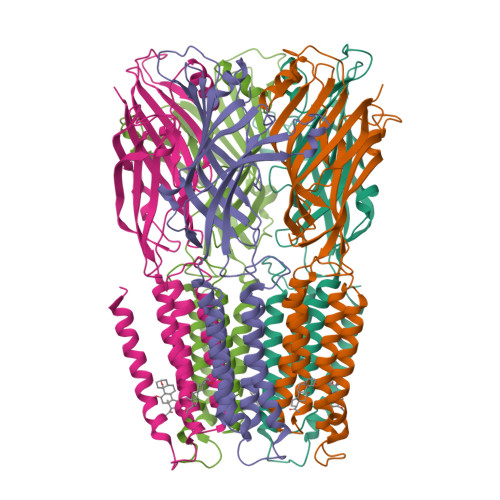
Gamma-aminobutyric acid receptor subunit alpha-1 structureClick to view 3D structureGamma-aminobutyric acid receptor subunit alpha-1P14867HumansKnownMethoxyflurane induces a reduction in junctional conductance by decreasing gap junction channel opening times and increasing gap junction channel closing times. Methoxyflurane also activates calcium dependent ATPase in the sarcoplasmic reticulum by increasing the fluidity of the lipid membrane. It also appears to bind the D subunit of ATP synthase and NADH dehydogenase. Methoxyflurane also binds to the GABA receptor, the large conductance Ca2+ activated potassium channel, the glutamate receptor and the glycine receptor.
Glutamate receptor 1 structureClick to view 3D structureGlutamate receptor 1P42261HumansKnownMethoxyflurane induces a reduction in junctional conductance by decreasing gap junction channel opening times and increasing gap junction channel closing times. Methoxyflurane also activates calcium dependent ATPase in the sarcoplasmic reticulum by increasing the fluidity of the lipid membrane. It also appears to bind the D subunit of ATP synthase and NADH dehydogenase. Methoxyflurane also binds to the GABA receptor, the large conductance Ca2+ activated potassium channel, the glutamate receptor and the glycine receptor.
Glycine receptor subunit alpha-1 structureClick to view 3D structureGlycine receptor subunit alpha-1P23415HumansKnownMethoxyflurane induces a reduction in junctional conductance by decreasing gap junction channel opening times and increasing gap junction channel closing times. Methoxyflurane also activates calcium dependent ATPase in the sarcoplasmic reticulum by increasing the fluidity of the lipid membrane. It also appears to bind the D subunit of ATP synthase and NADH dehydogenase. Methoxyflurane also binds to the GABA receptor, the large conductance Ca2+ activated potassium channel, the glutamate receptor and the glycine receptor.
NADH-ubiquinone oxidoreductase chain 1 structureClick to view 3D structureNADH-ubiquinone oxidoreductase chain 1P03886HumansKnownMethoxyflurane induces a reduction in junctional conductance by decreasing gap junction channel opening times and increasing gap junction channel closing times. Methoxyflurane also activates calcium dependent ATPase in the sarcoplasmic reticulum by increasing the fluidity of the lipid membrane. It also appears to bind the D subunit of ATP synthase and NADH dehydogenase. Methoxyflurane also binds to the GABA receptor, the large conductance Ca2+ activated potassium channel, the glutamate receptor and the glycine receptor.
Click to view 3D structurePotassium voltage-gated channel subfamily A member 1Q09470HumansKnownMethoxyflurane induces a reduction in junctional conductance by decreasing gap junction channel opening times and increasing gap junction channel closing times. Methoxyflurane also activates calcium dependent ATPase in the sarcoplasmic reticulum by increasing the fluidity of the lipid membrane. It also appears to bind the D subunit of ATP synthase and NADH dehydogenase. Methoxyflurane also binds to the GABA receptor, the large conductance Ca2+ activated potassium channel, the glutamate receptor and the glycine receptor.
Transient receptor potential cation channel subfamily A member 1 structureClick to view 3D structureTransient receptor potential cation channel subfamily A member 1O75762HumansKnownNot Available
Concentrations
Not Available
External Links
DrugBank IDDB01028
HMDB IDHMDB0015162
FooDB IDNot Available
Phenol Explorer IDNot Available
KNApSAcK IDNot Available
BiGG IDNot Available
BioCyc IDNot Available
METLIN IDNot Available
PDB IDNot Available
Wikipedia LinkMethoxyflurane
Chemspider ID3973
ChEBI ID6843
PubChem Compound ID4116
Kegg Compound IDC07517
YMDB IDNot Available
ECMDB IDNot Available
References
Synthesis ReferenceNot Available
MSDSLink
General References
  1. Wishart DS, Knox C, Guo AC, Cheng D, Shrivastava S, Tzur D, Gautam B, Hassanali M: DrugBank: a knowledgebase for drugs, drug actions and drug targets. Nucleic Acids Res. 2008 Jan;36(Database issue):D901-6. Epub 2007 Nov 29. [PubMed: 18048412]
  2. Drugs.com - http://www.drugs.com/cons/Methoxyflurane.html