Escitalopram (CED0002175)

Record Information
Version1.0
Creation Date2009-07-21 20:28:32 UTC
Update Date2026-05-14 16:58:29 UTC
SynCED IDCED0002175
Secondary Accession Numbers
  • CHEM002365
  • T3D3007
Identification
Common NameEscitalopram
ClassSmall Molecule
Description
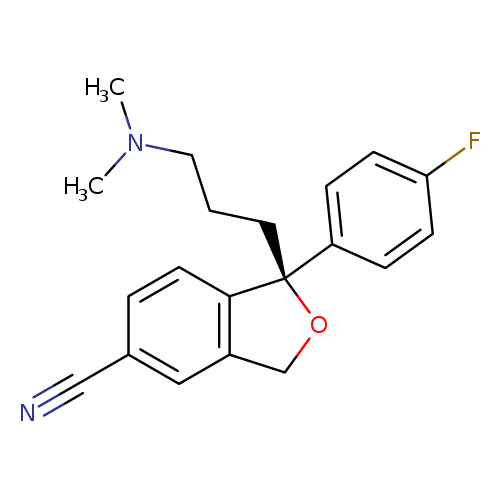
Escitalopram is an exogenous organic compound with the formula C20H21FN2O and an average molecular weight of 324.39 g/mol. It exists as a solid at room temperature. Escitalopram belongs to the phenylbutylamines, a subclass of benzene and substituted derivatives within the organic compounds. This compound acts as an antidepressant and a prolyl oligopeptidase (EC 3.4.21.26) inhibitor. Its antidepressant, antiobsessive-compulsive, and antibulimic actions are presumed to be linked to its inhibition of CNS neuronal uptake of serotonin. Escitalopram blocks the reuptake of serotonin at the serotonin reuptake pump of the neuronal membrane, which enhances the actions of serotonin on 5HT1A autoreceptors. It serves as an inhibitor of the sodium-dependent serotonin transporter (SLC6A4), as well as the sodium-dependent dopamine transporter (SLC6A3), the sodium-dependent noradrenaline transporter (SLC6A2), the alpha-1A adrenergic receptor (ADRA1A), the muscarinic acetylcholine receptor M1 (CHRM1), and 10 other proteins. Compared to tricyclic antidepressant drugs, SSRIs bind with significantly less affinity to norepinephrine, acetylcholine, and histamine receptors. Escitalopram is used as a treatment for depression (PMC4457595 ), although it is associated with weight gain (PMC11916920 ). It has been recorded in several sources, including antidepressants within healthcare, pharmaceuticals, and veterinary products; drinking water and water supply; fish processing within food and cookware; household cleaning and consumer products such as other smoking requisites and non-electric simulated smoking devices; and electrical and electronic equipment, including radio transmission systems and electric hearing aids. The recorded exposure route for this compound is oral.
Contaminant Type
  • Amine
  • Antidepressant, Second-Generation
  • Antidepressive Agent, Second-Generation
  • Drug
  • Ether
  • Food Toxin
  • Human Neurotoxin
  • Metabolite
  • Nitrile
  • Organic Compound
  • Organofluoride
  • Serotonin Uptake Inhibitor
  • Synthetic Compound
Chemical Structure
Synonyms
ValueSource
(+)-CitalopramChEBI
(S)-CitalopramChEBI
EscitalopramumChEBI
EsertiaChEBI
S(+)-CitalopramChEBI
S-(+)-CitalopramChEBI
CipralexHMDB
LexaproHMDB
CytalopramHMDB
CitalopramHMDB
CelexaHMDB
Citalopram hydrobromideHMDB
Escitalopram oxalateHMDB
SeropramHMDB
Chemical FormulaC20H21FN2O
Average Molecular Mass324.392 g/mol
Monoisotopic Mass324.164 g/mol
CAS Registry Number128196-01-0
IUPAC Name(1S)-1-[3-(dimethylamino)propyl]-1-(4-fluorophenyl)-1,3-dihydro-2-benzofuran-5-carbonitrile
Traditional Namelexapro
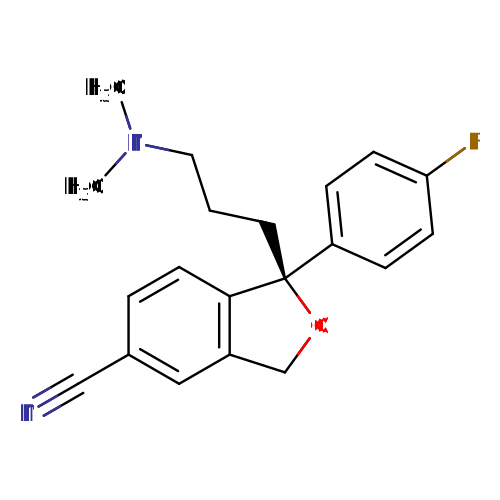
SMILESCN(C)CCC[C@]1(OCC2=C1C=CC(=C2)C#N)C1=CC=C(F)C=C1
InChI IdentifierInChI=1S/C20H21FN2O/c1-23(2)11-3-10-20(17-5-7-18(21)8-6-17)19-9-4-15(13-22)12-16(19)14-24-20/h4-9,12H,3,10-11,14H2,1-2H3/t20-/m0/s1
InChI KeyWSEQXVZVJXJVFP-FQEVSTJZSA-N
Chemical Taxonomy
Description Belongs to the class of organic compounds known as phenylbutylamines. Phenylbutylamines are compounds containing a phenylbutylamine moiety, which consists of a phenyl group substituted at the fourth carbon by an butan-1-amine.
KingdomOrganic compounds
Super ClassBenzenoids
ClassBenzene and substituted derivatives
Sub ClassPhenylbutylamines
Direct ParentPhenylbutylamines
Alternative Parents
Substituents
  • Phenylbutylamine
  • Isocoumaran
  • Fluorobenzene
  • Halobenzene
  • Aralkylamine
  • Aryl halide
  • Aryl fluoride
  • Tertiary amine
  • Tertiary aliphatic amine
  • Oxacycle
  • Dialkyl ether
  • Ether
  • Carbonitrile
  • Nitrile
  • Organoheterocyclic compound
  • Organic oxygen compound
  • Organopnictogen compound
  • Amine
  • Organohalogen compound
  • Organofluoride
  • Organonitrogen compound
  • Organooxygen compound
  • Organic nitrogen compound
  • Hydrocarbon derivative
  • Aromatic heteropolycyclic compound
Molecular FrameworkAromatic heteropolycyclic compounds
External Descriptors
  • 1-[3-(dimethylamino)propyl]-1-(4-fluorophenyl)-1,3-dihydro-2-benzofuran-5-carbonitrile (CHEBI:36791 )
Biological Properties
StatusDetected and Not Quantified
OriginExogenous
Cellular Locations
  • Membrane
Biofluid LocationsNot Available
Tissue LocationsNot Available
Applications
Biological Roles
Chemical Roles
Organoleptic EffectsNot Available
Physical Properties
StateSolid
AppearanceWhite powder.
Experimental Properties
PropertyValue
Melting PointNot Available
Boiling PointNot Available
SolubilityNot Available
Predicted Properties
PropertyValueSource
Water Solubility0.0059 g/LALOGPS
logP3.58ALOGPS
logP3.76ChemAxon
logS-4.7ALOGPS
pKa (Strongest Basic)9.78ChemAxon
Physiological Charge1ChemAxon
Hydrogen Acceptor Count3ChemAxon
Hydrogen Donor Count0ChemAxon
Polar Surface Area36.26 ŲChemAxon
Rotatable Bond Count5ChemAxon
Refractivity94.02 m³·mol⁻¹ChemAxon
Polarizability35.21 ųChemAxon
Number of Rings3ChemAxon
BioavailabilityYesChemAxon
Rule of FiveYesChemAxon
Ghose FilterYesChemAxon
Veber's RuleYesChemAxon
MDDR-like RuleNoChemAxon
Spectra
Spectra
Spectrum TypeDescriptionSplash KeyDeposition DateView
Predicted GC-MSPredicted GC-MS Spectrumsplash10-000i-6190000000-9c092c583199a2a486efNot AvailableView Spectrum
Predicted GC-MSPredicted GC-MS SpectrumNot AvailableNot AvailableView Spectrum
LC-MS/MSLC-MS/MS Spectrumsplash10-004i-1497000000-a840cd3176ff240d74f6Not AvailableView Spectrum
LC-MS/MSLC-MS/MS Spectrumsplash10-0bt9-0692000000-dbd03d31621a5efaba54Not AvailableView Spectrum
Predicted LC-MS/MSPredicted LC-MS/MS Spectrumsplash10-004i-1029000000-b0f10b0f7897ca083ed5Not AvailableView Spectrum
Predicted LC-MS/MSPredicted LC-MS/MS Spectrumsplash10-003r-2294000000-5935fccdd160458bb836Not AvailableView Spectrum
Predicted LC-MS/MSPredicted LC-MS/MS Spectrumsplash10-00di-9740000000-7a3a98de78c385feae56Not AvailableView Spectrum
Predicted LC-MS/MSPredicted LC-MS/MS Spectrumsplash10-00di-0019000000-84c6ddc8fad411d8541fNot AvailableView Spectrum
Predicted LC-MS/MSPredicted LC-MS/MS Spectrumsplash10-00di-1029000000-d4716f92fec4a098ef2cNot AvailableView Spectrum
Predicted LC-MS/MSPredicted LC-MS/MS Spectrumsplash10-0005-5290000000-45334fd57d41c1fadf1aNot AvailableView Spectrum
Predicted LC-MS/MSPredicted LC-MS/MS Spectrumsplash10-004i-0009000000-5baf9d241e4712801e87Not AvailableView Spectrum
Predicted LC-MS/MSPredicted LC-MS/MS Spectrumsplash10-004i-3079000000-3efd9cf0f4fddbeed2c9Not AvailableView Spectrum
Predicted LC-MS/MSPredicted LC-MS/MS Spectrumsplash10-0a4i-1950000000-69ba9b80f8bec9cbe874Not AvailableView Spectrum
Predicted LC-MS/MSPredicted LC-MS/MS Spectrumsplash10-00di-0009000000-23521c8b9dc4834c9328Not AvailableView Spectrum
Predicted LC-MS/MSPredicted LC-MS/MS Spectrumsplash10-000i-0091000000-bdb51930294423bb3315Not AvailableView Spectrum
Predicted LC-MS/MSPredicted LC-MS/MS Spectrumsplash10-000i-1590000000-b821092ee64991ad4390Not AvailableView Spectrum
Toxicity Profile
Toxicity Values
Toxicity ValueOrganismDose DescriptorRoute of ExposurePredicted or ExperimentalToxicity RatingReference
234.0 Log mg/kg [130:420]RatLD50oralpredictedNot AvailableNot Available
Toxicity / Toxin ClassNot Available
Mechanism of ToxicityThe antidepressant, antiobsessive-compulsive, and antibulimic actions of escitalopram are presumed to be linked to its inhibition of CNS neuronal uptake of serotonin. Escitalopram blocks the reuptake of serotonin at the serotonin reuptake pump of the neuronal membrane, enhancing the actions of serotonin on 5HT1A autoreceptors. SSRIs bind with significantly less affinity to histamine, acetylcholine, and norepinephrine receptors than tricyclic antidepressant drugs.
Carcinogenicity (IARC Classification)No indication of carcinogenicity to humans (not listed by IARC).
Minimum Risk LevelNot Available
SymptomsSigns of overdose include convulsions, coma, dizziness, hypotension, insomnia, nausea, vomiting, sinus tachycardia, somnolence, and ECG changes (including QT prolongation).
TreatmentEstablish and maintain an airway to ensure adequate ventilation and oxygenation. Gastric evacuation by lavage and use of activated charcoal should be considered. Careful observation and cardiac and vital sign monitoring are recommended, along with general symptomatic and supportive care. Due to the large volume of distribution of escitalopram, forced diuresis, dialysis, hemoperfusion, and exchange transfusion are unlikely to be of benefit. There are no specific antidotes for Escitalopram. (7)
Health Effects
Health EffectRelationshipDirectionDescriptionReference
weight gainAssociated With?Not AvailableA finding characterized by an increase in overall body weight; for pediatrics, greater than the baseline growth curve. (NCI CTCAE)PMC11916920
depressionNot AvailableNot AvailableNot AvailablePMC4457595
major depressive disorderNot AvailableNot AvailableAn endogenous depression that is characterized by an all-encompassing low mood accompanied by low self-esteem, and by loss of interest or pleasure in normally enjoyable activities. (DO)PMC6595891 , PMC6300990
agitationNot AvailableNot AvailableA disorder characterized by a state of restlessness associated with unpleasant feelings of irritability and tension. (NCI CTCAE)PMC11859965
anxiety disorderNot AvailableNot AvailableNot AvailablePMC11859965
depressive disorderNot AvailableNot AvailableNot AvailablePMC11859965 , PMC8566020
generalized anxiety disorderNot AvailableNot AvailableNot AvailablePMC9783879 , PMC8566020
ApathyNot AvailableNot AvailableNot AvailablePMC11859965
Exposure Sources
Source IDSourceSectorReference
CEDs000010Insecticides?Insecticides are synthetic chemicals designed to control or eliminate insect pests that threaten crops and other agricultural products.Agriculture & land managementPubChem
CEDs000115Drinking water?Drinking water can be a medium for synthetic chemical contamination, often originating from various industrial processes and agricultural practices.Drinking water & water supplyNot Available
CEDs000377Antidepressants?Antidepressants, a class of synthetic chemicals designed to alleviate symptoms of depression and anxiety, can enter the environment through various pathways, leading to contamination of water systems.Healthcare, pharmaceuticals & veterinary productsNot Available
CEDs000516Electric Hearing Aids?Electric hearing aids are small electronic devices designed to amplify sound for individuals with hearing loss.Electrical & Electronic EquipmentPubChem
CEDs000518Electrically Stimulated Smoking Devices?Electrically stimulated smoking devices, commonly known as e-cigarettes or vape pens, utilize electrical components to heat a liquid solution, often containing nicotine, flavorings, and other additives, to produce an aerosol for inhalation.Electrical & Electronic EquipmentPubChem
CEDs000519Electrodes?Electrodes, used in various electrical and electronic applications, can be a source of synthetic chemical contamination due to the materials from which they are constructed and the processes involved in their manufacturing.Electrical & Electronic EquipmentPubChem
CEDs000530Radio Transmission Systems?Radio transmission systems utilize a variety of synthetic chemicals in their manufacturing and maintenance processes.Electrical & Electronic EquipmentPubChem
CEDs000545Food Preservation?Food preservation often involves the use of synthetic chemicals, such as preservatives, flavor enhancers, and color additives, to extend shelf life and enhance the sensory qualities of food products.Food, food processing & cookwarePubChem
CEDs000551Processing Fish?Processing fish can lead to synthetic chemical contamination through various stages of production and preservation.Food, food processing & cookwarePubChem
CEDs000556Cigar Cigarettes?Cigar cigarettes are a source of synthetic chemical contamination due to the combustion of various tobacco blends and additives.Household cleaning & consumer productsPubChem
CEDs000559Non Electric Simulated Smoking Devices?Non-electric simulated smoking devices, often designed to mimic the experience of smoking without combustion, can be sources of synthetic chemical contamination due to the materials and chemicals used in their construction and operation.Household cleaning & consumer productsPubChem
CEDs000560Other Smoking Requisites?Other smoking requisites, including items such as lighters, matches, and rolling papers, can introduce synthetic chemical contamination through various components and additives.Household cleaning & consumer productsPubChem
CEDs000561Perfumes Within Detergents And Soaps?Perfumes within detergents and soaps are synthetic fragrance compounds added to enhance the sensory experience of cleaning products.Household cleaning & consumer productsPubChem
CEDs000563Soap Detergents?Soap detergents are synthetic surfactants designed to enhance the cleaning efficacy of water by reducing surface tension, allowing for better interaction with dirt and grease.Household cleaning & consumer productsPubChem
CEDs000580Manufacture Preparation Of Tobacco Products?The manufacture and preparation of tobacco products involve various processes that can result in the introduction of synthetic chemicals into the environment.Industrial manufacturing & chemical processingPubChem
CEDs000596Acaricides?Acaricides are synthetic chemicals specifically designed to target and control mite populations that can damage crops and plants.Agriculture & land managementPubChem
CEDs000602Molluscicides?Molluscicides are synthetic chemicals specifically designed to control and eliminate mollusks, such as snails and slugs, which can be detrimental to crops and agricultural productivity.Agriculture & land managementPubChem
CEDs000603Nematocides?Nematocides are synthetic chemicals specifically designed to control nematodes, which are microscopic roundworms that can cause significant damage to crops and plants.Agriculture & land managementPubChem
CEDs000605Pest Repellants?Pest repellents, often formulated from synthetic chemicals, are widely used to protect crops from insect infestations and other pests.Agriculture & land managementPubChem
CEDs000606Plant Growth Regulators?Plant Growth Regulators (PGRs) are synthetic chemicals designed to influence the growth and development of plants.Agriculture & land managementPubChem
CEDs000610Aftersun Products?Aftersun products are designed to soothe and hydrate the skin after sun exposure, often containing various synthetic chemicals such as emollients, preservatives, and fragrances.Personal care & cosmeticsPubChem
CEDs000611Anti Perspirants Or Body Deoderants?Antiperspirants and body deodorants commonly contain synthetic chemicals such as aluminum compounds, parabens, and synthetic fragrances.Personal care & cosmeticsPubChem
CEDs000614Essential Oils Or Perfumes?Essential oils and perfumes are complex mixtures of volatile compounds derived from natural or synthetic sources, commonly used for their aromatic properties.Personal care & cosmeticsPubChem
CEDs000615Eye Makeup Products?Eye makeup products, including mascaras, eyeliners, and eyeshadows, often contain a variety of synthetic chemicals such as pigments, preservatives, and film-forming agents.Personal care & cosmeticsPubChem
CEDs000618Lip Makeup Products?Lip makeup products, such as lipsticks, lip glosses, and lip liners, often contain a variety of synthetic chemicals, including pigments, preservatives, and emollients.Personal care & cosmeticsPubChem
CEDs000632Apparel?Apparel production often involves the use of various synthetic chemicals, including dyes, finishing agents, and preservatives.Textiles, leather & furnishingsPubChem
CEDs000671Airplanes And Helicopters?Airplanes and helicopters are significant sources of synthetic chemical contamination primarily through the use of aviation fuels, lubricants, and de-icing agents.Aviation & AerospacePubChem
CEDs000685Ceramics?Ceramics can be a source of synthetic chemical contamination through various additives and processing agents used in their production.Building & ConstructionPubChem
CEDs000696Nanotechnology?Nanotechnology involves the manipulation of materials at the molecular or atomic level, typically within the range of 1 to 100 nanometers.Industrial manufacturing & chemical processingPubChem
CEDs000735Explosives?Explosives are chemical compounds or mixtures designed to undergo rapid decomposition, releasing energy in the form of gas and heat.Defense & military infrastructurePubChem
CEDs000739Inks?Inks are complex mixtures composed of pigments or dyes, solvents, resins, and additives used primarily for printing and writing applications.Paper, pulp & fiber productsPubChem
CEDs000743Sludge Treatment?Sludge treatment involves the processing of waste materials generated from wastewater treatment plants, which often contain a variety of organic and inorganic substances.Wastewater, sanitation & biosolidsPubChem
CEDs000744Water, Wastewater, & Sewage Treatment?Water, wastewater, and sewage treatment processes are critical for managing and mitigating pollutants in water systems.Wastewater, sanitation & biosolidsPubChem
CEDs01148MilkFood, food processing & cookwarePMC13318911
CEDs02255WaterAquatic systems & sedimentsPMC8566020
CEDs02264SedimentAquatic systems & sedimentsPMC9696070 , PMC8566020
CEDs02269Natural WatersAquatic systems & sedimentsPMC8566020
CEDs02270RiverAquatic systems & sedimentsPMC8566020
CEDs02276Aquatic EnvironmentAquatic systems & sedimentsPMC8566020
CEDs02286LakeAquatic systems & sedimentsPMC8566020
CEDs03020Domestic WastewaterWastewater, sanitation & biosolidsPMC8566020
Pathways
4 pathwaysPathway Source: PathBank
Targets
StructureProteinUniProt IDOrganismRelationshipDetails
Sodium-dependent serotonin transporter structureClick to view 3D structureSodium-dependent serotonin transporterP31645HumansPredicted (SEA)
Prediction Confidence Score
0.632
Applicability Domain
1.0
Statistical Significance
5.10e-04
Supporting Reference Compounds
593
E-value
3.97031
Click to view 3D structureSodium-dependent serotonin transporterP31652Rattus norvegicusPredicted (SEA)
Prediction Confidence Score
0.625
Applicability Domain
1.0
Statistical Significance
5.30e-04
Supporting Reference Compounds
297
E-value
4.12601
Click to view 3D structureSodium-dependent dopamine transporterP23977Rattus norvegicusPredicted (SEA)
Prediction Confidence Score
0.622
Applicability Domain
1.0
Statistical Significance
4.10e-04
Supporting Reference Compounds
203
E-value
3.19182
Click to view 3D structureTransporterQ63380Rattus norvegicusPredicted (SEA)
Prediction Confidence Score
0.45
Applicability Domain
1.0
Statistical Significance
2.70e-04
Supporting Reference Compounds
54
E-value
2.10193
Voltage-gated inwardly rectifying potassium channel KCNH2 structureClick to view 3D structureVoltage-gated inwardly rectifying potassium channel KCNH2Q12809HumansPredicted (SEA)
Prediction Confidence Score
0.424
Applicability Domain
1.0
Statistical Significance
0.0199
Supporting Reference Compounds
1498
E-value
155.231
Histamine H1 receptor structureClick to view 3D structureHistamine H1 receptorP35367HumansPredicted (SEA)
Prediction Confidence Score
0.39
Applicability Domain
1.0
Statistical Significance
0.0105
Supporting Reference Compounds
507
E-value
82.0531
Sodium-dependent noradrenaline transporter structureClick to view 3D structureSodium-dependent noradrenaline transporterP23975HumansPredicted (SEA)
Prediction Confidence Score
0.386
Applicability Domain
1.0
Statistical Significance
0.0065
Supporting Reference Compounds
451
E-value
50.9912
5-hydroxytryptamine receptor 2C structureClick to view 3D structure5-hydroxytryptamine receptor 2CP28335HumansPredicted (SEA)
Prediction Confidence Score
0.384
Applicability Domain
1.0
Statistical Significance
0.0155
Supporting Reference Compounds
823
E-value
120.355
5-hydroxytryptamine receptor 2B structureClick to view 3D structure5-hydroxytryptamine receptor 2BP41595HumansPredicted (SEA)
Prediction Confidence Score
0.38
Applicability Domain
1.0
Statistical Significance
0.0113
Supporting Reference Compounds
686
E-value
87.8918
5-hydroxytryptamine receptor 6 structureClick to view 3D structure5-hydroxytryptamine receptor 6P50406HumansPredicted (SEA)
Prediction Confidence Score
0.38
Applicability Domain
1.0
Statistical Significance
0.0117
Supporting Reference Compounds
536
E-value
90.7722
Click to view 3D structureAlpha-1A adrenergic receptorP43140Rattus norvegicusPredicted (SEA)
Prediction Confidence Score
0.379
Applicability Domain
1.0
Statistical Significance
0.0063
Supporting Reference Compounds
208
E-value
48.9672
Sigma non-opioid intracellular receptor 1 structureClick to view 3D structureSigma non-opioid intracellular receptor 1Q99720HumansPredicted (SEA)
Prediction Confidence Score
0.378
Applicability Domain
1.0
Statistical Significance
0.0169
Supporting Reference Compounds
562
E-value
131.487
Click to view 3D structureNorepinephrine transporterQ9WTR4Rattus norvegicusPredicted (SEA)
Prediction Confidence Score
0.373
Applicability Domain
1.0
Statistical Significance
0.0031
Supporting Reference Compounds
112
E-value
23.8997
Click to view 3D structureAlpha-1D adrenergic receptorP25100HumansPredicted (SEA)
Prediction Confidence Score
0.373
Applicability Domain
1.0
Statistical Significance
0.0062
Supporting Reference Compounds
258
E-value
48.4222
Click to view 3D structureAlpha-1B adrenergic receptorP15823Rattus norvegicusPredicted (SEA)
Prediction Confidence Score
0.37
Applicability Domain
1.0
Statistical Significance
0.0035
Supporting Reference Compounds
130
E-value
27.1694
Click to view 3D structureSigma non-opioid intracellular receptor 1Q9R0C9Rattus norvegicusPredicted (SEA)
Prediction Confidence Score
0.367
Applicability Domain
1.0
Statistical Significance
0.0056
Supporting Reference Compounds
207
E-value
43.9848
Click to view 3D structureSigma intracellular receptor 2Q5U3Y7Rattus norvegicusPredicted (SEA)
Prediction Confidence Score
0.362
Applicability Domain
1.0
Statistical Significance
0.0059
Supporting Reference Compounds
110
E-value
46.0867
Click to view 3D structureSodium-dependent serotonin transporterQ60857Mus musculusPredicted (SEA)
Prediction Confidence Score
0.357
Applicability Domain
1.0
Statistical Significance
4.20e-04
Supporting Reference Compounds
20
E-value
3.26967
Click to view 3D structureSodium-dependent noradrenaline transporterO55192Mus musculusPredicted (SEA)
Prediction Confidence Score
0.356
Applicability Domain
1.0
Statistical Significance
1.80e-04
Supporting Reference Compounds
15
E-value
1.40129
Click to view 3D structureSodium-dependent dopamine transporterQ61327MousePredicted (SEA)
Prediction Confidence Score
0.34
Applicability Domain
1.0
Statistical Significance
6.40e-04
Supporting Reference Compounds
18
E-value
4.98235
Click to view 3D structureC-X-C chemokine receptor type 2P35344Oryctolagus cuniculusPredicted (SEA)
Prediction Confidence Score
0.258
Applicability Domain
0.268 Low confidence
Statistical Significance
0.0013
Supporting Reference Compounds
2
E-value
10.4318
D(3) dopamine receptor structureClick to view 3D structureD(3) dopamine receptorP35462HumansPredicted (SEA)
Prediction Confidence Score
0.24
Applicability Domain
0.281 Low confidence
Statistical Significance
0.3436
Supporting Reference Compounds
861
E-value
2675.05
Cytochrome P450 2D6 structureClick to view 3D structureCytochrome P450 2D6P10635HumansPredicted (SEA)
Prediction Confidence Score
0.239
Applicability Domain
0.268 Low confidence
Statistical Significance
0.5852
Supporting Reference Compounds
1130
E-value
4555.5
5-hydroxytryptamine receptor 2C structureClick to view 3D structure5-hydroxytryptamine receptor 2CP08909RatPredicted (SEA)
Prediction Confidence Score
0.237
Applicability Domain
0.333
Statistical Significance
0.1287
Supporting Reference Compounds
185
E-value
1001.92
Sodium-dependent dopamine transporter structureClick to view 3D structureSodium-dependent dopamine transporterQ01959HumansPredicted (SEA)
Prediction Confidence Score
0.234
Applicability Domain
0.25 Low confidence
Statistical Significance
0.3161
Supporting Reference Compounds
506
E-value
2460.97
Cytochrome P450 2C19 structureClick to view 3D structureCytochrome P450 2C19P33261HumansKnownNot Available
Sodium-dependent serotonin transporter structureClick to view 3D structureSodium-dependent serotonin transporterP31645HumansKnownThe antidepressant, antiobsessive-compulsive, and antibulimic actions of escitalopram are presumed to be linked to its inhibition of CNS neuronal uptake of serotonin. Escitalopram blocks the reuptake of serotonin at the serotonin reuptake pump of the neuronal membrane, enhancing the actions of serotonin on 5HT1A autoreceptors. SSRIs bind with significantly less affinity to histamine, acetylcholine, and norepinephrine receptors than tricyclic antidepressant drugs.
Alpha-1A adrenergic receptor structureClick to view 3D structureAlpha-1A adrenergic receptorP35348HumansKnownNot Available
Histamine H1 receptor structureClick to view 3D structureHistamine H1 receptorP35367HumansKnownNot Available
Muscarinic acetylcholine receptor M1 structureClick to view 3D structureMuscarinic acetylcholine receptor M1P11229HumansKnownNot Available
Sodium-dependent dopamine transporter structureClick to view 3D structureSodium-dependent dopamine transporterQ01959HumansKnownNot Available
Sodium-dependent noradrenaline transporter structureClick to view 3D structureSodium-dependent noradrenaline transporterP23975HumansKnownNot Available
Concentrations
Not Available
External Links
DrugBank IDDB01175
HMDB IDHMDB0005028
FooDB IDFDB023596
Phenol Explorer IDNot Available
KNApSAcK IDNot Available
BiGG IDNot Available
BioCyc IDNot Available
METLIN IDNot Available
PDB IDNot Available
Wikipedia LinkEscitalopram
Chemspider ID129277
ChEBI ID36791
PubChem Compound ID146570
Kegg Compound IDNot Available
YMDB IDNot Available
ECMDB IDNot Available
References
Synthesis Reference

Robert Dancer, “Escitalopram hydrobromide and a method for the preparation thereof.” U.S. Patent US20040167209, issued August 26, 2004.

MSDSNot Available
General References
  1. Bielski RJ, Ventura D, Chang CC: A double-blind comparison of escitalopram and venlafaxine extended release in the treatment of major depressive disorder. J Clin Psychiatry. 2004 Sep;65(9):1190-6. [PubMed: 15367045]
  2. Chen F, Larsen MB, Sanchez C, Wiborg O: The S-enantiomer of R,S-citalopram, increases inhibitor binding to the human serotonin transporter by an allosteric mechanism. Comparison with other serotonin transporter inhibitors. Eur Neuropsychopharmacol. 2005 Mar;15(2):193-8. [PubMed: 15695064]
  3. Moore N, Verdoux H, Fantino B: Prospective, multicentre, randomized, double-blind study of the efficacy of escitalopram versus citalopram in outpatient treatment of major depressive disorder. Int Clin Psychopharmacol. 2005 May;20(3):131-7. [PubMed: 15812262]
  4. Boulenger JP, Huusom AK, Florea I, Baekdal T, Sarchiapone M: A comparative study of the efficacy of long-term treatment with escitalopram and paroxetine in severely depressed patients. Curr Med Res Opin. 2006 Jul;22(7):1331-41. [PubMed: 16834832]
  5. Nierenberg AA, Greist JH, Mallinckrodt CH, Prakash A, Sambunaris A, Tollefson GD, Wohlreich MM: Duloxetine versus escitalopram and placebo in the treatment of patients with major depressive disorder: onset of antidepressant action, a non-inferiority study. Curr Med Res Opin. 2007 Feb;23(2):401-16. [PubMed: 17288694]
  6. Drugs.com - http://www.drugs.com/cons/Escitalopram.html
  7. RxList: The Internet Drug Index (2009). - http://www.rxlist.com/