Isocarboxazid (CED0009083)

Record Information
Version1.0
Creation Date2009-07-21 20:28:44 UTC
Update Date2026-05-14 16:59:06 UTC
SynCED IDCED0009083
Secondary Accession Numbers
  • CHEM002387
  • T3D3033
Identification
Common NameIsocarboxazid
ClassSmall Molecule
Description
Isocarboxazid is an exogenous solid with the formula C12H13N3O2 and an average molecular weight of 231.25 g/mol. Isocarboxazid belongs to the benzene and substituted derivatives, a class of benzenoids within the organic compounds. It is recorded as being found in or released from antidepressants, as well as various household cleaning and consumer products—including perfumes within detergents and soaps, tobacco smoke filters, pipe accessories, other smoking requisites, and non electric simulated smoking devices—and electrical and electronic equipment, such as antennas, electrodes, radio transmission systems, television systems, and electrically stimulated smoking devices. The recorded exposure route is oral. As a nonselective MAO inhibitor, isocarboxazid binds irreversibly to its protein targets, amine oxidase [flavin-containing] A (MAOA) and amine oxidase [flavin-containing] B (MAOB). Isocarboxazid works by irreversibly blocking the action of a chemical substance known as monoamine oxidase (MAO) in the nervous system. MAO subtypes A and B are involved in the metabolism of serotonin and catecholamine neurotransmitters such as epinephrine, norepinephrine, and dopamine. The reduced MAO activity results in an increased concentration of these neurotransmitters in storage sites throughout the central nervous system (CNS) and sympathetic nervous system. This increased availability of one or more monoamines is the basis for the antidepressant activity of MAO inhibitors. Isocarboxazid is effective in the treatment of atypical depression, dysthymic disorder, and major depression, and is also useful in the treatment of phobic disorders and panic disorder.
Contaminant Type
  • Amide
  • Amine
  • Antidepressant
  • Antidepressive Agent
  • Drug
  • Ester
  • Human Neurotoxin
  • Hydrazine
  • Metabolite
  • Monoamine Oxidase Inhibitor
  • Organic Compound
  • Synthetic Compound
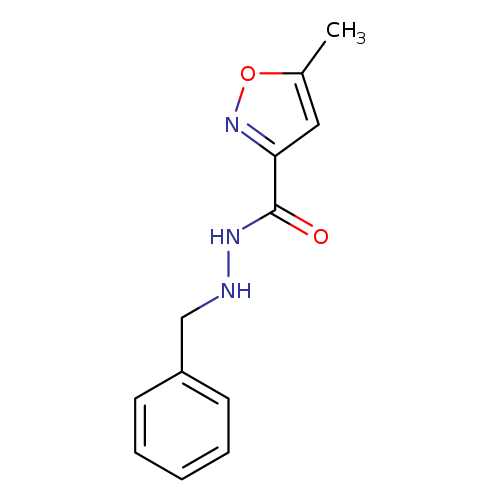
Chemical Structure
Synonyms
ValueSource
MarplanKegg
IsocarbonazidHMDB
IsocarbossazideHMDB
IsocarboxazideHMDB
IsocarboxyzidHMDB
Chemical FormulaC12H13N3O2
Average Molecular Mass231.251 g/mol
Monoisotopic Mass231.101 g/mol
CAS Registry Number59-63-2
IUPAC NameN'-benzyl-5-methyl-1,2-oxazole-3-carbohydrazide
Traditional Nameisocarboxazid
SMILESCC1=CC(=NO1)C(=O)NNCC1=CC=CC=C1
InChI IdentifierInChI=1S/C12H13N3O2/c1-9-7-11(15-17-9)12(16)14-13-8-10-5-3-2-4-6-10/h2-7,13H,8H2,1H3,(H,14,16)
InChI KeyXKFPYPQQHFEXRZ-UHFFFAOYSA-N
Chemical Taxonomy
Description Belongs to the class of organic compounds known as benzene and substituted derivatives. These are aromatic compounds containing one monocyclic ring system consisting of benzene.
KingdomOrganic compounds
Super ClassBenzenoids
ClassBenzene and substituted derivatives
Sub ClassNot Available
Direct ParentBenzene and substituted derivatives
Alternative Parents
Substituents
  • Monocyclic benzene moiety
  • Azole
  • Isoxazole
  • Heteroaromatic compound
  • Carboxylic acid hydrazide
  • Carboxylic acid derivative
  • Organoheterocyclic compound
  • Azacycle
  • Oxacycle
  • Organooxygen compound
  • Organonitrogen compound
  • Organic oxide
  • Organopnictogen compound
  • Organic nitrogen compound
  • Organic oxygen compound
  • Hydrocarbon derivative
  • Aromatic heteromonocyclic compound
Molecular FrameworkAromatic heteromonocyclic compounds
External DescriptorsNot Available
Biological Properties
StatusDetected and Not Quantified
OriginExogenous
Cellular Locations
  • Cytoplasm
  • Extracellular
Biofluid LocationsNot Available
Tissue LocationsNot Available
ApplicationsNot Available
Biological Roles
Chemical RolesNot Available
Organoleptic EffectsNot Available
Physical Properties
StateSolid
AppearanceWhite powder.
Experimental Properties
PropertyValue
Melting Point105-106°C
Boiling PointNot Available
Solubility1.6 mg/mL at 25°C
Predicted Properties
PropertyValueSource
Water Solubility0.22 g/LALOGPS
logP1.19ALOGPS
logP1.43ChemAxon
logS-3ALOGPS
pKa (Strongest Acidic)12.02ChemAxon
pKa (Strongest Basic)3.12ChemAxon
Physiological Charge0ChemAxon
Hydrogen Acceptor Count3ChemAxon
Hydrogen Donor Count2ChemAxon
Polar Surface Area67.16 ŲChemAxon
Rotatable Bond Count4ChemAxon
Refractivity74.78 m³·mol⁻¹ChemAxon
Polarizability24.51 ųChemAxon
Number of Rings2ChemAxon
BioavailabilityYesChemAxon
Rule of FiveYesChemAxon
Ghose FilterYesChemAxon
Veber's RuleNoChemAxon
MDDR-like RuleNoChemAxon
Spectra
Spectra
Spectrum TypeDescriptionSplash KeyDeposition DateView
GC-MSGC-MS Spectrumsplash10-0006-9600000000-952a7c1093fe532d1df3Not AvailableView Spectrum
Predicted GC-MSPredicted GC-MS Spectrumsplash10-052f-9510000000-c11f3aaa62df1be7ea3fNot AvailableView Spectrum
Predicted GC-MSPredicted GC-MS SpectrumNot AvailableNot AvailableView Spectrum
LC-MS/MSLC-MS/MS Spectrumsplash10-0006-9210100010-78b2f412502a142509e6Not AvailableView Spectrum
Predicted LC-MS/MSPredicted LC-MS/MS Spectrumsplash10-001i-3290000000-9801781c24b97ecc0817Not AvailableView Spectrum
Predicted LC-MS/MSPredicted LC-MS/MS Spectrumsplash10-0006-9350000000-d8f9ca354f060f4330e2Not AvailableView Spectrum
Predicted LC-MS/MSPredicted LC-MS/MS Spectrumsplash10-0006-9100000000-6cedb1354fdeece131f6Not AvailableView Spectrum
Predicted LC-MS/MSPredicted LC-MS/MS Spectrumsplash10-001i-1690000000-07a8545573baa300826fNot AvailableView Spectrum
Predicted LC-MS/MSPredicted LC-MS/MS Spectrumsplash10-001l-9640000000-077985063287a38f7095Not AvailableView Spectrum
Predicted LC-MS/MSPredicted LC-MS/MS Spectrumsplash10-0kx0-9300000000-a6c0764f23b7adf2144eNot AvailableView Spectrum
Predicted LC-MS/MSPredicted LC-MS/MS Spectrumsplash10-001l-6390000000-911dc29e6ed1ee470433Not AvailableView Spectrum
Predicted LC-MS/MSPredicted LC-MS/MS Spectrumsplash10-0006-9100000000-4896c74c701f3ec4b2fdNot AvailableView Spectrum
Predicted LC-MS/MSPredicted LC-MS/MS Spectrumsplash10-0006-9200000000-cc7b99641fc7414fb559Not AvailableView Spectrum
Predicted LC-MS/MSPredicted LC-MS/MS Spectrumsplash10-001i-0090000000-b203703a00eee615a207Not AvailableView Spectrum
Predicted LC-MS/MSPredicted LC-MS/MS Spectrumsplash10-001l-9110000000-fc267c475e490b4f9f3cNot AvailableView Spectrum
Predicted LC-MS/MSPredicted LC-MS/MS Spectrumsplash10-000x-9100000000-b1b63bbca6e5cb19e8b8Not AvailableView Spectrum
MSMS Spectrumsplash10-0006-9500000000-6ab30f52fc69889b3fa2Not AvailableView Spectrum
Toxicity Profile
Toxicity Values
Toxicity ValueOrganismDose DescriptorRoute of ExposurePredicted or ExperimentalToxicity RatingReference
246.0 Log mg/kg [140:440]RatLD50oralpredictedNot AvailableNot Available
Toxicity / Toxin ClassNot Available
Mechanism of ToxicityIsocarboxazid works by irreversibly blocking the action of a chemical substance known as monoamine oxidase (MAO) in the nervous system. MAO subtypes A and B are involved in the metabolism of serotonin and catecholamine neurotransmitters such as epinephrine, norepinephrine, and dopamine. Isocarboxazid, as a nonselective MAO inhibitor, binds irreversibly to monoamine oxidase–A (MAO-A) and monoamine oxidase–B (MAO-B). The reduced MAO activity results in an increased concentration of these neurotransmitters in storage sites throughout the central nervous system (CNS) and sympathetic nervous system. This increased availability of one or more monoamines is the basis for the antidepressant activity of MAO inhibitors.
Carcinogenicity (IARC Classification)No indication of carcinogenicity to humans (not listed by IARC).
Minimum Risk LevelNot Available
SymptomsSigns of overdose include severe anxiety, confusion, convulsions, cool clammy skin, severe dizziness, severe drowsiness, fast and irregular pulse, fever, hallucinations, severe headache, high or low blood pressure, hyperactive reflexes, muscle stiffness, respiratory depression or failure, slowed reflexes, sweating, severe trouble in sleeping, and unusual irritability.
TreatmentGeneral supportive measures should be used, along with immediate gastric lavage or emetics. If the latter are given, the danger of aspiration must be borne in mind. An adequate airway should be maintained, with supplemental oxygen if necessary. The mechanism by which amine-oxidase inhibitors produce hypotension is not fully understood, but there is evidence that these agents block the vascular bed response. Thus it is suggested that plasma may be of value in the management of this hypotension. Administration of pressor amines such as levarterenol bitartrate may be of limited value (note that their effects may be potentiated by Isocarboxazid). Continue treatment for several days until homeostasis is restored. Liver function studies are recommended during the 4 to 6 weeks after recovery, as well as the time of overdosage.
Health Effects
Health EffectRelationshipDirectionDescriptionReference
mood disorderNot AvailableNot AvailableNot AvailablePMC12787771
Exposure Sources
Source IDSourceSectorReference
CEDs000010Insecticides?Insecticides are synthetic chemicals designed to control or eliminate insect pests that threaten crops and other agricultural products.Agriculture & land managementPubChem
CEDs000377Antidepressants?Antidepressants, a class of synthetic chemicals designed to alleviate symptoms of depression and anxiety, can enter the environment through various pathways, leading to contamination of water systems.Healthcare, pharmaceuticals & veterinary productsNot Available
CEDs000506Antennas?Antennas, commonly used in communication technologies, can be a source of synthetic chemical contamination through the materials and coatings used in their construction.Electrical & Electronic EquipmentPubChem
CEDs000518Electrically Stimulated Smoking Devices?Electrically stimulated smoking devices, commonly known as e-cigarettes or vape pens, utilize electrical components to heat a liquid solution, often containing nicotine, flavorings, and other additives, to produce an aerosol for inhalation.Electrical & Electronic EquipmentPubChem
CEDs000519Electrodes?Electrodes, used in various electrical and electronic applications, can be a source of synthetic chemical contamination due to the materials from which they are constructed and the processes involved in their manufacturing.Electrical & Electronic EquipmentPubChem
CEDs000530Radio Transmission Systems?Radio transmission systems utilize a variety of synthetic chemicals in their manufacturing and maintenance processes.Electrical & Electronic EquipmentPubChem
CEDs000537Television Systems?Television systems can be a source of synthetic chemical contamination due to the various materials and components used in their manufacture and operation.Electrical & Electronic EquipmentPubChem
CEDs000559Non Electric Simulated Smoking Devices?Non-electric simulated smoking devices, often designed to mimic the experience of smoking without combustion, can be sources of synthetic chemical contamination due to the materials and chemicals used in their construction and operation.Household cleaning & consumer productsPubChem
CEDs000560Other Smoking Requisites?Other smoking requisites, including items such as lighters, matches, and rolling papers, can introduce synthetic chemical contamination through various components and additives.Household cleaning & consumer productsPubChem
CEDs000561Perfumes Within Detergents And Soaps?Perfumes within detergents and soaps are synthetic fragrance compounds added to enhance the sensory experience of cleaning products.Household cleaning & consumer productsPubChem
CEDs000562Pipe Accessories?Pipe accessories, such as fittings, connectors, and seals, are components used in plumbing systems to facilitate the flow of liquids and gases.Household cleaning & consumer productsPubChem
CEDs000569Tobacco Smoke Filters?Tobacco smoke filters are designed to reduce the inhalation of harmful substances in cigarette smoke, including tar and other particulate matter.Household cleaning & consumer productsPubChem
CEDs000580Manufacture Preparation Of Tobacco Products?The manufacture and preparation of tobacco products involve various processes that can result in the introduction of synthetic chemicals into the environment.Industrial manufacturing & chemical processingPubChem
CEDs000596Acaricides?Acaricides are synthetic chemicals specifically designed to target and control mite populations that can damage crops and plants.Agriculture & land managementPubChem
CEDs000611Anti Perspirants Or Body Deoderants?Antiperspirants and body deodorants commonly contain synthetic chemicals such as aluminum compounds, parabens, and synthetic fragrances.Personal care & cosmeticsPubChem
CEDs000614Essential Oils Or Perfumes?Essential oils and perfumes are complex mixtures of volatile compounds derived from natural or synthetic sources, commonly used for their aromatic properties.Personal care & cosmeticsPubChem
CEDs000615Eye Makeup Products?Eye makeup products, including mascaras, eyeliners, and eyeshadows, often contain a variety of synthetic chemicals such as pigments, preservatives, and film-forming agents.Personal care & cosmeticsPubChem
CEDs000618Lip Makeup Products?Lip makeup products, such as lipsticks, lip glosses, and lip liners, often contain a variety of synthetic chemicals, including pigments, preservatives, and emollients.Personal care & cosmeticsPubChem
CEDs000632Apparel?Apparel production often involves the use of various synthetic chemicals, including dyes, finishing agents, and preservatives.Textiles, leather & furnishingsPubChem
CEDs000642Footwear?Footwear production often involves the use of various synthetic chemicals, such as adhesives, dyes, and treatments, which can contribute to environmental contamination.Textiles, leather & furnishingsPubChem
CEDs000643Headwear?Headwear made from synthetic materials often incorporates chemicals used in the manufacturing and finishing processes, such as dyes, flame retardants, and water repellents.Textiles, leather & furnishingsPubChem
CEDs000650Purses Luggage Hand Bags?Purses, luggage, and handbags are often manufactured using synthetic materials such as polyvinyl chloride (PVC), polyurethane, and various types of nylon.Textiles, leather & furnishingsPubChem
CEDs000671Airplanes And Helicopters?Airplanes and helicopters are significant sources of synthetic chemical contamination primarily through the use of aviation fuels, lubricants, and de-icing agents.Aviation & AerospacePubChem
CEDs000685Ceramics?Ceramics can be a source of synthetic chemical contamination through various additives and processing agents used in their production.Building & ConstructionPubChem
CEDs000696Nanotechnology?Nanotechnology involves the manipulation of materials at the molecular or atomic level, typically within the range of 1 to 100 nanometers.Industrial manufacturing & chemical processingPubChem
CEDs000735Explosives?Explosives are chemical compounds or mixtures designed to undergo rapid decomposition, releasing energy in the form of gas and heat.Defense & military infrastructurePubChem
CEDs000739Inks?Inks are complex mixtures composed of pigments or dyes, solvents, resins, and additives used primarily for printing and writing applications.Paper, pulp & fiber productsPubChem
CEDs000744Water, Wastewater, & Sewage Treatment?Water, wastewater, and sewage treatment processes are critical for managing and mitigating pollutants in water systems.Wastewater, sanitation & biosolidsPubChem
Pathways
3 pathwaysPathway Source: PathBank
Targets
StructureProteinUniProt IDOrganismRelationshipDetails
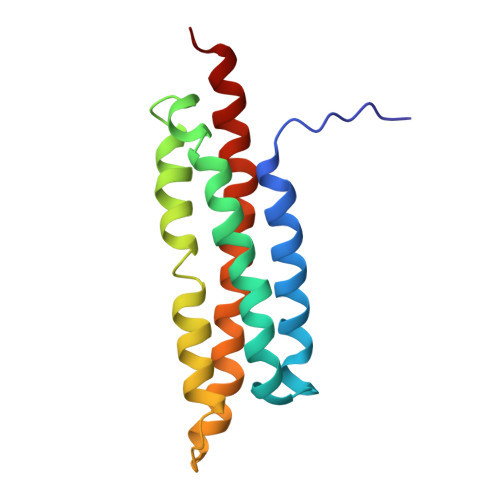
Tyrosine-protein phosphatase non-receptor type 7 structureClick to view 3D structureTyrosine-protein phosphatase non-receptor type 7P35236HumansPredicted (SEA)
Prediction Confidence Score
0.316
Applicability Domain
0.365
Statistical Significance
0.0033
Supporting Reference Compounds
130
E-value
25.9238
Rho-associated protein kinase 2 structureClick to view 3D structureRho-associated protein kinase 2O75116HumansPredicted (SEA)
Prediction Confidence Score
0.31
Applicability Domain
0.339
Statistical Significance
0.0797
Supporting Reference Compounds
811
E-value
620.225
Induced myeloid leukemia cell differentiation protein Mcl-1 structureClick to view 3D structureInduced myeloid leukemia cell differentiation protein Mcl-1Q07820HumansPredicted (SEA)
Prediction Confidence Score
0.306
Applicability Domain
0.365
Statistical Significance
0.017
Supporting Reference Compounds
343
E-value
132.733
Histone deacetylase 1 structureClick to view 3D structureHistone deacetylase 1Q13547HumansPredicted (SEA)
Prediction Confidence Score
0.303
Applicability Domain
0.313
Statistical Significance
0.0644
Supporting Reference Compounds
497
E-value
501.738
Protein deacetylase HDAC6 structureClick to view 3D structureProtein deacetylase HDAC6Q9UBN7HumansPredicted (SEA)
Prediction Confidence Score
0.302
Applicability Domain
0.313
Statistical Significance
0.0654
Supporting Reference Compounds
553
E-value
509.367
Click to view 3D structureATP-dependent 6-phosphofructokinaseQ4E657Trypanosoma cruziPredicted (SEA)
Prediction Confidence Score
0.297
Applicability Domain
0.302
Statistical Significance
0.0011
Supporting Reference Compounds
2
E-value
8.79696
Histone deacetylase 2 structureClick to view 3D structureHistone deacetylase 2Q92769HumansPredicted (SEA)
Prediction Confidence Score
0.296
Applicability Domain
0.303
Statistical Significance
0.0428
Supporting Reference Compounds
307
E-value
333.35
Histone deacetylase 3 structureClick to view 3D structureHistone deacetylase 3O15379HumansPredicted (SEA)
Prediction Confidence Score
0.296
Applicability Domain
0.303
Statistical Significance
0.0358
Supporting Reference Compounds
257
E-value
278.545
Click to view 3D structure15-cis-phytoene desaturaseP26294Synechococcus elongatus (strain PCC 7942) (Anacystis nidulans R2)Predicted (SEA)
Prediction Confidence Score
0.295
Applicability Domain
0.295 Low confidence
Statistical Significance
0.0023
Supporting Reference Compounds
1
E-value
18.1389
Click to view 3D structureStreptokinase AP10520Streptococcus pyogenes serotype M1Predicted (SEA)
Prediction Confidence Score
0.294
Applicability Domain
0.306
Statistical Significance
0.026
Supporting Reference Compounds
425
E-value
202.252
Serine/threonine-protein kinase pim-1 structureClick to view 3D structureSerine/threonine-protein kinase pim-1P11309HumansPredicted (SEA)
Prediction Confidence Score
0.294
Applicability Domain
0.339
Statistical Significance
0.1212
Supporting Reference Compounds
967
E-value
943.688
Histone deacetylase 4 structureClick to view 3D structureHistone deacetylase 4P56524HumansPredicted (SEA)
Prediction Confidence Score
0.292
Applicability Domain
0.299 Low confidence
Statistical Significance
0.0271
Supporting Reference Compounds
185
E-value
211.283
Histone deacetylase 8 structureClick to view 3D structureHistone deacetylase 8Q9BY41HumansPredicted (SEA)
Prediction Confidence Score
0.291
Applicability Domain
0.294 Low confidence
Statistical Significance
0.0521
Supporting Reference Compounds
317
E-value
405.75
Protein-tyrosine kinase 2-beta structureClick to view 3D structureProtein-tyrosine kinase 2-betaQ14289HumansPredicted (SEA)
Prediction Confidence Score
0.288
Applicability Domain
0.365
Statistical Significance
0.078
Supporting Reference Compounds
414
E-value
607.38
Carbonic anhydrase 1 structureClick to view 3D structureCarbonic anhydrase 1P00915HumansPredicted (SEA)
Prediction Confidence Score
0.288
Applicability Domain
0.327
Statistical Significance
0.0508
Supporting Reference Compounds
407
E-value
395.863
Aminopeptidase N structureClick to view 3D structureAminopeptidase NP15145Sus scrofaPredicted (SEA)
Prediction Confidence Score
0.287
Applicability Domain
0.308
Statistical Significance
0.0125
Supporting Reference Compounds
40
E-value
97.6229
Carbonic anhydrase 12 structureClick to view 3D structureCarbonic anhydrase 12O43570HumansPredicted (SEA)
Prediction Confidence Score
0.287
Applicability Domain
0.327
Statistical Significance
0.0435
Supporting Reference Compounds
332
E-value
338.722
Cytochrome P450 2C9 structureClick to view 3D structureCytochrome P450 2C9P11712HumansPredicted (SEA)
Prediction Confidence Score
0.286
Applicability Domain
0.313
Statistical Significance
0.1936
Supporting Reference Compounds
1245
E-value
1507.01
Carbonic anhydrase 7 structureClick to view 3D structureCarbonic anhydrase 7P43166HumansPredicted (SEA)
Prediction Confidence Score
0.286
Applicability Domain
0.327
Statistical Significance
0.0289
Supporting Reference Compounds
242
E-value
225.296
72 kDa type IV collagenase structureClick to view 3D structure72 kDa type IV collagenaseP08253HumansPredicted (SEA)
Prediction Confidence Score
0.285
Applicability Domain
0.357
Statistical Significance
0.061
Supporting Reference Compounds
400
E-value
475.036
Click to view 3D structureFatty-acid amide hydrolase 1O00519HumansPredicted (SEA)
Prediction Confidence Score
0.284
Applicability Domain
0.321
Statistical Significance
0.0237
Supporting Reference Compounds
106
E-value
184.347
Cytochrome P450 3A4 structureClick to view 3D structureCytochrome P450 3A4P08684HumansPredicted (SEA)
Prediction Confidence Score
0.284
Applicability Domain
0.305
Statistical Significance
0.2533
Supporting Reference Compounds
1538
E-value
1972.0
Lysine-specific demethylase 4E structureClick to view 3D structureLysine-specific demethylase 4EB2RXH2HumansPredicted (SEA)
Prediction Confidence Score
0.284
Applicability Domain
0.353
Statistical Significance
0.0031
Supporting Reference Compounds
39
E-value
24.0554
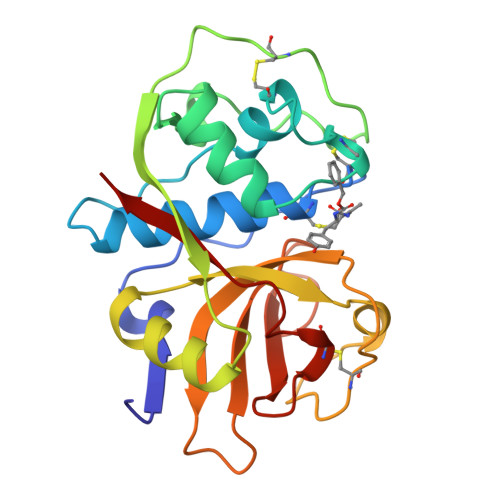
Cruzipain structureClick to view 3D structureCruzipainP25779Trypanosoma cruziPredicted (SEA)
Prediction Confidence Score
0.283
Applicability Domain
0.313
Statistical Significance
0.0147
Supporting Reference Compounds
65
E-value
114.361
Mitogen-activated protein kinase 8 structureClick to view 3D structureMitogen-activated protein kinase 8P45983HumansPredicted (SEA)
Prediction Confidence Score
0.282
Applicability Domain
0.323
Statistical Significance
0.151
Supporting Reference Compounds
782
E-value
1175.68
Amine oxidase [flavin-containing] A structureClick to view 3D structureAmine oxidase [flavin-containing] AP21397HumansKnownIsocarboxazid works by irreversibly blocking the action of a chemical substance known as monoamine oxidase (MAO) in the nervous system. MAO subtypes A and B are involved in the metabolism of serotonin and catecholamine neurotransmitters such as epinephrine, norepinephrine, and dopamine. Isocarboxazid, as a nonselective MAO inhibitor, binds irreversibly to monoamine oxidase–A (MAO-A) and monoamine oxidase–B (MAO-B). The reduced MAO activity results in an increased concentration of these neurotransmitters in storage sites throughout the central nervous system (CNS) and sympathetic nervous system. This increased availability of one or more monoamines is the basis for the antidepressant activity of MAO inhibitors.
Amine oxidase [flavin-containing] B structureClick to view 3D structureAmine oxidase [flavin-containing] BP27338HumansKnownIsocarboxazid works by irreversibly blocking the action of a chemical substance known as monoamine oxidase (MAO) in the nervous system. MAO subtypes A and B are involved in the metabolism of serotonin and catecholamine neurotransmitters such as epinephrine, norepinephrine, and dopamine. Isocarboxazid, as a nonselective MAO inhibitor, binds irreversibly to monoamine oxidase–A (MAO-A) and monoamine oxidase–B (MAO-B). The reduced MAO activity results in an increased concentration of these neurotransmitters in storage sites throughout the central nervous system (CNS) and sympathetic nervous system. This increased availability of one or more monoamines is the basis for the antidepressant activity of MAO inhibitors.
Concentrations
Not Available
External Links
DrugBank IDDB01247
HMDB IDHMDB0015377
FooDB IDNot Available
Phenol Explorer IDNot Available
KNApSAcK IDNot Available
BiGG IDNot Available
BioCyc IDNot Available
METLIN IDNot Available
PDB IDNot Available
Wikipedia LinkIsocarboxazid
Chemspider ID3628
ChEBI ID775119
PubChem Compound ID3759
Kegg Compound IDNot Available
YMDB IDNot Available
ECMDB IDNot Available
References
Synthesis Reference

U.S. Patent 2,908,688.

MSDSNot Available
General References
  1. Kennedy SH, Piran N, Warsh JJ, Prendergast P, Mainprize E, Whynot C, Garfinkel PE: A trial of isocarboxazid in the treatment of bulimia nervosa. J Clin Psychopharmacol. 1988 Dec;8(6):391-6. [PubMed: 3069879]
  2. Drugs.com - http://www.drugs.com/cons/Isocarboxazid.html