Some data may have been extracted from scientific literature using a pipeline that uses large language models (LLMs). Source articles are cited where applicable to help verify the extracted relationships.
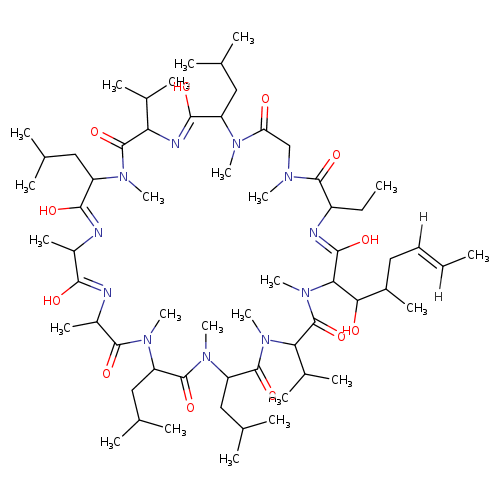
Cyclosporin (C62H111N11O12) is an exogenous solid at room temperature. Cyclosporin belongs to the peptoid-peptide hybrids, a subclass of peptidomimetics within the organic compounds. With an average molecular weight of 1,203 g/mol, Cyclosporin is a heavy molecule. It functions as a metabolite and is utilized as an immunosuppressive agent, antifungal agent, antirheumatic drug, dermatologic drug, and anti-asthmatic drug. Biologically, it acts as a carcinogenic agent and an EC 3.1.3.16 (phosphoprotein phosphatase) inhibitor.
The compound is found in healthcare, pharmaceuticals, and veterinary products, specifically within ophthalmologicals and immunosuppressants, as well as in electrical and electronic equipment such as antennas. Exposure routes include oral, intravenous, topical, and ophthalmic administration.
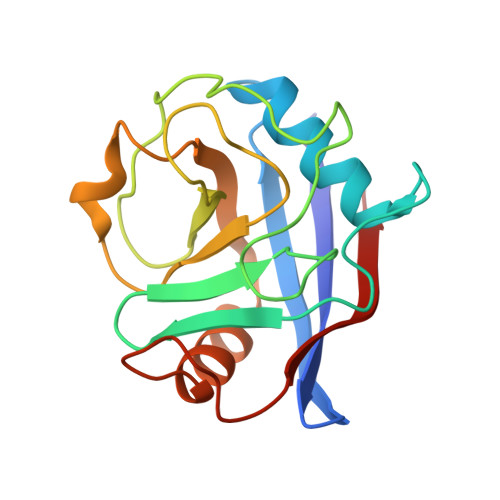
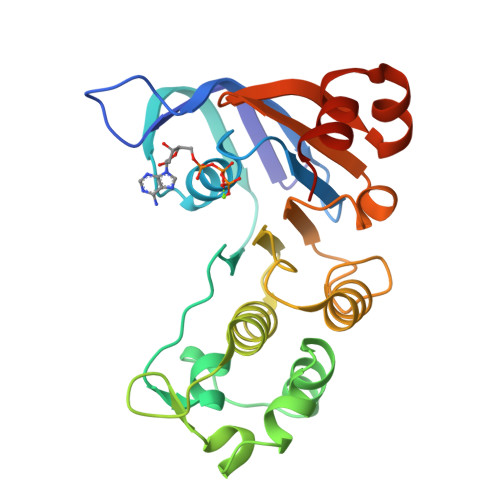
Cyclosporin interacts with seven protein targets, including the ATP-dependent translocase ABCB1, the solute carrier organic anion transporter family member 1B3 (SLCO1B3), the guided entry of tail-anchored proteins factor CAMLG, and the peptidyl-prolyl cis-trans isomerase A (PPIA) and F, mitochondrial (PPIF). It also targets the protein phosphatase 3 catalytic subunit alpha (PPP3CA) and calcineurin subunit B type 2 (PPP3R2). Cyclosporine binds to cyclophillin to form a complex that inhibits calcineurin, which typically activates the transcription of interleukin 2. Additionally, it inhibits interleukin release and lymphokine production. In ophthalmic applications, where the precise mechanism of action is unknown, cyclosporine emulsion is thought to act as a partial immunomodulator for patients with keratoconjunctivitis sicca whose tear production is presumed to be suppressed due to ocular inflammation.
carcinogenic agent ?A role played by a chemical compound which is known to induce a process of carcinogenesis by corrupting normal cellular pathways, leading to the acquistion of tumoral capabilities.
toxin (PMC10779191 )?A chemical substance naturally produced by an organism and poisonous to other organisms
nephrotoxic agent (PMC2760132 , PMC10779191 )?A role played by a chemical compound exihibiting itself through the ability to induce damage to the kidney in animals.
Cyclosporine binds to cyclophilin. The complex then inhibits calcineurin which is normally responsible for activating transcription of interleukin 2. Cyclosporine also inhibits lymphokine production and interleukin release. In ophthalmic applications, the precise mechanism of action is not known. Cyclosporine emulsion is thought to act as a partial immunomodulator in patients whose tear production is presumed to be suppressed due to ocular inflammation associated with keratoconjunctivitis sicca.
The oral LD50 is 2329 mg/kg in mice, 1480 mg/kg in rats, and > 1000 mg/kg in rabbits. The I.V. LD50 is 148 mg/kg in mice, 104 mg/kg in rats, and 46 mg/kg in rabbits.
The oral LD50 is 2329 mg/kg in mice, 1480 mg/kg in rats, and > 1000 mg/kg in rabbits. The I.V. LD50 is 148 mg/kg in mice, 104 mg/kg in rats, and 46 mg/kg in rabbits.
Treatment
Not Available
Health Effects
Health Effect
Relationship
Direction
Description
Reference
hypertension
Associated With?
increase
A disorder characterized by a pathological increase in blood pressure; a repeatedly elevation in the blood pressure exceeding 140 over 90 mm Hg. (NCI CTCAE)
A disorder characterized by a pathological increase in blood pressure; a repeatedly elevation in the blood pressure exceeding 140 over 90 mm Hg. (NCI CTCAE)
A disorder characterized by a sensation of marked discomfort in various parts of the head, not confined to the area of distribution of any nerve. (NCI CTCAE)
An autoimmune disease is a condition arising from an abnormal immune response to a functioning body part. There are at least 80 types of autoimmune diseases. Nearly any body part can be involved. Common symptoms include low grade fever and feeling tired. Some autoimmune diseases such as lupus run in families, and certain cases may be triggered by infections or other environmental factors. Some common diseases that are generally considered autoimmune include celiac disease, diabetes mellitus type 1, Graves' disease, inflammatory bowel disease, multiple sclerosis, psoriasis, rheumatoid arthritis, and systemic lupus erythematosus. About 24 million (7%) people in the United States are affected by an autoimmune disease. Women are more commonly affected than men.
A hypersensitivity reaction type II disease that causes depigmentation of patches of skin resulting from loss of function or death of melanoctyes. (DO)
Drinking water?Drinking water can be a medium for synthetic chemical contamination, often originating from various industrial processes and agricultural practices.
Immunosuppressants?Immunosuppressants are synthetic chemicals used to inhibit the immune response, primarily in patients undergoing organ transplants or those with autoimmune disorders.
Ophthalmologicals?Ophthalmologicals are a category of synthetic chemicals used primarily for the treatment of eye disorders, including medications such as anti-inflammatories, antibiotics, and lubricants.
Antennas?Antennas, commonly used in communication technologies, can be a source of synthetic chemical contamination through the materials and coatings used in their construction.
Conductors Or Conductive Bodies Characterised By The Conductive Materials?Conductors, or conductive bodies, are materials that allow the flow of electrical current, typically made from metals such as copper, aluminum, or silver.
Discharge Lamps?Discharge lamps, including fluorescent and high-intensity discharge (HID) lamps, are commonly used for lighting applications due to their energy efficiency and brightness.
Electrodes?Electrodes, used in various electrical and electronic applications, can be a source of synthetic chemical contamination due to the materials from which they are constructed and the processes involved in their manufacturing.
Fixed Capacitors And Their Manufacture?Fixed capacitors are passive electronic components used to store and release electrical energy, playing a critical role in various circuits.
Television Systems?Television systems can be a source of synthetic chemical contamination due to the various materials and components used in their manufacture and operation.
Food Preservation?Food preservation often involves the use of synthetic chemicals, such as preservatives, flavor enhancers, and color additives, to extend shelf life and enhance the sensory qualities of food products.
Bleaching Agents?Bleaching agents are chemical substances used to whiten or lighten materials, often employed in various cleaning products for their stain removal and disinfecting properties.
Perfumes Within Detergents And Soaps?Perfumes within detergents and soaps are synthetic fragrance compounds added to enhance the sensory experience of cleaning products.
Tobacco Smoke Filters?Tobacco smoke filters are designed to reduce the inhalation of harmful substances in cigarette smoke, including tar and other particulate matter.
Manufacture Preparation Of Tobacco Products?The manufacture and preparation of tobacco products involve various processes that can result in the introduction of synthetic chemicals into the environment.
Aftersun Products?Aftersun products are designed to soothe and hydrate the skin after sun exposure, often containing various synthetic chemicals such as emollients, preservatives, and fragrances.
Anti Perspirants Or Body Deoderants?Antiperspirants and body deodorants commonly contain synthetic chemicals such as aluminum compounds, parabens, and synthetic fragrances.
Depilatories?Depilatories are products designed to remove unwanted hair through the application of synthetic chemicals that break down the protein structure of hair, facilitating its removal.
Essential Oils Or Perfumes?Essential oils and perfumes are complex mixtures of volatile compounds derived from natural or synthetic sources, commonly used for their aromatic properties.
Eye Makeup Products?Eye makeup products, including mascaras, eyeliners, and eyeshadows, often contain a variety of synthetic chemicals such as pigments, preservatives, and film-forming agents.
Lip Care Products?Lip care products, including lipsticks, balms, and glosses, often contain a variety of synthetic chemicals such as parabens, phthalates, and synthetic fragrances.
Lip Makeup Products?Lip makeup products, such as lipsticks, lip glosses, and lip liners, often contain a variety of synthetic chemicals, including pigments, preservatives, and emollients.
Footwear?Footwear production often involves the use of various synthetic chemicals, such as adhesives, dyes, and treatments, which can contribute to environmental contamination.
Purses Luggage Hand Bags?Purses, luggage, and handbags are often manufactured using synthetic materials such as polyvinyl chloride (PVC), polyurethane, and various types of nylon.
Glass Coatings?Glass coatings are synthetic chemical formulations applied to glass surfaces to enhance properties such as durability, UV resistance, and aesthetic appeal.
Nanotechnology?Nanotechnology involves the manipulation of materials at the molecular or atomic level, typically within the range of 1 to 100 nanometers.
Water, Wastewater, & Sewage Treatment?Water, wastewater, and sewage treatment processes are critical for managing and mitigating pollutants in water systems.
Cyclosporine binds to cyclophillin. The complex then inhibits calcineurin which is normally responsible for activating transcription of interleukin 2. Cyclosporine also inhibits lymphokine production and interleukin release. In ophthalmic applications, the precise mechanism of action is not known. Cyclosporine emulsion is thought to act as a partial immunomodulator in patients whose tear production is presumed to be suppressed due to ocular inflammation associated with keratoconjunctivitis sicca.
Cyclosporine binds to cyclophillin. The complex then inhibits calcineurin which is normally responsible for activating transcription of interleukin 2. Cyclosporine also inhibits lymphokine production and interleukin release. In ophthalmic applications, the precise mechanism of action is not known. Cyclosporine emulsion is thought to act as a partial immunomodulator in patients whose tear production is presumed to be suppressed due to ocular inflammation associated with keratoconjunctivitis sicca.
Cyclosporine binds to cyclophillin. The complex then inhibits calcineurin which is normally responsible for activating transcription of interleukin 2. Cyclosporine also inhibits lymphokine production and interleukin release. In ophthalmic applications, the precise mechanism of action is not known. Cyclosporine emulsion is thought to act as a partial immunomodulator in patients whose tear production is presumed to be suppressed due to ocular inflammation associated with keratoconjunctivitis sicca.
Guided entry of tail-anchored proteins factor CAMLG
P49069
Humans
Known
Cyclosporine binds to cyclophillin. The complex then inhibits calcineurin which is normally responsible for activating transcription of interleukin 2. Cyclosporine also inhibits lymphokine production and interleukin release. In ophthalmic applications, the precise mechanism of action is not known. Cyclosporine emulsion is thought to act as a partial immunomodulator in patients whose tear production is presumed to be suppressed due to ocular inflammation associated with keratoconjunctivitis sicca.
Hans Dietl, “Pharmaceutical preparation containing cyclosporine(s) for intravenous administration and a process for its production.” U.S. Patent US5527537, issued October, 1990.
MSDS
Not Available
General References
Lichtiger S, Present DH, Kornbluth A, Gelernt I, Bauer J, Galler G, Michelassi F, Hanauer S: Cyclosporine in severe ulcerative colitis refractory to steroid therapy. N Engl J Med. 1994 Jun 30;330(26):1841-5. [PubMed: 8196726]
Husi H, Schorgendorfer K, Stempfer G, Taylor P, Walkinshaw MD: Prediction of substrate-specific pockets in cyclosporin synthetase. FEBS Lett. 1997 Sep 15;414(3):532-6. [PubMed: 9323029]
International Agency for Research on Cancer (2014). IARC Monographs on the Evaluation of Carcinogenic Risks to Humans. - http://monographs.iarc.fr/index.php