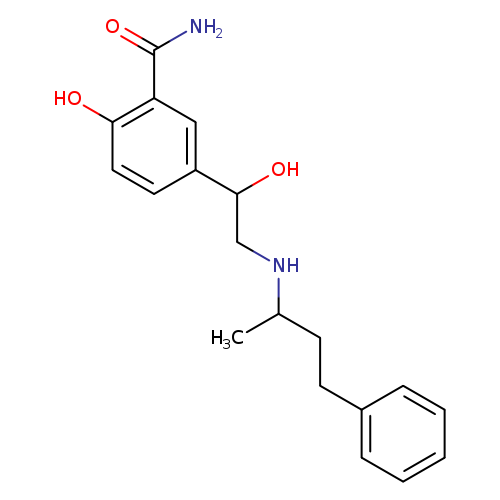
Click to view 3D structure Click to view 3D structure | Cytochrome P450 2D6 | P10635 | Humans | Known | Not Available |
 Click to view 3D structure Click to view 3D structure | Beta-1 adrenergic receptor | B0FL73 | Cavia porcellus | Predicted (SEA) | - Prediction Confidence Score
- 0.585
- Applicability Domain
- 1.0
- Statistical Significance
- 1.10e-04
- Supporting Reference Compounds
- 37
- E-value
- 0.856341
|
| Click to view 3D structure | Beta-2 adrenergic receptor | Q8K4Z4 | Cavia porcellus | Predicted (SEA) | - Prediction Confidence Score
- 0.585
- Applicability Domain
- 1.0
- Statistical Significance
- 1.00e-04
- Supporting Reference Compounds
- 48
- E-value
- 0.778492
|
 Click to view 3D structure Click to view 3D structure | Beta-1 adrenergic receptor | P08588 | Humans | Predicted (SEA) | - Prediction Confidence Score
- 0.585
- Applicability Domain
- 1.0
- Statistical Significance
- 2.40e-04
- Supporting Reference Compounds
- 180
- E-value
- 1.86838
|
 Click to view 3D structure Click to view 3D structure | Beta-2 adrenergic receptor | P07550 | Humans | Predicted (SEA) | - Prediction Confidence Score
- 0.548
- Applicability Domain
- 1.0
- Statistical Significance
- 4.40e-04
- Supporting Reference Compounds
- 258
- E-value
- 3.42537
|
| Click to view 3D structure | Alpha-1D adrenergic receptor | P25100 | Humans | Predicted (SEA) | - Prediction Confidence Score
- 0.495
- Applicability Domain
- 1.0
- Statistical Significance
- 0.001
- Supporting Reference Compounds
- 258
- E-value
- 8.09632
|
 Click to view 3D structure Click to view 3D structure | Sodium-dependent noradrenaline transporter | P23975 | Humans | Predicted (SEA) | - Prediction Confidence Score
- 0.482
- Applicability Domain
- 1.0
- Statistical Significance
- 0.0014
- Supporting Reference Compounds
- 451
- E-value
- 10.6653
|
| Click to view 3D structure | Alpha-1A adrenergic receptor | P43140 | Rattus norvegicus | Predicted (SEA) | - Prediction Confidence Score
- 0.474
- Applicability Domain
- 1.0
- Statistical Significance
- 0.0016
- Supporting Reference Compounds
- 208
- E-value
- 12.5337
|
 Click to view 3D structure Click to view 3D structure | Sodium-dependent dopamine transporter | Q01959 | Humans | Predicted (SEA) | - Prediction Confidence Score
- 0.469
- Applicability Domain
- 1.0
- Statistical Significance
- 0.0021
- Supporting Reference Compounds
- 506
- E-value
- 16.504
|
| Click to view 3D structure | Alpha-1B adrenergic receptor | P15823 | Rattus norvegicus | Predicted (SEA) | - Prediction Confidence Score
- 0.46
- Applicability Domain
- 1.0
- Statistical Significance
- 5.40e-04
- Supporting Reference Compounds
- 130
- E-value
- 4.20386
|
 Click to view 3D structure Click to view 3D structure | Sigma non-opioid intracellular receptor 1 | Q99720 | Humans | Predicted (SEA) | - Prediction Confidence Score
- 0.455
- Applicability Domain
- 1.0
- Statistical Significance
- 0.0049
- Supporting Reference Compounds
- 562
- E-value
- 38.4575
|
| Click to view 3D structure | Cytochrome P450 2D6 | P10635 | Humans | Predicted (SEA) | - Prediction Confidence Score
- 0.439
- Applicability Domain
- 1.0
- Statistical Significance
- 0.0074
- Supporting Reference Compounds
- 1130
- E-value
- 57.297
|
| Click to view 3D structure | Taste receptor type 2 member 50 | P59544 | Humans | Predicted (SEA) | - Prediction Confidence Score
- 0.431
- Applicability Domain
- 0.431
- Statistical Significance
- 1.00e-04
- Supporting Reference Compounds
- 1
- E-value
- 0.778492
|
| Click to view 3D structure | Taste receptor type 2 member 45 | P59539 | Humans | Predicted (SEA) | - Prediction Confidence Score
- 0.431
- Applicability Domain
- 0.431
- Statistical Significance
- 1.00e-04
- Supporting Reference Compounds
- 1
- E-value
- 0.778492
|
| Click to view 3D structure | Taste receptor type 2 member 42 | Q7RTR8 | Humans | Predicted (SEA) | - Prediction Confidence Score
- 0.431
- Applicability Domain
- 0.431
- Statistical Significance
- 1.00e-04
- Supporting Reference Compounds
- 1
- E-value
- 0.778492
|
| Click to view 3D structure | Taste receptor type 2 member 41 | P59536 | Humans | Predicted (SEA) | - Prediction Confidence Score
- 0.431
- Applicability Domain
- 0.431
- Statistical Significance
- 1.00e-04
- Supporting Reference Compounds
- 1
- E-value
- 0.778492
|
| Click to view 3D structure | Taste receptor type 2 member 7 | Q9NYW3 | Humans | Predicted (SEA) | - Prediction Confidence Score
- 0.431
- Applicability Domain
- 0.431
- Statistical Significance
- 1.00e-04
- Supporting Reference Compounds
- 1
- E-value
- 0.778492
|
| Click to view 3D structure | Taste receptor type 2 member 30 | P59541 | Humans | Predicted (SEA) | - Prediction Confidence Score
- 0.431
- Applicability Domain
- 0.431
- Statistical Significance
- 1.00e-04
- Supporting Reference Compounds
- 1
- E-value
- 0.778492
|
| Click to view 3D structure | Taste receptor type 2 member 60 | P59551 | Humans | Predicted (SEA) | - Prediction Confidence Score
- 0.431
- Applicability Domain
- 0.431
- Statistical Significance
- 1.00e-04
- Supporting Reference Compounds
- 1
- E-value
- 0.778492
|
| Click to view 3D structure | Taste receptor type 2 member 19 | P59542 | Humans | Predicted (SEA) | - Prediction Confidence Score
- 0.431
- Applicability Domain
- 0.431
- Statistical Significance
- 1.00e-04
- Supporting Reference Compounds
- 1
- E-value
- 0.778492
|
| Click to view 3D structure | Taste receptor type 2 member 20 | P59543 | Humans | Predicted (SEA) | - Prediction Confidence Score
- 0.431
- Applicability Domain
- 0.431
- Statistical Significance
- 1.00e-04
- Supporting Reference Compounds
- 1
- E-value
- 0.778492
|
| Click to view 3D structure | Taste receptor type 2 member 1 | Q9NYW7 | Humans | Predicted (SEA) | - Prediction Confidence Score
- 0.431
- Applicability Domain
- 0.431
- Statistical Significance
- 1.00e-04
- Supporting Reference Compounds
- 1
- E-value
- 0.778492
|
| Click to view 3D structure | Taste receptor type 2 member 40 | P59535 | Humans | Predicted (SEA) | - Prediction Confidence Score
- 0.431
- Applicability Domain
- 0.431
- Statistical Significance
- 1.00e-04
- Supporting Reference Compounds
- 1
- E-value
- 0.778492
|
| Click to view 3D structure | Taste receptor type 2 member 3 | Q9NYW6 | Humans | Predicted (SEA) | - Prediction Confidence Score
- 0.431
- Applicability Domain
- 0.431
- Statistical Significance
- 1.00e-04
- Supporting Reference Compounds
- 1
- E-value
- 0.778492
|
| Click to view 3D structure | Taste receptor type 2 member 13 | Q9NYV9 | Humans | Predicted (SEA) | - Prediction Confidence Score
- 0.431
- Applicability Domain
- 0.431
- Statistical Significance
- 1.00e-04
- Supporting Reference Compounds
- 1
- E-value
- 0.778492
|
| Click to view 3D structure | Taste receptor type 2 member 39 | P59534 | Humans | Predicted (SEA) | - Prediction Confidence Score
- 0.431
- Applicability Domain
- 0.431
- Statistical Significance
- 1.00e-04
- Supporting Reference Compounds
- 1
- E-value
- 0.778492
|
| Click to view 3D structure | Beta-1 adrenergic receptor | P08588 | Humans | Known | Labetalol has two asymmetric centers and therefore, exists as a molecular complex of two diastereoisomeric pairs. Dilevalol, the R,R' stereoisomer, makes up 25% of racemic labetalol. Labetalol HCl combines both selective, competitive, alpha-1-adrenergic blocking and nonselective, competitive, beta-adrenergic blocking activity in a single substance. In man, the ratios of alpha- to beta- blockade have been estimated to be approximately 1:3 and 1:7 following oral and intravenous (IV) administration, respectively. Beta-2-agonist activity has been demonstrated in animals with minimal beta-1-agonist (ISA) activity detected. In animals, at doses greater than those required for alpha- or beta- adrenergic blockade, a membrane stabilizing effect has been demonstrated. |
| Click to view 3D structure | Beta-2 adrenergic receptor | P07550 | Humans | Known | Labetalol has two asymmetric centers and therefore, exists as a molecular complex of two diastereoisomeric pairs. Dilevalol, the R,R' stereoisomer, makes up 25% of racemic labetalol. Labetalol HCl combines both selective, competitive, alpha-1-adrenergic blocking and nonselective, competitive, beta-adrenergic blocking activity in a single substance. In man, the ratios of alpha- to beta- blockade have been estimated to be approximately 1:3 and 1:7 following oral and intravenous (IV) administration, respectively. Beta-2-agonist activity has been demonstrated in animals with minimal beta-1-agonist (ISA) activity detected. In animals, at doses greater than those required for alpha- or beta- adrenergic blockade, a membrane stabilizing effect has been demonstrated. |
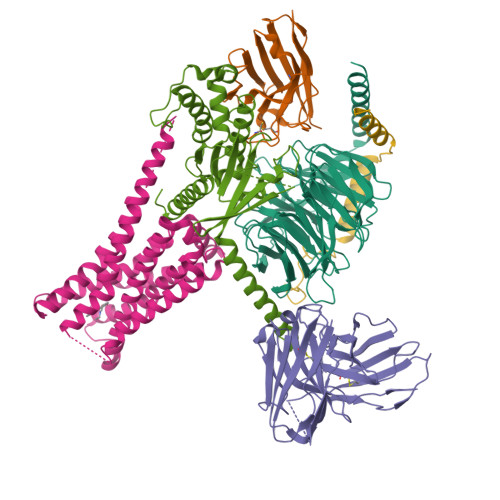 Click to view 3D structure Click to view 3D structure | Beta-3 adrenergic receptor | P13945 | Humans | Known | Not Available |
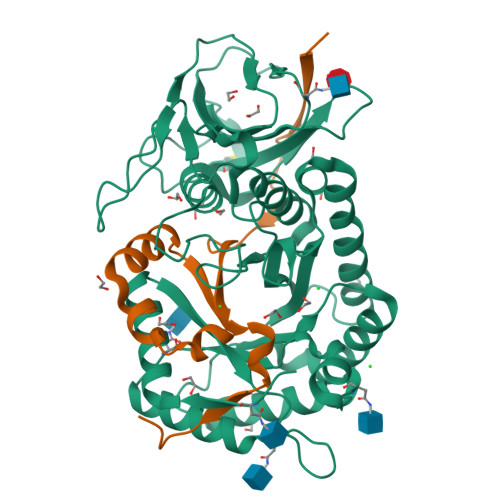 Click to view 3D structure Click to view 3D structure | Heparanase | Q9Y251 | Humans | Known | Not Available |
 Click to view 3D structure Click to view 3D structure | Alpha-1A adrenergic receptor | P35348 | Humans | Known | Labetalol has two asymmetric centers and therefore, exists as a molecular complex of two diastereoisomeric pairs. Dilevalol, the R,R' stereoisomer, makes up 25% of racemic labetalol. Labetalol HCl combines both selective, competitive, alpha-1-adrenergic blocking and nonselective, competitive, beta-adrenergic blocking activity in a single substance. In man, the ratios of alpha- to beta- blockade have been estimated to be approximately 1:3 and 1:7 following oral and intravenous (IV) administration, respectively. Beta-2-agonist activity has been demonstrated in animals with minimal beta-1-agonist (ISA) activity detected. In animals, at doses greater than those required for alpha- or beta- adrenergic blockade, a membrane stabilizing effect has been demonstrated. |
| Click to view 3D structure | Alpha-1B adrenergic receptor | P35368 | Humans | Known | Labetalol has two asymmetric centers and therefore, exists as a molecular complex of two diastereoisomeric pairs. Dilevalol, the R,R' stereoisomer, makes up 25% of racemic labetalol. Labetalol HCl combines both selective, competitive, alpha-1-adrenergic blocking and nonselective, competitive, beta-adrenergic blocking activity in a single substance. In man, the ratios of alpha- to beta- blockade have been estimated to be approximately 1:3 and 1:7 following oral and intravenous (IV) administration, respectively. Beta-2-agonist activity has been demonstrated in animals with minimal beta-1-agonist (ISA) activity detected. In animals, at doses greater than those required for alpha- or beta- adrenergic blockade, a membrane stabilizing effect has been demonstrated. |