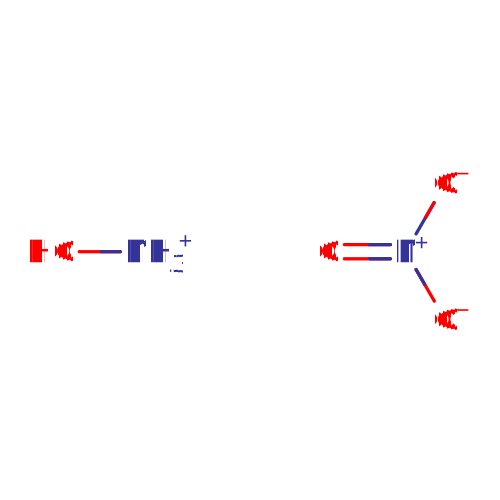
Hydroxylammonium nitrate (CED0015653)

Record Information
Version1.0
Creation Date2009-08-05 17:11:03 UTC
Update Date2026-04-05 21:34:37 UTC
SynCED IDCED0015653
Secondary Accession Numbers
  • CHEM002551
  • T3D3562
Identification
Common NameHydroxylammonium nitrate
ClassSmall Molecule
Description
Hydroxylammonium nitrate is an exogenous inorganic compound with the formula H4N2O4 and an average molecular weight of 96.04 g/mol. At room temperature, this substance exists as a solid. Hydroxylammonium nitrate belongs to the non-metal nitrates, a subclass of non-metal oxoanionic compounds within the inorganic compounds. It is classified as a homogeneous non-metal compound. The compound is identified as being released from or found in two recorded sources: antennas and sparking plugs within electrical and electronic equipment. In industrial and technical applications, hydroxylammonium nitrate is used in nuclear reprocessing as a plutonium reductant and is being developed as a potential rocket propellant. The compound interacts with two recorded protein targets: hemoglobin subunit alpha (HBA1) and hemoglobin subunit beta (HBB). Nitrite causes the autocatalytic oxidation of oxyhemoglobin to hydrogen peroxide and methemoglobin. This process results in an elevation of methemoglobin levels, a condition known as methemoglobinemia. Methemoglobinemia is characterized by tissue hypoxia because methemoglobin cannot bind oxygen.
Contaminant Type
  • Industrial/Workplace Toxin
  • Inorganic Compound
  • Nitrate
  • Nitrite
  • Non-Metal
  • Synthetic Compound
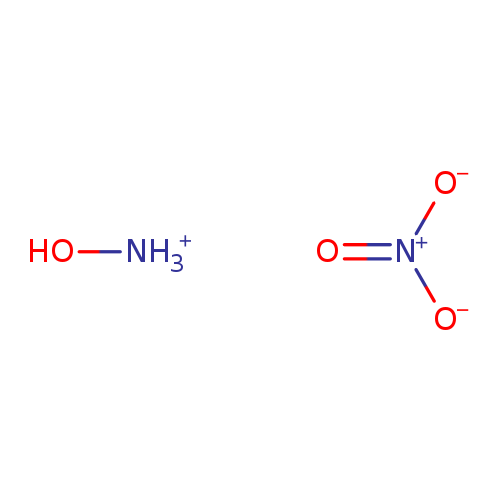
Chemical Structure
Synonyms
ValueSource
Hydroxylammonium nitric acidGenerator
Chemical FormulaH4N2O4
Average Molecular Mass96.043 g/mol
Monoisotopic Mass96.017 g/mol
CAS Registry Number13465-08-2
IUPAC Namehydroxyazanium nitrate
Traditional Namehydroxyazanium nitrate
SMILES[NH3+]O.[O-][N+]([O-])=O
InChI IdentifierInChI=1S/NO3.H4NO/c2-1(3)4;1-2/h;2H,1H3/q-1;+1
InChI KeyCRJZNQFRBUFHTE-UHFFFAOYSA-N
Chemical Taxonomy
Description Belongs to the class of inorganic compounds known as non-metal nitrates. These are inorganic non-metallic compounds containing a nitrate as its largest oxoanion.
KingdomInorganic compounds
Super ClassHomogeneous non-metal compounds
ClassNon-metal oxoanionic compounds
Sub ClassNon-metal nitrates
Direct ParentNon-metal nitrates
Alternative Parents
Substituents
  • Non-metal nitrate
  • Inorganic oxide
  • Inorganic salt
Molecular FrameworkNot Available
External DescriptorsNot Available
Biological Properties
StatusDetected and Not Quantified
OriginExogenous
Cellular Locations
  • Cytoplasm
  • Extracellular
Biofluid LocationsNot Available
Tissue LocationsNot Available
ApplicationsNot Available
Biological RolesNot Available
Chemical RolesNot Available
Organoleptic EffectsNot Available
Physical Properties
StateSolid
AppearanceWhite powder.
Experimental Properties
PropertyValue
Melting PointNot Available
Boiling PointNot Available
SolubilityNot Available
Predicted Properties
PropertyValueSource
logP0.028ChemAxon
pKa (Strongest Acidic)-1.4ChemAxon
pKa (Strongest Basic)-6.1ChemAxon
Physiological Charge-1ChemAxon
Hydrogen Acceptor Count3ChemAxon
Hydrogen Donor Count0ChemAxon
Polar Surface Area68.88 ŲChemAxon
Rotatable Bond Count0ChemAxon
Refractivity9.85 m³·mol⁻¹ChemAxon
Polarizability3.24 ųChemAxon
Number of Rings0ChemAxon
BioavailabilityYesChemAxon
Rule of FiveYesChemAxon
Ghose FilterNoChemAxon
Veber's RuleNoChemAxon
MDDR-like RuleNoChemAxon
Spectra
Spectra
Spectrum TypeDescriptionSplash KeyDeposition DateView
Predicted LC-MS/MSPredicted LC-MS/MS Spectrumsplash10-0002-9000000000-3cdc8b7b8bbaaeae6a75Not AvailableView Spectrum
Predicted LC-MS/MSPredicted LC-MS/MS Spectrumsplash10-0002-9000000000-80cdb45982ae019b1f9cNot AvailableView Spectrum
Toxicity Profile
Toxicity ValuesNot Available
Toxicity / Toxin ClassNot Available
Mechanism of ToxicityNitrate's toxicity is a result of it's conversion to nitrite once in the body. Nitrite causes the autocatalytic oxidation of oxyhemoglobin to hydrogen peroxide and methemoglobin. This elevation of methemoglobin levels is a condition known as methemoglobinemia, and is characterized by tissue hypoxia, as methemoglobin cannot bind oxygen. (1, 4)
Carcinogenicity (IARC Classification)Ingested nitrate or nitrite under conditions that result in endogenous nitrosation is probably carcinogenic to humans (Group 2A). (2)
Minimum Risk LevelNot Available
SymptomsNitrate and nitrite poisoning causes methemoglobinemia. Symptoms include cyanosis, cardiac dysrhythmias and circulatory failure, and progressive central nervous system (CNS) effects. CNS effects can range from mild dizziness and lethargy to coma and convulsions. (3)
TreatmentMethemoglobinemia can be treated with supplemental oxygen and methylene blue 1% solution administered intravenously slowly over five minutes followed by IV flush with normal saline. Methylene blue restores the iron in hemoglobin to its normal (reduced) oxygen-carrying state. (4)
Health Effects
Health EffectRelationshipDirectionReference
Exposure Sources
Source IDSourceSectorReference
CEDs000506Antennas?Antennas, commonly used in communication technologies, can be a source of synthetic chemical contamination through the materials and coatings used in their construction.Electrical & Electronic EquipmentNot Available
CEDs000511Conductors Or Conductive Bodies Characterised By The Conductive Materials?Conductors, or conductive bodies, are materials that allow the flow of electrical current, typically made from metals such as copper, aluminum, or silver.Electrical & Electronic EquipmentNot Available
CEDs000519Electrodes?Electrodes, used in various electrical and electronic applications, can be a source of synthetic chemical contamination due to the materials from which they are constructed and the processes involved in their manufacturing.Electrical & Electronic EquipmentNot Available
CEDs000524Hybrid Capacitors?Hybrid capacitors are energy storage devices that combine the properties of electrolytic and supercapacitors, utilizing a combination of electrochemical principles to achieve higher energy density and power density.Electrical & Electronic EquipmentNot Available
CEDs000533Sparking Plugs?Spark plugs are critical components in internal combustion engines, facilitating the ignition of fuel-air mixtures by generating a spark.Electrical & Electronic EquipmentNot Available
CEDs000563Soap Detergents?Soap detergents are synthetic surfactants designed to enhance the cleaning efficacy of water by reducing surface tension, allowing for better interaction with dirt and grease.Household cleaning & consumer productsNot Available
CEDs000592Marine Propulsion Or Steering?Marine propulsion and steering systems often rely on various synthetic chemicals, including lubricants, fuels, and hydraulic fluids.Marine, shipping & aquacultureNot Available
CEDs000630Toys?Toys, particularly those made from synthetic materials such as plastics, can be a source of chemical contamination due to the presence of various additives and compounds used in their production.Recreation & sports surfacesNot Available
CEDs000665Fire Extinguishers?Fire extinguishers contain various synthetic chemicals designed to suppress flames and prevent the spread of fire.Fire suppression systems & agentsNot Available
CEDs000685Ceramics?Ceramics can be a source of synthetic chemical contamination through various additives and processing agents used in their production.Building & ConstructionNot Available
CEDs000688Glass Coatings?Glass coatings are synthetic chemical formulations applied to glass surfaces to enhance properties such as durability, UV resistance, and aesthetic appeal.Building & ConstructionNot Available
CEDs000692Silica Free Oxide Glass?Silica Free Oxide Glass is a type of glass that is produced using alternative materials to traditional silica-based formulations.Building & ConstructionNot Available
CEDs000696Nanotechnology?Nanotechnology involves the manipulation of materials at the molecular or atomic level, typically within the range of 1 to 100 nanometers.Industrial manufacturing & chemical processingNot Available
CEDs000697Submarines?Submarines, while essential for military and research purposes, can be a source of synthetic chemical contamination due to their use of various industrial chemicals.Marine, shipping & aquacultureNot Available
CEDs000699Mining Or Quarrying?Mining and quarrying operations can lead to synthetic chemical contamination through the release of various pollutants associated with the extraction and processing of minerals.Mining & metal processingNot Available
CEDs000734Coating Compositions?Coating compositions, which include paints, sealants, and varnishes, are formulated with a variety of synthetic chemicals such as solvents, resins, pigments, and additives.Building & ConstructionNot Available
CEDs000735Explosives?Explosives are chemical compounds or mixtures designed to undergo rapid decomposition, releasing energy in the form of gas and heat.Defense & military infrastructureNot Available
CEDs000736Fuses?Fuses are safety devices designed to protect electrical circuits by breaking the circuit when excessive current flows through.Electrical & Electronic EquipmentNot Available
CEDs000737Chemical Igniters?Chemical igniters are substances or devices designed to initiate combustion in various applications, often found in products like lighters, candles, and certain household cleaning agents.Household itemsNot Available
CEDs000740Paper?Paper production involves the processing of wood fibers and the use of various chemicals, which can lead to synthetic chemical contamination.Paper, pulp & fiber productsNot Available
CEDs000744Water, Wastewater, & Sewage Treatment?Water, wastewater, and sewage treatment processes are critical for managing and mitigating pollutants in water systems.Wastewater, sanitation & biosolidsNot Available
Pathways
0 pathwaysPathway Source: PathBank

No pathways found

No metabolic pathways have been associated with this synthetic chemical

Targets
StructureProteinUniProt IDOrganismRelationshipDetails
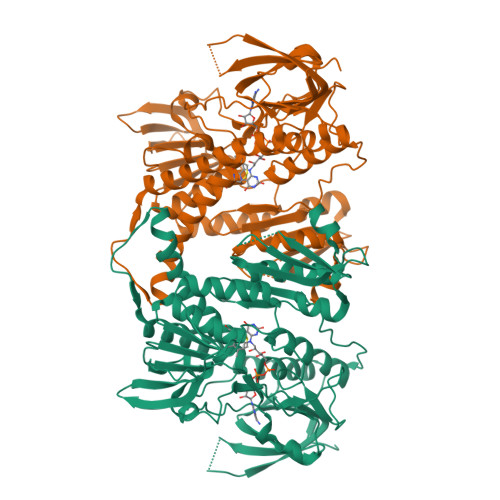
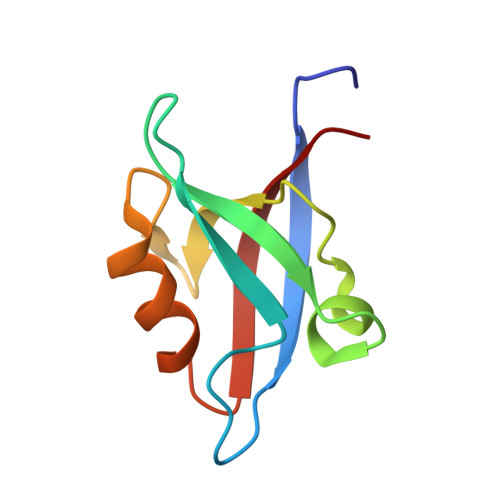
Endolysin structureClick to view 3D structureEndolysinP00720Enterobacteria phage T4Predicted (SEA)
Prediction Confidence Score
0.286
Applicability Domain
0.286 Low confidence
Statistical Significance
0.0016
Supporting Reference Compounds
1
E-value
12.6894
Click to view 3D structureCatechol O-methyltransferaseQ99028Sus scrofaPredicted (SEA)
Prediction Confidence Score
0.207
Applicability Domain
0.207 Low confidence
Statistical Significance
0.0018
Supporting Reference Compounds
2
E-value
14.2464
Catechol O-methyltransferase structureClick to view 3D structureCatechol O-methyltransferaseP22734Rattus norvegicusPredicted (SEA)
Prediction Confidence Score
0.185
Applicability Domain
0.231 Low confidence
Statistical Significance
0.0211
Supporting Reference Compounds
15
E-value
163.95
Carbonic anhydrase 2 structureClick to view 3D structureCarbonic anhydrase 2P00918HumansPredicted (SEA)
Prediction Confidence Score
0.177
Applicability Domain
0.214 Low confidence
Statistical Significance
0.8257
Supporting Reference Compounds
472
E-value
6427.7
Click to view 3D structurePutative nitroreductaseQ4A0P1Staphylococcus saprophyticus subsp. saprophyticus (strain ATCC 15305 / DSM20229 / NCIMB 8711 / NCTC 7292 / S-41)Predicted (SEA)
Prediction Confidence Score
0.169
Applicability Domain
0.176 Low confidence
Statistical Significance
0.013
Supporting Reference Compounds
2
E-value
101.048
Click to view 3D structureModulator of drug activity AQ8X6S1Escherichia coli O157:H7Predicted (SEA)
Prediction Confidence Score
0.167
Applicability Domain
0.176 Low confidence
Statistical Significance
0.0108
Supporting Reference Compounds
2
E-value
84.155
Carbonic anhydrase 1 structureClick to view 3D structureCarbonic anhydrase 1P00915HumansPredicted (SEA)
Prediction Confidence Score
0.164
Applicability Domain
0.214 Low confidence
Statistical Significance
0.8893
Supporting Reference Compounds
407
E-value
6923.29
Click to view 3D structureATP-dependent molecular chaperone HSP82C4YTQ8Candida albicans (strain WO-1) (Yeast)Predicted (SEA)
Prediction Confidence Score
0.163
Applicability Domain
0.182 Low confidence
Statistical Significance
0.8533
Supporting Reference Compounds
205
E-value
6642.95
Cystathionine beta-lyase MetC structureClick to view 3D structureCystathionine beta-lyase MetCP06721Escherichia coli K-12Predicted (SEA)
Prediction Confidence Score
0.162
Applicability Domain
0.162 Low confidence
Statistical Significance
0.0589
Supporting Reference Compounds
1
E-value
458.298
Carbonic anhydrase 9 structureClick to view 3D structureCarbonic anhydrase 9Q16790HumansPredicted (SEA)
Prediction Confidence Score
0.158
Applicability Domain
0.171 Low confidence
Statistical Significance
0.9168
Supporting Reference Compounds
372
E-value
7136.98
Thioredoxin reductase structureClick to view 3D structureThioredoxin reductaseP61076Plasmodium falciparum 3D7Predicted (SEA)
Prediction Confidence Score
0.156
Applicability Domain
0.156 Low confidence
Statistical Significance
0.0107
Supporting Reference Compounds
1
E-value
83.3765
Click to view 3D structureHeat shock factor protein 1P38532Mus musculusPredicted (SEA)
Prediction Confidence Score
0.156
Applicability Domain
0.171 Low confidence
Statistical Significance
0.9018
Supporting Reference Compounds
166
E-value
7020.29
Click to view 3D structureIntestinal-type alkaline phosphataseP24822Mus musculusPredicted (SEA)
Prediction Confidence Score
0.152
Applicability Domain
0.172 Low confidence
Statistical Significance
0.5929
Supporting Reference Compounds
58
E-value
4615.52
Arylsulfatase structureClick to view 3D structureArylsulfataseP51691Pseudomonas aeruginosa (strain ATCC 15692 / PAO1 / 1C / PRS 101 / LMG 12228)Predicted (SEA)
Prediction Confidence Score
0.152
Applicability Domain
0.152 Low confidence
Statistical Significance
0.0354
Supporting Reference Compounds
1
E-value
275.431
Carbonic anhydrase 12 structureClick to view 3D structureCarbonic anhydrase 12O43570HumansPredicted (SEA)
Prediction Confidence Score
0.15
Applicability Domain
0.171 Low confidence
Statistical Significance
0.9457
Supporting Reference Compounds
332
E-value
7361.89
G-protein coupled receptor 35 structureClick to view 3D structureG-protein coupled receptor 35Q9HC97HumansPredicted (SEA)
Prediction Confidence Score
0.15
Applicability Domain
0.171 Low confidence
Statistical Significance
0.9403
Supporting Reference Compounds
115
E-value
7320.24
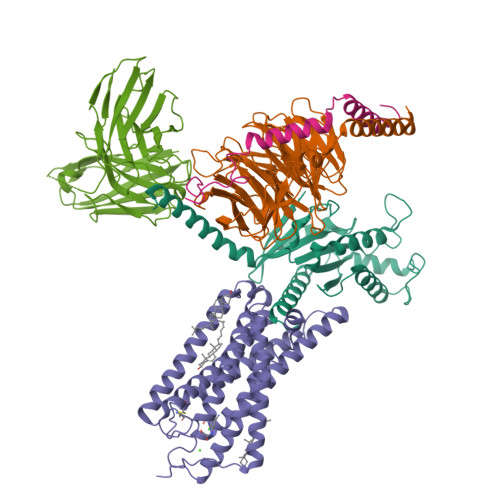
Tyrosine-protein kinase JAK2 structureClick to view 3D structureTyrosine-protein kinase JAK2O60674HumansPredicted (SEA)
Prediction Confidence Score
0.149
Applicability Domain
0.194 Low confidence
Statistical Significance
0.9883
Supporting Reference Compounds
1022
E-value
7693.84
Transthyretin structureClick to view 3D structureTransthyretinP02766HumansPredicted (SEA)
Prediction Confidence Score
0.149
Applicability Domain
0.231 Low confidence
Statistical Significance
0.6732
Supporting Reference Compounds
55
E-value
5241.12
Click to view 3D structureStreptokinase AP10520Streptococcus pyogenes serotype M1Predicted (SEA)
Prediction Confidence Score
0.149
Applicability Domain
0.158 Low confidence
Statistical Significance
0.9821
Supporting Reference Compounds
425
E-value
7645.49
Protein RecA structureClick to view 3D structureProtein RecAP9WHJ3Mycobacterium tuberculosisPredicted (SEA)
Prediction Confidence Score
0.146
Applicability Domain
0.176 Low confidence
Statistical Significance
0.9651
Supporting Reference Compounds
296
E-value
7513.54
Prostaglandin G/H synthase 2 structureClick to view 3D structureProstaglandin G/H synthase 2P35354HumansPredicted (SEA)
Prediction Confidence Score
0.146
Applicability Domain
0.182 Low confidence
Statistical Significance
0.9663
Supporting Reference Compounds
201
E-value
7522.34
Aldo-keto reductase family 1 member C3 structureClick to view 3D structureAldo-keto reductase family 1 member C3P42330HumansPredicted (SEA)
Prediction Confidence Score
0.143
Applicability Domain
0.171 Low confidence
Statistical Significance
0.8534
Supporting Reference Compounds
57
E-value
6643.5
Aldo-keto reductase family 1 member C2 structureClick to view 3D structureAldo-keto reductase family 1 member C2P52895HumansPredicted (SEA)
Prediction Confidence Score
0.143
Applicability Domain
0.171 Low confidence
Statistical Significance
0.7632
Supporting Reference Compounds
40
E-value
5941.22
Click to view 3D structureNitric oxide synthase 3P70313Mus musculusPredicted (SEA)
Prediction Confidence Score
0.143
Applicability Domain
0.143 Low confidence
Statistical Significance
0.1432
Supporting Reference Compounds
1
E-value
1115.19
Glutamate receptor-interacting protein 1 structureClick to view 3D structureGlutamate receptor-interacting protein 1P97879Rattus norvegicusPredicted (SEA)
Prediction Confidence Score
0.143
Applicability Domain
0.143 Low confidence
Statistical Significance
0.0157
Supporting Reference Compounds
1
E-value
122.145
Hemoglobin subunit alpha structureClick to view 3D structureHemoglobin subunit alphaP69905HumansKnownNitrite causes the autocatalytic oxidation of oxyhemoglobin to hydrogen peroxide and methemoglobin. This elevation of methemoglobin levels is a condition known as methemoglobinemia, and is characterized by tissue hypoxia, as methemoglobin cannot bind oxygen. (A2450, L1613)
Hemoglobin subunit beta structureClick to view 3D structureHemoglobin subunit betaP68871HumansKnownNitrite causes the autocatalytic oxidation of oxyhemoglobin to hydrogen peroxide and methemoglobin. This elevation of methemoglobin levels is a condition known as methemoglobinemia, and is characterized by tissue hypoxia, as methemoglobin cannot bind oxygen. (A2450, L1613)
Concentrations
Not Available
External Links
DrugBank IDNot Available
HMDB IDNot Available
FooDB IDNot Available
Phenol Explorer IDNot Available
KNApSAcK IDNot Available
BiGG IDNot Available
BioCyc IDNot Available
METLIN IDNot Available
PDB IDNot Available
Wikipedia LinkHydroxylammonium nitrate
Chemspider IDNot Available
ChEBI IDNot Available
PubChem Compound ID26045
Kegg Compound IDNot Available
YMDB IDNot Available
ECMDB IDNot Available
References
Synthesis ReferenceNot Available
MSDSNot Available
General References
  1. Keszler A, Piknova B, Schechter AN, Hogg N: The reaction between nitrite and oxyhemoglobin: a mechanistic study. J Biol Chem. 2008 Apr 11;283(15):9615-22. doi: 10.1074/jbc.M705630200. Epub 2008 Jan 17. [PubMed: 18203719]
  2. International Agency for Research on Cancer (2014). IARC Monographs on the Evaluation of Carcinogenic Risks to Humans. - http://monographs.iarc.fr/index.php
  3. ATSDR - Agency for Toxic Substances and Disease Registry (2007). Case Studies in Environmental Medicine. Nitrate/Nitrite Toxicity. U.S. Public Health Service in collaboration with U.S. Environmental Protection Agency (EPA). - http://www.atsdr.cdc.gov/csem/nitrate/nitrate.html
  4. Wikipedia. Methemoglobinemia. Last Updated 22 July 2009. - http://en.wikipedia.org/wiki/Methemoglobinemia
  5. Wikipedia. Hydroxylammonium nitrate. Last Updated 7 February 2009. - http://en.wikipedia.org/wiki/Hydroxylammonium_nitrate
  6. American Conference of Governmental Industrial Hygienists, Inc. (1991). Documentation of the Threshold Limit Values and Biological Exposure Indices. 6th ed. Volumes I, II, III. Cincinnati, OH: American Conference of Governmental Industrial Hygienists.