Strontium nitrate (CED0010748)

Record Information
Version1.0
Creation Date2009-08-05 17:39:35 UTC
Update Date2026-04-05 19:12:44 UTC
Accession NumberCHEM002560
Identification
Common NameStrontium nitrate
ClassSmall Molecule
Description
Strontium nitrate (N2O6Sr) is an exogenous inorganic compound with an average molecular weight of 211.63 g/mol. It exists as a solid at room temperature. Strontium nitrate belongs to the alkaline earth metal nitrates, a subclass of alkaline earth metal oxoanionic compounds within the inorganic compounds. Industrially, the compound is utilized as a softener and conditioner. It is found in or released from 22 recorded sources, including building and construction materials such as fencing, and food processing applications specifically for the treatment of hops. It is also associated with household cleaning and consumer products, including bleaching agents, cigar cigarettes, tobacco pipes, other smoking requisites, and non electric simulated smoking devices. Additionally, it is present in electrical and electronic equipment, such as antennas, communication cables or conductors, discharge lamps, auxiliary devices, and cores yokes or armatures. The compound is linked to two protein targets: hemoglobin subunit alpha (HBA1) and hemoglobin subunit beta (HBB). Nitrite causes the autocatalytic oxidation of oxyhemoglobin to hydrogen peroxide and methemoglobin. This elevation of methemoglobin levels results in a condition known as methemoglobinemia, which is characterized by tissue hypoxia because methemoglobin cannot bind oxygen.
Contaminant Type
  • Industrial/Workplace Toxin
  • Inorganic Compound
  • Nitrate
  • Nitrite
  • Pollutant
  • Synthetic Compound
Chemical Structure
Synonyms
ValueSource
Strontium nitric acidGenerator
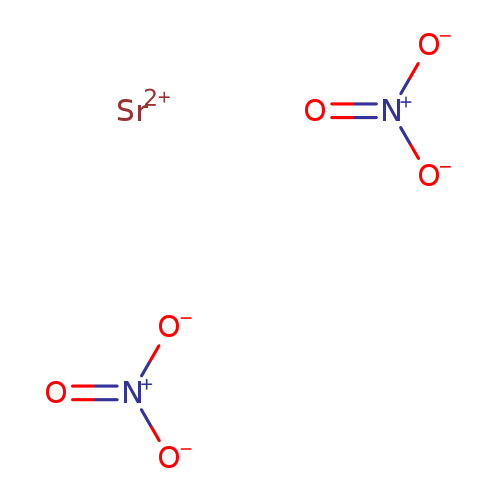
Chemical FormulaN2O6Sr
Average Molecular Mass211.630 g/mol
Monoisotopic Mass211.881 g/mol
CAS Registry Number10042-76-9
IUPAC Namestrontium(2+) ion dinitrate
Traditional Namestrontium(2+) ion dinitrate
SMILES[Sr++].[O-][N+]([O-])=O.[O-][N+]([O-])=O
InChI IdentifierInChI=1S/2NO3.Sr/c2*2-1(3)4;/q2*-1;+2
InChI KeyDHEQXMRUPNDRPG-UHFFFAOYSA-N
Chemical Taxonomy
Description Belongs to the class of inorganic compounds known as alkaline earth metal nitrates. These are inorganic compounds in which the largest oxoanion is nitrate, and in which the heaviest atom not in an oxoanion is an alkaline earth metal.
KingdomInorganic compounds
Super ClassMixed metal/non-metal compounds
ClassAlkaline earth metal oxoanionic compounds
Sub ClassAlkaline earth metal nitrates
Direct ParentAlkaline earth metal nitrates
Alternative Parents
Substituents
  • Alkaline earth metal nitrate
  • Inorganic oxide
  • Inorganic salt
Molecular FrameworkNot Available
External DescriptorsNot Available
Biological Properties
StatusDetected and Not Quantified
OriginExogenous
Cellular Locations
  • Cytoplasm
  • Extracellular
Biofluid LocationsNot Available
Tissue LocationsNot Available
ApplicationsNot Available
Biological RolesNot Available
Chemical RolesNot Available
Organoleptic EffectsNot Available
Physical Properties
StateSolid
AppearanceWhite powder.
Experimental Properties
PropertyValue
Melting Point570°C
Boiling Point645°C (decomposes)
SolubilityNot Available
Predicted Properties
PropertyValueSource
logP0.028ChemAxon
pKa (Strongest Acidic)-1.4ChemAxon
pKa (Strongest Basic)-6.1ChemAxon
Physiological Charge-1ChemAxon
Hydrogen Acceptor Count3ChemAxon
Hydrogen Donor Count0ChemAxon
Polar Surface Area68.88 ŲChemAxon
Rotatable Bond Count0ChemAxon
Refractivity9.85 m³·mol⁻¹ChemAxon
Polarizability3.24 ųChemAxon
Number of Rings0ChemAxon
BioavailabilityYesChemAxon
Rule of FiveYesChemAxon
Ghose FilterNoChemAxon
Veber's RuleNoChemAxon
MDDR-like RuleNoChemAxon
Spectra
SpectraNot Available
Toxicity Profile
Mechanism of ToxicityNitrate's toxicity is a result of it's conversion to nitrite once in the body. Nitrite causes the autocatalytic oxidation of oxyhemoglobin to hydrogen peroxide and methemoglobin. This elevation of methemoglobin levels is a condition known as methemoglobinemia, and is characterized by tissue hypoxia, as methemoglobin cannot bind oxygen. (1, 5)
Carcinogenicity (IARC Classification)Ingested nitrate or nitrite under conditions that result in endogenous nitrosation is probably carcinogenic to humans (Group 2A). (2)
Minimum Risk LevelNot Available
SymptomsNitrate and nitrite poisoning causes methemoglobinemia. Symptoms include cyanosis, cardiac dysrhythmias and circulatory failure, and progressive central nervous system (CNS) effects. CNS effects can range from mild dizziness and lethargy to coma and convulsions. (4)
TreatmentMethemoglobinemia can be treated with supplemental oxygen and methylene blue 1% solution administered intravenously slowly over five minutes followed by IV flush with normal saline. Methylene blue restores the iron in hemoglobin to its normal (reduced) oxygen-carrying state. (5)
Toxicity Values
Toxicity ValueUnitValue RangeOrganismDose DescriptorRoute of ExposurePredicted or ExperimentalReference
540.0mg/kgNot AvailableRatLD50IntraperitonealexperimentalT14
Health Effects
Health EffectRelationshipDirectionReference
Exposure Sources
Source IDSourceSectorReference
233BrushesPersonal care & cosmeticsNot Available
496FencingBuilding & ConstructionNot Available
506AntennasElectrical & Electronic EquipmentNot Available
507Auxiliary DevicesElectrical & Electronic EquipmentNot Available
510Communication Cables Or ConductorsElectrical & Electronic EquipmentNot Available
513Cores Yokes Or ArmaturesElectrical & Electronic EquipmentNot Available
514Discharge LampsElectrical & Electronic EquipmentNot Available
517Electric SwitchesElectrical & Electronic EquipmentNot Available
518Electrically Stimulated Smoking DevicesElectrical & Electronic EquipmentNot Available
521Fixed Capacitors And Their ManufactureElectrical & Electronic EquipmentNot Available
523Gas Filled Discharge Tubes With Solid CathodeElectrical & Electronic EquipmentNot Available
529Power CablesElectrical & Electronic EquipmentNot Available
535Superconducting Magnets And Superconducting CoilsElectrical & Electronic EquipmentNot Available
536Superconductive Or Hyperconductive Conductors Cables Or Transmission LinesElectrical & Electronic EquipmentNot Available
537Television SystemsElectrical & Electronic EquipmentNot Available
538Thin Magnetic FilmsElectrical & Electronic EquipmentNot Available
553Treatment Of HopsFood, food processing & cookwareNot Available
555Bleaching AgentsHousehold cleaning & consumer productsNot Available
556Cigar CigarettesHousehold cleaning & consumer productsNot Available
559Non Electric Simulated Smoking DevicesHousehold cleaning & consumer productsNot Available
560Other Smoking RequisitesHousehold cleaning & consumer productsNot Available
566Tobacco PipesHousehold cleaning & consumer productsNot Available
569Tobacco Smoke FiltersHousehold cleaning & consumer productsNot Available
578Making CigarsIndustrial manufacturing & chemical processingNot Available
579Manufacture Of Iron Or SteelIndustrial manufacturing & chemical processingNot Available
581Paper Making MachinesIndustrial manufacturing & chemical processingNot Available
589Life BuoysMarine, shipping & aquacultureNot Available
609AftershavePersonal care & cosmeticsNot Available
613DepilatoriesPersonal care & cosmeticsNot Available
627Roulette GamesRecreation & sports surfacesNot Available
630ToysRecreation & sports surfacesNot Available
638Decorating TextilesTextiles, leather & furnishingsNot Available
643HeadwearTextiles, leather & furnishingsNot Available
652RopesTextiles, leather & furnishingsNot Available
653SewingTextiles, leather & furnishingsNot Available
657Surface Finishing Of LeatherTextiles, leather & furnishingsNot Available
662Yarns Or ThreadsTextiles, leather & furnishingsNot Available
Pathways
0 pathways

No pathways found

No metabolic pathways have been associated with this synthetic chemical

Targets
StructureProteinUniProt IDOrganismRelationshipDetails
Endolysin structureClick to view 3D structureEndolysinP00720Enterobacteria phage T4Predicted (SEA)28.2593
Click to view 3D structureCatechol O-methyltransferaseQ99028Sus scrofaPredicted (SEA)38.0683
Carbonic anhydrase 2 structureClick to view 3D structureCarbonic anhydrase 2P00918HumansPredicted (SEA)6689.58
Click to view 3D structureThioredoxin reductaseP61076Plasmodium falciparum 3D7Predicted (SEA)63.3693
Click to view 3D structurePutative nitroreductaseQ4A0P1Staphylococcus saprophyticus subsp. saprophyticus (strain ATCC 15305 / DSM20229 / NCIMB 8711 / NCTC 7292 / S-41)Predicted (SEA)114.283
Arylsulfatase structureClick to view 3D structureArylsulfataseP51691Pseudomonas aeruginosa (strain ATCC 15692 / PAO1 / 1C / PRS 101 / LMG 12228)Predicted (SEA)197.893
Click to view 3D structureCatechol O-methyltransferaseP22734Rattus norvegicusPredicted (SEA)523.614
Click to view 3D structureHeat shock factor protein 1P38532Mus musculusPredicted (SEA)7124.84
Click to view 3D structureATP-dependent molecular chaperone HSP82C4YTQ8Candida albicans (strain WO-1) (Yeast)Predicted (SEA)7373.8
Click to view 3D structureIntestinal-type alkaline phosphataseP24822Mus musculusPredicted (SEA)5466.49
Toll-like receptor 9 structureClick to view 3D structureToll-like receptor 9Q9NR96HumansPredicted (SEA)7346.79
Carbonic anhydrase 1 structureClick to view 3D structureCarbonic anhydrase 1P00915HumansPredicted (SEA)7605.56
Click to view 3D structureModulator of drug activity AQ8X6S1Escherichia coli O157:H7Predicted (SEA)212.451
Carbonic anhydrase 9 structureClick to view 3D structureCarbonic anhydrase 9Q16790HumansPredicted (SEA)7597.31
Carbonic anhydrase 12 structureClick to view 3D structureCarbonic anhydrase 12O43570HumansPredicted (SEA)7548.42
Click to view 3D structureCarboxylesteraseB3TNN2Loxostege sticticalisPredicted (SEA)203.42
Click to view 3D structureProtein RecAP9WHJ3Mycobacterium tuberculosisPredicted (SEA)7589.44
Caspase-3 structureClick to view 3D structureCaspase-3P42574HumansPredicted (SEA)7458.58
Sphingosine 1-phosphate receptor 4 structureClick to view 3D structureSphingosine 1-phosphate receptor 4O95977HumansPredicted (SEA)7419.34
Prostaglandin G/H synthase 2 structureClick to view 3D structureProstaglandin G/H synthase 2P35354HumansPredicted (SEA)7622.84
Click to view 3D structureGlucose-6-phosphate dehydrogenase-6-phosphogluconolactonaseQ9BHT9Plasmodium bergheiPredicted (SEA)6975.37
Click to view 3D structureCystathionine beta-lyase MetCP06721Escherichia coli K-12Predicted (SEA)1157.46
Induced myeloid leukemia cell differentiation protein Mcl-1 structureClick to view 3D structureInduced myeloid leukemia cell differentiation protein Mcl-1Q07820HumansPredicted (SEA)7672.51
Tyrosine-protein kinase JAK2 structureClick to view 3D structureTyrosine-protein kinase JAK2O60674HumansPredicted (SEA)7757.36
Signal transducer and activator of transcription 3 structureClick to view 3D structureSignal transducer and activator of transcription 3P40763HumansPredicted (SEA)7684.03
Hemoglobin subunit alpha structureClick to view 3D structureHemoglobin subunit alphaP69905HumansKnownNitrite causes the autocatalytic oxidation of oxyhemoglobin to hydrogen peroxide and methemoglobin. This elevation of methemoglobin levels is a condition known as methemoglobinemia, and is characterized by tissue hypoxia, as methemoglobin cannot bind oxygen. (A2450, L1613)
Hemoglobin subunit beta structureClick to view 3D structureHemoglobin subunit betaP68871HumansKnownNitrite causes the autocatalytic oxidation of oxyhemoglobin to hydrogen peroxide and methemoglobin. This elevation of methemoglobin levels is a condition known as methemoglobinemia, and is characterized by tissue hypoxia, as methemoglobin cannot bind oxygen. (A2450, L1613)
Concentrations
Not Available
External Links
DrugBank IDNot Available
HMDB IDNot Available
FooDB IDNot Available
Phenol Explorer IDNot Available
KNApSAcK IDNot Available
BiGG IDNot Available
BioCyc IDNot Available
METLIN IDNot Available
PDB IDNot Available
Wikipedia LinkStrontium nitrate
Chemspider IDNot Available
ChEBI IDNot Available
PubChem Compound ID24848
Kegg Compound IDNot Available
YMDB IDNot Available
ECMDB IDNot Available
References
Synthesis ReferenceNot Available
MSDSNot Available
General References