Record Information
Version1.0
Creation Date2014-08-29 04:49:15 UTC
Update Date2026-05-14 16:42:39 UTC
Accession NumberCHEM002977
Identification
Common NameVinblastine
ClassSmall Molecule
Description
Vinblastine is only found in individuals that have used or taken this drug. It is an antitumor alkaloid isolated from Vinca rosea. (Merck, 11th ed.)The antitumor activity of vinblastine is thought to be due primarily to inhibition of mitosis at metaphase through its interaction with tubulin. Vinblastine binds to the microtubular proteins of the mitotic spindle, leading to crystallization of the microtubule and mitotic arrest or cell death.
Contaminant Sources
  • HMDB Contaminants - Urine
  • STOFF IDENT Compounds
  • T3DB toxins
Contaminant Type
  • Amine
  • Antineoplastic Agent, Phytogenic
  • Drug
  • Ester
  • Ether
  • Metabolite
  • Organic Compound
  • PFAS
  • Phytotoxin
  • Synthetic Compound
  • Tubulin Modulator
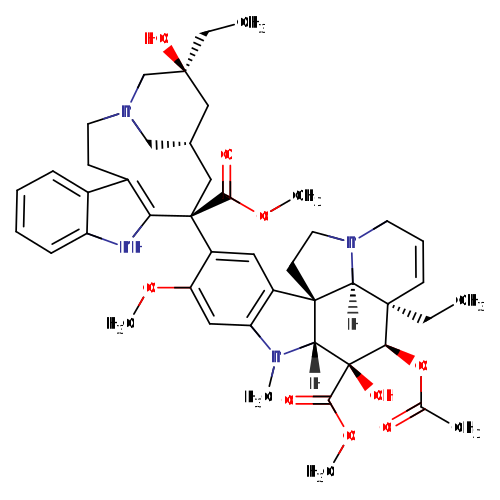
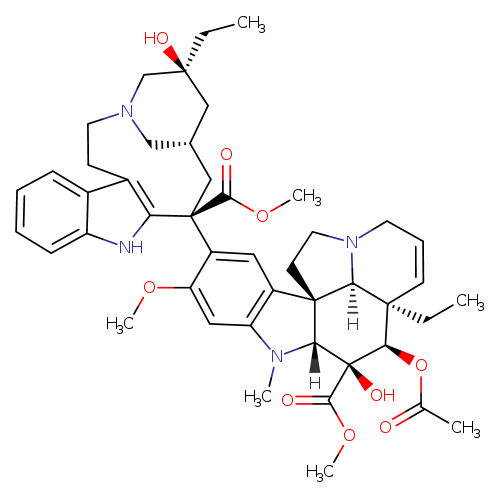
Chemical Structure
Synonyms
ValueSource
(2ALPHA,2'BETA,3BETA,4ALPHA,5BETA)-VINCALEUKOBLASTINEChEBI
VLBChEBI
VinblastinaKegg
(2a,2'b,3b,4a,5b)-VINCALEUKOBLASTINEGenerator
(2Α,2'β,3β,4α,5β)-vincaleukoblastineGenerator
Gry brand OF vinblastine sulfateHMDB
Hexal brand OF vinblastine sulfateHMDB
Lilly brand OF vinblastine sulfateHMDB
VelbeHMDB
EG labo brand OF vinblastine sulfateHMDB
LemblastineHMDB
Vinblastinsulfat-gryHMDB
VincaleukoblastineHMDB
Faulding brand OF vinblastine sulfateHMDB
VelbanHMDB
Vinblastin hexalHMDB
Vinblastina lillyHMDB
Cell pharm brand OF vinblastine sulfateHMDB
Gastrozepin brand OF vinblastine sulfateHMDB
Lemery brand OF vinblastine sulfateHMDB
Sulfate, vinblastineHMDB
Vinblastine sulfateHMDB
CellblastinHMDB
Chemical FormulaC46H58N4O9
Average Molecular Mass810.974 g/mol
Monoisotopic Mass810.420 g/mol
CAS Registry Number865-21-4
IUPAC Namemethyl (1R,9R,10S,11R,12R,19R)-11-(acetyloxy)-12-ethyl-4-[(13S,15S,17S)-17-ethyl-17-hydroxy-13-(methoxycarbonyl)-1,11-diazatetracyclo[13.3.1.0⁴,¹².0⁵,¹⁰]nonadeca-4(12),5,7,9-tetraen-13-yl]-10-hydroxy-5-methoxy-8-methyl-8,16-diazapentacyclo[10.6.1.0¹,⁹.0²,⁷.0¹⁶,¹⁹]nonadeca-2(7),3,5,13-tetraene-10-carboxylate
Traditional Namevinblastine
SMILES[H][C@@]12N(C)C3=C(C=C(C(OC)=C3)[C@]3(C[C@@H]4CN(C[C@](O)(CC)C4)CCC4=C3NC3=CC=CC=C43)C(=O)OC)[C@@]11CCN3CC=C[C@@](CC)([C@@H](OC(C)=O)[C@]2(O)C(=O)OC)[C@@]13[H]
InChI IdentifierInChI=1S/C46H58N4O9/c1-8-42(54)23-28-24-45(40(52)57-6,36-30(15-19-49(25-28)26-42)29-13-10-11-14-33(29)47-36)32-21-31-34(22-35(32)56-5)48(4)38-44(31)17-20-50-18-12-16-43(9-2,37(44)50)39(59-27(3)51)46(38,55)41(53)58-7/h10-14,16,21-22,28,37-39,47,54-55H,8-9,15,17-20,23-26H2,1-7H3/t28-,37+,38-,39-,42+,43-,44-,45+,46+/m1/s1
InChI KeyJXLYSJRDGCGARV-XQKSVPLYSA-N
Chemical Taxonomy
Description Belongs to the class of organic compounds known as glutamic acid and derivatives. Glutamic acid and derivatives are compounds containing glutamic acid or a derivative thereof resulting from reaction of glutamic acid at the amino group or the carboxy group, or from the replacement of any hydrogen of glycine by a heteroatom.
KingdomOrganic compounds
Super ClassOrganic acids and derivatives
ClassCarboxylic acids and derivatives
Sub ClassAmino acids, peptides, and analogues
Direct ParentGlutamic acid and derivatives
Alternative Parents
Substituents
  • Glutamic acid or derivatives
  • Hippuric acid or derivatives
  • Hippuric acid
  • N-acyl-alpha-amino acid
  • N-acyl-alpha amino acid or derivatives
  • Aminobenzamide
  • Aminobenzoic acid or derivatives
  • Pteridine
  • Benzamide
  • Benzoic acid or derivatives
  • Benzoyl
  • Aniline or substituted anilines
  • Tertiary aliphatic/aromatic amine
  • Dialkylarylamine
  • Aminopyrimidine
  • Aralkylamine
  • Benzenoid
  • Pyrimidine
  • Pyrazine
  • Monocyclic benzene moiety
  • Dicarboxylic acid or derivatives
  • Heteroaromatic compound
  • Tertiary amine
  • Secondary carboxylic acid amide
  • Carboxamide group
  • Amino acid
  • Carboxylic acid
  • Organoheterocyclic compound
  • Azacycle
  • Organic oxygen compound
  • Primary amine
  • Carbonyl group
  • Amine
  • Organic oxide
  • Organic nitrogen compound
  • Organopnictogen compound
  • Hydrocarbon derivative
  • Organooxygen compound
  • Organonitrogen compound
  • Aromatic heteropolycyclic compound
Molecular FrameworkAromatic heteropolycyclic compounds
External Descriptors
Biological Properties
StatusDetected and Not Quantified
OriginExogenous
Cellular Locations
  • Cytoplasm
  • Membrane
Biofluid LocationsNot Available
Tissue LocationsNot Available
PathwaysNot Available
ApplicationsNot Available
Biological RolesNot Available
Chemical RolesNot Available
Physical Properties
StateSolid
AppearanceWhite powder.
Experimental Properties
PropertyValue
Melting Point267°C
Boiling PointNot Available
SolubilityNegligible
Predicted Properties
PropertyValueSource
Water Solubility0.017 g/LALOGPS
logP4.22ALOGPS
logP4.18ChemAxon
logS-4.7ALOGPS
pKa (Strongest Acidic)10.87ChemAxon
pKa (Strongest Basic)8.86ChemAxon
Physiological Charge2ChemAxon
Hydrogen Acceptor Count9ChemAxon
Hydrogen Donor Count3ChemAxon
Polar Surface Area154.1 ŲChemAxon
Rotatable Bond Count10ChemAxon
Refractivity222.42 m³·mol⁻¹ChemAxon
Polarizability87.3 ųChemAxon
Number of Rings9ChemAxon
BioavailabilityYesChemAxon
Rule of FiveNoChemAxon
Ghose FilterNoChemAxon
Veber's RuleNoChemAxon
MDDR-like RuleYesChemAxon
Spectra
Spectra
Toxicity Profile
Route of ExposureNot Available
Mechanism of ToxicityThe antitumor activity of vinblastine is thought to be due primarily to inhibition of mitosis at metaphase through its interaction with tubulin. Vinblastine binds to the microtubular proteins of the mitotic spindle, leading to crystallization of the microtubule and mitotic arrest or cell death.
MetabolismHepatic. Metabolism of vinblastine has been shown to be mediated by hepatic cytochrome P450 3A isoenzymes. Route of Elimination: The major route of excretion may be through the biliary system. Half Life: Triphasic: 35 min, 53 min, and 19 hours
Toxicity ValuesOral, mouse: LD50 = 423 mg/kg; Oral, rat: LD50 = 305 mg/kg.
Lethal DoseNot Available
Carcinogenicity (IARC Classification)No indication of carcinogenicity to humans (not listed by IARC).
Uses/SourcesFor treatment of breast cancer, testicular cancer, lymphomas, neuroblastoma, Hodgkin's and non-Hodgkin's lymphomas, mycosis fungoides, histiocytosis, and Kaposi's sarcoma.
Minimum Risk LevelNot Available
Health EffectsNot Available
SymptomsNot Available
TreatmentNot Available
Concentrations
Not Available
External Links
DrugBank IDNot Available
HMDB IDHMDB0014710
FooDB IDNot Available
Phenol Explorer IDNot Available
KNApSAcK IDC00001781
BiGG IDNot Available
BioCyc IDNot Available
METLIN IDNot Available
PDB IDNot Available
Wikipedia LinkVinblastine
Chemspider ID211446
ChEBI ID27375
PubChem Compound ID241903
Kegg Compound IDC07201
YMDB IDNot Available
ECMDB IDNot Available
References
Synthesis Reference

Pierre Potier, Pierre Mangeney, Nicole Langlois, Yves Langlois, “Process for the synthesis of vinblastine and leurosidine.” U.S. Patent US4305875, issued October, 1977.

MSDSLink
General References
1. Starling D: Two ultrastructurally distinct tubulin paracrystals induced in sea-urchin eggs by vinblastine sulphate. J Cell Sci. 1976 Jan;20(1):79-89.