Record Information
Version1.0
Creation Date2014-08-29 04:49:22 UTC
Update Date2026-05-14 19:28:16 UTC
Accession NumberCHEM002983
Identification
Common NameNeosaxitoxin
ClassSmall Molecule
Description
Neosaxitoxin is produced by Protogonyaulax and found in shellfish. Neosaxitoxin has been shown to exhibit anesthetic function. Neosaxitoxin belongs to the family of Saxitoxins, Gonyautoxins, and Derivatives. These are compounds whose structure is based on a 2,6-diamino-4-methyl-pyrrolo[1,2-c]purin-10-ol skeleton. (1).
Contaminant Sources
  • FooDB Chemicals
  • STOFF IDENT Compounds
  • T3DB toxins
Contaminant Type
  • Amide
  • Amine
  • Animal Toxin
  • Ether
  • Food Toxin
  • Human Neurotoxin
  • Marine Toxin
  • Metabolite
  • Natural Compound
  • Organic Compound
  • PFAS
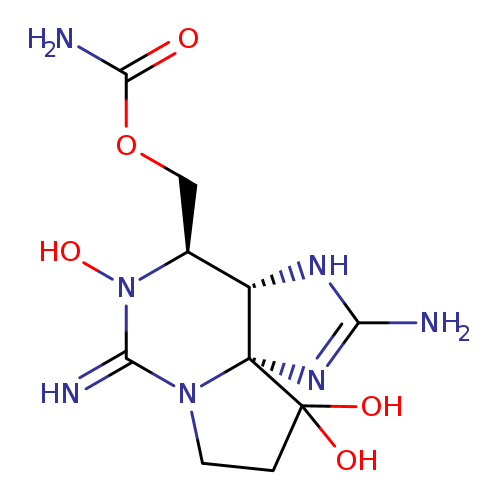
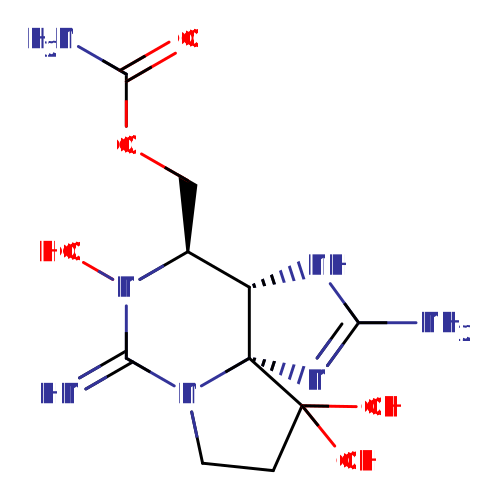
Chemical Structure
Synonyms
ValueSource
[(3AS,4R,10as)-5,10,10-trihydroxy-2,6-diiminooctahydro-1H,8H-pyrrolo[1,2-c]purin-4-yl]methyl carbamateChEBI
NeosaxitoxinaChEBI
NeoSTXChEBI
NSTXChEBI
[(3AS,4R,10as)-5,10,10-trihydroxy-2,6-diiminooctahydro-1H,8H-pyrrolo[1,2-c]purin-4-yl]methyl carbamic acidGenerator
Chemical FormulaC10H17N7O5
Average Molecular Mass315.286 g/mol
Monoisotopic Mass315.129 g/mol
CAS Registry Number64296-20-4
IUPAC Name[(4R,10aS,10bS)-2-amino-5,10,10-trihydroxy-6-imino-3H,4H,5H,6H,8H,9H,10H,10bH-pyrrolo[1,2-c]purin-4-yl]methyl carbamate
Traditional Name[(4R,10aS,10bS)-2-amino-5,10,10-trihydroxy-6-imino-3H,4H,8H,9H,10bH-pyrrolo[1,2-c]purin-4-yl]methyl carbamate
SMILESNC(=O)OC[C@H]1[C@@H]2NC(N)=N[C@]22N(CCC2(O)O)C(=N)N1O
InChI IdentifierInChI=1S/C10H17N7O5/c11-6-14-5-4(3-22-8(13)18)17(21)7(12)16-2-1-9(19,20)10(5,16)15-6/h4-5,12,19-21H,1-3H2,(H2,13,18)(H3,11,14,15)/t4-,5-,10-/m0/s1
InChI KeyPPEKGEBBBBNZKS-HGRQIUPRSA-N
Chemical Taxonomy
Description Belongs to the class of organic compounds known as saxitoxins, gonyautoxins, and derivatives. Saxitoxins, gonyautoxins, and derivatives are compounds with a structure based on a 2,6-diamino-4-methyl-pyrrolo[1,2-c]purin-10-ol skeleton.
KingdomOrganic compounds
Super ClassPhenylpropanoids and polyketides
ClassSaxitoxins, gonyautoxins, and derivatives
Sub ClassNot Available
Direct ParentSaxitoxins, gonyautoxins, and derivatives
Alternative Parents
Substituents
  • Saxitoxin-gonyautoxin skeleton
  • Imidazopyrimidine
  • Alkaloid or derivatives
  • 1,3-diazinane
  • N-hydroxyguanidine
  • 2-imidazoline
  • Pyrrolidine
  • Carbamic acid ester
  • Guanidine
  • Carbonic acid derivative
  • Carbonyl hydrate
  • Azacycle
  • Polyol
  • Organoheterocyclic compound
  • Organic 1,3-dipolar compound
  • Carboximidamide
  • Propargyl-type 1,3-dipolar organic compound
  • Organonitrogen compound
  • Carbonyl group
  • Imine
  • Organooxygen compound
  • Organic oxygen compound
  • Organic oxide
  • Organic nitrogen compound
  • Hydrocarbon derivative
  • Organopnictogen compound
  • Aliphatic heteropolycyclic compound
Molecular FrameworkAliphatic heteropolycyclic compounds
External DescriptorsNot Available
Biological Properties
StatusDetected and Not Quantified
OriginExogenous
Cellular Locations
  • Cytoplasm
  • Extracellular
  • Membrane
Biofluid LocationsNot Available
Tissue LocationsNot Available
PathwaysNot Available
ApplicationsNot Available
Biological RolesNot Available
Chemical RolesNot Available
Physical Properties
StateSolid
AppearanceWhite powder.
Experimental Properties
PropertyValue
Melting PointNot Available
Boiling PointNot Available
SolubilityNot Available
Predicted Properties
PropertyValueSource
Water Solubility4.19 g/LALOGPS
logP-2ALOGPS
logP-2.6ChemAxon
logS-1.9ALOGPS
pKa (Strongest Acidic)10.6ChemAxon
pKa (Strongest Basic)9.14ChemAxon
Physiological Charge2ChemAxon
Hydrogen Acceptor Count10ChemAxon
Hydrogen Donor Count7ChemAxon
Polar Surface Area193.75 ŲChemAxon
Rotatable Bond Count3ChemAxon
Refractivity79.89 m³·mol⁻¹ChemAxon
Polarizability28.82 ųChemAxon
Number of Rings3ChemAxon
BioavailabilityYesChemAxon
Rule of FiveNoChemAxon
Ghose FilterNoChemAxon
Veber's RuleNoChemAxon
MDDR-like RuleNoChemAxon
Spectra
Spectra
Toxicity Profile
Route of ExposureNot Available
Mechanism of ToxicityNeosaxitoxin (NSTX) blocks the extracellular portion, the outer vestibule, of some voltage gated sodium channels in a very powerful and reversible manner, without affection of other ion channels. NSTX and other site 1 blockers (i.e., tetrodotoxin and saxitoxin) have high affinity (very low dissociation constant) and high specificity for Nav channels ("Voltage gated", also called "voltage sensitive" and "voltage dependant" sodium channel also known as "VGSCs" or "Nav channel"). The action of NSTX produces minimal effect on cardiac Nav, where it exhibits about 20_60 fold lesser affinity than in Nav channels from rat skeletal muscle and rat brain. Toxins such as neosaxitoxin and tetrodotoxin have less affinity for most cardiac Nav channels than for most Nav channels in nerve tissue. Moreover, NSTX is so active on nerve Nav channel than is roughly a million-fold more potent than lidocaine. (Wikipedia)

MetabolismNot Available
Toxicity ValuesNot Available
Lethal DoseNot Available
Carcinogenicity (IARC Classification)No indication of carcinogenicity to humans (not listed by IARC).
Uses/SourcesNot Available
Minimum Risk LevelNot Available
Health EffectsNot Available
SymptomsNot Available
TreatmentNot Available
Concentrations
Not Available
External Links
DrugBank IDDB12989
HMDB IDHMDB0029369
FooDB IDFDB000438
Phenol Explorer IDNot Available
KNApSAcK IDC00055233
BiGG IDNot Available
BioCyc IDNot Available
METLIN IDNot Available
PDB IDNot Available
Wikipedia LinkNeosaxitoxin
Chemspider ID19975931
ChEBI ID167561
PubChem Compound ID104753
Kegg Compound IDC17208
YMDB IDNot Available
ECMDB IDNot Available
References
Synthesis ReferenceNot Available
MSDSNot Available
General References
1. https://www.ncbi.nlm.nih.gov/pubmed/?term=18487408
2. https://www.ncbi.nlm.nih.gov/pubmed/?term=25257789
3. https://www.ncbi.nlm.nih.gov/pubmed/?term=26275090
4. https://www.ncbi.nlm.nih.gov/pubmed/?term=26280473
5. https://www.ncbi.nlm.nih.gov/pubmed/?term=26372144
6. https://www.ncbi.nlm.nih.gov/pubmed/?term=27710889
7. https://www.ncbi.nlm.nih.gov/pubmed/?term=29146176
8. https://www.ncbi.nlm.nih.gov/pubmed/?term=30107206
9. https://www.ncbi.nlm.nih.gov/pubmed/?term=30951754
10. https://www.ncbi.nlm.nih.gov/pubmed/?term=31683507
11. https://www.ncbi.nlm.nih.gov/pubmed/?term=31958316
12. https://www.ncbi.nlm.nih.gov/pubmed/?term=32471037
13. https://www.ncbi.nlm.nih.gov/pubmed/?term=6284918
14. Rodriguez-Navarro AJ, Lagos M, Figueroa C, Garcia C, Recabal P, Silva P, Iglesias V, Lagos N: Potentiation of local anesthetic activity of neosaxitoxin with bupivacaine or epinephrine: development of a long-acting pain blocker. Neurotox Res. 2009 Nov;16(4):408-15. doi: 10.1007/s12640-009-9092-3. Epub 2009 Jul 28.
15. Yannai, Shmuel. (2004) Dictionary of food compounds with CD-ROM: Additives, flavors, and ingredients. Boca Raton: Chapman & Hall/CRC.