Record Information
Version1.0
Creation Date2014-08-29 04:49:32 UTC
Update Date2026-08-22 11:55:21 UTC
Accession NumberCHEM002991
Identification
Common NamePhomopsin A
ClassSmall Molecule
Description
Phomopsin A, a peptide mycotoxin originally derived from Phomopsis leptostromiformis, has been shown to be a potent microtubule inhibitor.
Contaminant Sources
  • FooDB Chemicals
  • T3DB toxins
Contaminant Type
  • Amide
  • Amine
  • Ether
  • Food Toxin
  • Fungal Toxin
  • Natural Compound
  • Organic Compound
  • Organochloride
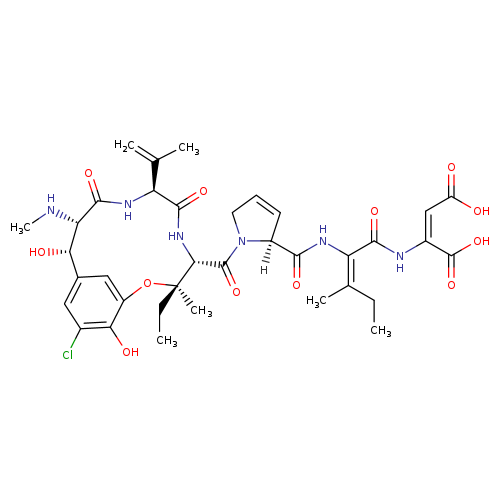
Chemical Structure
Synonyms
ValueSource
PhomopsinHMDB
Phomopside bHMDB
Phomopside aHMDB
(2E)-2-{[(2E)-2-({[(2S)-1-[(3R,4S,7S,10S,11S)-14-chloro-3-ethyl-6,9,11,15-tetrahydroxy-3-methyl-10-(methylamino)-7-(prop-1-en-2-yl)-2-oxa-5,8-diazabicyclo[10.3.1]hexadeca-1(16),5,8,12,14-pentaene-4-carbonyl]-2,5-dihydro-1H-pyrrol-2-yl](hydroxy)methylidene}amino)-1-hydroxy-3-methylpent-2-en-1-ylidene]amino}but-2-enedioateHMDB
Chemical FormulaC36H45ClN6O12
Average Molecular Mass789.229 g/mol
Monoisotopic Mass788.278 g/mol
CAS Registry Number64925-80-0
IUPAC Name(2E)-2-[(2E)-2-{[(2S)-1-[(3R,4S,7S,10S,11S)-14-chloro-3-ethyl-11,15-dihydroxy-3-methyl-10-(methylamino)-6,9-dioxo-7-(prop-1-en-2-yl)-2-oxa-5,8-diazabicyclo[10.3.1]hexadeca-1(16),12,14-triene-4-carbonyl]-2,5-dihydro-1H-pyrrol-2-yl]formamido}-3-methylpent-2-enamido]but-2-enedioic acid
Traditional Name(2E)-2-[(2E)-2-{[(2S)-1-[(3R,4S,7S,10S,11S)-14-chloro-3-ethyl-11,15-dihydroxy-3-methyl-10-(methylamino)-6,9-dioxo-7-(prop-1-en-2-yl)-2-oxa-5,8-diazabicyclo[10.3.1]hexadeca-1(16),12,14-triene-4-carbonyl]-2,5-dihydropyrrol-2-yl]formamido}-3-methylpent-2-enamido]but-2-enedioic acid
SMILES[H]\C(C(O)=O)=C(/N=C(O)C(\N=C(O)[C@]1([H])C=CCN1C(=O)[C@@]1([H])N=C(O)[C@@]([H])(N=C(O)[C@@]([H])(NC)[C@@]([H])(O)C2=CC(Cl)=C(O)C(O[C@]1(C)CC)=C2)C(C)=C)=C(\C)CC)C(O)=O
InChI IdentifierInChI=1S/C36H45ClN6O12/c1-8-17(5)25(32(50)39-20(35(53)54)15-23(44)45)41-30(48)21-11-10-12-43(21)34(52)29-36(6,9-2)55-22-14-18(13-19(37)28(22)47)27(46)26(38-7)33(51)40-24(16(3)4)31(49)42-29/h10-11,13-15,21,24,26-27,29,38,46-47H,3,8-9,12H2,1-2,4-7H3,(H,39,50)(H,40,51)(H,41,48)(H,42,49)(H,44,45)(H,53,54)/b20-15+,25-17+/t21-,24-,26-,27-,29+,36+/m0/s1
InChI KeyFAFRRYBYQKPKSY-AJSRVUJESA-N
Chemical Taxonomy
Description Belongs to the class of organic compounds known as oligopeptides. These are organic compounds containing a sequence of between three and ten alpha-amino acids joined by peptide bonds.
KingdomOrganic compounds
Super ClassOrganic acids and derivatives
ClassCarboxylic acids and derivatives
Sub ClassAmino acids, peptides, and analogues
Direct ParentOligopeptides
Alternative Parents
Substituents
  • Alpha-oligopeptide
  • Cyclic alpha peptide
  • N-acyl-alpha amino acid or derivatives
  • N-acyl-alpha-amino acid
  • Macrolactam
  • Alpha-amino acid amide
  • Alpha-amino acid or derivatives
  • Pyrroline carboxylic acid or derivatives
  • Alkyl aryl ether
  • Aralkylamine
  • Aryl chloride
  • Aryl halide
  • N-acyl-amine
  • Benzenoid
  • Dicarboxylic acid or derivatives
  • Vinylogous amide
  • Tertiary carboxylic acid amide
  • Pyrroline
  • Amino acid
  • Lactam
  • Amino acid or derivatives
  • Carboxamide group
  • Secondary alcohol
  • Secondary carboxylic acid amide
  • Oxacycle
  • Azacycle
  • Carboxylic acid
  • Organoheterocyclic compound
  • Secondary aliphatic amine
  • Secondary amine
  • Ether
  • Organopnictogen compound
  • Organic oxygen compound
  • Organic nitrogen compound
  • Carbonyl group
  • Alcohol
  • Hydrocarbon derivative
  • Amine
  • Organic oxide
  • Organooxygen compound
  • Organonitrogen compound
  • Organochloride
  • Organohalogen compound
  • Aromatic heteropolycyclic compound
Molecular FrameworkAromatic heteropolycyclic compounds
External DescriptorsNot Available
Biological Properties
StatusDetected and Not Quantified
OriginExogenous
Cellular Locations
  • Cytoplasm
  • Extracellular
  • Kinetochore
  • Microtubule
  • Tubulin
Biofluid LocationsNot Available
Tissue LocationsNot Available
Pathways
NameSMPDB LinkKEGG Link
Cell cycleNot Availablemap04110
ApoptosisNot Availablemap04210
ApplicationsNot Available
Biological RolesNot Available
Chemical RolesNot Available
Physical Properties
StateSolid
AppearanceWhite powder.
Experimental Properties
PropertyValue
Melting PointNot Available
Boiling PointNot Available
SolubilityNot Available
Predicted Properties
PropertyValueSource
Water Solubility0.014 g/LALOGPS
logP1.64ALOGPS
logP-2.5ChemAxon
logS-4.7ALOGPS
pKa (Strongest Acidic)1.98ChemAxon
pKa (Strongest Basic)7.57ChemAxon
Physiological Charge-1ChemAxon
Hydrogen Acceptor Count13ChemAxon
Hydrogen Donor Count9ChemAxon
Polar Surface Area273.03 ŲChemAxon
Rotatable Bond Count11ChemAxon
Refractivity197.6 m³·mol⁻¹ChemAxon
Polarizability75.62 ųChemAxon
Number of Rings3ChemAxon
BioavailabilityNoChemAxon
Rule of FiveNoChemAxon
Ghose FilterNoChemAxon
Veber's RuleNoChemAxon
MDDR-like RuleYesChemAxon
Spectra
Spectra
Toxicity Profile
Route of ExposureNot Available
Mechanism of ToxicityNot Available
MetabolismNot Available
Toxicity ValuesNot Available
Lethal DoseNot Available
Carcinogenicity (IARC Classification)No indication of carcinogenicity to humans (not listed by IARC).
Uses/SourcesPhomopsin A, a peptide mycotoxin originally derived from Phomopsis leptostromiformis, has been shown to be a potent microtubule inhibitor.
Minimum Risk LevelNot Available
Health EffectsNot Available
SymptomsNot Available
TreatmentNot Available
Concentrations
Not Available
External Links
DrugBank IDNot Available
HMDB IDHMDB0030447
FooDB IDNot Available
Phenol Explorer IDNot Available
KNApSAcK IDC00024794
BiGG IDNot Available
BioCyc IDNot Available
METLIN IDNot Available
PDB IDHOS
Wikipedia LinkNot Available
Chemspider ID4943049
ChEBI IDNot Available
PubChem Compound ID6438581
Kegg Compound IDC19955
YMDB IDNot Available
ECMDB IDNot Available
References
Synthesis ReferenceNot Available
MSDSNot Available
General References
1. Yannai, Shmuel. (2004) Dictionary of food compounds with CD-ROM: Additives, flavors, and ingredients. Boca Raton: Chapman & Hall/CRC.