Record Information
Version1.0
Creation Date2014-08-29 06:15:48 UTC
Update Date2026-04-05 17:30:25 UTC
Accession NumberCHEM003248
Identification
Common NameTetrahydrocortisol
ClassSmall Molecule
Description
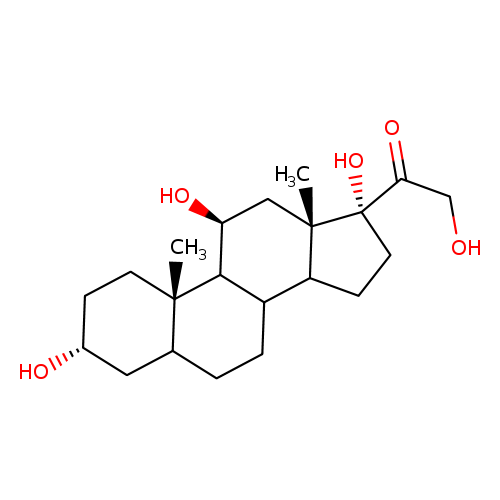
Tetrahydrocortisol is the most powerful natural angiostatic steroid. It is involved in C21-Steroid hormone metabolism pathway (KEGG).
Contaminant Sources
  • FooDB Chemicals
  • HMDB Contaminants - Urine
  • T3DB toxins
Contaminant Type
  • Animal Toxin
  • Food Toxin
  • Metabolite
  • Natural Compound
  • Organic Compound
Chemical Structure
Synonyms
ValueSource
2-Hydroxy-1-(3,11,17-trihydroxy-10,13-dimethyl-hexadecahydro-cyclopenta[a]phenanthren-17-yl)-ethanoneHMDB
3a,11b,17,21-Tetrahydroxy-5b-pregnan-20-oneHMDB
3b,11b,17,21-Tetrahydroxy-5b-pregnan-20-oneHMDB
3b,11b,17a,21-Tetrahydroxy-5b-pregnan-20-ONHMDB
5b-TetrahydrocortisolHMDB, Generator
DihydrocortisonHMDB
tetrahydro-CortisolHMDB
UrocortisolHMDB, ChEBI
3alpha,5beta-TetrahydrocortisolChEBI
5beta-Pregnane-3alpha,11beta,17alpha,21-tetrol-20-oneChEBI
5beta-TetrahydrocortisolChEBI
TetrahydrohydrocortisoneChEBI
3a,5b-TetrahydrocortisolGenerator
3Α,5β-tetrahydrocortisolGenerator
5b-Pregnane-3a,11b,17a,21-tetrol-20-oneGenerator
5Β-pregnane-3α,11β,17α,21-tetrol-20-oneGenerator
5Β-tetrahydrocortisolGenerator
Chemical FormulaC21H34O5
Average Molecular Mass366.492 g/mol
Monoisotopic Mass366.241 g/mol
CAS Registry Number53-02-1
IUPAC Name2-hydroxy-1-[(2S,5R,14R,15S,17S)-5,14,17-trihydroxy-2,15-dimethyltetracyclo[8.7.0.0²,⁷.0¹¹,¹⁵]heptadecan-14-yl]ethan-1-one
Traditional Name2-hydroxy-1-[(2S,5R,14R,15S,17S)-5,14,17-trihydroxy-2,15-dimethyltetracyclo[8.7.0.0²,⁷.0¹¹,¹⁵]heptadecan-14-yl]ethanone
SMILESC[C@]12C[C@H](O)C3C(CCC4C[C@H](O)CC[C@]34C)C1CC[C@]2(O)C(=O)CO
InChI IdentifierInChI=1S/C21H34O5/c1-19-7-5-13(23)9-12(19)3-4-14-15-6-8-21(26,17(25)11-22)20(15,2)10-16(24)18(14)19/h12-16,18,22-24,26H,3-11H2,1-2H3/t12?,13-,14?,15?,16+,18?,19+,20+,21+/m1/s1
InChI KeyAODPIQQILQLWGS-OBRSLYEHSA-N
Chemical Taxonomy
Description Belongs to the class of organic compounds known as 21-hydroxysteroids. These are steroids carrying a hydroxyl group at the 21-position of the steroid backbone.
KingdomOrganic compounds
Super ClassLipids and lipid-like molecules
ClassSteroids and steroid derivatives
Sub ClassHydroxysteroids
Direct Parent21-hydroxysteroids
Alternative Parents
Substituents
  • Progestogin-skeleton
  • 21-hydroxysteroid
  • 20-oxosteroid
  • Pregnane-skeleton
  • 3-hydroxysteroid
  • Oxosteroid
  • 11-beta-hydroxysteroid
  • 11-hydroxysteroid
  • 3-alpha-hydroxysteroid
  • 17-hydroxysteroid
  • Tertiary alcohol
  • Alpha-hydroxy ketone
  • Cyclic alcohol
  • Ketone
  • Secondary alcohol
  • Polyol
  • Primary alcohol
  • Alcohol
  • Hydrocarbon derivative
  • Organooxygen compound
  • Organic oxide
  • Organic oxygen compound
  • Carbonyl group
  • Aliphatic homopolycyclic compound
Molecular FrameworkAliphatic homopolycyclic compounds
External DescriptorsNot Available
Biological Properties
StatusDetected and Not Quantified
OriginEndogenous
Cellular Locations
  • Cytoplasm
  • Extracellular
  • Membrane
Biofluid LocationsNot Available
Tissue LocationsNot Available
Pathways
NameSMPDB LinkKEGG Link
SteroidogenesisSMP00130 map00140
Apparent mineralocorticoid excess syndromeSMP00717 Not Available
ApplicationsNot Available
Biological RolesNot Available
Chemical RolesNot Available
Physical Properties
StateSolid
AppearanceWhite powder.
Experimental Properties
PropertyValue
Melting PointNot Available
Boiling PointNot Available
SolubilityNot Available
Predicted Properties
PropertyValueSource
Water Solubility0.47 g/LALOGPS
logP1.38ALOGPS
logP1.11ChemAxon
logS-2.9ALOGPS
pKa (Strongest Acidic)12.58ChemAxon
pKa (Strongest Basic)-1.4ChemAxon
Physiological Charge0ChemAxon
Hydrogen Acceptor Count5ChemAxon
Hydrogen Donor Count4ChemAxon
Polar Surface Area97.99 ŲChemAxon
Rotatable Bond Count2ChemAxon
Refractivity97.6 m³·mol⁻¹ChemAxon
Polarizability40.89 ųChemAxon
Number of Rings4ChemAxon
BioavailabilityYesChemAxon
Rule of FiveYesChemAxon
Ghose FilterYesChemAxon
Veber's RuleNoChemAxon
MDDR-like RuleNoChemAxon
Spectra
Spectra
Toxicity Profile
Route of ExposureNot Available
Mechanism of ToxicityNot Available
MetabolismNot Available
Toxicity ValuesNot Available
Lethal DoseNot Available
Carcinogenicity (IARC Classification)No indication of carcinogenicity to humans (not listed by IARC).
Uses/SourcesThis is an endogenously produced metabolite found in the human body. It is used in metabolic reactions, catabolic reactions or waste generation.
Minimum Risk LevelNot Available
Health EffectsNot Available
SymptomsNot Available
TreatmentNot Available
Concentrations
Not Available
External Links
DrugBank IDNot Available
HMDB IDHMDB0000949
FooDB IDFDB022333
Phenol Explorer IDNot Available
KNApSAcK IDNot Available
BiGG IDNot Available
BioCyc IDNot Available
METLIN IDNot Available
PDB IDNot Available
Wikipedia LinkTetrahydrocortisol
Chemspider ID5655
ChEBI ID28320
PubChem Compound ID44725717
Kegg Compound IDC05472
YMDB IDNot Available
ECMDB IDNot Available
References
Synthesis ReferenceGould, David H.; Oliveto, Eugene P. 17a-Hydroxycorticosterone and intermediates. (1957), US 2783254 19570226 CAN 51:62564 AN 1957:62564
MSDSNot Available
General References
1. Gould, David H.; Oliveto, Eugene P. 17a-Hydroxycorticosterone and intermediates. (1957), US 2783254 19570226 CAN 51:62564 AN 1957:62564
2. Shackleton C, Malunowicz E: Apparent pregnene hydroxylation deficiency (APHD): seeking the parentage of an orphan metabolome. Steroids. 2003 Oct;68(9):707-17.
3. Mune T, White PC: Apparent mineralocorticoid excess: genotype is correlated with biochemical phenotype. Hypertension. 1996 Jun;27(6):1193-9.
4. Weykamp CW, Penders TJ, Schmidt NA, Borburgh AJ, van de Calseyde JF, Wolthers BJ: Steroid profile for urine: reference values. Clin Chem. 1989 Dec;35(12):2281-4.
5. Kerstens MN, van der Kleij FG, Boonstra AH, Sluiter WJ, van der Molen JC, Navis G, Dullaart RP: Angiotensin administration stimulates renal 11 beta-hydroxysteroid dehydrogenase activity in healthy men. Kidney Int. 2004 Jun;65(6):2065-70.
6. Koren W, Grienspuhn A, Kuznetsov SR, Berezin M, Rosenthal T, Postnov YV: Enhanced Na+/H+ exchange in Cushing's syndrome reflects functional hypermineralocorticoidism. J Hypertens. 1998 Aug;16(8):1187-91.
7. Rosler A, Leiberman E, Rosenmann A, Ben-Uzilio R, Weidenfeld J: Prenatal diagnosis of 11beta-hydroxylase deficiency congenital adrenal hyperplasia. J Clin Endocrinol Metab. 1979 Oct;49(4):546-51.
8. Melander O, Frandsen E, Groop L, Hulthen UL: No evidence of a relation between 11beta-hydroxysteroid dehydrogenase type 2 activity and salt sensitivity. Am J Hypertens. 2003 Sep;16(9 Pt 1):729-33.
9. Quinkler M, Zehnder D, Lepenies J, Petrelli MD, Moore JS, Hughes SV, Cockwell P, Hewison M, Stewart PM: Expression of renal 11beta-hydroxysteroid dehydrogenase type 2 is decreased in patients with impaired renal function. Eur J Endocrinol. 2005 Aug;153(2):291-9.
10. Rapetti S, Francia G, Iacono C, Martignoni G, Contessi G, Brunelli M, Galvanin F, Serio G: An unusual case of Cushing's syndrome due to ACTH-independent macronodular adrenal hyperplasia. Chir Ital. 2003 Mar-Apr;55(2):235-41.
11. Panin LE, Tuzikov FV, Gimautdinova OI: Tetrahydrocortisol-apolipoprotein A-I complex specifically interacts with eukaryotic DNA and GCC elements of genes. J Steroid Biochem Mol Biol. 2003 Dec;87(4-5):309-18.