Record Information
Version1.0
Creation Date2014-08-29 06:16:12 UTC
Update Date2026-05-14 17:59:23 UTC
Accession NumberCHEM003251
Identification
Common NameHomo-L-arginine
ClassSmall Molecule
Description
Homoarginine is a guanidino compounds of guanidinoethanesulfonic acid. It is an organ-specific uncompetitive inhibitor of human liver and bone alkaline phosphohydrolase. (1).
Contaminant Sources
  • FooDB Chemicals
  • HMDB Contaminants - Urine
  • T3DB toxins
Contaminant Type
  • Amide
  • Amine
  • Animal Toxin
  • Food Toxin
  • Metabolite
  • Natural Compound
  • Organic Compound
Chemical Structure
Synonyms
ValueSource
HomoarginineChEBI
L-N(6)-AmidinolysineChEBI
N6-(Aminoiminomethyl)-L-lysineChEBI
N6-Amidino-L-lysineChEBI
N6-Amidino-lysineChEBI
L-HomoarginineKegg
Homo-L-arginineChEBI
Chemical FormulaC7H16N4O2
Average Molecular Mass188.228 g/mol
Monoisotopic Mass188.127 g/mol
CAS Registry Number156-86-5
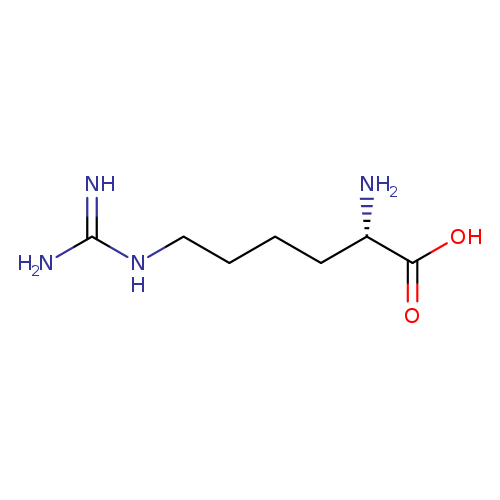
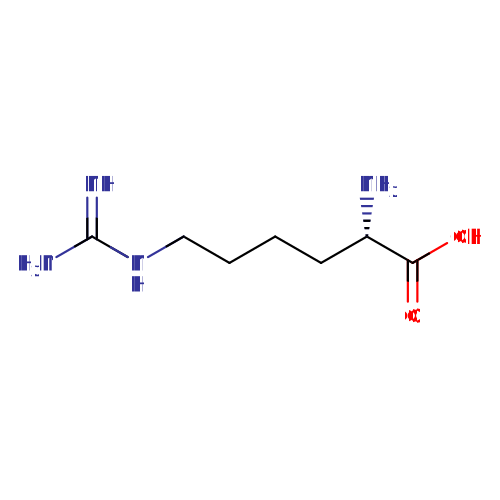
IUPAC Name(2S)-2-amino-6-carbamimidamidohexanoic acid
Traditional NameL-homoarginine
SMILESN[C@@H](CCCCNC(N)=N)C(O)=O
InChI IdentifierInChI=1S/C7H16N4O2/c8-5(6(12)13)3-1-2-4-11-7(9)10/h5H,1-4,8H2,(H,12,13)(H4,9,10,11)/t5-/m0/s1
InChI KeyQUOGESRFPZDMMT-YFKPBYRVSA-N
Chemical Taxonomy
Description Belongs to the class of organic compounds known as l-alpha-amino acids. These are alpha amino acids which have the L-configuration of the alpha-carbon atom.

KingdomOrganic compounds
Super ClassOrganic acids and derivatives
ClassCarboxylic acids and derivatives
Sub ClassAmino acids, peptides, and analogues
Direct ParentL-alpha-amino acids
Alternative Parents
Substituents
  • L-alpha-amino acid
  • Medium-chain fatty acid
  • Amino fatty acid
  • Fatty acid
  • Fatty acyl
  • Guanidine
  • Amino acid
  • Carboximidamide
  • Monocarboxylic acid or derivatives
  • Carboxylic acid
  • Organic oxide
  • Organopnictogen compound
  • Organic oxygen compound
  • Primary amine
  • Organooxygen compound
  • Organonitrogen compound
  • Primary aliphatic amine
  • Imine
  • Carbonyl group
  • Organic nitrogen compound
  • Amine
  • Hydrocarbon derivative
  • Aliphatic acyclic compound
Molecular FrameworkAliphatic acyclic compounds
External Descriptors
Biological Properties
StatusDetected and Not Quantified
OriginEndogenous
Cellular Locations
  • Cytoplasm
  • Membrane
Biofluid LocationsNot Available
Tissue Locations
  • Intestine
  • Testes
Pathways
NameSMPDB LinkKEGG Link
ArgininemiaSMP00357 Not Available
ApplicationsNot Available
Biological Roles
Chemical Roles
Physical Properties
StateSolid
AppearanceWhite powder.
Experimental Properties
PropertyValue
Melting Point213 - 215°C
Boiling PointNot Available
SolubilityNot Available
Predicted Properties
PropertyValueSource
Water Solubility1.58 g/LALOGPS
logP-3.7ALOGPS
logP-2.7ChemAxon
logS-2.1ALOGPS
pKa (Strongest Acidic)2.49ChemAxon
pKa (Strongest Basic)12.3ChemAxon
Physiological Charge1ChemAxon
Hydrogen Acceptor Count6ChemAxon
Hydrogen Donor Count5ChemAxon
Polar Surface Area125.22 ŲChemAxon
Rotatable Bond Count6ChemAxon
Refractivity58.52 m³·mol⁻¹ChemAxon
Polarizability20.04 ųChemAxon
Number of Rings0ChemAxon
BioavailabilityYesChemAxon
Rule of FiveYesChemAxon
Ghose FilterNoChemAxon
Veber's RuleNoChemAxon
MDDR-like RuleNoChemAxon
Spectra
Spectra
Toxicity Profile
Route of ExposureNot Available
Mechanism of ToxicityNot Available
MetabolismNot Available
Toxicity ValuesNot Available
Lethal DoseNot Available
Carcinogenicity (IARC Classification)No indication of carcinogenicity to humans (not listed by IARC).
Uses/SourcesThis is an endogenously produced metabolite found in the human body. It is used in metabolic reactions, catabolic reactions or waste generation.
Minimum Risk LevelNot Available
Health EffectsNot Available
SymptomsNot Available
TreatmentNot Available
Concentrations
Not Available
External Links
DrugBank IDDB03974
HMDB IDHMDB0000670
FooDB IDFDB112164
Phenol Explorer IDNot Available
KNApSAcK IDC00001364
BiGG IDNot Available
BioCyc IDNot Available
METLIN ID5640
PDB IDNot Available
Wikipedia LinkNot Available
Chemspider ID8732
ChEBI ID27747
PubChem Compound ID9085
Kegg Compound IDC01924
YMDB IDNot Available
ECMDB IDM2MDB005671
References
Synthesis ReferenceNot Available
MSDSLink
General References
1. https://www.ncbi.nlm.nih.gov/pubmed/?term=12768501
2. https://www.ncbi.nlm.nih.gov/pubmed/?term=18802314
3. https://www.ncbi.nlm.nih.gov/pubmed/?term=21737361
4. https://www.ncbi.nlm.nih.gov/pubmed/?term=25153574
5. https://www.ncbi.nlm.nih.gov/pubmed/?term=25474016
6. https://www.ncbi.nlm.nih.gov/pubmed/?term=25618752
7. https://www.ncbi.nlm.nih.gov/pubmed/?term=25647833
8. https://www.ncbi.nlm.nih.gov/pubmed/?term=25746168
9. https://www.ncbi.nlm.nih.gov/pubmed/?term=25792110
10. https://www.ncbi.nlm.nih.gov/pubmed/?term=25820767
11. https://www.ncbi.nlm.nih.gov/pubmed/?term=25828044
12. https://www.ncbi.nlm.nih.gov/pubmed/?term=25832546
13. https://www.ncbi.nlm.nih.gov/pubmed/?term=25894888
14. https://www.ncbi.nlm.nih.gov/pubmed/?term=25957527
15. https://www.ncbi.nlm.nih.gov/pubmed/?term=26031828
16. https://www.ncbi.nlm.nih.gov/pubmed/?term=26055922
17. https://www.ncbi.nlm.nih.gov/pubmed/?term=26077714
18. https://www.ncbi.nlm.nih.gov/pubmed/?term=26210755
19. https://www.ncbi.nlm.nih.gov/pubmed/?term=26562034
20. https://www.ncbi.nlm.nih.gov/pubmed/?term=26573540
21. https://www.ncbi.nlm.nih.gov/pubmed/?term=26676627
22. https://www.ncbi.nlm.nih.gov/pubmed/?term=6174211
23. https://www.ncbi.nlm.nih.gov/pubmed/?term=6186121
24. https://www.ncbi.nlm.nih.gov/pubmed/?term=6191705
25. https://www.ncbi.nlm.nih.gov/pubmed/?term=7518015
26. Izumiya, Nobuo. Synthesis of DL-homoarginine and Na-methyl-DL-homoarginine. Nippon Kagaku Zasshi (1951), 72 521-3. CODEN: NPKZAZ ISSN:0369-5387. CAN 46:42183 AN 1952:42183
27. Mung D, Li L: Development of Chemical Isotope Labeling LC-MS for Milk Metabolomics: Comprehensive and Quantitative Profiling of the Amine/Phenol Submetabolome. Anal Chem. 2017 Apr 18;89(8):4435-4443. doi: 10.1021/acs.analchem.6b03737. Epub 2017 Mar 28.
28. Karetnikova ES, Jarzebska N, Markov AG, Weiss N, Lentz SR, Rodionov RN: Is Homoarginine a Protective Cardiovascular Risk Factor? Arterioscler Thromb Vasc Biol. 2019 May;39(5):869-875. doi: 10.1161/ATVBAHA.118.312218.
29. Sobczak A, Prokopowicz A, Radek M, Szula M, Zaciera M, Kurek J, Goniewicz ML: Tobacco smoking decreases plasma concentration of the emerging cardiovascular risk marker, L-homoarginine. Circ J. 2014;78(5):1254-8. doi: 10.1253/circj.cj-13-1334. Epub 2014 Feb 28.
30. Chafai A, Fromm MF, Konig J, Maas R: The prognostic biomarker L-homoarginine is a substrate of the cationic amino acid transporters CAT1, CAT2A and CAT2B. Sci Rep. 2017 Jul 6;7(1):4767. doi: 10.1038/s41598-017-04965-2.
31. Lin CW, Fishman WH: L-Homoarginine. An organ-specific, uncompetitive inhibitor of human liver and bone alkaline phosphohydrolases. J Biol Chem. 1972 May 25;247(10):3082-7.
32. Izumiya, Nobuo. Synthesis of DL-homoarginine and Na-methyl-DL-homoarginine. Nippon Kagaku Zasshi (1951), 72 521-3. CODEN: NPKZAZ ISSN:0369-5387. CAN 46:42183 AN 1952:42183
33. Mori A, Watanabe Y, Fujimoto N: Fluorometrical analysis of guanidino compounds in human cerebrospinal fluid. J Neurochem. 1982 Feb;38(2):448-50.
34. Tamura Y, Fujii S: Purification of human plasma kallikrein and urokinase by affinity chromatography. J Biochem. 1976 Sep;80(3):507-11.
35. Shoda J, Tanaka N, Osuga T, Matsuura K, Miyazaki H: Altered bile acid metabolism in liver disease: concurrent occurrence of C-1 and C-6 hydroxylated bile acid metabolites and their preferential excretion into urine. J Lipid Res. 1990 Feb;31(2):249-59.
36. Lin CW, Fishman WH: L-Homoarginine. An organ-specific, uncompetitive inhibitor of human liver and bone alkaline phosphohydrolases. J Biol Chem. 1972 May 25;247(10):3082-7.
37. Marescau B, Qureshi IA, De Deyn P, Letarte J, Ryba R, Lowenthal A: Guanidino compounds in plasma, urine and cerebrospinal fluid of hyperargininemic patients during therapy. Clin Chim Acta. 1985 Feb 28;146(1):21-7.
38. Brock DJ: Amniotic fluid alkaline phosphatase isoenzymes in early prenatal diagnosis of cystic fibrosis. Lancet. 1983 Oct 22;2(8356):941-3.
39. Crofton PM, Smith AF: Alkaline phosphatase of high and low molecular mass in human serum and bile: a comparative study of kinetic properties. Clin Chem. 1980 Mar;26(3):451-6.
40. el-Mokhefi Z, Duvivier J, Plomteux G, Gielen J: [Biochemical characterization of a high-molecular weight alkaline phosphatase in a patient with cholangiocarcinoma (alpha-1 alkaline phosphatase)]. Ann Biol Clin (Paris). 1985;43(3):215-20.
41. Muller F, Berg S, Frot JC, Boue J, Boue A: Prenatal diagnosis of cystic fibrosis. I. Prospective study of 51 pregnancies. Prenat Diagn. 1985 Mar-Apr;5(2):97-108.
42. Chang CH, Angellis D, Fishman WH: Presence of the rare D-variant heat-stable, placental-type alkaline phosphatase in normal human testis. Cancer Res. 1980 May;40(5):1506-10.
43. Mizutani N, Hayakawa C, Ohya Y, Watanabe K, Watanabe Y, Mori A: Guanidino compounds in hyperargininemia. Tohoku J Exp Med. 1987 Nov;153(3):197-205.
44. Gatti R, Gioia MG: Anisoin: a useful pre-chromatographic derivatization fluorogenic reagent for LC analysis of guanidino compounds. J Pharm Biomed Anal. 2006 Sep 11;42(1):11-6. Epub 2006 Feb 3.
45. Marescau B, De Deyn PP, Lowenthal A, Qureshi IA, Antonozzi I, Bachmann C, Cederbaum SD, Cerone R, Chamoles N, Colombo JP, et al.: Guanidino compound analysis as a complementary diagnostic parameter for hyperargininemia: follow-up of guanidino compound levels during therapy. Pediatr Res. 1990 Mar;27(3):297-303.
46. Suzuki K, Yoshimura Y, Hisada Y, Matsumoto A: Sensitivity of intestinal alkaline phosphatase to L-homoarginine and its regulation by subunit-subunit interaction. Jpn J Pharmacol. 1994 Feb;64(2):97-102.
47. Elshenawy S, Pinney SE, Stuart T, Doulias PT, Zura G, Parry S, Elovitz MA, Bennett MJ, Bansal A, Strauss JF 3rd, Ischiropoulos H, Simmons RA: The Metabolomic Signature of the Placenta in Spontaneous Preterm Birth. Int J Mol Sci. 2020 Feb 4;21(3). pii: ijms21031043. doi: 10.3390/ijms21031043.
48. Karetnikova ES, Jarzebska N, Markov AG, Weiss N, Lentz SR, Rodionov RN: Is Homoarginine a Protective Cardiovascular Risk Factor? Arterioscler Thromb Vasc Biol. 2019 May;39(5):869-875. doi: 10.1161/ATVBAHA.118.312218.
49. Sobczak A, Prokopowicz A, Radek M, Szula M, Zaciera M, Kurek J, Goniewicz ML: Tobacco smoking decreases plasma concentration of the emerging cardiovascular risk marker, L-homoarginine. Circ J. 2014;78(5):1254-8. doi: 10.1253/circj.cj-13-1334. Epub 2014 Feb 28.
50. Chafai A, Fromm MF, Konig J, Maas R: The prognostic biomarker L-homoarginine is a substrate of the cationic amino acid transporters CAT1, CAT2A and CAT2B. Sci Rep. 2017 Jul 6;7(1):4767. doi: 10.1038/s41598-017-04965-2.