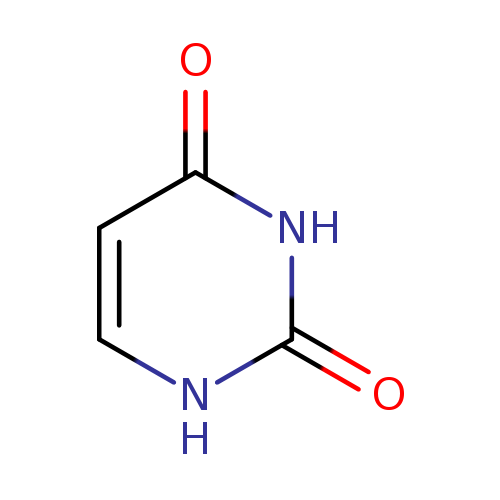
Uracil is a common naturally occurring pyrimidine found in RNA, it base pairs with adenine and is replaced by thymine in DNA. Methylation of uracil produces thymine. Uracil's use in the body is to help carry out the synthesis of many enzymes necessary for cell function through bonding with riboses and phosphates. Uracil serves as allosteric regulator and coenzyme for many important biochemical reactions. UDP and UTP regulate CPSase II activity in animals. UDP-glucose regulates the conversion of glucose to galactose in the liver and other tissues in the process of carbohydrate metabolism. Uracil is also involved in the biosynthesis of polysaccharides and the transportation of sugars containing aldehydes.
Belongs to the class of organic compounds known as pyrimidones. Pyrimidones are compounds that contain a pyrimidine ring, which bears a ketone. Pyrimidine is a 6-membered ring consisting of four carbon atoms and two nitrogen centers at the 1- and 3- ring positions.
Kurt Klemm, Wolfgang Schoetensack, Wolfgang Prusse, “Aryl-substituted piperazinyl-alkylamino-uracils, -uracil ethers and -uracil thioethers and method for their production.” U.S. Patent US3957786, issued September, 1951.