Record Information
Version1.0
Creation Date2014-08-29 06:25:21 UTC
Update Date2026-04-05 15:27:02 UTC
Accession NumberCHEM003282
Identification
Common NameUroporphyrin III
ClassSmall Molecule
Description
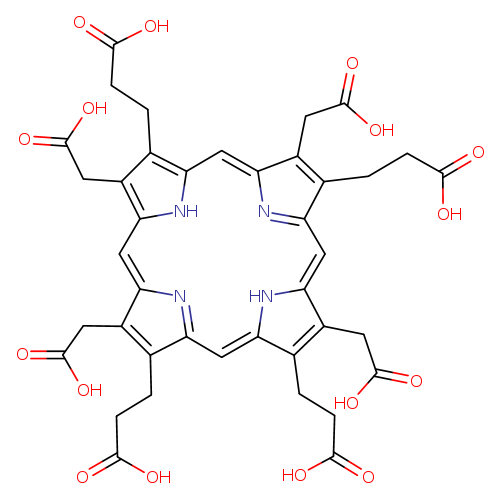
Uroporphyrin is the porphyrin produced by oxidation of the methylene bridges in uroporphyrinogen. They have four acetic acid and four propionic acid side chains attached to the pyrrole rings. Uroporphyrinogen I and III are formed from polypyrryl methane in the presence of uroporphyrinogen III cosynthetase and uroporphyrin I synthetase, respectively. They can yield uroporphyrins by autooxidation or coproporphyrinogens by decarboxylation. Excessive amounts of uroporphyrin I are excreted in congenital erythropoietic porphyria, and both types I and III are excreted in porphyria cutanea tarda. Uroporphyrin I and III are the most common isomers.
Contaminant Sources
  • FooDB Chemicals
  • HMDB Contaminants - Urine
  • T3DB toxins
Contaminant Type
  • Animal Toxin
  • Food Toxin
  • Human Neurotoxin
  • Metabolite
  • Natural Compound
  • Organic Compound
Chemical Structure
Synonyms
ValueSource
3,8,13,17-Tetrakis(carboxymethyl)porphyrin-2,7,12,18-tetrapropionic acidChEBI
Uroporphyrin 3ChEBI
3,8,13,17-Tetrakis(carboxymethyl)porphyrin-2,7,12,18-tetrapropionateGenerator
3,8,13,17-Tetrakis(carboxymethyl)porphyrin-2,7,12,18-tetrapropanoateHMDB
3,8,13,17-Tetrakis(carboxymethyl)porphyrin-2,7,12,18-tetrapropanoic acidHMDB
3,8,13,17-Tetramethyl-2,7,12,18-porphinetetrapropionateHMDB
3,8,13,17-Tetramethyl-2,7,12,18-porphinetetrapropionic acidHMDB
Coproporphyrin IIIHMDB
Chemical FormulaC40H38N4O16
Average Molecular Mass830.747 g/mol
Monoisotopic Mass830.228 g/mol
CAS Registry Number18273-06-8
IUPAC Name3-[9,14,20-tris(2-carboxyethyl)-5,10,15,19-tetrakis(carboxymethyl)-21,22,23,24-tetraazapentacyclo[16.2.1.1^{3,6}.1^{8,11}.1^{13,16}]tetracosa-1,3,5,7,9,11(23),12,14,16,18(21),19-undecaen-4-yl]propanoic acid
Traditional Name3-[9,14,20-tris(2-carboxyethyl)-5,10,15,19-tetrakis(carboxymethyl)-21,22,23,24-tetraazapentacyclo[16.2.1.1^{3,6}.1^{8,11}.1^{13,16}]tetracosa-1,3,5,7,9,11(23),12,14,16,18(21),19-undecaen-4-yl]propanoic acid
SMILESOC(=O)CCC1=C(CC(O)=O)/C2=C/C3=N/C(=C\C4=C(CCC(O)=O)C(CC(O)=O)=C(N4)/C=C4\N=C(\C=C\1/N\2)C(CC(O)=O)=C4CCC(O)=O)/C(CCC(O)=O)=C3CC(O)=O
InChI IdentifierInChI=1S/C40H38N4O16/c45-33(46)5-1-17-21(9-37(53)54)29-14-27-19(3-7-35(49)50)22(10-38(55)56)30(43-27)15-28-20(4-8-36(51)52)24(12-40(59)60)32(44-28)16-31-23(11-39(57)58)18(2-6-34(47)48)26(42-31)13-25(17)41-29/h13-16,41,44H,1-12H2,(H,45,46)(H,47,48)(H,49,50)(H,51,52)(H,53,54)(H,55,56)(H,57,58)(H,59,60)/b25-13-,26-13-,27-14-,28-15-,29-14-,30-15-,31-16-,32-16-
InChI KeyVZVFNUAIRVUCEW-UJJXFSCMSA-N
Chemical Taxonomy
Description Belongs to the class of organic compounds known as porphyrins. Porphyrins are compounds containing a fundamental skeleton of four pyrrole nuclei united through the alpha-positions by four methine groups to form a macrocyclic structure.
KingdomOrganic compounds
Super ClassOrganoheterocyclic compounds
ClassTetrapyrroles and derivatives
Sub ClassPorphyrins
Direct ParentPorphyrins
Alternative ParentsNot Available
SubstituentsNot Available
Molecular FrameworkNot Available
External DescriptorsNot Available
Biological Properties
StatusDetected and Not Quantified
OriginEndogenous
Cellular Locations
  • Cytoplasm
  • Membrane
  • Mitochondria
Biofluid LocationsNot Available
Tissue Locations
  • Liver
Pathways
NameSMPDB LinkKEGG Link
Porphyrin MetabolismSMP00024 map00860
Congenital Erythropoietic Porphyria (CEP) or Gunther DiseaseSMP00345 Not Available
Porphyria Variegata (PV)SMP00346 Not Available
ApplicationsNot Available
Biological Roles
Chemical RolesNot Available
Physical Properties
StateSolid
AppearanceWhite powder.
Experimental Properties
PropertyValue
Melting PointNot Available
Boiling PointNot Available
SolubilityNot Available
Predicted Properties
PropertyValueSource
Water Solubility0.038 g/LALOGPS
logP0.79ALOGPS
logP3.51ChemAxon
logS-4.4ALOGPS
pKa (Strongest Acidic)3.11ChemAxon
Physiological Charge-8ChemAxon
Hydrogen Acceptor Count18ChemAxon
Hydrogen Donor Count10ChemAxon
Polar Surface Area355.76 ŲChemAxon
Rotatable Bond Count20ChemAxon
Refractivity201.32 m³·mol⁻¹ChemAxon
Polarizability85.12 ųChemAxon
Number of Rings5ChemAxon
BioavailabilityNoChemAxon
Rule of FiveNoChemAxon
Ghose FilterNoChemAxon
Veber's RuleNoChemAxon
MDDR-like RuleYesChemAxon
Spectra
Spectra
Toxicity Profile
Route of ExposureNot Available
Mechanism of ToxicityNot Available
MetabolismNot Available
Toxicity ValuesNot Available
Lethal DoseNot Available
Carcinogenicity (IARC Classification)No indication of carcinogenicity to humans (not listed by IARC).
Uses/SourcesThis is an endogenously produced metabolite found in the human body. It is used in metabolic reactions, catabolic reactions or waste generation.
Minimum Risk LevelNot Available
Health EffectsChronically high levels of porophyrins are associated with porphyrias such as Porphyria variegate, Acute Intermittent Porphyria and Hereditary Coproporphyria (HCP).

SymptomsNot Available
TreatmentNot Available
Concentrations
Not Available
External Links
DrugBank IDNot Available
HMDB IDHMDB0000916
FooDB IDFDB005664
Phenol Explorer IDNot Available
KNApSAcK IDNot Available
BiGG IDNot Available
BioCyc IDNot Available
METLIN ID5870
PDB IDNot Available
Wikipedia LinkNot Available
Chemspider ID16736727
ChEBI ID15436
PubChem Compound IDNot Available
Kegg Compound IDC02469
YMDB IDYMDB16122
ECMDB IDECMDB00916
References
Synthesis Reference

Ichiro Kojima, Kenji Maruhashi, Yasuo Fujiwara, “Process for producing coproporphyrin III.” U.S. Patent US4334021, issued September, 1978.

MSDSNot Available
General References
1. Kajiwara, Masahiro; Mizutani, Minoru; Kojima, Ichiro. Manufacture of uroporphyrin III with Arthrobacter. Jpn. Kokai Tokkyo Koho (1993), 7 pp.
2. Tsai SF, Bishop DF, Desnick RJ: Purification and properties of uroporphyrinogen III synthase from human erythrocytes. J Biol Chem. 1987 Jan 25;262(3):1268-73.
3. Bozek P, Hutta M, Hrivnakova B: Rapid analysis of porphyrins at low ng/l and microg/l levels in human urine by a gradient liquid chromatography method using octadecylsilica monolithic columns. J Chromatogr A. 2005 Aug 19;1084(1-2):24-32.
4. Ohdoi C, Nyhan WL, Kuhara T: Chemical diagnosis of Lesch-Nyhan syndrome using gas chromatography-mass spectrometry detection. J Chromatogr B Analyt Technol Biomed Life Sci. 2003 Jul 15;792(1):123-30.
5. Luo J, Lim CK: Isolation and characterization of new porphyrin metabolites in human porphyria cutanea tarda and in rats treated with hexachlorobenzene by HPTLC, HPLC and liquid secondary ion mass spectrometry. Biomed Chromatogr. 1995 May-Jun;9(3):113-22.
6. Schonning C, Leeming R, Stenstrom TA: Faecal contamination of source-separated human urine based on the content of faecal sterols. Water Res. 2002 Apr;36(8):1965-72.
7. Hernandez-Zavala A, Del Razo LM, Garcia-Vargas GG, Aguilar C, Borja VH, Albores A, Cebrian ME: Altered activity of heme biosynthesis pathway enzymes in individuals chronically exposed to arsenic in Mexico. Arch Toxicol. 1999 Mar;73(2):90-5.
8. Salen G, Berginer V, Shore V, Horak I, Horak E, Tint GS, Shefer S: Increased concentrations of cholestanol and apolipoprotein B in the cerebrospinal fluid of patients with cerebrotendinous xanthomatosis. Effect of chenodeoxycholic acid. N Engl J Med. 1987 May 14;316(20):1233-8.
9. To-Figueras J, Ozalla D, Mateu CH: Long-standing changes in the urinary profile of porphyrin isomers after clinical remission of porphyria cutanea tarda. Ann Clin Lab Sci. 2003 Summer;33(3):251-6.
10. Winkelman JW, Collins GH: Neurotoxicity of tetraphenylporphinesulfonate TPPS4 and its relation to photodynamic therapy. Photochem Photobiol. 1987 Nov;46(5):801-7.