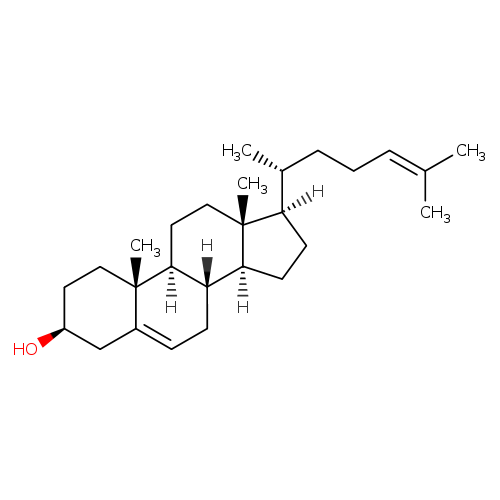
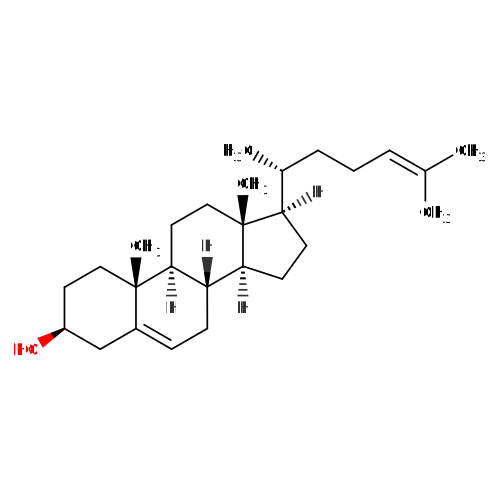
Desmosterol is an intermediate in the synthesis of cholesterol. Desmosterolosis is a rare autosomal recessive inborn errors of cholesterol synthesis that is caused by defective activity of desmosterol reductase which results in an accumulation of demosterol (DHCR24, EC 1.3.1.72), combines a severe osteosclerotic skeletal dysplasia and includes 2-3 toe syndactyly with Smith-Lemli-Opitz syndrome (SLOS; the biochemical block in SLOS results in decreased cholesterol levels and increased 7-dehydrocholesterol levels). Desmosterolosis is caused by mutation of the 24-dehydrocholesterol reductase gene (DHCR24). Many of the malformations in SLOS and desmosterolosis are consistent with impaired hedgehog function. The hedgehog proteins include Sonic hedgehog (SHH), which plays a major role in midline patterning and limb development. Desmosterolosis, caused by defective activity of desmosterol reductase, combines a severe osteosclerotic skeletal dysplasia. 7-dehydrocholesterol reductase (DHCR7, EC 1.3.1.21) reduces the C7-C8 double bond in the sterol B ring to form cholesterol or desmosterol depending upon the precursor. Desmosterol can be converted to cholesterol by DHCR24. Therefore, SLOS and Desmosterolosis patients invariably have elevated levels of cholesterol precursor's 7-dehydrocholesterol (and its spontaneous isomer 8-dehydrocholesterol) and absent desmosterol. (1, 2).
Belongs to the class of organic compounds known as cholesterols and derivatives. Cholesterols and derivatives are compounds containing a 3-hydroxylated cholestane core.
Kircher, Henry W.; Rosenstein, Fumiko U. Preparation of desmosterol from (20S,22R,S)-3b-acetoxychola-5,23-dien-22-ol. Journal of Organic Chemistry (1987), 52(12), 2586-8.