Record Information
Version1.0
Creation Date2014-08-29 06:28:48 UTC
Update Date2026-08-22 18:02:38 UTC
Accession NumberCHEM003293
Identification
Common NameDihydrouracil
ClassSmall Molecule
Description
Dihydrouracil is an intermediate breakdown product of uracil. Dihydropyrimidine dehydrogenase catalyzes the reduction of uracil to 5, 6-dihydrouracil then dihydropyrimidinase hydrolyzes 5, 6-dihydrouracil to N-carbamyl-b-alanine. Finally, beta-ureidopropionase catalyzes the conversion of N-carbamyl-b-alanine to beta-alanine. Patients with dihydropyrimidinase deficiency (DPYS; also called 5, 6-dihydropyrimidine amidohydrolase, or DHP; EC 3.5.2.2) exhibit highly increased concentrations of 5, 6-dihydrouracil in urine. The direct measurement of the activity of DHP in patients had been hampered by the fact that the enzyme is expressed almost exclusively in liver tissue. Various neurological abnormalities have been described in this group of patients. (OMIM 222748).
Contaminant Sources
  • FooDB Chemicals
  • HMDB Contaminants - Urine
  • HPV EPA Chemicals
  • T3DB toxins
Contaminant Type
  • Animal Toxin
  • Food Toxin
  • Metabolite
  • Natural Compound
  • Organic Compound
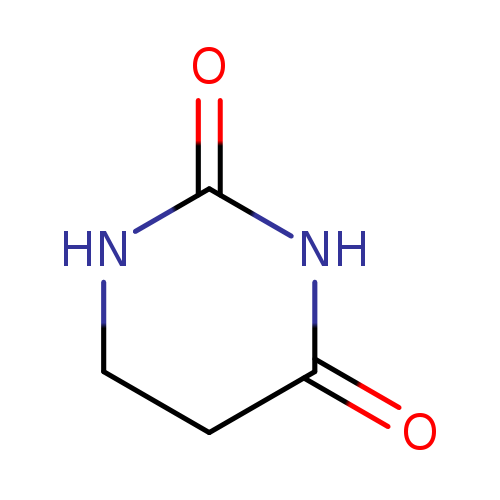
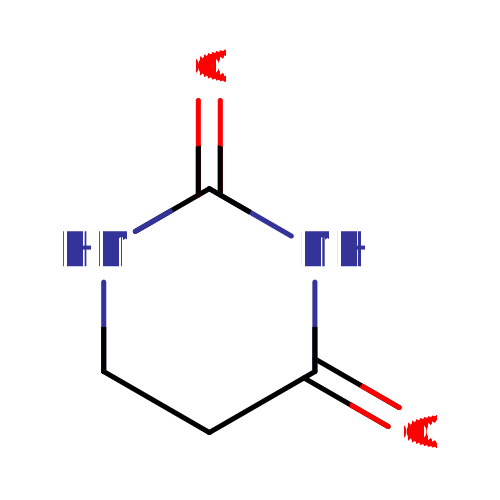
Chemical Structure
Synonyms
ValueSource
2,4-DioxotetrahydropyrimidineChEBI
5,6-Dihydro-2,4-dihydroxypyrimidineChEBI
Dihydro-2,4(1H,3H)-pyrimidinedioneChEBI
DIHYDROPYRIMIDINE-2,4(1H,3H)-dioneChEBI
DihydrouracileChEBI
HydrouracilChEBI
5,6-Dihydro-2,4(1H,3H)-pyrimidinedioneHMDB
5,6-DihydrouracilHMDB
Dihydro-pyrimidine-2,4-dioneHMDB
Chemical FormulaC4H6N2O2
Average Molecular Mass114.103 g/mol
Monoisotopic Mass114.043 g/mol
CAS Registry Number504-07-4
IUPAC Name1,3-diazinane-2,4-dione
Traditional Namedihydrouracil
SMILESO=C1CCNC(=O)N1
InChI IdentifierInChI=1S/C4H6N2O2/c7-3-1-2-5-4(8)6-3/h1-2H2,(H2,5,6,7,8)
InChI KeyOIVLITBTBDPEFK-UHFFFAOYSA-N
Chemical Taxonomy
Description Belongs to the class of organic compounds known as pyrimidones. Pyrimidones are compounds that contain a pyrimidine ring, which bears a ketone. Pyrimidine is a 6-membered ring consisting of four carbon atoms and two nitrogen centers at the 1- and 3- ring positions.

KingdomOrganic compounds
Super ClassOrganoheterocyclic compounds
ClassDiazines
Sub ClassPyrimidines and pyrimidine derivatives
Direct ParentPyrimidones
Alternative Parents
Substituents
  • N-acyl urea
  • Pyrimidone
  • Ureide
  • 1,3-diazinane
  • Dicarboximide
  • Urea
  • Carbonic acid derivative
  • Azacycle
  • Carboxylic acid derivative
  • Organic oxide
  • Organopnictogen compound
  • Organooxygen compound
  • Organonitrogen compound
  • Organic oxygen compound
  • Organic nitrogen compound
  • Carbonyl group
  • Hydrocarbon derivative
  • Aliphatic heteromonocyclic compound
Molecular FrameworkAliphatic heteromonocyclic compounds
External Descriptors
Biological Properties
StatusDetected and Not Quantified
OriginEndogenous
Cellular Locations
  • Cytoplasm
  • Membrane
  • Nucleus
Biofluid LocationsNot Available
Tissue Locations
  • Fibroblasts
  • Kidney
  • Liver
  • Prostate
Pathways
NameSMPDB LinkKEGG Link
Beta-Alanine MetabolismSMP00007 map00410
Pyrimidine MetabolismSMP00046 map00240
Dihydropyrimidinase DeficiencySMP00178 Not Available
ApplicationsNot Available
Biological Roles
Chemical RolesNot Available
Physical Properties
StateSolid
AppearanceWhite powder.
Experimental Properties
PropertyValue
Melting Point279 - 281°C
Boiling PointNot Available
SolubilityNot Available
Predicted Properties
PropertyValueSource
Water Solubility25.9 g/LALOGPS
logP-1.3ALOGPS
logP-1.2ChemAxon
logS-0.64ALOGPS
pKa (Strongest Acidic)11.73ChemAxon
pKa (Strongest Basic)-7.6ChemAxon
Physiological Charge0ChemAxon
Hydrogen Acceptor Count2ChemAxon
Hydrogen Donor Count2ChemAxon
Polar Surface Area58.2 ŲChemAxon
Rotatable Bond Count0ChemAxon
Refractivity25.75 m³·mol⁻¹ChemAxon
Polarizability10.13 ųChemAxon
Number of Rings1ChemAxon
BioavailabilityYesChemAxon
Rule of FiveYesChemAxon
Ghose FilterNoChemAxon
Veber's RuleNoChemAxon
MDDR-like RuleNoChemAxon
Spectra
Spectra
Toxicity Profile
Route of ExposureNot Available
Mechanism of ToxicityNot Available
MetabolismNot Available
Toxicity ValuesNot Available
Lethal DoseNot Available
Carcinogenicity (IARC Classification)No indication of carcinogenicity to humans (not listed by IARC).
Uses/SourcesThis is an endogenously produced metabolite found in the human body. It is used in metabolic reactions, catabolic reactions or waste generation.
Minimum Risk LevelNot Available
Health EffectsNot Available
SymptomsNot Available
TreatmentNot Available
Concentrations
Not Available
External Links
DrugBank IDDB01849
HMDB IDHMDB0000076
FooDB IDFDB030556
Phenol Explorer IDNot Available
KNApSAcK IDNot Available
BiGG ID34956
BioCyc IDDI-H-URACIL
METLIN ID285
PDB IDNot Available
Wikipedia LinkDihydrouracil
Chemspider ID629
ChEBI ID15901
PubChem Compound ID649
Kegg Compound IDC00429
YMDB IDNot Available
ECMDB IDECMDB00076
References
Synthesis ReferenceNot Available
MSDSLink
General References
1. Bhat, K. S.; Rao, A. S. Synthesis of uracil, 6-methyluracil and some dihydrouracils. Organic Preparations and Procedures International (1983), 15(5), 303-13.
2. Melzer N, Wittenburg D, Hartwig S, Jakubowski S, Kesting U, Willmitzer L, Lisec J, Reinsch N, Repsilber D: Investigating associations between milk metabolite profiles and milk traits of Holstein cows. J Dairy Sci. 2013 Mar;96(3):1521-34. doi: 10.3168/jds.2012-5743.
3. Bhat, K. S.; Rao, A. S. Synthesis of uracil, 6-methyluracil and some dihydrouracils. Organic Preparations and Procedures International (1983), 15(5), 303-13.
4. Van Kuilenburg AB, Stroomer AE, Van Lenthe H, Abeling NG, Van Gennip AH: New insights in dihydropyrimidine dehydrogenase deficiency: a pivotal role for beta-aminoisobutyric acid? Biochem J. 2004 Apr 1;379(Pt 1):119-24.
5. Grem JL: Intratumoral molecular or genetic markers as predictors of clinical outcome with chemotherapy in colorectal cancer. Semin Oncol. 2005 Feb;32(1):120-7.
6. Assmann B, Hoffmann GF, Wagner L, Brautigam C, Seyberth HW, Duran M, Van Kuilenburg AB, Wevers R, Van Gennip AH: Dihydropyrimidinase deficiency and congenital microvillous atrophy: coincidence or genetic relation? J Inherit Metab Dis. 1997 Sep;20(5):681-8.
7. Megyeri A, Bacso Z, Shields A, Eliason JF: Development of a stereological method to measure levels of fluoropyrimidine metabolizing enzymes in tumor sections using laser scanning cytometry. Cytometry A. 2005 Apr;64(2):62-71.
8. Nakamura A, Kikuchi K, Ohishi T, Masuike T: [Assay method for uracil, dihydrouracil, 5-fluorouracil and 5-fluoro-5, 6-dihydrouracil by high-performance liquid chromatography]. Gan To Kagaku Ryoho. 2004 Mar;31(3):381-6.
9. van Lenthe H, van Kuilenburg AB, Ito T, Bootsma AH, van Cruchten A, Wada Y, van Gennip AH: Defects in pyrimidine degradation identified by HPLC-electrospray tandem mass spectrometry of urine specimens or urine-soaked filter paper strips. Clin Chem. 2000 Dec;46(12):1916-22.
10. Sumi S, Kidouchi K, Ohba S, Wada Y: Automated screening system for purine and pyrimidine metabolism disorders using high-performance liquid chromatography. J Chromatogr B Biomed Appl. 1995 Oct 20;672(2):233-9.
11. Hofmann U, Schwab M, Seefried S, Marx C, Zanger UM, Eichelbaum M, Murdter TE: Sensitive method for the quantification of urinary pyrimidine metabolites in healthy adults by gas chromatography-tandem mass spectrometry. J Chromatogr B Analyt Technol Biomed Life Sci. 2003 Jul 5;791(1-2):371-80.
12. Shen GP, Galick H, Inoue M, Wallace SS: Decline of nuclear and mitochondrial oxidative base excision repair activity in late passage human diploid fibroblasts. DNA Repair (Amst). 2003 Jun 11;2(6):673-93.
13. Tan BR, McLeod HL: Pharmacogenetic influences on treatment response and toxicity in colorectal cancer. Semin Oncol. 2005 Feb;32(1):113-9.
14. Garcia AA, Blessing JA, Lenz HJ, Darcy KM, Mannel RS, Miller DS, Husseinzadeh N: Phase II clinical trial of capecitabine in ovarian carcinoma recurrent 6-12 months after completion of primary chemotherapy, with exploratory TS, DPD, and TP correlates: a Gynecologic Oncology Group study. Gynecol Oncol. 2005 Mar;96(3):810-7.
15. Schneider S, Uchida K, Brabender J, Baldus SE, Yochim J, Danenberg KD, Salonga D, Chen P, Tsao-Wei D, Groshen S, Hoelscher AH, Schneider PM, Danenberg PV: Downregulation of TS, DPD, ERCC1, GST-Pi, EGFR, and HER2 gene expression after neoadjuvant three-modality treatment in patients with esophageal cancer. J Am Coll Surg. 2005 Mar;200(3):336-44.
16. Jiang H, Jiang J, Hu P, Hu Y: Measurement of endogenous uracil and dihydrouracil in plasma and urine of normal subjects by liquid chromatography-tandem mass spectrometry. J Chromatogr B Analyt Technol Biomed Life Sci. 2002 Mar 25;769(1):169-76.
17. Sreekumar A, Poisson LM, Rajendiran TM, Khan AP, Cao Q, Yu J, Laxman B, Mehra R, Lonigro RJ, Li Y, Nyati MK, Ahsan A, Kalyana-Sundaram S, Han B, Cao X, Byun J, Omenn GS, Ghosh D, Pennathur S, Alexander DC, Berger A, Shuster JR, Wei JT, Varambally S, Beecher C, Chinnaiyan AM: Metabolomic profiles delineate potential role for sarcosine in prostate cancer progression. Nature. 2009 Feb 12;457(7231):910-4. doi: 10.1038/nature07762.
18. https://www.ncbi.nlm.nih.gov/pubmed/?term=15724255
19. https://www.ncbi.nlm.nih.gov/pubmed/?term=18619742
20. https://www.ncbi.nlm.nih.gov/pubmed/?term=20926004
21. https://www.ncbi.nlm.nih.gov/pubmed/?term=22770225