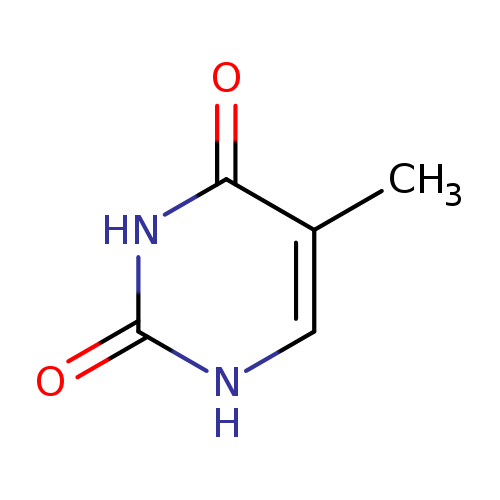
One of the pyrimidine bases of living matter. Derivation: Hydrolysis of deoxyribonucleic acid, from methylcyanoacetylurea by catalytic reduction. Use: Biochemical research. (Hawley's Condensed Chemical Dictionary). Thymine is a pyrimidine nucleobase. As the name implies, thymine may be derived by methylation of uracil at the 5th carbon. Thymine is found in the nucleic acid DNA. In RNA thymine is replaced with uracil in most cases. In DNA, thymine binds to adenine via two hydrogen bonds to assist in stabilizing the nucleic acid structures.
Belongs to the class of organic compounds known as hydroxypyrimidines. These are organic compounds containing a hydroxyl group attached to a pyrimidine ring. Pyrimidine is a 6-membered ring consisting of four carbon atoms and two nitrogen centers at the 1- and 3- ring positions.
Charles W. Murtiashaw, “Process for the production of O.sup. 2,2’-anhydro-1-(.beta.-D-arabinofuranosyl)thymine.” U.S. Patent US5008384, issued February, 1988.