Record Information
Version1.0
Creation Date2014-08-29 06:31:18 UTC
Update Date2026-04-05 14:29:40 UTC
Accession NumberCHEM003309
Identification
Common NameGalactitol
ClassSmall Molecule
Description
Galactitol is a naturally occurring product of plants obtained following reduction of galactose. It appears as a white crystalline powder with a slight sweet taste. It may form in excess in the lens of the eye in galactosemias a deficiency of galactokinase.
Contaminant Sources
  • FooDB Chemicals
  • HMDB Contaminants - Feces
  • HMDB Contaminants - Urine
  • T3DB toxins
  • ToxCast & Tox21 Chemicals
Contaminant Type
  • Food Toxin
  • Metabolite
  • Natural Compound
  • Organic Compound
  • Plant Toxin
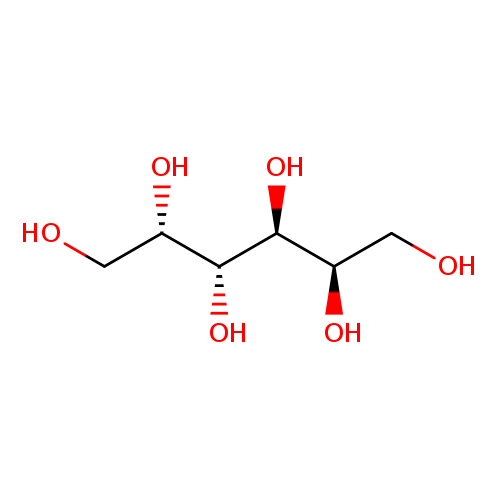
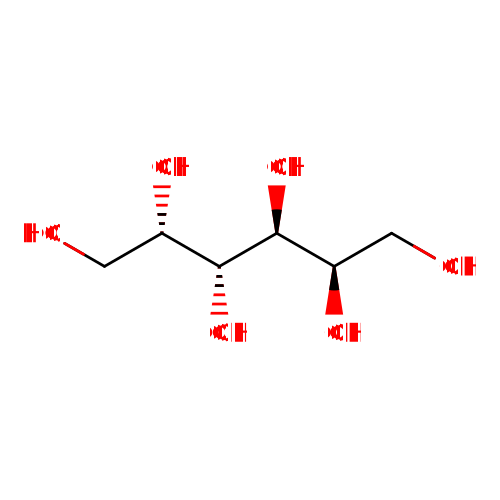
Chemical Structure
Synonyms
ValueSource
(2R,3S,4R,5S)-Hexane-1,2,3,4,5,6-hexolChEBI
D-DulcitolChEBI
D-GalactitolChEBI
DulcitolChEBI
DulcoseChEBI
EuonymitChEBI
L-GalactitolChEBI
MelampyrinChEBI
MelampyritChEBI
Ambap5938HMDB
DulciteHMDB
HexitolHMDB
MelampyriteHMDB
MelampyrumHMDB
meso-GalactitolHMDB
Chemical FormulaC6H14O6
Average Molecular Mass182.172 g/mol
Monoisotopic Mass182.079 g/mol
CAS Registry Number608-66-2
IUPAC Name(2R,3S,4R,5S)-hexane-1,2,3,4,5,6-hexol
Traditional Namegalactitol
SMILESOC[C@H](O)[C@@H](O)[C@@H](O)[C@H](O)CO
InChI IdentifierInChI=1S/C6H14O6/c7-1-3(9)5(11)6(12)4(10)2-8/h3-12H,1-2H2/t3-,4+,5+,6-
InChI KeyFBPFZTCFMRRESA-GUCUJZIJSA-N
Chemical Taxonomy
Description Belongs to the class of organic compounds known as sugar alcohols. These are hydrogenated forms of carbohydrate in which the carbonyl group (aldehyde or ketone, reducing sugar) has been reduced to a primary or secondary hydroxyl group.
KingdomOrganic compounds
Super ClassOrganic oxygen compounds
ClassOrganooxygen compounds
Sub ClassCarbohydrates and carbohydrate conjugates
Direct ParentSugar alcohols
Alternative Parents
Substituents
  • Sugar alcohol
  • Monosaccharide
  • Secondary alcohol
  • Polyol
  • Hydrocarbon derivative
  • Primary alcohol
  • Alcohol
  • Aliphatic acyclic compound
Molecular FrameworkAliphatic acyclic compounds
External Descriptors
Biological Properties
StatusDetected and Not Quantified
OriginEndogenous
Cellular Locations
  • Extracellular
  • Membrane
Biofluid LocationsNot Available
Tissue Locations
  • Brain
  • Erythrocyte
  • Eye Lens
  • Lens
Pathways
NameSMPDB LinkKEGG Link
Galactose MetabolismSMP00043 map00052
GalactosemiaSMP00182 Not Available
Galactosemia II (GALK)SMP00495 Not Available
ApplicationsNot Available
Biological Roles
Chemical RolesNot Available
Physical Properties
StateSolid
AppearanceWhite powder.
Experimental Properties
PropertyValue
Melting Point189.5°C
Boiling PointNot Available
Solubility31,0 mg/mL at 15°C
Predicted Properties
PropertyValueSource
Water Solubility229 g/LALOGPS
logP-2.7ALOGPS
logP-3.7ChemAxon
logS0.1ALOGPS
pKa (Strongest Acidic)12.59ChemAxon
pKa (Strongest Basic)-3ChemAxon
Physiological Charge0ChemAxon
Hydrogen Acceptor Count6ChemAxon
Hydrogen Donor Count6ChemAxon
Polar Surface Area121.38 ŲChemAxon
Rotatable Bond Count5ChemAxon
Refractivity38.4 m³·mol⁻¹ChemAxon
Polarizability17.25 ųChemAxon
Number of Rings0ChemAxon
BioavailabilityYesChemAxon
Rule of FiveNoChemAxon
Ghose FilterNoChemAxon
Veber's RuleNoChemAxon
MDDR-like RuleNoChemAxon
Spectra
Spectra
Toxicity Profile
Route of ExposureNot Available
Mechanism of ToxicityAccumulation of galactitol in the body has been shown to be toxic. Accumulation of galactitol in the lens causes the osmotic phenomena and results in cataract formation. It may form in excess in the lens of the eye in galactosemias, a deficiency of galactokinase.

MetabolismNot Available
Toxicity ValuesNot Available
Lethal DoseNot Available
Carcinogenicity (IARC Classification)No indication of carcinogenicity to humans (not listed by IARC).
Uses/SourcesThis is an endogenously produced metabolite found in the human body. It is used in metabolic reactions, catabolic reactions or waste generation.
Minimum Risk LevelNot Available
Health EffectsChronically high levels of galactitol are associated with at least 2 inborn errors of metabolism including: Galactosemia and Galactosemia type II.
SymptomsNot Available
TreatmentNot Available
Concentrations
Not Available
External Links
DrugBank IDNot Available
HMDB IDHMDB0000107
FooDB IDFDB006453
Phenol Explorer IDNot Available
KNApSAcK IDC00001160
BiGG ID38183
BioCyc IDNot Available
METLIN ID5148
PDB IDNot Available
Wikipedia LinkGalactitol
Chemspider ID11357
ChEBI ID16813
PubChem Compound ID11850
Kegg Compound IDC01697
YMDB IDNot Available
ECMDB IDECMDB00107
References
Synthesis ReferenceMuniruzzaman, Syed; Itoh, Hiromichi; Yoshino, Akira; Katayama, Takeshi; Izumori, Ken. Biotransformation of lactose to galactitol. Journal of Fermentation and Bioengineering (1994), 77(1), 32-5.
MSDSNot Available
General References
1. https://www.ncbi.nlm.nih.gov/pubmed/?term=16664750
2. https://www.ncbi.nlm.nih.gov/pubmed/?term=16901854
3. https://www.ncbi.nlm.nih.gov/pubmed/?term=17336832
4. https://www.ncbi.nlm.nih.gov/pubmed/?term=17979222
5. https://www.ncbi.nlm.nih.gov/pubmed/?term=21501963
6. https://www.ncbi.nlm.nih.gov/pubmed/?term=22155165
7. https://www.ncbi.nlm.nih.gov/pubmed/?term=22628202
8. https://www.ncbi.nlm.nih.gov/pubmed/?term=22654107
9. https://www.ncbi.nlm.nih.gov/pubmed/?term=23830453
10. https://www.ncbi.nlm.nih.gov/pubmed/?term=24643482
11. Muniruzzaman, Syed; Itoh, Hiromichi; Yoshino, Akira; Katayama, Takeshi; Izumori, Ken. Biotransformation of lactose to galactitol. Journal of Fermentation and Bioengineering (1994), 77(1), 32-5.
12. Melzer N, Wittenburg D, Hartwig S, Jakubowski S, Kesting U, Willmitzer L, Lisec J, Reinsch N, Repsilber D: Investigating associations between milk metabolite profiles and milk traits of Holstein cows. J Dairy Sci. 2013 Mar;96(3):1521-34. doi: 10.3168/jds.2012-5743.
13. Muniruzzaman, Syed; Itoh, Hiromichi; Yoshino, Akira; Katayama, Takeshi; Izumori, Ken. Biotransformation of lactose to galactitol. Journal of Fermentation and Bioengineering (1994), 77(1), 32-5.
14. Ning C, Segal S: Plasma galactose and galactitol concentration in patients with galactose-1-phosphate uridyltransferase deficiency galactosemia: determination by gas chromatography/mass spectrometry. Metabolism. 2000 Nov;49(11):1460-6.
15. Jakobs C, Warner TG, Sweetman L, Nyhan WL: Stable isotope dilution analysis of galactitol in amniotic fluid: an accurate approach to the prenatal diagnosis of galactosemia. Pediatr Res. 1984 Aug;18(8):714-8.
16. Ning C, Reynolds R, Chen J, Yager C, Berry GT, McNamara PD, Leslie N, Segal S: Galactose metabolism by the mouse with galactose-1-phosphate uridyltransferase deficiency. Pediatr Res. 2000 Aug;48(2):211-7.
17. Budde M, Gusek-Schneider GC, Junemann A, Jansen F, Shin YS: [Familial cataract in plasma galactitol increase without known enzyme defect]. Klin Monbl Augenheilkd. 1999 Oct;215(4):255-7.
18. Berry GT, Hunter JV, Wang Z, Dreha S, Mazur A, Brooks DG, Ning C, Zimmerman RA, Segal S: In vivo evidence of brain galactitol accumulation in an infant with galactosemia and encephalopathy. J Pediatr. 2001 Feb;138(2):260-2.
19. Pettit BR, King GS, Blau K: The analysis of hexitols in biological fluid by selected ion monitoring. Biomed Mass Spectrom. 1980 Jul;7(7):309-13.
20. Ficicioglu C, Yager C, Segal S: Galactitol and galactonate in red blood cells of children with the Duarte/galactosemia genotype. Mol Genet Metab. 2005 Feb;84(2):152-9. Epub 2004 Dec 9.
21. Jakobs C, Schweitzer S, Dorland B: Galactitol in galactosemia. Eur J Pediatr. 1995;154(7 Suppl 2):S50-2.
22. Roboz J, Kappatos DC, Greaves J, Holland JF: Determination of polyols in serum by selected ion monitoring. Clin Chem. 1984 Oct;30(10):1611-5.
23. Airey CM, Price DE, Kemp JV, Perkins CM, Wales JK: The effect of aldose reductase inhibition on erythrocyte polyols and galactitol accumulation in diabetic patients. Diabet Med. 1989 Dec;6(9):804-8.
24. Schwarz HP, Schaefer T, Bachmann C: Galactose and galactitol in the urine of children with compound heterozygosity for Duarte variant and classical galactosemia (GtD/gt) after an oral galactose load. Clin Chem. 1985 Mar;31(3):420-2.
25. Arola H, Sillanaukee P, Aine E, Koivula T, Isokoski M: Galactitol is not a cause of senile cataract. Graefes Arch Clin Exp Ophthalmol. 1992;230(3):240-2.
26. Allen JT, Holton JB, Gillett MG: Gas-liquid chromatographic determination of galactitol in amniotic fluid for possible use in prenatal diagnosis of galactosaemia. Clin Chim Acta. 1981 Feb 19;110(1):59-63.
27. Shetty HU, Holloway HW, Rapoport SI: Capillary gas chromatography combined with ion trap detection for quantitative profiling of polyols in cerebrospinal fluid and plasma. Anal Biochem. 1995 Jan 1;224(1):279-85.
28. Berry GT, Palmieri M, Gross KC, Acosta PB, Henstenburg JA, Mazur A, Reynolds R, Segal S: The effect of dietary fruits and vegetables on urinary galactitol excretion in galactose-1-phosphate uridyltransferase deficiency. J Inherit Metab Dis. 1993;16(1):91-100.