Record Information
Version1.0
Creation Date2014-08-29 06:37:04 UTC
Update Date2026-05-14 18:13:56 UTC
Accession NumberCHEM003337
Identification
Common NameHistamine
ClassSmall Molecule
Description
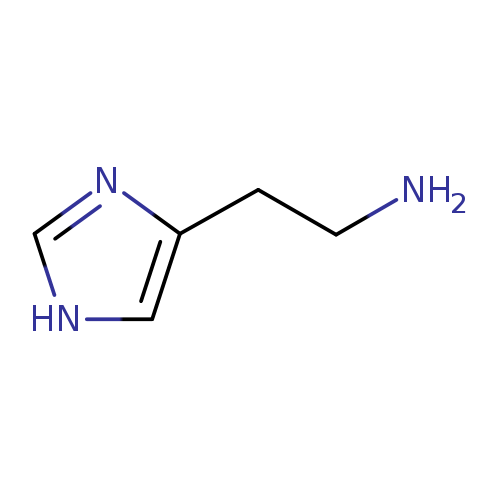
Histamine is an amine derived by enzymatic decarboxylation of histidine. It is a powerful stimulant of gastric secretion, a constrictor of bronchial smooth muscle, a vasodilator, and also a centrally acting neurotransmitter.
Contaminant Sources
  • Disinfection Byproducts
  • EAFUS Chemicals
  • FooDB Chemicals
  • HMDB Contaminants - Urine
  • HPV EPA Chemicals
  • OECD HPV Chemicals
  • STOFF IDENT Compounds
  • Suspected Compounds – Schymanski Project
  • T3DB toxins
  • ToxCast & Tox21 Chemicals
Contaminant Type
  • Amine
  • Animal Toxin
  • Food Toxin
  • Metabolite
  • Natural Compound
  • Organic Compound
  • PFAS
  • Phytotoxin
Chemical Structure
Synonyms
ValueSource
1H-Imidazole-4-ethanamineChEBI
2-(4-Imidazolyl)ethylamineChEBI
2-(1H-Imidazol-4-yl)ethanamineHMDB
2-(1H-Imidazol-4-yl)ethylamineHMDB
2-(1H-Imidazol-5-yl)ethanamineHMDB
2-(1H-Imidazol-5-yl)ethylamineHMDB
2-(4-Imidazolyl)ethanamineHMDB
2-Imidazol-4-yl-ethylamineHMDB
2-Imidazol-4-ylethylamineHMDB
4-(2-Aminoethyl)-1H-imidazoleHMDB
4-(2-Aminoethyl)imidazoleHMDB
4-ImidazoleethylamineHMDB
5-ImidazoleethylamineHMDB
b-Imidazolyl-4-ethylamineHMDB
beta-AminoethylglyoxalineHMDB
beta-AminoethylimidazoleHMDB
beta-AminothethylglyoxalineHMDB
beta-Imidazolyl-4-ethylamineHMDB
EraminHMDB
ErgamineHMDB
ErgotidineHMDB
HSMHMDB
2-(3H-Imidazol-4-yl)ethylamineHMDB
Imidazole-4-ethylamineHMDB
Β-imidazolyl-4-ethylamineHMDB
HistamineHMDB
Chemical FormulaC5H9N3
Average Molecular Mass111.145 g/mol
Monoisotopic Mass111.080 g/mol
CAS Registry Number51-45-6
IUPAC Name2-(1H-imidazol-4-yl)ethan-1-amine
Traditional Namehistamine
SMILESNCCC1=CNC=N1
InChI IdentifierInChI=1S/C5H9N3/c6-2-1-5-3-7-4-8-5/h3-4H,1-2,6H2,(H,7,8)
InChI KeyNTYJJOPFIAHURM-UHFFFAOYSA-N
Chemical Taxonomy
Description Belongs to the class of organic compounds known as 2-arylethylamines. These are primary amines that have the general formula RCCNH2, where R is an organic group.

KingdomOrganic compounds
Super ClassOrganic nitrogen compounds
ClassOrganonitrogen compounds
Sub ClassAmines
Direct Parent2-arylethylamines
Alternative Parents
Substituents
  • 2-arylethylamine
  • Aralkylamine
  • Heteroaromatic compound
  • Imidazole
  • Azole
  • Azacycle
  • Organoheterocyclic compound
  • Organopnictogen compound
  • Hydrocarbon derivative
  • Primary aliphatic amine
  • Aromatic heteromonocyclic compound
Molecular FrameworkAromatic heteromonocyclic compounds
External Descriptors
Biological Properties
StatusDetected and Not Quantified
OriginEndogenous
Cellular Locations
  • Cytoplasm
  • Extracellular
Biofluid LocationsNot Available
Tissue Locations
  • Adipose Tissue
  • Adrenal Medulla
  • Bladder
  • Brain
  • Fibroblasts
  • Intestine
  • Kidney
  • Mast Cell
  • Muscle
  • Myelin
  • Nerve Cells
  • Neuron
  • Pancreas
  • Placenta
  • Platelet
  • Prostate
  • Skin
  • Spleen
  • Testes
Pathways
NameSMPDB LinkKEGG Link
Histidine MetabolismSMP00044 map00340
HistidinemiaSMP00191 Not Available
ApplicationsNot Available
Biological Roles
Chemical RolesNot Available
Physical Properties
StateSolid
AppearanceWhite powder.
Experimental Properties
PropertyValue
Melting Point86°C
Boiling Point209.5°C (409.1°F)
SolubilityNot Available
Predicted Properties
PropertyValueSource
Water Solubility169 g/LALOGPS
logP-0.69ALOGPS
logP-0.7ChemAxon
logS0.18ALOGPS
pKa (Strongest Acidic)14.46ChemAxon
pKa (Strongest Basic)9.58ChemAxon
Physiological Charge1ChemAxon
Hydrogen Acceptor Count2ChemAxon
Hydrogen Donor Count2ChemAxon
Polar Surface Area54.7 ŲChemAxon
Rotatable Bond Count2ChemAxon
Refractivity31.66 m³·mol⁻¹ChemAxon
Polarizability12.08 ųChemAxon
Number of Rings1ChemAxon
BioavailabilityYesChemAxon
Rule of FiveYesChemAxon
Ghose FilterNoChemAxon
Veber's RuleNoChemAxon
MDDR-like RuleNoChemAxon
Spectra
Spectra
Toxicity Profile
Route of ExposureNot Available
Mechanism of ToxicityNot Available
MetabolismNot Available
Toxicity ValuesNot Available
Lethal DoseNot Available
Carcinogenicity (IARC Classification)No indication of carcinogenicity to humans (not listed by IARC).
Uses/SourcesThis is an endogenously produced metabolite found in the human body. It is used in metabolic reactions, catabolic reactions or waste generation.
Minimum Risk LevelNot Available
Health EffectsNot Available
SymptomsNot Available
TreatmentNot Available
Concentrations
StatusValueUnitSample LocationReference
External Links
DrugBank IDDB05381
HMDB IDHMDB0000870
FooDB IDFDB012596
Phenol Explorer IDNot Available
KNApSAcK IDC00001414
BiGG ID1810403
BioCyc IDHISTAMINE
METLIN ID68
PDB IDNot Available
Wikipedia LinkHistamine
Chemspider ID753
ChEBI ID18295
PubChem Compound ID774
Kegg Compound IDC00388
YMDB IDYMDB01556
ECMDB IDM2MDB004848
References
Synthesis ReferencePyman, Frank L. 2-Thiol-4(5)-b-aminoethylglyoxaline (2-thiolhistamine). Journal of the Chemical Society (1930), 98-100.
MSDSLink
General References
1. https://www.ncbi.nlm.nih.gov/pubmed/?term=16399866
2. https://www.ncbi.nlm.nih.gov/pubmed/?term=19547708
3. https://www.ncbi.nlm.nih.gov/pubmed/?term=19843401
4. https://www.ncbi.nlm.nih.gov/pubmed/?term=22770225
5. https://www.ncbi.nlm.nih.gov/pubmed/?term=24101735
6. Pyman, Frank L. 2-Thiol-4(5)-b-aminoethylglyoxaline (2-thiolhistamine). Journal of the Chemical Society (1930), 98-100.
7. Aurand LW, Moore PA, Jones EE: Effect of histamine on bovine milk fatty acids. J Anim Sci. 1980 May;50(5):783-92.
8. Pyman, Frank L. 2-Thiol-4(5)-b-aminoethylglyoxaline (2-thiolhistamine). Journal of the Chemical Society (1930), 98-100.
9. Dvorak AM: New aspects of mast cell biology. Int Arch Allergy Immunol. 1997 Sep;114(1):1-9.
10. Ito C: The role of the central histaminergic system on schizophrenia. Drug News Perspect. 2004 Jul-Aug;17(6):383-7.
11. Bordignon V, Burastero SE: Age, gender and reactivity to allergens independently influence skin reactivity to histamine. J Investig Allergol Clin Immunol. 2006;16(2):129-35.
12. Yosipovitch G, Fast K, Bernhard JD: Noxious heat and scratching decrease histamine-induced itch and skin blood flow. J Invest Dermatol. 2005 Dec;125(6):1268-72.
13. Koizumi H, Ohkawara A: H2 histamine receptor-mediated increase in intracellular Ca2+ in cultured human keratinocytes. J Dermatol Sci. 1999 Sep;21(2):127-32.
14. Brew OB, Sullivan MH: Localisation of mRNAs for diamine oxidase and histamine receptors H1 and H2, at the feto-maternal interface of human pregnancy. Inflamm Res. 2001 Sep;50(9):449-52.
15. Narasimha SK, Srinivas CR, Mathew AC: Effect of topical corticosteroid application frequency on histamine-induced wheals. Int J Dermatol. 2005 May;44(5):425-7.
16. Musio S, Gallo B, Scabeni S, Lapilla M, Poliani PL, Matarese G, Ohtsu H, Galli SJ, Mantegazza R, Steinman L, Pedotti R: A key regulatory role for histamine in experimental autoimmune encephalomyelitis: disease exacerbation in histidine decarboxylase-deficient mice. J Immunol. 2006 Jan 1;176(1):17-26.
17. Kidon MI, See Y, Bun CY, Goh A, Chay OM, Balakrishnan A: Bimodal skin reactivity to histamine in atopic children in Singapore: influence of specific sensitizations. Pediatr Allergy Immunol. 2004 Dec;15(6):545-50.
18. Masaki T, Yoshimatsu H, Chiba S, Watanabe T, Sakata T: Central infusion of histamine reduces fat accumulation and upregulates UCP family in leptin-resistant obese mice. Diabetes. 2001 Feb;50(2):376-84.
19. Khandelwal JK, Hough LB, Morrishow AM, Green JP: Measurement of tele-methylhistamine and histamine in human cerebrospinal fluid, urine, and plasma. Agents Actions. 1982 Dec;12(5-6):583-90.
20. Morgan TK, Montgomery K, Mason V, West RB, Wang L, van de Rijn M, Higgins JP: Upregulation of histidine decarboxylase expression in superficial cortical nephrons during pregnancy in mice and women. Kidney Int. 2006 Jul;70(2):306-14. Epub 2006 Jun 7.
21. Xie H, He SH, Cheng MH, Fu YL: [Effect of tryptase inhibitors on histamine release from human colon mast cells]. Xi Bao Yu Fen Zi Mian Yi Xue Za Zhi. 2004 Nov;20(6):678-81.
22. Gill DS, Fonseca VA, Barradas MA, Balliod R, Moorhead JF, Dandona P: Plasma histamine in patients with chronic renal failure and nephrotic syndrome. J Clin Pathol. 1991 Mar;44(3):243-5.
23. Tedeschi A, Lorini M, Asero R: No evidence of increased serum substance P levels in chronic urticaria patients with and without demonstrable circulating vasoactive factors. Clin Exp Dermatol. 2005 Mar;30(2):171-5.
24. Bruysters M, Jongejan A, Gillard M, van de Manakker F, Bakker RA, Chatelain P, Leurs R: Pharmacological differences between human and guinea pig histamine H1 receptors: Asn84 (2.61) as key residue within an additional binding pocket in the H1 receptor. Mol Pharmacol. 2005 Apr;67(4):1045-52. Epub 2004 Dec 30.
25. Ronchetti R, Villa MP, Rennerova Z, Haluszka J, Dawi EB, Di Felice G, Al-Bousafy A, Zakrzewski J, Barletta B, Barreto M: Allergen skin weal/radioallergosorbent test relationship in childhood populations that differ in histamine skin reactivity: a multi-national survey. Clin Exp Allergy. 2005 Jan;35(1):70-4.
26. Yamamoto T, Katayama I, Nishioka K: Possible contribution of stem cell factor in psoriasis vulgaris. J Dermatol Sci. 2000 Dec;24(3):171-6.
27. Fahmy NR, Sunder N, Soter NA: Role of histamine in the hemodynamic and plasma catecholamine responses to morphine. Clin Pharmacol Ther. 1983 May;33(5):615-20.
28. Kyllonen H, Malmberg P, Remitz A, Rytila P, Metso T, Helenius I, Haahtela T, Reitamo S: Respiratory symptoms, bronchial hyper-responsiveness, and eosinophilic airway inflammation in patients with moderate-to-severe atopic dermatitis. Clin Exp Allergy. 2006 Feb;36(2):192-7.
29. Sreekumar A, Poisson LM, Rajendiran TM, Khan AP, Cao Q, Yu J, Laxman B, Mehra R, Lonigro RJ, Li Y, Nyati MK, Ahsan A, Kalyana-Sundaram S, Han B, Cao X, Byun J, Omenn GS, Ghosh D, Pennathur S, Alexander DC, Berger A, Shuster JR, Wei JT, Varambally S, Beecher C, Chinnaiyan AM: Metabolomic profiles delineate potential role for sarcosine in prostate cancer progression. Nature. 2009 Feb 12;457(7231):910-4. doi: 10.1038/nature07762.
30. Thiele I, Swainston N, Fleming RM, Hoppe A, Sahoo S, Aurich MK, Haraldsdottir H, Mo ML, Rolfsson O, Stobbe MD, Thorleifsson SG, Agren R, Bolling C, Bordel S, Chavali AK, Dobson P, Dunn WB, Endler L, Hala D, Hucka M, Hull D, Jameson D, Jamshidi N, Jonsson JJ, Juty N, Keating S, Nookaew I, Le Novere N, Malys N, Mazein A, Papin JA, Price ND, Selkov E Sr, Sigurdsson MI, Simeonidis E, Sonnenschein N, Smallbone K, Sorokin A, van Beek JH, Weichart D, Goryanin I, Nielsen J, Westerhoff HV, Kell DB, Mendes P, Palsson BO: A community-driven global reconstruction of human metabolism. Nat Biotechnol. 2013 May;31(5):419-25. doi: 10.1038/nbt.2488. Epub 2013 Mar 3.
31. de las Rivas B, Marcobal A, Carrascosa AV, Munoz R: PCR detection of foodborne bacteria producing the biogenic amines histamine, tyramine, putrescine, and cadaverine. J Food Prot. 2006 Oct;69(10):2509-14.