Record Information
Version1.0
Creation Date2014-08-29 06:37:37 UTC
Update Date2026-08-23 05:13:01 UTC
Accession NumberCHEM003340
Identification
Common Name1-Methylhistamine
ClassSmall Molecule
Description
1-Methylhistamine is a histamine metabolite. It is a product of histamine 1-methyltransferase [EC 2.1.1.8] in the pathway histidine metabolism (KEGG).
Contaminant Sources
  • FooDB Chemicals
  • HMDB Contaminants - Urine
  • T3DB toxins
Contaminant Type
  • Amine
  • Animal Toxin
  • Food Toxin
  • Metabolite
  • Natural Compound
  • Organic Compound
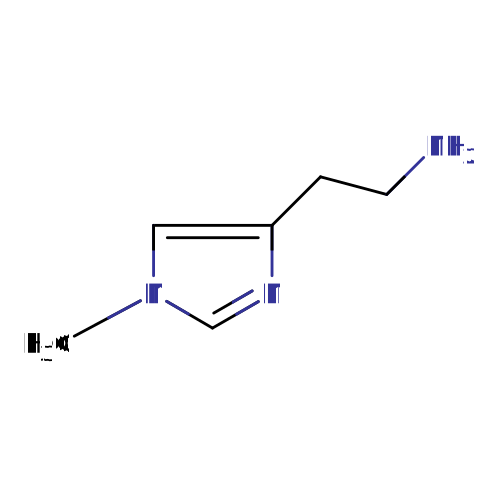
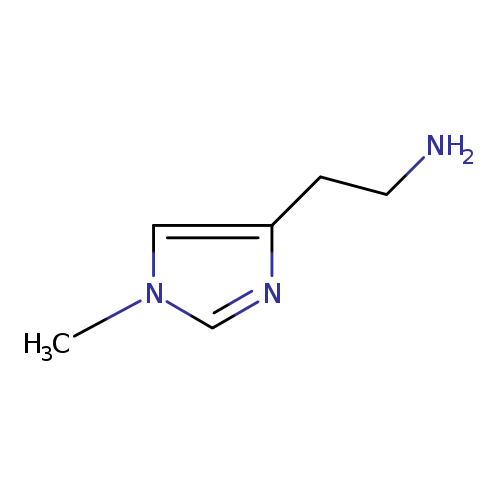
Chemical Structure
Synonyms
ValueSource
1-Methyl-1H-imidazole-4-ethanamineChEBI
1-Methyl-4-(2-aminoethyl)imidazoleChEBI
3-MethylhistamineChEBI
4-(1-Aminoethyl)-1-methyl-1H-imidazoleChEBI
MethylhistamineChEBI
N-MethylhistamineChEBI
N(1)-MethylhistamineChEBI
Ntau-methylhistamineChEBI
tele-MethylhistamineChEBI
tele-Methylhistamine dihydrochlorideHMDB
1-Methyl-4-(beta-aminoethyl)imidazoleHMDB
1,4-MethylhistamineHMDB
N-tele MethylhistamineHMDB
1-Methyl-4-(b-aminoethyl)imidazoleHMDB
1-Methyl-4-histamineHMDB
2-(1-Methyl-1H-imidazol-4-yl)ethanamineHMDB
2-(1-Methyl-1H-imidazol-4-yl)ethylamineHMDB
4-(2-Aminoethyl)-1-methyl-imidazoleHMDB
4-(2-Aminoethyl)-1-methylimidazoleHMDB
H137HMDB
N( 1)-MethylhistamineHMDB
N(T)-MethylhistamineHMDB
N-tele-MethylhistamineHMDB
N-Telle-methylhistamineHMDB
N1-MethylhistamineHMDB
NT-MethylhistamineHMDB
Chemical FormulaC6H11N3
Average Molecular Mass125.172 g/mol
Monoisotopic Mass125.095 g/mol
CAS Registry Number501-75-7
IUPAC Name2-(1-methyl-1H-imidazol-4-yl)ethan-1-amine
Traditional Namemethylhistamine
SMILESCN1C=NC(CCN)=C1
InChI IdentifierInChI=1S/C6H11N3/c1-9-4-6(2-3-7)8-5-9/h4-5H,2-3,7H2,1H3
InChI KeyFHQDWPCFSJMNCT-UHFFFAOYSA-N
Chemical Taxonomy
Description Belongs to the class of organic compounds known as 2-arylethylamines. These are primary amines that have the general formula RCCNH2, where R is an organic group.
KingdomOrganic compounds
Super ClassOrganic nitrogen compounds
ClassOrganonitrogen compounds
Sub ClassAmines
Direct Parent2-arylethylamines
Alternative Parents
Substituents
  • 2-arylethylamine
  • Aralkylamine
  • N-substituted imidazole
  • Heteroaromatic compound
  • Imidazole
  • Azole
  • Azacycle
  • Organoheterocyclic compound
  • Organopnictogen compound
  • Hydrocarbon derivative
  • Primary aliphatic amine
  • Aromatic heteromonocyclic compound
Molecular FrameworkAromatic heteromonocyclic compounds
External Descriptors
Biological Properties
StatusDetected and Not Quantified
OriginEndogenous
Cellular Locations
  • Cytoplasm
  • Extracellular
Biofluid LocationsNot Available
Tissue Locations
  • Bone Marrow
  • Brain
  • Mast Cell
Pathways
NameSMPDB LinkKEGG Link
Histidine MetabolismSMP00044 map00340
HistidinemiaSMP00191 Not Available
ApplicationsNot Available
Biological Roles
Chemical RolesNot Available
Physical Properties
StateSolid
AppearanceWhite powder.
Experimental Properties
PropertyValue
Melting PointNot Available
Boiling PointNot Available
SolubilityNot Available
Predicted Properties
PropertyValueSource
Water Solubility5.12 g/LALOGPS
logP-0.57ALOGPS
logP-0.48ChemAxon
logS-1.4ALOGPS
pKa (Strongest Basic)9.57ChemAxon
Physiological Charge1ChemAxon
Hydrogen Acceptor Count2ChemAxon
Hydrogen Donor Count1ChemAxon
Polar Surface Area43.84 ŲChemAxon
Rotatable Bond Count2ChemAxon
Refractivity36.56 m³·mol⁻¹ChemAxon
Polarizability14.24 ųChemAxon
Number of Rings1ChemAxon
BioavailabilityYesChemAxon
Rule of FiveYesChemAxon
Ghose FilterNoChemAxon
Veber's RuleNoChemAxon
MDDR-like RuleNoChemAxon
Spectra
Spectra
Toxicity Profile
Route of ExposureNot Available
Mechanism of ToxicityNot Available
MetabolismNot Available
Toxicity ValuesNot Available
Lethal DoseNot Available
Carcinogenicity (IARC Classification)No indication of carcinogenicity to humans (not listed by IARC).
Uses/SourcesThis is an endogenously produced metabolite found in the human body. It is used in metabolic reactions, catabolic reactions or waste generation.
Minimum Risk LevelNot Available
Health EffectsNot Available
SymptomsNot Available
TreatmentNot Available
Concentrations
Not Available
External Links
DrugBank IDNot Available
HMDB IDHMDB0000898
FooDB IDFDB022306
Phenol Explorer IDNot Available
KNApSAcK IDNot Available
BiGG ID45171
BioCyc IDN-METHYL-HISTAMINE
METLIN ID5854
PDB IDNot Available
Wikipedia LinkMethylhistamine
Chemspider ID3488
ChEBI ID29009
PubChem Compound ID3614
Kegg Compound IDC05127
YMDB IDNot Available
ECMDB IDM2MDB005083
References
Synthesis ReferenceRothschild, Zuleika; Schayer, Richard W. Synthesis and metabolism of a histamine metabolite, 1-methyl-4-(b-aminoethyl)imidazole. Biochimica et Biophysica Acta (1958), 30 23-7.

MSDSLink
General References
1. Rothschild, Zuleika; Schayer, Richard W. Synthesis and metabolism of a histamine metabolite, 1-methyl-4-(b-aminoethyl)imidazole. Biochimica et Biophysica Acta (1958), 30 23-7.
2. Winterkamp S, Weidenhiller M, Otte P, Stolper J, Schwab D, Hahn EG, Raithel M: Urinary excretion of N-methylhistamine as a marker of disease activity in inflammatory bowel disease. Am J Gastroenterol. 2002 Dec;97(12):3071-7.
3. Elmore BO, Bollinger JA, Dooley DM: Human kidney diamine oxidase: heterologous expression, purification, and characterization. J Biol Inorg Chem. 2002 Jun;7(6):565-79. Epub 2002 Feb 13.
4. Ito C: The role of the central histaminergic system on schizophrenia. Drug News Perspect. 2004 Jul-Aug;17(6):383-7.
5. Robbins IM, Barst RJ, Rubin LJ, Gaine SP, Price PV, Morrow JD, Christman BW: Increased levels of prostaglandin D(2) suggest macrophage activation in patients with primary pulmonary hypertension. Chest. 2001 Nov;120(5):1639-44.
6. O'Sullivan S, Roquet A, Dahlen B, Dahlen S, Kumlin M: Urinary excretion of inflammatory mediators during allergen-induced early and late phase asthmatic reactions. Clin Exp Allergy. 1998 Nov;28(11):1332-9.
7. Martens-Lobenhoffer J, Neumann HJ: Determination of 1-methylhistamine and 1-methylimidazoleacetic acid in human urine as a tool for the diagnosis of mastocytosis. J Chromatogr B Biomed Sci Appl. 1999 Jan 8;721(1):135-40.
8. Theoharides TC, Sant GR, el-Mansoury M, Letourneau R, Ucci AA Jr, Meares EM Jr: Activation of bladder mast cells in interstitial cystitis: a light and electron microscopic study. J Urol. 1995 Mar;153(3 Pt 1):629-36.
9. Brumsen C, Papapoulos SE, Lentjes EG, Kluin PM, Hamdy NA: A potential role for the mast cell in the pathogenesis of idiopathic osteoporosis in men. Bone. 2002 Nov;31(5):556-61.
10. Rozniecki JJ, Hauser SL, Stein M, Lincoln R, Theoharides TC: Elevated mast cell tryptase in cerebrospinal fluid of multiple sclerosis patients. Ann Neurol. 1995 Jan;37(1):63-6.
11. Alakarppa K, Tupala E, Mantere T, Sarkioja T, Rasanen P, Tarhanen J, Tiihonen J, Tuomisto L: Effect of alcohol abuse on human brain histamine and tele-methylhistamine. Inflamm Res. 2002 Apr;51 Suppl 1:S40-1.
12. Tredget EE, Iwashina T, Scott PG, Ghahary A: Determination of plasma Ntau-methylhistamine in vivo by isotope dilution using benchtop gas chromatography-mass spectrometry. J Chromatogr B Biomed Sci Appl. 1997 Jun 20;694(1):1-9.
13. van Toorenenbergen AW, Oranje AP: Comparison of serum tryptase and urine N-methylhistamine in patients with suspected mastocytosis. Clin Chim Acta. 2005 Sep;359(1-2):72-7.
14. Droogendijk HJ, Kluin-Nelemans HJ, van Doormaal JJ, Oranje AP, van de Loosdrecht AA, van Daele PL: Imatinib mesylate in the treatment of systemic mastocytosis: a phase II trial. Cancer. 2006 Jul 15;107(2):345-51.
15. Oranje AP, Mulder PG, Heide R, Tank B, Riezebos P, van Toorenenbergen AW: Urinary N-methylhistamine as an indicator of bone marrow involvement in mastocytosis. Clin Exp Dermatol. 2002 Sep;27(6):502-6.
16. Rinne JO, Anichtchik OV, Eriksson KS, Kaslin J, Tuomisto L, Kalimo H, Roytta M, Panula P: Increased brain histamine levels in Parkinson's disease but not in multiple system atrophy. J Neurochem. 2002 Jun;81(5):954-60.
17. Fitzpatrick MF, Mackay T, Walters C, Tai PC, Church MK, Holgate ST, Douglas NJ: Circulating histamine and eosinophil cationic protein levels in nocturnal asthma. Clin Sci (Lond). 1992 Aug;83(2):227-32.
18. Khandelwal JK, Hough LB, Morrishow AM, Green JP: Measurement of tele-methylhistamine and histamine in human cerebrospinal fluid, urine, and plasma. Agents Actions. 1982 Dec;12(5-6):583-90.
19. Butterfield JH, Tefferi A, Kozuh GF: Successful treatment of systemic mastocytosis with high-dose interferon-alfa: long-term follow-up of a case. Leuk Res. 2005 Feb;29(2):131-4.
20. Winterkamp S, Weidenhiller M, Wilken V, Donhauser N, Schultis HW, Buchwald F, Hahn EG, Raithel M: Standardised evaluation of urinary excretion of N-tele-methylhistamine in different periods of age in a healthy population. Inflamm Res. 2003 Apr;52 Suppl 1:S57-8.
21. Coruzzi G, Morini G, Adami M, Grandi D: Role of histamine H3 receptors in the regulation of gastric functions. J Physiol Pharmacol. 2001 Dec;52(4 Pt 1):539-53.
22. https://www.ncbi.nlm.nih.gov/pubmed/?term=23024434
23. https://www.ncbi.nlm.nih.gov/pubmed/?term=2409780
24. https://www.ncbi.nlm.nih.gov/pubmed/?term=7711000