Record Information
Version1.0
Creation Date2014-08-29 06:51:42 UTC
Update Date2026-08-18 15:58:01 UTC
Accession NumberCHEM003457
Identification
Common NameDiphenylamine
ClassSmall Molecule
Description
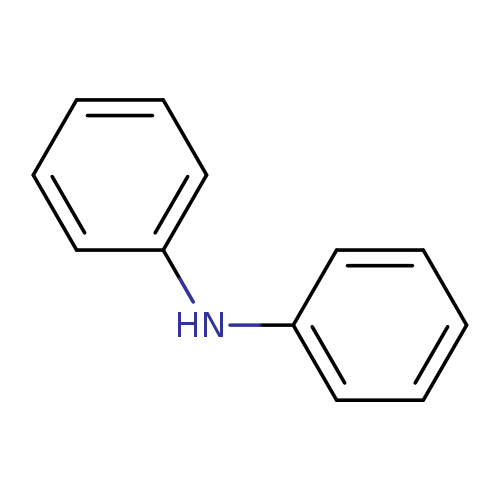
Diphenylamine is found in coriander. Diphenylamine is used for control of superficial scald in stored apples Diphenylamine is the organic compound with the formula (C6H5)2NH. It is a colourless solid, but samples are often yellow due to oxidized impurities. It is a weak base, with a KB of 10 14. With strong acids, it forms the water soluble salt. Diphenylamine belongs to the family of Aromatic Homomonocyclic Compounds. These are aromatic compounds containig only one ring, which is homocyclic.
Contaminant Sources
  • Clean Air Act Chemicals
  • FooDB Chemicals
  • HPV EPA Chemicals
  • My Exposome Chemicals
  • OECD HPV Chemicals
  • STOFF IDENT Compounds
  • T3DB toxins
  • ToxCast & Tox21 Chemicals
Contaminant Type
  • Amine
  • Food Toxin
  • Household Toxin
  • Metabolite
  • Natural Compound
  • Organic Compound
  • PMT
  • Pesticide
  • Plant Toxin
Chemical Structure
Synonyms
ValueSource
(Phenylamino)benzeneChEBI
AnilinobenzeneChEBI
C6H5-NH-C6H5ChEBI
DPAChEBI
N,N-DiphenylamineChEBI
N-PhenylbenzenamineChEBI
(phenylamino)-BenzeneHMDB
2-Biphenylyl-N-pyridyl-acetamideHMDB
2-Biphenylyl-N-pyridylacetamideHMDB
anilino-BenzeneHMDB
Benzenamine, N-phenyl-, styrenatedHMDB
Big dipperHMDB
Deccoscald 282HMDB
DFAHMDB
DifenylaminHMDB
DiphenpyramideHMDB
Diphenyl-amineHMDB
Diphenylamine indicatorHMDB
Diphenylamine, acsHMDB
Diphenylamine, reaction product with 2,2,4-trimethylpenteneHMDB
N-FenylanilinHMDB
N-Phenyl-anilineHMDB
N-Phenyl-benzenamineHMDB
N-Phenylbenzenamine, 9ciHMDB
N-Phenylbenzenamine, styrenatedHMDB
N-PhenylbenzeneamineHMDB
Naugalube 428lHMDB
no ScaldHMDB
no Scald dpa 283HMDB
NO-ScaldHMDB
NO-Scald dpa 283HMDB
PhenylanilineHMDB
Poly(diphenylamine)HMDB
Pyridyl-biphenylyl-acetamideHMDB
ScaldipHMDB
Shield dpaHMDB
Styrenated diphenylamineHMDB
Styrene, reaction product with diphenylamineHMDB
Chemical FormulaC12H11N
Average Molecular Mass169.222 g/mol
Monoisotopic Mass169.089 g/mol
CAS Registry Number122-39-4
IUPAC NameN-phenylaniline
Traditional Namediphenylamine
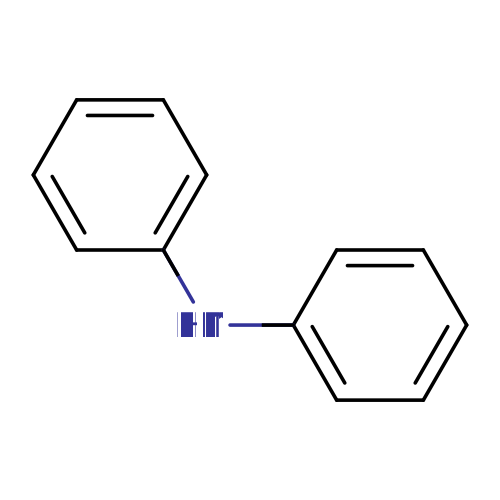
SMILESN(C1=CC=CC=C1)C1=CC=CC=C1
InChI IdentifierInChI=1S/C12H11N/c1-3-7-11(8-4-1)13-12-9-5-2-6-10-12/h1-10,13H
InChI KeyDMBHHRLKUKUOEG-UHFFFAOYSA-N
Chemical Taxonomy
Description Belongs to the class of organic compounds known as aniline and substituted anilines. These are organic compounds containing an aminobenzene moiety.
KingdomOrganic compounds
Super ClassBenzenoids
ClassBenzene and substituted derivatives
Sub ClassAniline and substituted anilines
Direct ParentAniline and substituted anilines
Alternative Parents
Substituents
  • Aniline or substituted anilines
  • Secondary amine
  • Organic nitrogen compound
  • Organopnictogen compound
  • Hydrocarbon derivative
  • Organonitrogen compound
  • Amine
  • Aromatic homomonocyclic compound
Molecular FrameworkAromatic homomonocyclic compounds
External Descriptors
Biological Properties
StatusDetected and Not Quantified
OriginExogenous
Cellular Locations
  • Membrane
Biofluid LocationsNot Available
Tissue LocationsNot Available
PathwaysNot Available
ApplicationsNot Available
Biological Roles
Chemical Roles
Physical Properties
StateSolid
AppearanceWhite powder.
Experimental Properties
PropertyValue
Melting Point52 - 54°C
Boiling Point302°C (575.6°F)
Solubility0.053 mg/mL at 20°C
Predicted Properties
PropertyValueSource
Water Solubility0.25 g/LALOGPS
logP3.34ALOGPS
logP3.41ChemAxon
logS-2.8ALOGPS
pKa (Strongest Basic)0.78ChemAxon
Physiological Charge0ChemAxon
Hydrogen Acceptor Count1ChemAxon
Hydrogen Donor Count1ChemAxon
Polar Surface Area12.03 ŲChemAxon
Rotatable Bond Count2ChemAxon
Refractivity54.54 m³·mol⁻¹ChemAxon
Polarizability19.26 ųChemAxon
Number of Rings2ChemAxon
BioavailabilityYesChemAxon
Rule of FiveYesChemAxon
Ghose FilterYesChemAxon
Veber's RuleYesChemAxon
MDDR-like RuleNoChemAxon
Spectra
Spectra
Toxicity Profile
Route of ExposureNot Available
Mechanism of ToxicityDiphenylamine uncouples mitochondrial oxidative phosphorylation, resulting in a decrease in hepatocellular ATP content and consequently hepatocyte injury (22). Short-term and long-term exposure in animal models results in altered haematological parameters, splenic erythropoiesis, splenic congestion and haemosiderosis (23).

MetabolismNot Available
Toxicity ValuesNot Available
Lethal DoseNot Available
Carcinogenicity (IARC Classification)No indication of carcinogenicity to humans (not listed by IARC).
Uses/SourcesThis is a natural compound that is used as a pesticide.
Minimum Risk LevelNot Available
Health EffectsNot Available
SymptomsNot Available
TreatmentNot Available
Concentrations
Not Available
External Links
DrugBank IDNot Available
HMDB IDHMDB0032562
FooDB IDFDB010494
Phenol Explorer IDNot Available
KNApSAcK IDNot Available
BiGG IDNot Available
BioCyc IDCPD-9937
METLIN IDNot Available
PDB IDNot Available
Wikipedia LinkDiphenylamine
Chemspider ID11003
ChEBI ID4640
PubChem Compound ID11487
Kegg Compound IDC11016
YMDB IDNot Available
ECMDB IDNot Available
References
Synthesis ReferenceNot Available
MSDSLink
General References
1. https://www.ncbi.nlm.nih.gov/pubmed/?term=16172927
2. https://www.ncbi.nlm.nih.gov/pubmed/?term=16336182
3. https://www.ncbi.nlm.nih.gov/pubmed/?term=23200380
4. https://www.ncbi.nlm.nih.gov/pubmed/?term=23311914
5. https://www.ncbi.nlm.nih.gov/pubmed/?term=6446435
6. https://www.ncbi.nlm.nih.gov/pubmed/?term=8192920
7. Jitsui Y, Ohtani N: Transmission electron microscope observation of organic-inorganic hybrid thin active layers of light-emitting diodes. Nanoscale Res Lett. 2012 Oct 25;7(1):591. doi: 10.1186/1556-276X-7-591.
8. Ramon JG, Bittner ER: Excited state calculations on fluorene-based polymer blends: effect of stacking orientation and solvation. J Chem Phys. 2007 May 14;126(18):181101.
9. Shyla B, Nagendrappa G: Redox spectrophotometric method involving electrolytically generated manganese(III) sulphate with diphenylamine for the determination of ascorbic acid present in the samples of various fruits, commercial juices and sprouted food grains. Food Chem. 2013 Jun 1;138(2-3):2036-42. doi: 10.1016/j.foodchem.2012.11.076. Epub 2012 Nov 24.
10. Authors unspecified: para-Nitrosodiphenylamine. IARC Monogr Eval Carcinog Risk Chem Hum. 1982 Apr;27:227-33.
11. Nagata T, Masuda K, Maeno S, Miura I: Synthesis and structure-activity study of fungicidal anilinopyrimidines leading to mepanipyrim (KIF-3535) as an anti-Botrytis agent. Pest Manag Sci. 2004 Apr;60(4):399-407.
12. Benson-Smith JJ, Wilson J, Dyer-Smith C, Mouri K, Yamaguchi S, Murata H, Nelson J: Long-lived exciplex formation and delayed exciton emission in bulk heterojunction blends of silole derivative and polyfluorene copolymer: the role of morphology on exciplex formation and charge separation. J Phys Chem B. 2009 Jun 4;113(22):7794-9. doi: 10.1021/jp808671f.
13. Huang YS, Westenhoff S, Avilov I, Sreearunothai P, Hodgkiss JM, Deleener C, Friend RH, Beljonne D: Electronic structures of interfacial states formed at polymeric semiconductor heterojunctions. Nat Mater. 2008 Jun;7(6):483-9. doi: 10.1038/nmat2182. Epub 2008 Apr 27.
14. Lin Y, El-Khouly ME, Chen Y, Supur M, Gu L, Li Y, Fukuzumi S: A new cyanofluorene-triphenylamine copolymer: synthesis and photoinduced intramolecular electron transfer processes. Chemistry. 2009 Oct 19;15(41):10818-24. doi: 10.1002/chem.200900752.
15. Liu B, Najari A, Pan C, Leclerc M, Xiao D, Zou Y: New low bandgap dithienylbenzothiadiazole vinylene based copolymers: synthesis and photovoltaic properties. Macromol Rapid Commun. 2010 Feb 16;31(4):391-8. doi: 10.1002/marc.200900654. Epub 2009 Nov 24.
16. Dalby O, Birkett JW: The evaluation of solid phase micro-extraction fibre types for the analysis of organic components in unburned propellant powders. J Chromatogr A. 2010 Nov 12;1217(46):7183-8. doi: 10.1016/j.chroma.2010.09.012. Epub 2010 Sep 15.
17. Fun HK, Chantrapromma S, D'Silva ED, Patil PS, Dharmaprakash SM: S-Benzyl-thiouronium 4-anilinobenzene-sulfonate. Acta Crystallogr Sect E Struct Rep Online. 2008 Aug 30;64(Pt 9):o1858-9. doi: 10.1107/S160053680802727X.
18. Hirai Y, Uozumi Y: Heterogeneous aromatic amination of aryl halides with arylamines in water with PS-PEG resin-supported palladium complexes. Chem Asian J. 2010 Aug 2;5(8):1788-95. doi: 10.1002/asia.201000192.
19. Jin R, Levermore PA, Huang J, Wang X, Bradley DD, deMello JC: On the use and influence of electron-blocking interlayers in polymer light-emitting diodes. Phys Chem Chem Phys. 2009 May 14;11(18):3455-62. doi: 10.1039/b819200f. Epub 2009 Mar 6.
20. Sedinova V, Urbanova E, Skarda J, Jukl A: [Determination of the number of somatic cells in milk using the rapid diphenylamine DNA filter method]. Vet Med (Praha). 1985 Aug;30(8):467-75.
21. Agarwala S, Peh CK, Ho GW: Investigation of ionic conductivity and long-term stability of a LiI and KI coupled diphenylamine quasi-solid-state dye-sensitized solar cell. ACS Appl Mater Interfaces. 2011 Jul;3(7):2383-91. doi: 10.1021/am200296f. Epub 2011 Jun 20.
22. Marjanovic B, Juranic I, Ciric-Marjanovic G: Revised mechanism of Boyland-Sims oxidation. J Phys Chem A. 2011 Apr 21;115(15):3536-50. doi: 10.1021/jp111129t. Epub 2011 Mar 24.
23. Kim JS, Lu L, Sreearunothai P, Seeley A, Yim KH, Petrozza A, Murphy CE, Beljonne D, Cornil J, Friend RH: Optoelectronic and charge transport properties at organic-organic semiconductor interfaces: comparison between polyfluorene-based polymer blend and copolymer. J Am Chem Soc. 2008 Oct 1;130(39):13120-31. doi: 10.1021/ja803766j. Epub 2008 Sep 4.
24. Patterson J, Mura C: Rapid colorimetric assays to qualitatively distinguish RNA and DNA in biomolecular samples. J Vis Exp. 2013 Feb 4;(72):e50225. doi: 10.3791/50225.
25. Lee KP, Gopalan AI, Kim KS, Santhosh P: Synthesis and characterization of processable multi-walled carbon nanotubes-sulfonated polydiphenylamine graft copolymers. J Nanosci Nanotechnol. 2007 Oct;7(10):3386-93.
26. Abid-Essefi S, Bouaziz C, Golli-Bennour EE, Ouanes Z, Bacha H: Comparative study of toxic effects of zearalenone and its two major metabolites alpha-zearalenol and beta-zearalenol on cultured human Caco-2 cells. J Biochem Mol Toxicol. 2009 Jul-Aug;23(4):233-43. doi: 10.1002/jbt.20284.
27. Philips MF, Gopalan AI, Lee KP: Development of a novel cyano group containing electrochemically deposited polymer film for ultrasensitive simultaneous detection of trace level cadmium and lead. J Hazard Mater. 2012 Oct 30;237-238:46-54. doi: 10.1016/j.jhazmat.2012.07.069. Epub 2012 Aug 24.
28. Yannai, Shmuel. (2004) Dictionary of food compounds with CD-ROM: Additives, flavors, and ingredients. Boca Raton: Chapman & Hall/CRC.