Profenofos (CED0007827)

Record Information
Version1.0
Creation Date2014-08-29 06:51:45 UTC
Update Date2026-08-18 10:47:55 UTC
SynCED IDCED0007827
Secondary Accession Numbers
  • CHEM003488
  • T3D4528
Identification
Common NameProfenofos
ClassSmall Molecule
Description
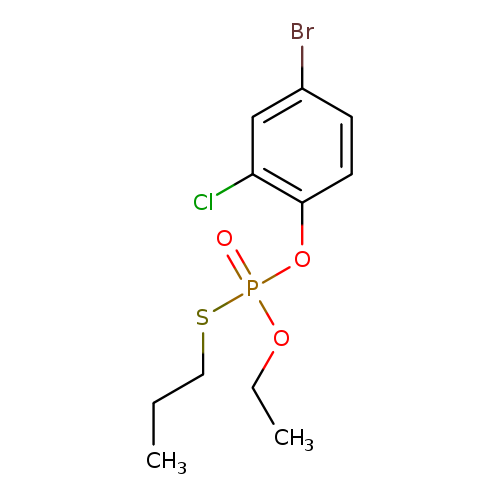
Profenofos is an exogenous organic compound with the formula C11H15BrClO3PS and an average molecular weight of 373.63 g/mol. Profenofos belongs to the phenoxy compounds, a subclass of benzene and substituted derivatives within the organic compounds. At room temperature, this substance exists as a solid. It functions as an acetylcholinesterase (EC 3.1.1.7) inhibitor. In industrial and biological applications, profenofos is used as an agrochemical, biocide, pesticide (PMC12452724 , PMC7763907 ), insecticide (PMC11277490 ), and acaricide (PMC10008910 ). It targets 16 recorded proteins, including the estrogen receptor (ESR1), interstitial collagenase (MMP1), nuclear receptor subfamily 1 group I member 2 (NR1I2), and mitochondrial 25-hydroxyvitamin D-1 alpha hydroxylase (CYP27B1). Profenofos has been recorded in nine sources, including drinking water, floors in building and construction, and cigar cigarettes in household cleaning and consumer products. It is also found in food processing and cookware, specifically in the preparation of malt and molasses and the treatment of molasses, as well as in electrical and electronic equipment such as discharge lamps, colour television systems, television systems, and electrically stimulated smoking devices. The recorded route of exposure for this compound is oral.
Contaminant Type
  • Bromide Compound
  • Insecticide
  • Organic Compound
  • Organobromide
  • Organochloride
  • Pesticide
  • Synthetic Compound
Chemical Structure
Synonyms
ValueSource
CuracronChEBI
O-(4-Bromo-2-chlorophenyl) O-ethyl S-propyl thiophosphateChEBI
Phosphorothioic acid, O-(4-bromo-2-chlorophenyl) O-ethyl S-propyl esterChEBI
O-(4-Bromo-2-chlorophenyl) O-ethyl S-propyl thiophosphoric acidGenerator
Phosphorothioate, O-(4-bromo-2-chlorophenyl) O-ethyl S-propyl esterGenerator
SelecronMeSH
Chemical FormulaC11H15BrClO3PS
Average Molecular Mass373.631 g/mol
Monoisotopic Mass371.935 g/mol
CAS Registry Number41198-08-7
IUPAC Name4-bromo-2-chlorophenyl ethyl (propylsulfanyl)phosphonate
Traditional Nameprofenofos
SMILESCCCSP(=O)(OCC)OC1=C(Cl)C=C(Br)C=C1
InChI IdentifierInChI=1S/C11H15BrClO3PS/c1-3-7-18-17(14,15-4-2)16-11-6-5-9(12)8-10(11)13/h5-6,8H,3-4,7H2,1-2H3
InChI KeyQYMMJNLHFKGANY-UHFFFAOYSA-N
Chemical Taxonomy
Description Belongs to the class of organic compounds known as phenoxy compounds. These are aromatic compounds contaning a phenoxy group.
KingdomOrganic compounds
Super ClassBenzenoids
ClassBenzene and substituted derivatives
Sub ClassPhenoxy compounds
Direct ParentPhenoxy compounds
Alternative Parents
Substituents
  • Phenoxy compound
  • Bromobenzene
  • Chlorobenzene
  • Halobenzene
  • Aryl bromide
  • Aryl chloride
  • Aryl halide
  • Sulfenyl compound
  • Organothiophosphorus compound
  • Organobromide
  • Organohalogen compound
  • Organosulfur compound
  • Organic oxygen compound
  • Hydrocarbon derivative
  • Organic oxide
  • Organochloride
  • Organooxygen compound
  • Aromatic homomonocyclic compound
Molecular FrameworkAromatic homomonocyclic compounds
External Descriptors
Biological Properties
StatusDetected and Not Quantified
OriginExogenous
Cellular Locations
  • Membrane
  • Microsome
Biofluid LocationsNot Available
Tissue LocationsNot Available
Applications
Biological Roles
Chemical Roles
Organoleptic EffectsNot Available
Physical Properties
StateSolid
AppearanceWhite powder.
Experimental Properties
PropertyValue
Melting PointNot Available
Boiling PointNot Available
SolubilityNot Available
Predicted Properties
PropertyValueSource
Water Solubility0.018 g/LALOGPS
logP4.3ALOGPS
logP4.88ChemAxon
logS-4.3ALOGPS
pKa (Strongest Basic)-8.3ChemAxon
Physiological Charge0ChemAxon
Hydrogen Acceptor Count1ChemAxon
Hydrogen Donor Count0ChemAxon
Polar Surface Area35.53 ŲChemAxon
Rotatable Bond Count7ChemAxon
Refractivity80.82 m³·mol⁻¹ChemAxon
Polarizability32.37 ųChemAxon
Number of Rings1ChemAxon
BioavailabilityYesChemAxon
Rule of FiveYesChemAxon
Ghose FilterYesChemAxon
Veber's RuleYesChemAxon
MDDR-like RuleNoChemAxon
Spectra
Spectra
Spectrum TypeDescriptionSplash KeyDeposition DateView
Predicted LC-MS/MSPredicted LC-MS/MS Spectrumsplash10-00bc-5009000000-419ae74b0911f5f1f598Not AvailableView Spectrum
Predicted LC-MS/MSPredicted LC-MS/MS Spectrumsplash10-0006-9002000000-32228f213b68cb75e3f4Not AvailableView Spectrum
Predicted LC-MS/MSPredicted LC-MS/MS Spectrumsplash10-0006-9111000000-0e390d9c5ba4f37758caNot AvailableView Spectrum
Predicted LC-MS/MSPredicted LC-MS/MS Spectrumsplash10-00dl-0329000000-8af4d2ce211290bc0daaNot AvailableView Spectrum
Predicted LC-MS/MSPredicted LC-MS/MS Spectrumsplash10-002u-5829000000-2f8ec9899b0db956f5d5Not AvailableView Spectrum
Predicted LC-MS/MSPredicted LC-MS/MS Spectrumsplash10-00si-1942000000-c98869b8c77b47731339Not AvailableView Spectrum
MSMS Spectrumsplash10-000i-9587000000-fdac6d1bf02eb3a0f9a5Not AvailableView Spectrum
Toxicity Profile
Toxicity Values
Toxicity ValueOrganismDose DescriptorRoute of ExposurePredicted or ExperimentalToxicity RatingReference
134.0 Log mg/kg [80:240]RatLD50oralpredictedNot AvailableNot Available
20.0 mg/kg-day European RabbitLOELdermalexperimentalNot AvailableECOTOX - EPA ORD
12.0 mg/kg-day MouseLOELoralexperimentalNot AvailableECOTOX - EPA ORD
165.0 mg/kg-day RatNOELdermalexperimentalNot AvailableECOTOX - EPA ORD
17.9 mg/kg-day RatLOELoralexperimentalNot AvailableECOTOX - EPA ORD
1.7088 mg/kg-day RatLOELoralexperimentalNot AvailableECOTOX - EPA ORD
20.0 mg/kg-day European RabbitLOELdermalexperimentalNot AvailableECOTOX - EPA ORD
20.0 mg/kg-day MouseLOELoralexperimentalNot AvailableECOTOX - EPA ORD
36.0 mg/kg-day MouseLOELoralexperimentalNot AvailableECOTOX - EPA ORD
10.0 ppm European RabbitLOELoralexperimentalNot AvailableECOTOX - EPA ORD
0.1 % MouseLOELoralexperimentalNot AvailableECOTOX - EPA ORD
12.0 mg/kg-day MouseLOELoralexperimentalNot AvailableECOTOX - EPA ORD
165.0 mg/kg-day RatLOELdermalexperimentalNot AvailableECOTOX - EPA ORD
60.0 mg/kg-day MouseNOELoralexperimentalNot AvailableECOTOX - EPA ORD
21.25 mg/kg-day MouseLOELoralexperimentalNot AvailableECOTOX - EPA ORD
20.0 mg/kg-day European RabbitNOELdermalexperimentalNot AvailableECOTOX - EPA ORD
80.0 mg/kg-day European RabbitLOELdermalexperimentalNot AvailableECOTOX - EPA ORD
600.0 mg/kg-day European RabbitLOELoralexperimentalNot AvailableECOTOX - EPA ORD
2.65 mg/kg-day MouseLOELoralexperimentalNot AvailableECOTOX - EPA ORD
10.0 mg/kg-day RatNOELoralexperimentalNot AvailableECOTOX - EPA ORD
100.0 ppm RatLOELoralexperimentalNot AvailableECOTOX - EPA ORD
216.0 mg/kg-day MouseLOELoralexperimentalNot AvailableECOTOX - EPA ORD
17.8 mg/kg-day RatLOELoralexperimentalNot AvailableECOTOX - EPA ORD
20.0 mg/kg-day MouseNOELinjectionexperimentalNot AvailableECOTOX - EPA ORD
Toxicity / Toxin ClassNot Available
Mechanism of ToxicityProfenofos is a cholinesterase or acetylcholinesterase (AChE) inhibitor. A cholinesterase inhibitor (or 'anticholinesterase') suppresses the action of acetylcholinesterase. Because of its essential function, chemicals that interfere with the action of acetylcholinesterase are potent neurotoxins, causing excessive salivation and eye-watering in low doses, followed by muscle spasms and ultimately death. Nerve gases and many substances used in insecticides have been shown to act by binding a serine in the active site of acetylcholine esterase, inhibiting the enzyme completely. Acetylcholine esterase breaks down the neurotransmitter acetylcholine, which is released at nerve and muscle junctions, in order to allow the muscle or organ to relax. The result of acetylcholine esterase inhibition is that acetylcholine builds up and continues to act so that any nerve impulses are continually transmitted and muscle contractions do not stop. Among the most common acetylcholinesterase inhibitors are phosphorus-based compounds, which are designed to bind to the active site of the enzyme. The structural requirements are a phosphorus atom bearing two lipophilic groups, a leaving group (such as a halide or thiocyanate), and a terminal oxygen.
Carcinogenicity (IARC Classification)No indication of carcinogenicity to humans (not listed by IARC).
Minimum Risk LevelNot Available
SymptomsSymptoms of low dose exposure include excessive salivation and eye-watering. Acute dose symptoms include severe nausea/vomiting, salivation, sweating, bradycardia, hypotension, collapse, and convulsions. Increasing muscle weakness is a possibility and may result in death if respiratory muscles are involved. Hypertension, hypoglycemia, anxiety, headache, tremor and ataxia may also result.
TreatmentIf the compound has been ingested, rapid gastric lavage should be performed using 5% sodium bicarbonate. For skin contact, the skin should be washed with soap and water. If the compound has entered the eyes, they should be washed with large quantities of isotonic saline or water. In serious cases, atropine and/or pralidoxime should be administered. Anti-cholinergic drugs work to counteract the effects of excess acetylcholine and reactivate AChE. Atropine can be used as an antidote in conjunction with pralidoxime or other pyridinium oximes (such as trimedoxime or obidoxime), though the use of '-oximes' has been found to be of no benefit, or possibly harmful, in at least two meta-analyses. Atropine is a muscarinic antagonist, and thus blocks the action of acetylcholine peripherally.
Health Effects
Health EffectRelationshipDirectionDescriptionReference
dizzinessAssociated With?Not AvailableA sensation of lightheadedness, unsteadiness, turning, spinning or rocking.PMC11573769
headacheAssociated With?Not AvailableA disorder characterized by a sensation of marked discomfort in various parts of the head, not confined to the area of distribution of any nerve. (NCI CTCAE)PMC7557847
coughAssociated With?Not AvailableA sudden, often repetitive, spasmodic contraction of the thoracic cavity, resulting in violent release of air from the lungs and usually accompanied by a distinctive sound. (NCI CTCAE)PMC11573769 , PMC7557847
PoisoningAssociated With?Not AvailableNot AvailablePMC11573769 , PMC11573769
pain agnosiaHas Therapeutic Effect OnNot AvailableNot AvailablePMC11748481
HypothermiaAssociated With?increaseNot AvailablePMC11748481
HypoesthesiaAssociated With?Not AvailableNot AvailablePMC11573769
Slurred speechAssociated With?Not AvailableNot AvailablePMC11573769
Exposure Sources
Source IDSourceSectorReference
CEDs000010Insecticides?Insecticides are synthetic chemicals designed to control or eliminate insect pests that threaten crops and other agricultural products.Agriculture & land managementPubChem
CEDs000115Drinking water?Drinking water can be a medium for synthetic chemical contamination, often originating from various industrial processes and agricultural practices.Drinking water & water supplyNot Available
CEDs000181Ballast water?Ballast water, taken on by ships to maintain stability and balance, often contains a diverse array of microorganisms, including bacteria, viruses, and plankton.Marine, shipping & aquaculturePubChem
CEDs000182Bilge water?Bilge water is a byproduct generated from the accumulation of water in the lowest part of a ship's hull, which may include a mixture of seawater, oil, fuel residues, and various contaminants.Marine, shipping & aquaculturePubChem
CEDs000468Industrial wastewater?Industrial wastewater is a byproduct generated during various manufacturing and processing activities, which often contains a complex mixture of organic and inorganic synthetic chemicals.Wastewater, sanitation & biosolidsPMC11238013
CEDs000497Floors?Floors in built environments can be a significant source of synthetic chemical contamination due to the materials and finishes used in their construction.Building & ConstructionPubChem
CEDs000509Colour Television Systems?Colour television systems contain various synthetic chemicals that can lead to environmental contamination.Electrical & Electronic EquipmentPubChem
CEDs000514Discharge Lamps?Discharge lamps, including fluorescent and high-intensity discharge (HID) lamps, are commonly used for lighting applications due to their energy efficiency and brightness.Electrical & Electronic EquipmentPubChem
CEDs000518Electrically Stimulated Smoking Devices?Electrically stimulated smoking devices, commonly known as e-cigarettes or vape pens, utilize electrical components to heat a liquid solution, often containing nicotine, flavorings, and other additives, to produce an aerosol for inhalation.Electrical & Electronic EquipmentPubChem
CEDs000524Hybrid Capacitors?Hybrid capacitors are energy storage devices that combine the properties of electrolytic and supercapacitors, utilizing a combination of electrochemical principles to achieve higher energy density and power density.Electrical & Electronic EquipmentPubChem
CEDs000537Television Systems?Television systems can be a source of synthetic chemical contamination due to the various materials and components used in their manufacture and operation.Electrical & Electronic EquipmentPubChem
CEDs000545Food Preservation?Food preservation often involves the use of synthetic chemicals, such as preservatives, flavor enhancers, and color additives, to extend shelf life and enhance the sensory qualities of food products.Food, food processing & cookwarePubChem
CEDs000546Molasses And Treatment Of Molasses?Molasses is a thick, viscous byproduct of sugar production, derived from the extraction of sugar cane or sugar beet juice.Food, food processing & cookwarePubChem
CEDs000547Preparation Of Malt?Malt preparation involves the germination and drying of cereal grains, primarily barley, to produce malt for brewing and food products.Food, food processing & cookwarePubChem
CEDs000556Cigar Cigarettes?Cigar cigarettes are a source of synthetic chemical contamination due to the combustion of various tobacco blends and additives.Household cleaning & consumer productsPubChem
CEDs000561Perfumes Within Detergents And Soaps?Perfumes within detergents and soaps are synthetic fragrance compounds added to enhance the sensory experience of cleaning products.Household cleaning & consumer productsPubChem
CEDs000563Soap Detergents?Soap detergents are synthetic surfactants designed to enhance the cleaning efficacy of water by reducing surface tension, allowing for better interaction with dirt and grease.Household cleaning & consumer productsPubChem
CEDs000580Manufacture Preparation Of Tobacco Products?The manufacture and preparation of tobacco products involve various processes that can result in the introduction of synthetic chemicals into the environment.Industrial manufacturing & chemical processingPubChem
CEDs000583Anchoring Equipment?Anchoring equipment, commonly used in marine applications, can be a source of synthetic chemical contamination due to the materials and coatings utilized in their manufacturing.Marine, shipping & aquaculturePubChem
CEDs000596Acaricides?Acaricides are synthetic chemicals specifically designed to target and control mite populations that can damage crops and plants.Agriculture & land managementPubChem
CEDs000597Chemosterilants?Chemosterilants are synthetic chemicals designed to induce sterility in target pest populations, thereby controlling their reproduction and mitigating damage to crops.Agriculture & land managementPubChem
CEDs000598Fertiliser Distributors?Fertiliser distributors play a critical role in the supply of synthetic fertilizers, which are widely used to enhance soil fertility and crop yield.Agriculture & land managementPubChem
CEDs000600Herbicides And Algicides?Herbicides and algicides are synthetic chemicals primarily used to control unwanted plants and algae in various environments.Agriculture & land managementPubChem
CEDs000602Molluscicides?Molluscicides are synthetic chemicals specifically designed to control and eliminate mollusks, such as snails and slugs, which can be detrimental to crops and agricultural productivity.Agriculture & land managementPubChem
CEDs000603Nematocides?Nematocides are synthetic chemicals specifically designed to control nematodes, which are microscopic roundworms that can cause significant damage to crops and plants.Agriculture & land managementPubChem
CEDs000604Pest Attractants?Pest attractants are synthetic chemicals designed to lure specific pests for monitoring or control purposes.Agriculture & land managementPubChem
CEDs000605Pest Repellants?Pest repellents, often formulated from synthetic chemicals, are widely used to protect crops from insect infestations and other pests.Agriculture & land managementPubChem
CEDs000606Plant Growth Regulators?Plant Growth Regulators (PGRs) are synthetic chemicals designed to influence the growth and development of plants.Agriculture & land managementPubChem
CEDs000607Rodenticides(1)?Rodenticides are synthetic chemicals specifically formulated to control rodent populations, serving as a crucial tool in managing pests that can damage crops and spread diseases.Agriculture & land managementPubChem
CEDs000608Rodenticides?Rodenticides are chemical substances specifically designed to control rodent populations by causing death through various mechanisms, including anticoagulation or neurotoxicity.Agriculture & land managementPubChem
CEDs000609Aftershave?Aftershave is a grooming product typically used to soothe and protect the skin following shaving.Personal care & cosmeticsPubChem
CEDs000610Aftersun Products?Aftersun products are designed to soothe and hydrate the skin after sun exposure, often containing various synthetic chemicals such as emollients, preservatives, and fragrances.Personal care & cosmeticsPubChem
CEDs000611Anti Perspirants Or Body Deoderants?Antiperspirants and body deodorants commonly contain synthetic chemicals such as aluminum compounds, parabens, and synthetic fragrances.Personal care & cosmeticsPubChem
CEDs000613Depilatories?Depilatories are products designed to remove unwanted hair through the application of synthetic chemicals that break down the protein structure of hair, facilitating its removal.Personal care & cosmeticsPubChem
CEDs000615Eye Makeup Products?Eye makeup products, including mascaras, eyeliners, and eyeshadows, often contain a variety of synthetic chemicals such as pigments, preservatives, and film-forming agents.Personal care & cosmeticsPubChem
CEDs000617Lip Care Products?Lip care products, including lipsticks, balms, and glosses, often contain a variety of synthetic chemicals such as parabens, phthalates, and synthetic fragrances.Personal care & cosmeticsPubChem
CEDs000618Lip Makeup Products?Lip makeup products, such as lipsticks, lip glosses, and lip liners, often contain a variety of synthetic chemicals, including pigments, preservatives, and emollients.Personal care & cosmeticsPubChem
CEDs000632Apparel?Apparel production often involves the use of various synthetic chemicals, including dyes, finishing agents, and preservatives.Textiles, leather & furnishingsPubChem
CEDs000671Airplanes And Helicopters?Airplanes and helicopters are significant sources of synthetic chemical contamination primarily through the use of aviation fuels, lubricants, and de-icing agents.Aviation & AerospacePubChem
CEDs000673Unmanned Aerial Vehicles?Unmanned Aerial Vehicles (UAVs), commonly known as drones, utilize various synthetic chemicals in their manufacturing, operation, and maintenance processes.Aviation & AerospacePubChem
CEDs000678Nitrogenous Fertilisers?Nitrogenous fertilizers are synthetic chemical compounds primarily used to enhance plant growth by supplying essential nitrogen, a crucial nutrient for photosynthesis and protein synthesis.Agriculture & land managementPubChem
CEDs000679Phosphatic Fertilisers?Phosphatic fertilizers are synthetic chemical products primarily composed of phosphorus, which is essential for plant growth.Agriculture & land managementPubChem
CEDs000685Ceramics?Ceramics can be a source of synthetic chemical contamination through various additives and processing agents used in their production.Building & ConstructionPubChem
CEDs000696Nanotechnology?Nanotechnology involves the manipulation of materials at the molecular or atomic level, typically within the range of 1 to 100 nanometers.Industrial manufacturing & chemical processingPubChem
CEDs000735Explosives?Explosives are chemical compounds or mixtures designed to undergo rapid decomposition, releasing energy in the form of gas and heat.Defense & military infrastructurePubChem
CEDs000738Cooling Circuit Water?Cooling circuit water is utilized in various industrial processes to absorb and dissipate heat generated during operations.Industrial manufacturing & chemical processingPubChem
CEDs000739Inks?Inks are complex mixtures composed of pigments or dyes, solvents, resins, and additives used primarily for printing and writing applications.Paper, pulp & fiber productsPubChem
CEDs000740Paper?Paper production involves the processing of wood fibers and the use of various chemicals, which can lead to synthetic chemical contamination.Paper, pulp & fiber productsPubChem
CEDs000741Pigment Pastes?Pigment pastes are concentrated dispersions of pigments used to impart color and properties to materials.Paper, pulp & fiber productsPubChem
CEDs000744Water, Wastewater, & Sewage Treatment?Water, wastewater, and sewage treatment processes are critical for managing and mitigating pollutants in water systems.Wastewater, sanitation & biosolidsPubChem
CEDs00751FeedAgriculture & land managementPMC8822143
CEDs01144FoodFood, food processing & cookwarePMC6821668 , PMC7824741
CEDs01148MilkFood, food processing & cookwarePMC13363344 , PMC7229043
CEDs01151FruitsFood, food processing & cookwarePMC12452724
CEDs01198HoneyFood, food processing & cookwarePMC10884052 , PMC10884052
CEDs01200VegetablesFood, food processing & cookwarePMC12452724 , PMC8515571
CEDs01228Tomato FruitsFood, food processing & cookwarePMC12134545
CEDs01669Fresh VegetablesFood, food processing & cookwarePMC8515571 , PMC8515571
CEDs02255WaterAquatic systems & sedimentsPMC7139375 , PMC11477957
CEDs02298Aquatic EcosystemAquatic systems & sedimentsPMC10008975
CEDs03417Fish FarmMarine, shipping & aquaculturePMC11449979
Pathways
1 pathwayPathway Source: PathBank
Targets
StructureProteinUniProt IDOrganismRelationshipDetails
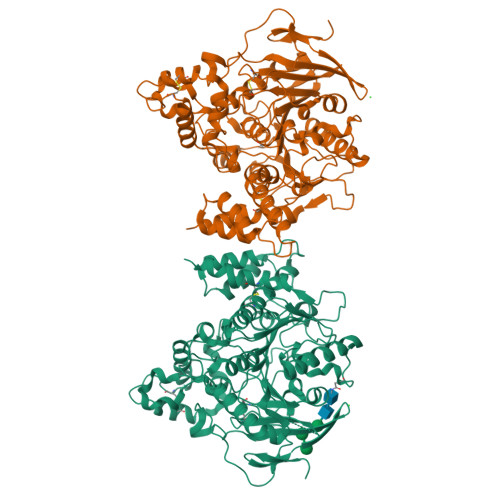
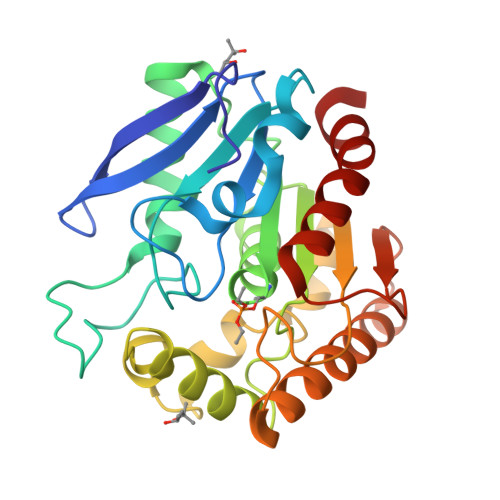
Acetylcholinesterase structureClick to view 3D structureAcetylcholinesteraseP07140Drosophila melanogasterPredicted (SEA)
Prediction Confidence Score
0.346
Applicability Domain
0.364
Statistical Significance
5.00e-05
Supporting Reference Compounds
2
E-value
0.389246
Click to view 3D structureLeucyl-tRNA synthetase, putativeQ386D9Trypanosoma brucei brucei (strain 927/4 GUTat10.1)Predicted (SEA)
Prediction Confidence Score
0.253
Applicability Domain
0.253 Low confidence
Statistical Significance
0.0012
Supporting Reference Compounds
1
E-value
9.34191
Click to view 3D structureFatty-acid amide hydrolase 1O08914Mus musculusPredicted (SEA)
Prediction Confidence Score
0.223
Applicability Domain
0.321
Statistical Significance
0.0722
Supporting Reference Compounds
46
E-value
562.227
Click to view 3D structureCannabinoid receptor 1P47746Mus musculusPredicted (SEA)
Prediction Confidence Score
0.223
Applicability Domain
0.321
Statistical Significance
0.0266
Supporting Reference Compounds
42
E-value
207.001
Diacylglycerol acyltransferase/mycolyltransferase Ag85C structureClick to view 3D structureDiacylglycerol acyltransferase/mycolyltransferase Ag85CP9WQN9Mycobacterium tuberculosis (strain ATCC 25618 / H37Rv)Predicted (SEA)
Prediction Confidence Score
0.222
Applicability Domain
0.222 Low confidence
Statistical Significance
0.003
Supporting Reference Compounds
1
E-value
23.4326
Click to view 3D structureMonoglyceride lipaseO35678Mus musculusPredicted (SEA)
Prediction Confidence Score
0.221
Applicability Domain
0.321
Statistical Significance
0.0362
Supporting Reference Compounds
34
E-value
281.892
Acetylcholinesterase structureClick to view 3D structureAcetylcholinesteraseP21836Mus musculusPredicted (SEA)
Prediction Confidence Score
0.215
Applicability Domain
0.321
Statistical Significance
0.1108
Supporting Reference Compounds
58
E-value
862.959
Glycogen synthase kinase-3 beta structureClick to view 3D structureGlycogen synthase kinase-3 betaP49841HumansPredicted (SEA)
Prediction Confidence Score
0.214
Applicability Domain
0.236 Low confidence
Statistical Significance
0.7685
Supporting Reference Compounds
1157
E-value
5982.56
Click to view 3D structureStreptokinase AP10520Streptococcus pyogenes serotype M1Predicted (SEA)
Prediction Confidence Score
0.213
Applicability Domain
0.224 Low confidence
Statistical Significance
0.4489
Supporting Reference Compounds
425
E-value
3494.34
Dual specificity protein kinase CLK4 structureClick to view 3D structureDual specificity protein kinase CLK4Q9HAZ1HumansPredicted (SEA)
Prediction Confidence Score
0.212
Applicability Domain
0.225 Low confidence
Statistical Significance
0.7014
Supporting Reference Compounds
742
E-value
5460.27
Mitogen-activated protein kinase kinase kinase kinase 4 structureClick to view 3D structureMitogen-activated protein kinase kinase kinase kinase 4O95819HumansPredicted (SEA)
Prediction Confidence Score
0.21
Applicability Domain
0.225 Low confidence
Statistical Significance
0.7212
Supporting Reference Compounds
714
E-value
5614.8
Cyclin-dependent kinase 2 structureClick to view 3D structureCyclin-dependent kinase 2P24941HumansPredicted (SEA)
Prediction Confidence Score
0.21
Applicability Domain
0.236 Low confidence
Statistical Significance
0.7694
Supporting Reference Compounds
1029
E-value
5989.56
Serine/threonine-protein kinase PLK1 structureClick to view 3D structureSerine/threonine-protein kinase PLK1P53350HumansPredicted (SEA)
Prediction Confidence Score
0.21
Applicability Domain
0.229 Low confidence
Statistical Significance
0.7144
Supporting Reference Compounds
705
E-value
5561.63
Click to view 3D structureSigma intracellular receptor 2Q8VD00Mus musculusPredicted (SEA)
Prediction Confidence Score
0.21
Applicability Domain
0.21 Low confidence
Statistical Significance
0.0048
Supporting Reference Compounds
1
E-value
37.7569
Dual specificity tyrosine-phosphorylation-regulated kinase 1A structureClick to view 3D structureDual specificity tyrosine-phosphorylation-regulated kinase 1AQ13627HumansPredicted (SEA)
Prediction Confidence Score
0.208
Applicability Domain
0.225 Low confidence
Statistical Significance
0.7717
Supporting Reference Compounds
906
E-value
6007.78
Carbonic anhydrase 2 structureClick to view 3D structureCarbonic anhydrase 2P00918HumansPredicted (SEA)
Prediction Confidence Score
0.207
Applicability Domain
0.255 Low confidence
Statistical Significance
0.5013
Supporting Reference Compounds
472
E-value
3902.74
Carbonic anhydrase 9 structureClick to view 3D structureCarbonic anhydrase 9Q16790HumansPredicted (SEA)
Prediction Confidence Score
0.207
Applicability Domain
0.246 Low confidence
Statistical Significance
0.4453
Supporting Reference Compounds
372
E-value
3467.02
Carbonic anhydrase 12 structureClick to view 3D structureCarbonic anhydrase 12O43570HumansPredicted (SEA)
Prediction Confidence Score
0.206
Applicability Domain
0.246 Low confidence
Statistical Significance
0.4297
Supporting Reference Compounds
332
E-value
3345.18
Click to view 3D structureMisshapen-like kinase 1Q8N4C8HumansPredicted (SEA)
Prediction Confidence Score
0.205
Applicability Domain
0.225 Low confidence
Statistical Significance
0.7066
Supporting Reference Compounds
524
E-value
5500.51
Vascular endothelial growth factor receptor 2 structureClick to view 3D structureVascular endothelial growth factor receptor 2P35968HumansPredicted (SEA)
Prediction Confidence Score
0.205
Applicability Domain
0.225 Low confidence
Statistical Significance
0.8633
Supporting Reference Compounds
1660
E-value
6720.72
Serine/threonine-protein kinase PAK 4 structureClick to view 3D structureSerine/threonine-protein kinase PAK 4O96013HumansPredicted (SEA)
Prediction Confidence Score
0.204
Applicability Domain
0.225 Low confidence
Statistical Significance
0.7805
Supporting Reference Compounds
728
E-value
6076.29
cAMP-dependent protein kinase catalytic subunit alpha structureClick to view 3D structurecAMP-dependent protein kinase catalytic subunit alphaP17612HumansPredicted (SEA)
Prediction Confidence Score
0.204
Applicability Domain
0.225 Low confidence
Statistical Significance
0.779
Supporting Reference Compounds
735
E-value
6064.22
Serine/threonine-protein kinase pim-1 structureClick to view 3D structureSerine/threonine-protein kinase pim-1P11309HumansPredicted (SEA)
Prediction Confidence Score
0.204
Applicability Domain
0.225 Low confidence
Statistical Significance
0.82
Supporting Reference Compounds
967
E-value
6383.4
Ribosomal protein S6 kinase alpha-3 structureClick to view 3D structureRibosomal protein S6 kinase alpha-3P51812HumansPredicted (SEA)
Prediction Confidence Score
0.204
Applicability Domain
0.225 Low confidence
Statistical Significance
0.7832
Supporting Reference Compounds
733
E-value
6097.31
Glycogen synthase kinase-3 alpha structureClick to view 3D structureGlycogen synthase kinase-3 alphaP49840HumansPredicted (SEA)
Prediction Confidence Score
0.204
Applicability Domain
0.225 Low confidence
Statistical Significance
0.7938
Supporting Reference Compounds
754
E-value
6179.44
Acetylcholinesterase structureClick to view 3D structureAcetylcholinesteraseP22303HumansKnownNot Available
Cytochrome P450 2C9 structureClick to view 3D structureCytochrome P450 2C9P11712HumansKnownNot Available
Cholinesterase structureClick to view 3D structureCholinesteraseP06276HumansKnownNot Available
Prostaglandin E2 receptor EP2 subtype structureClick to view 3D structureProstaglandin E2 receptor EP2 subtypeP43116HumansKnownNot Available
Click to view 3D structureTranslocator proteinP30536HumansKnownNot Available
Cytochrome P450 1A2 structureClick to view 3D structureCytochrome P450 1A2P05177HumansKnownNot Available
Interstitial collagenase structureClick to view 3D structureInterstitial collagenaseP03956HumansKnownNot Available
Nuclear receptor subfamily 1 group I member 2 structureClick to view 3D structureNuclear receptor subfamily 1 group I member 2O75469HumansKnownNot Available
Click to view 3D structure25-hydroxyvitamin D-1 alpha hydroxylase, mitochondrialO15528HumansKnownNot Available
Estrogen receptor structureClick to view 3D structureEstrogen receptorP03372HumansKnownNot Available
Vitamin D3 receptor structureClick to view 3D structureVitamin D3 receptorP11473HumansKnownNot Available
Click to view 3D structureUDP-glucuronosyltransferase 1A1P22309HumansKnownNot Available
Aryl hydrocarbon receptor structureClick to view 3D structureAryl hydrocarbon receptorP35869HumansKnownNot Available
Cytochrome P450 3A5 structureClick to view 3D structureCytochrome P450 3A5P20815HumansKnownNot Available
Cytochrome P450 3A4 structureClick to view 3D structureCytochrome P450 3A4P08684HumansKnownNot Available
Cytochrome P450 2B6 structureClick to view 3D structureCytochrome P450 2B6P20813HumansKnownNot Available
Cytochrome P450 2C19 structureClick to view 3D structureCytochrome P450 2C19P33261HumansKnownNot Available
Concentrations
Not Available
External Links
DrugBank IDNot Available
HMDB IDNot Available
FooDB IDNot Available
Phenol Explorer IDNot Available
KNApSAcK IDNot Available
BiGG IDNot Available
BioCyc IDNot Available
METLIN IDNot Available
PDB IDNot Available
Wikipedia LinkProfenofos
Chemspider IDNot Available
ChEBI ID38845
PubChem Compound ID38779
Kegg Compound IDC18404
YMDB IDNot Available
ECMDB IDNot Available
References
Synthesis ReferenceNot Available
MSDSNot Available
General ReferencesNot Available